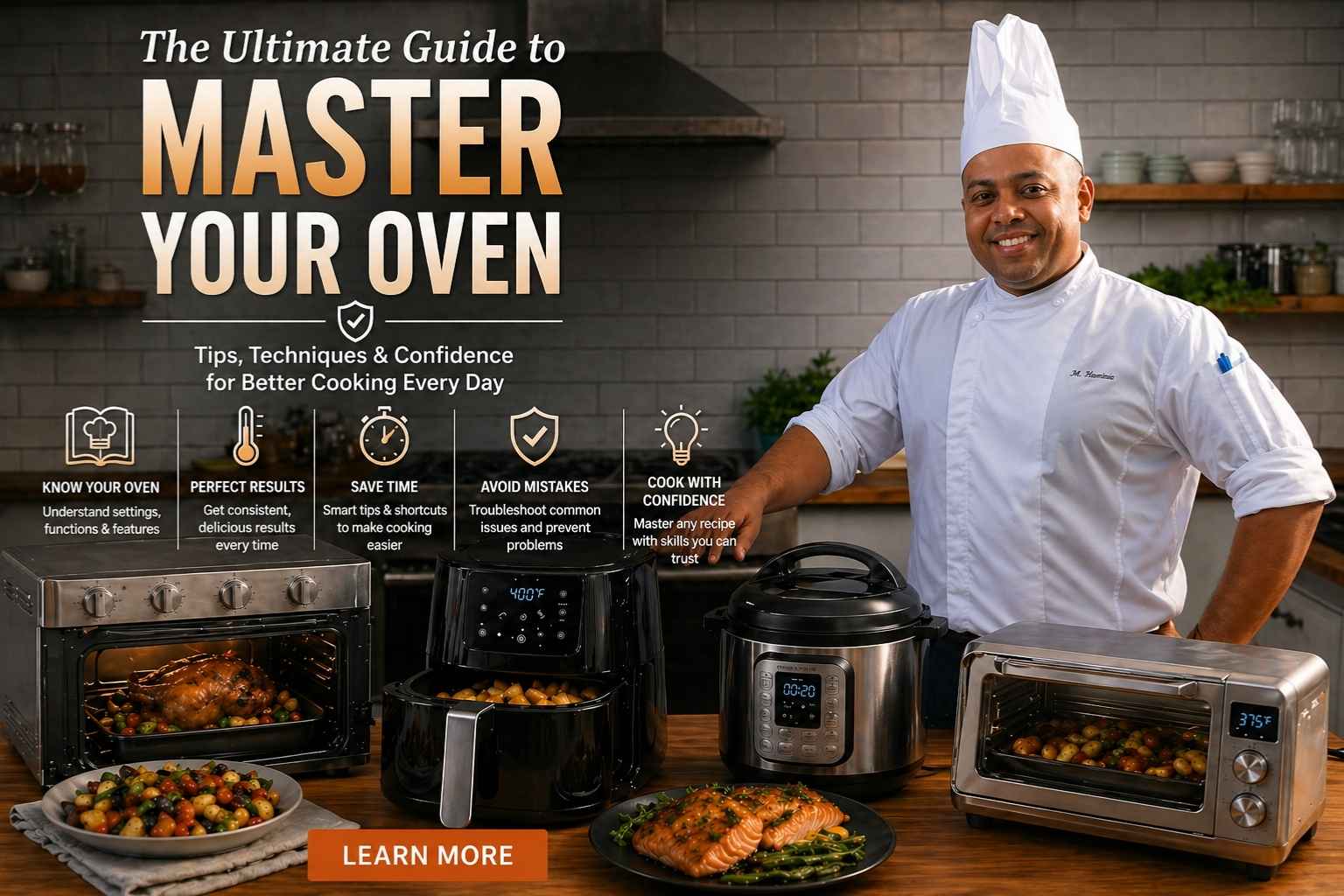
Do you feel like your oven is a wild beast you can’t tame? I have spent years in busy kitchens and I know how a bad rack height can ruin a meal. This The Ultimate Guide to Master Your Oven will help you cook like a real pro. You should also see my Complete Guide to Using an Oven at Home to learn more. Let us start this fun journey to better food right now!
Understanding Your Heat Source: Gas vs. Electric vs. Induction
Your choice of fuel changes how heat moves and how your favorite American comfort foods turn out after a long day. I spent years cooking on an old gas range in a cramped apartment in Boston. It clicked five times before it lit. It felt alive.
Gas ovens provide a “moist” heat. This is a dream for roasting a whole chicken; the skin gets brown, but the meat stays juicy. You can even level up your Sunday dinner by learning how to roast chicken and vegetables together in that humid environment.
However, gas can be moody. The flame cycles on and off, creating swings in temperature. If you use a BlueStar or Thor, you get raw power, but you might see “hot spots” near the back. Because of this unevenness, understanding the best oven settings for chicken is crucial to ensure every part of the bird is safe to eat. I always had to rotate my trays halfway through, especially when I was trying to bake marinated chicken wings to a perfect char.
Electric ovens are different. Most modern US homes use them. Brands like GE or KitchenAid offer a very dry heat. This is the secret to a perfect, shattered-glass crunch on a roast potato or getting that restaurant-quality crisp when you cook buffalo chicken wings. It is steady and reliable, making it much easier to bake bread at home without needing heavy specialized equipment.
Heat Sources at a Glance:
- Gas Ovens: Use an open flame. Great for browning meats and intensive tasks like cooking beef ribs. Often found in older homes or pro-style kitchens.
- Electric Ovens: Use metal coils. They stay at a very even temp. Best for delicate tasks like baking chicken for salad or cookies and cakes. If your electric oven has a fan, you might want to learn how to cook chicken in a convection oven to speed up your meal prep.
- Induction Ranges: These use magnets. They are fast and becoming very popular in eco-friendly US cities like Seattle.
No matter which source you have, success comes down to mastering the three pillars of heat: baking vs. roasting vs. broiling.
Check your oven’s BTU or wattage. High BTU means it heats up fast. This is great when you are in a rush and need to reheat chicken breast without drying it out. Even if you are working with a smaller setup, knowing how to reheat food in a toaster oven or even how to cook pizza in a microwave oven can save your dinner when time is tight.
The Science of Convection: Why Fans Matter
Convection is a tool that changes the physics of your cooking by moving hot air around the cavity.
In a standard oven, the air just sits there. It is like standing in the sun on a still day. Convection adds a fan. Now, it is like a warm breeze on a Florida beach. This moving air strips away “cold” spots around your food.
- Faster Cooking: Food usually cooks about 25% faster.
- Even Browning: Since the air moves, the top and bottom brown at the same rate.
- Better Texture: Great for crispy wings or flaky biscuits.
I once tried to bake a delicate lemon soufflé with the convection fan on. It was a disaster. The wind pushed the soufflé over. It looked like a melted candle. Use the fan for meats and roasted veggies. Turn it off for delicate cakes.
Most US ovens have a “Convection Bake” and “Convection Roast” setting. Use “Bake” for pastries. Use “Roast” for big proteins. If your recipe doesn’t mention convection, drop the temp by 25°F. This keeps the outside from burning before the inside is done.
Oven Calibration: Your Thermostat is Lying to You
Your oven might say it is 350°F, but the reality inside that metal box can be very different.
I’ve walked into multi-million dollar homes with Sub-Zero appliances that were off by 30 degrees. It is frustrating. You follow a recipe perfectly, yet the cake is raw. This is usually a calibration issue.
- Buy a Thermometer: A $10 analog thermometer is your best friend. Hang it on the center rack.
- The Sugar Test: Put a spoonful of sugar on a tray at 375°F. If it doesn’t melt, your oven is cold. Sugar melts at 366°F.
- Check the Manual: Most digital ovens let you adjust the display. You can “offset” the temp by a few degrees.
I do this once a year. It saves so much stress. I used to think I was a bad baker. It turns out my oven was just lazy. It was running 20 degrees cold. Once I fixed that, my sourdough finally had that big, beautiful rise.
Rack Placement: The Real Estate of Flavor
Where you put your tray is just as important as the ingredients you buy at the local Whole Foods or Kroger.
I used to just shove everything on the middle rack. It felt safe. But in a busy kitchen, we use every inch. The top of your oven is usually the hottest. Heat rises. If you want a bubbly, brown top on your mac and cheese, move it up.
The middle is for balance. This is the “Goldilocks” zone. Use it for your Toll House cookies or a classic birthday cake. It gives even heat to the top and the bottom. Most American bakers live in this space.
- The Top Third: Best for browning and broiling.
- The Center Square: The sweet spot for baking.
- The Bottom Rack: Use this for crusty breads or pizza.
The bottom of the oven has the most “conductive” heat. If I’m making a frozen pizza on a Friday night, I put it right at the bottom. It makes the crust snap. If you put it too high, the cheese burns before the dough is cooked.
Don’t crowd your oven. I know it’s tempting to cook three trays of roasted veggies at once. But if there is no room for air to flow, things get soggy. Leave at least two inches between your pans and the oven walls.
Thermal Mass and Heat Retention
Mastering your oven means learning how to keep the heat inside where it belongs.
Every time you open the door to “peek,” you lose about 25°F to 50°F. In the winter, especially in places like Chicago or Maine, that cold kitchen air rushes in. The oven has to work twice as hard to get back to temp.
Professional results come down to thermal mass. This is just a fancy way of saying “stuff that stays hot.” I love using a Baking Steel or a heavy stone. You leave it in the oven all the time. It acts like a battery for heat.
- Baking Steels: These conduct heat faster than stone. They are great for thin-crust pizza.
- Cast Iron: A heavy Lodge skillet is a secret weapon. Pre-heat it inside the oven before adding your steak.
- The Door Peek: Use the oven light instead. Only open the door when you absolutely have to.
I remember my first Thanksgiving. I kept opening the door to baste the turkey. The poor bird took six hours to cook. Now, I leave it alone. The more you trust your oven, the better it performs.
If you have a very light, cheap oven, add some unglazed quarry tiles to the bottom rack. It helps keep the temperature steady. This is a cheap trick I learned in a tiny bistro that had old, thin ovens.
Mastering the Broiler: The “Upside Down” Grill
The broiler is the most underutilized tool in the American kitchen; it is essentially an indoor grill that uses intense direct heat.
Most people are scared of the broiler. I get it. It’s a literal wall of fire or glowing red coils. But it is the fastest way to add flavor. Think of it as a grill that sits on your ceiling.
- Infrared Broilers: Found in high-end brands like Wolf. They get incredibly hot very fast.
- Standard Coils: These take a minute to glow. They are better for melting cheese.
- Distance Matters: Move your rack to the very top, about 3 to 4 inches from the heat.
I use the broiler for “charred” salsa. I throw tomatoes, onions, and peppers on a sheet pan. Five minutes under the flame and they look like they came off a charcoal grill. It adds a smoky depth you can’t get any other way.
Keep the door a crack open if you have an older electric oven. This stops the oven from cycling off when it gets too hot. You want that constant, searing heat. Just watch it closely. Things go from perfect to charcoal in about ten seconds.
I once got distracted by a phone call while broiling garlic bread. The smoke alarm in my apartment let the whole building know I messed up. Set a timer. Stay in the kitchen. The broiler waits for no one.
Regional Challenges: Altitude and Humidity
Your location in the US changes how physics works inside your oven, which is something many cookbooks forget to mention.
I once moved from a humid coastal town to the high desert. My favorite cake recipe suddenly failed. It collapsed in the middle every single time. I realized that air pressure changes how bubbles form in your batter.
In high-altitude spots like Denver or Salt Lake City, liquids evaporate faster. You might need to add an extra splash of milk. You also might need to turn your oven up by 15°F. The air is thinner, so it carries heat differently.
- High Altitude: Increase temp slightly. Use less sugar. Add more liquid.
- High Humidity: Flour can actually soak up moisture from the air. Your dough might feel sticky.
- Cold Climates: Your oven will take longer to preheat in a drafty New England kitchen.
Humidity is a big deal for bread. In the South, getting a crispy crust is hard. The air is so wet. I usually leave my bread in the oven with the door cracked after I turn it off. This helps “cure” the crust so it stays crunchy.
Always store your flour in an airtight container. This is vital in the Midwest or the South. If your flour gets damp, your measurements will be off. This small step solved my “soggy cookie” problem years ago.
Material Matters: Glass, Metal, and Ceramic
The pan you choose is an extension of your oven’s heating element and determines how heat enters your food.
I used to think a pan was just a pan. Then I baked a batch of cookies on a dark, non-stick sheet. The bottoms were black, but the tops were raw. I felt like a failure. It turns out, dark metal absorbs heat way too fast for delicate dough.
- Dark Metal Pans: These get hot quickly. Use them when you want a crust, like with roasted potatoes.
- Light Aluminum: This is the gold standard for bakers. Brands like Nordic Ware reflect heat for even browning.
- Glass Dishes: Glass takes a long time to get hot, but it stays hot forever. Great for keeping a casserole warm on the table.
Be careful with Pyrex or glass in a hot oven. If you take a cold dish from the fridge and put it in a 400°F oven, it can shatter. I saw this happen at a dinner party once. It sounds like a gunshot. Always let glass come to room temperature first.
Ceramic is my favorite for “low and slow” Sundays. If I’m making a pot roast, ceramic distributes the heat gently. It prevents the edges from drying out while the center is still tough. It’s a game-changer for your family recipes.
Cleaning and Longevity: Beyond the “Self-Clean” Button
Keeping your oven clean isn’t just about looks; it’s about making sure your appliance lasts for decades.
I have a secret: I never use the “Self-Clean” button. I know it’s tempting. But that cycle gets so hot it can actually fry the delicate wires inside your oven. I’ve seen many Samsung and Whirlpool units break right after a cleaning cycle.
- The Natural Scrub: Mix baking soda and water into a paste. Smear it on the grease. Let it sit overnight.
- Vinegar Rinse: Spritz it with vinegar the next day. It will fizz and lift the grime right off.
- Vacuum the Bottom: Use a shop vac to suck up crumbs. This prevents that “burnt toast” smell every time you cook.
Check your door gasket once a year. That’s the rubber seal around the opening. If it’s cracked, your heat is leaking out. This makes your kitchen hot and your energy bill high. It’s a five-minute fix that saves you a lot of money.
I also clean the glass window often. If you can’t see inside, you’ll keep opening the door. As we learned, opening the door is the enemy of a perfect bake. A clear window is the sign of a master of the kitchen.
Advanced Techniques: Steam, Roasting, and Proofing
You can turn a basic home oven into a professional-grade tool with a few simple tricks I used in the bistro.
My favorite trick for bread is the “Steam Bath.” Professional ovens have steam injectors. You probably don’t. But you can put a cast iron pan on the bottom rack while the oven preheats. When you slide your bread in, toss a cup of ice cubes into that pan.
- The Steam Effect: It keeps the bread surface moist. This allows the loaf to expand fully before the crust sets.
- The Reverse Sear: For a thick steak, cook it at 225°F until the middle is perfect. Then, sear it in a pan.
- The Oven Light Trick: Most ovens stay at about 80°F to 90°F just from the heat of the lightbulb. This is the perfect temp to let bread dough rise.
I once used my oven to dry out local herbs from my garden. I set it to the lowest setting, usually 170°F, and propped the door open with a wooden spoon. A few hours later, I had the best dried oregano I’ve ever tasted.
Mastering your oven is about curiosity. Don’t be afraid to try these “pro” moves. Even if you mess up a dish or two, you are learning how your specific machine breathes and cooks. That is how you become a chef in your own home.
The Holiday Crunch: Mastering the Thanksgiving Turkey
The American Thanksgiving is the ultimate stress test for any oven, and I’ve survived enough of them to know the pitfalls.
I remember my first year hosting. I had a 20-pound bird and a standard GE oven. I was terrified. The turkey is so big it blocks all the airflow. This is why the legs often stay raw while the breast dries out. It is a classic US kitchen disaster.
- The Spatchcock Method: I started cutting out the backbone to lay the bird flat. It cooks in half the time.
- The Foil Shield: If the skin gets dark too fast, don’t lower the temp. Just tent it with foil.
- Pre-Heating for an Hour: For a big bird, your oven needs to be deeply hot. Don’t trust the “beep.”
In many US homes, we try to cook sides like stuffing and yams at the same time. This is a mistake. The turkey is like a giant heat sponge. It sucks up all the energy. Cook your turkey, then let it rest for an hour. Use that hour to blast your sides at high heat.
Resting the meat is the “chef’s secret.” The juices stay inside. Plus, it frees up your oven for those rolls you forgot to bake. I’ve seen families argue over oven space. A little timing goes a long way for peace of mind.
Pizza Night: Achieving the “Leopard” Crust
You don’t need a fancy backyard pizza oven to get a crust that snaps and bubbles like a pro pie.
Living in the Northeast, I grew up on thin-crust pizza. In my own kitchen, I wanted that same crunch. I tried a thin cookie sheet first. It was a soggy mess. The metal just didn’t hold enough heat to “shock” the dough.
- Steel Over Stone: I switched to a Baking Steel. It’s heavy, but it transfers heat much faster than ceramic.
- The Hour Pre-Heat: I turn my oven to its highest setting (usually 500°F or 550°F) an hour before I cook.
- The Broiler Finish: I cook the pizza on the steel, then turn on the broiler for the last 60 seconds.
This gives you those charred “leopard spots” on the cheese. It smells like a real pizzeria in my house every Friday. If you are using a KitchenAid or Samsung, check if it has a “Pizza” mode. Some do, and they are actually quite good at cycling the heat.
Be careful with the flour on your peel. If you use too much, it burns on the bottom of the oven. It creates a lot of smoke. I once set off my apartment smoke detector three times in one night. Now, I use a little cornmeal instead. It acts like tiny ball bearings.
Baking for the Bake Sale: Consistency is Key
When you have to bake four batches of cookies, you learn exactly where your oven fails.
I volunteered for a school bake sale last year. I had to make 100 chocolate chip cookies. By the third tray, I noticed a pattern. The back-left corner was always darker. My oven had a “hot spot.” Every oven has one.
- The Rotation Rule: Always rotate your pans 180 degrees halfway through the timer.
- Double Trays: If the bottoms burn too fast, stack two baking sheets together. It creates an air gap.
- Cooling Between Batches: Never put dough on a hot pan. It ruins the texture.
I keep a few extra Nordic Ware sheets on the counter. This way, I always have a cold pan ready to go. If you use a hot pan, the butter melts before the edges set. You get a flat, greasy pancake instead of a puffy cookie.
Also, check your parchment paper. Some brands are only rated for 425°F. If you go higher, they get brittle and brown. I prefer the heavy-duty stuff you find at Costco. It handles the heat of a pro-style kitchen much better.
Troubleshooting Common Oven Noises and Smells
Your oven talks to you; learning what those clicks and whirs mean can save you a service call.
Last month, my oven started making a high-pitched squeak. It sounded like a mouse was trapped inside. It was actually the convection fan motor. In many US models, these fans can get clogged with grease over time.
- Ticking Sounds: This is usually just the metal expanding. It is normal, especially in gas units.
- Strong Gas Smell: If you smell gas when the oven is off, call a pro. If it’s just at the start, it’s likely a slow igniter.
- Acrid Smoke: This is usually just a cheese drip on the bottom. Clean it up once the oven is cool.
I once had an oven that smelled like burning plastic. I panicked. It turned out a plastic spatula had fallen behind the drawer. Always check your “storage” drawer before you pre-heat. Many of us treat that drawer like a junk bin.
If your oven takes forever to pre-heat, your “bake” element might be failing. Look at the bottom coil. It should glow bright red. If it’s dark in some spots, it is time for a $20 replacement part. You can usually swap it yourself with a screwdriver.
The Science of Searing: Why Your Roast Needs High Heat
Starting a roast at a high temperature is a chef’s secret to building deep, complex flavors through the Maillard reaction.
I remember my first attempt at a Sunday pot roast. I put it in at 325°F and waited. It came out grey and sad. It tasted okay, but it lacked that “wow” factor. I realized I was missing the crust. Now, I always start my oven at 450°F for the first fifteen minutes.
- The Maillard Reaction: This is when proteins and sugars transform into hundreds of flavor compounds.
- The Sizzle: If you don’t hear it when the meat hits the pan, your oven or pan isn’t hot enough.
- The Drop: After that initial blast, I drop the temp to 300°F to let the inside get tender.
In the US, we love our big cuts of meat like brisket or prime rib. Brands like Traeger have made “low and slow” popular, but you can do it in a Viking or Wolf indoor oven just as well. Just make sure your meat is dry. Pat it with paper towels.
I once tried to sear a roast that was still damp from the fridge. Instead of searing, it steamed. The kitchen filled with grey vapor, and the meat looked boiled. Now, I let my roasts sit uncovered in the fridge for a few hours. This dries the surface and guarantees a perfect, dark crust.
The “Oven Light” Secret: A Home for Fermentation
Your oven can be a powerful tool even when the heating elements are completely turned off.
I started baking sourdough during a cold winter in Minnesota. My kitchen was 62°F. My dough wouldn’t grow. It just sat there like a lump of clay. Then, a fellow baker told me to turn on the oven light and keep the door closed.
- Natural Warmth: An incandescent bulb can keep an oven between 80°F and 85°F.
- The Proofing Box: This is the perfect temperature for yeast to do its magic.
- Yogurt Making: You can even make homemade yogurt using just the residual heat of the light.
Be careful with modern LED oven lights. They don’t give off much heat. If you have a newer LG or Samsung, you might need to use the “Proof” setting instead. This setting uses a tiny bit of the heating element to keep things cozy.
I used the light trick to save a batch of cinnamon rolls for a Christmas brunch. They were taking forever to rise. I popped them in the dark oven with the light on. Within forty minutes, they were puffy and ready. It felt like a magic trick. Just don’t forget they are in there and pre-heat the oven with your dough inside!
Dealing with Hot Spots: The Toast Test
Every oven has a personality, and part of that personality is where it hides its extra heat.
No oven is perfectly even. I’ve worked with $20,000 ovens that still had a “hot corner.” I found this out the hard way when I burnt a dozen expensive macarons. To fix this, I used the “Toast Test.” It’s a cheap way to map your oven.
- The Setup: Cover a baking sheet with cheap white bread.
- The Bake: Put it in at 350°F for about 5 to 7 minutes.
- The Map: Look at which slices are dark and which are pale.
In my current oven, the back-right corner is a scorcher. Knowing this, I never put small items there. I also know that if I’m roasting a whole chicken, I should point the legs toward that hot corner. The legs can handle more heat than the breast.
If you find your oven is very uneven, try keeping a heavy pizza stone on the bottom rack. It helps absorb the heat and radiate it back more evenly. This saved my baking when I lived in a rental with a very old Whirlpool range that was all over the place.
Small Space Cooking: Mastering the Toaster Oven
In many modern US apartments, the toaster oven or “air fry” oven is the daily workhorse.
I used to look down on toaster ovens. I thought they were just for frozen pizza. Then I moved into a studio in New York City. My main oven was tiny and smelled like gas. I bought a high-end Breville Smart Oven, and my life changed.
- Efficiency: It heats up in three minutes. A full-size oven takes twenty.
- Air Frying: Many new models have high-speed fans. They make the crispiest Brussels sprouts I’ve ever had.
- Precision: Because the space is small, the temperature control is often better than a big oven.
You have to be careful with the top heating elements. They are very close to your food. I once tried to bake a tall loaf of bread, and the top caught fire because it touched the coils. For small ovens, keep your food flat.
I use my toaster oven for almost everything now. It’s perfect for a quick dinner of roasted salmon for two. Plus, in the summer, it doesn’t turn my kitchen into a sauna like the big oven does. It’s the ultimate tool for a busy, modern lifestyle.
The Chemistry of Temperature: Why 350°F is the Magic Number
If you look at almost any American recipe, from Grandma’s casserole to box mix brownies, you’ll see 350°F.
I used to wonder why this specific number was the “default.” In my early days at the bistro, I realized it’s the sweet spot for the Maillard reaction. It is hot enough to brown the outside but slow enough to cook the middle without drying it out.
- Low Heat (200°F–250°F): This is for “slow and low.” Think of a Texas-style brisket. It melts the tough connective tissue without boiling the juices away.
- Moderate Heat (325°F–375°F): The baking zone. This is where sugars caramelize and cakes rise.
- High Heat (400°F–500°F): The searing zone. This is for roasting veggies or getting that “pop” in your puff pastry.
I once tried to bake cookies at 425°F because I was in a rush. They looked like hockey pucks—burnt on the edges and raw dough in the center. Understanding these “heat brackets” changed how I cooked. If a dish is getting too dark but is still raw inside, don’t just wait. Drop the temp by 50 degrees.
In the US, we often use “Fahrenheit,” but if you are following an international recipe, watch out for Celsius. I’ve seen people bake at 200°C thinking it was 200°F. That is a 400°F mistake! Always double-check your dial before you slide the tray in.
Oven Safety: Protecting Your Kitchen and Family
An oven is a powerhouse of energy, and respecting that heat keeps your home safe and your meals stress-free.
I learned the hard way about “oven mitt quality” when I grabbed a heavy cast iron pan with a thin, damp towel. The steam went straight to my skin. It was a painful lesson. Always use dry, heavy-duty silicone or quilted mitts.
- The Grease Fire: Never throw water on an oven fire. Close the door and turn off the heat. Oxygen is the fuel; cutting it off kills the flame.
- Child Safety: Many Samsung or LG models have a “Control Lock.” Use it. It stops little hands from turning the gas on.
- Anti-Tip Brackets: In the US, new ovens must be bolted to the floor. If you lean on an open oven door, the whole unit can tilt forward.
I always keep a fire extinguisher near the pantry. I’ve only had to use it once, but I was glad it was there. Most kitchen fires start because of “spillover.” If you are baking a bubbly fruit pie, put a sheet pan on the rack below it.
The sugar in fruit pies can smoke and catch fire if it hits the bottom heating element. That small “drip tray” saves you from a smoky kitchen and a panicked evening. It’s the little habits that make you a pro.
DIY Maintenance: Replacing Elements and Gaskets
You don’t always need to call a repairman in a van to fix a “broken” oven; often, it is a simple fix you can do yourself.
I remember when my oven stopped heating up right before a big dinner party. I felt helpless. Then I looked at the bottom coil and saw a tiny crack. I went to the local hardware store, bought a $25 replacement, and fixed it in ten minutes with a screwdriver.
- Checking the Gasket: If you feel heat leaking from the door, the rubber seal is likely worn. You can usually pull it out and press a new one in by hand.
- Lightbulb Swaps: If your light goes out, check the manual. Some use a standard “appliance bulb,” while others need a specific halogen puck.
- Leveling the Oven: If your cakes always lean to one side, your oven isn’t level. Screw the feet at the bottom in or out to balance it.
I always keep a spare “bake element” in my utility closet now. It’s like having a spare tire for your car. In most US brands like Whirlpool or Maytag, these parts are standardized. It makes me feel empowered to know I can keep my kitchen running without a $200 service fee.
Just remember: Always unplug the stove or flip the breaker before you touch any wires. Safety first, dinner second. Once you realize how simple these machines are, you stop being afraid of them and start mastering them.
The Future of Cooking: Smart Ovens and Beyond
The American kitchen is changing fast with the rise of “smart” appliances that talk to your phone.
I recently tried an oven with a built-in camera. At first, I laughed. Why do I need to see my chicken on my iPhone? But then I was in the backyard playing with my kids and I could see the skin browning. I didn’t have to keep running back inside.
- Remote Pre-heating: You can start your oven while you are driving home from work.
- Probe Cooking: Many new ovens come with a “meat probe.” You plug it into the oven wall and the meat. The oven shuts off automatically when the steak hits 135°F.
- Voice Control: “Alexa, pre-heat the oven to 400.” It sounds like science fiction, but it’s great when your hands are covered in flour.
I still love the old-school feel of a manual dial, but these tools are great for busy families. They take the “guesswork” out of cooking. However, don’t let the technology make you lazy. You still need to understand the basics of heat.
Even the smartest oven can’t tell if your dough is over-proofed or if your spices are stale. Use the tech to help you, but keep your “chef’s brain” engaged. The best tool in any kitchen will always be the person standing in front of the stove.
A Masterclass in Oven-Roasted Vegetables
Roasting vegetables is the easiest way to turn a “side dish” into the star of the show by using high heat to unlock natural sugars.
I used to boil my broccoli. It was mushy and sad. Then I learned the “High Heat” method in a bistro in Vermont. We cranked the ovens to 425°F. The results were life-changing. The edges got crispy, and the inside stayed tender.
- Don’t Crowd the Pan: If the veggies touch, they steam. Give them space so the air can brown the edges.
- Oil is Your Friend: Use a high-smoke point oil like avocado or grapeseed. Extra virgin olive oil can smoke too much at 450°F.
- The “Flip” Rule: Always flip your veggies halfway through. This ensures both sides get that beautiful char.
I love roasting a mix of carrots and parsnips with a little honey. The high heat of a Wolf or Viking range turns that honey into a sticky glaze. My kids actually ask for seconds when I cook them this way. It’s all about that texture.
If you are cooking for a crowd, use two pans on different racks. Just remember to swap their positions halfway through. The top rack always browns faster than the bottom. This small move keeps everything consistent for your Sunday dinner.
The Science of Dehydrating: Low and Slow
Your oven isn’t just for cooking; it is also a powerful tool for preserving food through dehydration.
I started dehydrating when I had a massive harvest of Roma tomatoes from my garden. I didn’t have a dedicated dehydrator. I realized my oven could do the same job. I set it to the lowest possible setting—usually 170°F on most GE or Whirlpool models.
- Prop the Door: Use a wooden spoon to keep the door open a crack. This lets the moisture escape.
- Airflow is Key: Use a wire rack over a baking sheet. This lets the dry air hit the top and bottom of the food.
- Time and Patience: Beef jerky takes about 4 to 6 hours. Apple chips take about 3.
I made my own “sun-dried” tomatoes this way last August. They tasted so much better than the ones from the store. They were intense and sweet. Plus, the whole house smelled like a summer garden.
Just be careful with the temperature. If it’s too hot, you are just “cooking” the food slowly. You want to “dry” it. If your oven doesn’t go below 200°F, this might be tricky. Check your manual for a “Dehydrate” mode—many modern American ovens have one hidden in the settings!
Seasonal Oven Care and Deep Cleaning
Your oven works differently in the humid summers of the South than it does in the dry winters of the Midwest.
I noticed my oven was acting “sluggish” every January. It took forever to reach 350°F. I realized my kitchen was drafty. The oven had to fight the cold air. Now, I do a “seasonal checkup” every six months to keep things running smooth.
- Spring Cleaning: After a winter of heavy roasts and stews, do a deep scrub. Get rid of the grease buildup.
- Fall Calibration: Before the holiday baking rush, check your temp with a thermometer.
- Vacuum the Vents: Dust can clog the cooling fans on modern digital ovens. A quick vacuum keeps the electronics cool.
I once had a spill during a summer berry cobbler. I ignored it because it was too hot to clean. That was a mistake. Every time I used the oven for a month, it smelled like burnt sugar. Now, I keep a box of salt nearby.
If something spills, pour salt on it immediately while it’s still wet. The salt soaks up the juice and turns it into a crust. Once the oven is cool, you can just scrape the salt out with a spatula. It saves you hours of scrubbing later.
The Chef’s Final Word: Trust Your Senses
After twenty years in the kitchen, the most important lesson I can share is that your oven is a partner, not just a machine.
I’ve used every brand from Samsung to La Cornue. They all have “moods.” Some days they run hot. Some days the humidity makes the crusts soft. The best way to master your oven is to stop looking at the timer and start looking at the food.
- The Smell: When you start to smell the cookies, they are usually 2 minutes away from done.
- The Sound: A roasting chicken should “sizzle.” If it’s silent, turn up the heat.
- The Touch: A cake should spring back when you poke it. If it leaves a dent, it needs more time.
I used to be a slave to the recipe. “Bake for 20 minutes,” it said. So I waited exactly 20 minutes. But my oven was running hot that day, and the muffins were dry. Now, I start checking 5 minutes early.
Your oven is the heart of your home. It’s where the birthday cakes happen and where the Thanksgiving memories are made. Treat it well, learn its quirks, and it will reward you with perfect meals for years to come. Happy cooking!
FAQs: The Ultimate Guide to Master Your Oven
Why does my oven take so long to heat up?
Most ovens need twenty minutes to get hot. Older coils or bad seals can slow it down. This guide helps you check for leaks to save time.
How do I know if my oven temperature is right?
Buy a cheap oven thermometer at the store. Hang it on the middle rack. Use The Ultimate Guide to Master Your Oven to learn how to fix the dial.
Is the convection setting better for baking cookies?
Yes, it moves hot air for a fast, even bake. Drop the heat by 25 degrees first. It makes the edges crisp and the middle soft every time.
What is the best way to clean a greasy oven?
Skip the high-heat button. Use a mix of baking soda and water. Let it sit all night to lift the grime without any harsh chemicals or smells.
Can I use my oven light to help bread rise?
The light gives off a soft, steady heat. It is a great warm spot for dough. Just keep the door shut to trap the warmth inside the box.

I’m Mossaraof, a trained chef and the founder of OvenInsights.com. I spent years cooking at Larrupin’ Cafe and in kitchens across Chicago and Seattle. Now I test kitchen gear for a living. I moved to North Acton, London, and I test every tool I write about. I use real meals and real heat. No brand deals. No shortcuts. I cover 12 kitchen types and hundreds of recipes. I believe this: the right tools matter as much as the recipe.