At A Glance
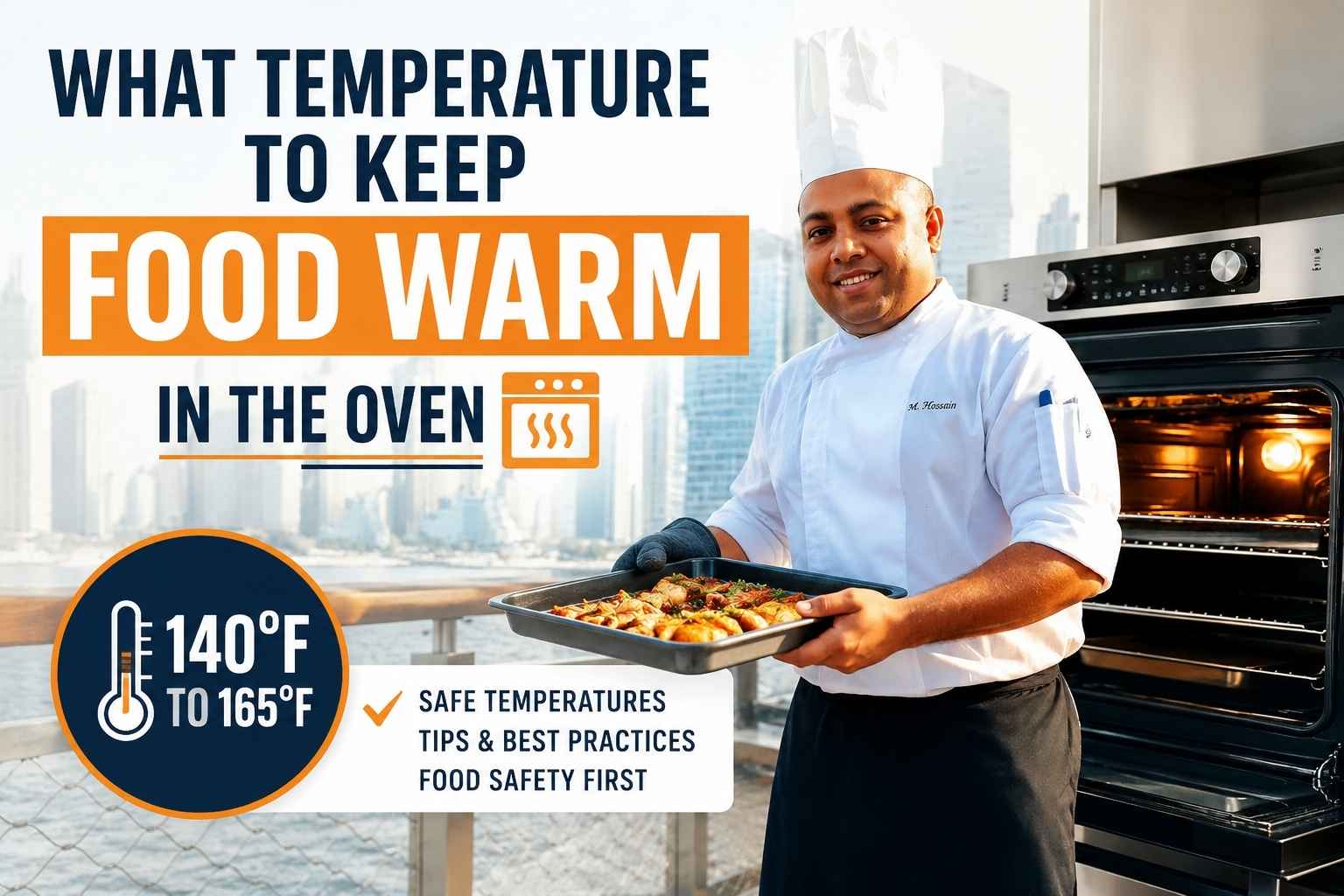
- The safe range to hold most cooked food is 170°F to 200°F. This keeps food above the 140°F danger line without drying it out (USDA Food Safety and Inspection Service, 2024).
- Never hold food below 140°F. The 40°F to 140°F range is the “danger zone,” where bacteria grow fast (USDA FSIS, 2024).
- The 2-hour rule sets a hard limit. After 2 hours in the danger zone, throw the food out, even if it looks fine.
- Match the temperature to the food. Roasts want 170-200°F, casseroles want 200-225°F, and fried foods need 200-225°F with the door cracked or a vent open.
- Your oven’s “keep warm” setting is often wrong. Check it with a cheap oven thermometer (Taylor Precision Products, 2025) before you trust it for a big meal.
Ever pulled dinner out too early, then watched it turn cold and sad on the counter? I’ve been there more times than I’d like to admit. As a chef, I get asked one thing all the time: what temperature to keep food warm in the oven without drying it out. After years of testing this in real kitchens (not just reading about it), I’ve got the exact number that works every time. Stick with me, and your next meal will stay warm, juicy, and ready when your guests are.
What “Keep Warm” Mode Actually Does Inside Your Oven
When you hit “keep warm,” your oven cycles the heating element on and off to hold a low, steady temperature, usually between 145°F and 200°F. It is not cooking your food anymore. It is just slowing down the cooling.
I learned this the hard way during my first banquet job. I put a tray of chicken thighs on “keep warm” for two hours and pulled them out dry as cardboard. The oven was holding at 200°F, but the chicken kept cooking the whole time, just slowly.
Here is what is really happening. Heat moves from the air in the oven into your food until both reach the same temperature. At 350°F, that transfer is fast and aggressive. At 180°F, it is gentle, but it does not stop. Your food keeps losing moisture the entire time it sits in there.
This matters because “keep warm” is not a pause button. It is a slow continuation of cooking. The lower the temperature, the slower the moisture loss, but it never hits zero. That is why timing and temperature both matter so much when you are holding food before a meal.
The Food Safety Danger Zone: Why 140°F Is the Line You Don’t Cross
Food becomes unsafe when it sits between 40°F and 140°F for too long. The USDA calls this range the “danger zone” because bacteria like Salmonella and Listeria can double in number in as little as 20 minutes at these temperatures (USDA FSIS, 2024).
Here is the simple rule I drilled into every cook I trained: 140°F is the floor, not the target. If your oven dips below 140°F, even briefly, the clock starts running on food safety, not just on quality.
Most ovens at home cycle a bit. They might say 150°F on the dial but actually swing between 130°F and 165°F as the element clicks on and off. That swing can dip your food below the safety line without you noticing.
This is why I always set my holding temperature higher than the bare minimum. I aim for 165°F to 180°F for most dishes. That gives me a buffer if the oven runs cold for a few minutes, and it still keeps the food from drying out too fast.
The 2-Hour Rule and How Holding Time Changes the Math
The 2-hour rule says food should not sit in the danger zone (below 140°F) for more than 2 hours total, counting all the time from cooking to serving (USDA FSIS, 2024). After that, it goes in the trash, no exceptions.
But here is the part most home cooks miss. The clock does not reset when you put food back in the oven. If your roast cooled to 120°F on the counter for 30 minutes while you plated sides, and then you held it at 170°F for another hour, you have used up 30 minutes of your 2-hour window already.
For catering and big family meals, I track this with a simple mental timer. The moment food comes off direct heat and starts cooling, I start counting. If it is going to sit for a while before serving, it goes straight into a warm oven, not onto the counter “for a minute.”
Hot food stays hot. Cold food stays cold. The danger is the gray area in between, and that gray area is exactly what “keep warm” mode is supposed to prevent, if you use it correctly.
Keep-Warm Temperature Reference Table (150°F to 250°F)
This table covers the full practical range for holding food in a home or commercial oven. Use it as a quick lookup before you set your dial.
| Oven Temp | Best For | Max Safe Holding Time | Notes |
|---|---|---|---|
| 150°F | Not recommended for holding | N/A | Too close to the 140°F danger line. Oven swings can drop food below safe range. |
| 160°F | Plated meals, soups, sauces | 1 hour | Cover loosely. Good for short waits, like a 20-minute delay before guests sit down. |
| 170°F | Roasts, bread, rolls | 2 hours | My go-to setting for most holding tasks. Safe buffer above 140°F. |
| 180°F | Roasts, casseroles, mashed potatoes | 2 hours | Slightly faster moisture loss than 170°F, but still gentle. |
| 190°F | Bread, pastries, pies | 1.5 hours | Keep uncovered or loosely tented to avoid a soggy crust. |
| 200°F | Casseroles, fried chicken (vented) | 1-2 hours | Crack the oven door or use a wire rack to keep fried foods from steaming. |
| 210°F | Fried foods, crispy items | 1 hour | Watch closely. Surfaces dry out faster above 200°F. |
| 220°F | Crispy items needing a quick re-crisp | 45 minutes | Good for reviving fries or wings, not for long holds. |
| 225°F | Casseroles, baked pasta dishes | 1.5 hours | Upper edge of “gentle.” Cover with foil if the top is browning too fast. |
| 250°F | Short-term only, last resort | 30 minutes | Risk of overcooking edges and drying centers. Use only if you need food hot fast before serving. |
The Right Temperature for Every Food Type
Different foods lose moisture and texture at different rates. Here is how I break it down by category, based on what I have learned holding hundreds of trays over the years.
Meats and Roasts: 170-200°F
Roasted meats hold best at 170-200°F, covered loosely with foil. The foil traps steam, which keeps the surface from drying out, while the low heat keeps the internal temperature above 140°F.
For a beef roast or whole turkey, I tent the foil so it does not touch the meat. Direct contact traps too much steam and turns a crisp skin soggy. A loose tent lets steam escape slowly while still holding in warmth.
One thing to watch: thick roasts keep cooking from residual heat even after you pull them from the main oven. If you carve too early, you will see more “doneness” creep up while it rests in the warm oven. I always pull roasts about 5°F below my target before moving them to hold.
Casseroles and Baked Dishes: 200-225°F
Casseroles do well at 200-225°F because they have moisture built into the dish itself. Cheese sauces, gravies, and broths act like a buffer, keeping the inside from drying out even at the higher end of this range.
Cover with foil for the first hour to lock in moisture. If you are holding longer than an hour and want the top to stay crisp (think a baked mac and cheese with a breadcrumb topping), pull the foil off for the last 15-20 minutes.
Fried Foods and Crispy Items: 200-225°F, Vented
Fried chicken, fries, and tempura need 200-225°F with the oven door slightly cracked or food on a wire rack. This is the single biggest difference between fried foods and everything else on this list.
If you cover fried food or seal it in a closed oven, the steam it releases has nowhere to go. That steam lands back on the food and turns a crisp crust into a soggy one within 15-20 minutes (America’s Test Kitchen, 2023).
A wire rack set over a sheet pan is the best setup I have found. Air moves under and around the food, so steam escapes instead of pooling underneath.
Bread and Pastries: 170-190°F
Bread, rolls, and pastries hold best at 170-190°F, uncovered or loosely tented with a cloth napkin instead of foil. Foil traps moisture and turns a crusty roll soft and chewy in the wrong way.
For dinner rolls at a holiday meal, I wrap them in a clean kitchen towel before placing them in a 170°F oven. The towel absorbs a little moisture without trapping it against the bread, so the crust stays mostly intact for up to an hour.
Plated Meals for Service: 140-165°F
Fully plated meals, ready to walk to the table, hold best at 140-165°F for short windows of 20-30 minutes. This range is close to the safety floor, so it is not meant for long holds, just for the gap between plating and serving.
I use this setting constantly during dinner parties. If three plates are ready but the fourth guest is still finishing a salad, those three plates go into a 150°F oven, uncovered, for no more than 15-20 minutes. Any longer and the proteins start to dry out.
Covered vs. Uncovered: How Foil Changes Texture
Whether to cover food comes down to one question: does this food need moisture, or does it need to stay dry and crisp? Foil traps steam and keeps food moist, but it ruins anything you want crunchy.
Cover with foil: roasts, casseroles, mashed potatoes, vegetables, anything with sauce or gravy. The steam keeps these foods from drying out during a hold.
Leave uncovered or vented: fried chicken, french fries, pizza, anything with a crust or breading you want to stay crisp. Steam is the enemy here.
I learned this lesson catering a wedding early in my career. We covered a full tray of fried chicken with foil to keep it “warm and fresh” for the cocktail hour. By the time the doors opened, the crust had gone completely limp, almost rubbery. Guests were polite about it, but I knew. That tray taught me more about holding food than any cookbook did.
If you are holding a mix of foods, like a plate with roast chicken, mashed potatoes, and a crispy skin garnish, cover the potatoes and chicken loosely but leave the crispy garnish exposed or add it just before serving.
Oven “Keep Warm” Setting vs. Just Using a Low Manual Temperature
Most modern ovens have a dedicated “keep warm” or “warm” setting, usually fixed somewhere between 145°F and 190°F. You can also skip this and set a manual low temperature, like 170°F, yourself.
The “keep warm” setting’s advantage is convenience. One button, and the oven manages the cycling for you. The downside is that you often cannot see or change the exact temperature, so you are trusting the manufacturer’s default.
Setting a manual low temperature’s advantage is control. You pick the exact number based on what you are holding, using the table above. The downside is you have to remember to turn it off and you risk forgetting it is on at all.
In my own kitchen, I use the manual setting almost every time. A dedicated “warm” button on a budget oven I tested ran at an actual 135°F when the display read “warm,” which is below the safety line (Serious Eats, 2024). That is too close to the danger zone for my comfort. Setting 170°F manually gives me a number I can verify.
How to Use an Oven Thermometer to Verify Your Setting Is Accurate
Your oven’s display temperature and its actual internal temperature can differ by 25°F or more, especially at low settings (Taylor Precision Products, 2025). The fix is a $10 oven thermometer, and you should own one if you cook regularly.
Here is how I check a new oven, or any oven I am not familiar with:
- Place the oven thermometer on the middle rack, in the spot where you usually put food.
- Set the oven to your target “keep warm” temperature, like 170°F.
- Wait 20 minutes for the oven to fully stabilize.
- Read the thermometer, not the oven’s display.
- Repeat at a couple of points over the next hour to see how much the temperature swings.
If your oven reads 170°F on the dial but the thermometer shows 145°F, you now know to set the dial higher, maybe to 195°F, to actually hold at 170°F. I do this test on every oven I work with for the first time, whether it is a home range or a commercial unit. It takes 30 minutes and saves a lot of guesswork later.
When It’s Okay to Hold Food, and When You Should Never Hold It
Most cooked, dense foods hold well in a warm oven for an hour or two. But some foods break down, separate, or become unsafe much faster, and holding them is a mistake no matter the temperature.
Safe to hold: roasted meats, casseroles, rice, beans, cooked vegetables, bread, gravies, and most braised dishes. These foods are dense enough and stable enough to handle gentle, prolonged heat.
Never hold these:
- Raw or undercooked ingredients meant to finish cooking later, like a partially seared steak you plan to finish to order. Holding it half-cooked sits it in the danger zone without ever reaching a safe internal temperature.
- Delicate seafood, like scallops, shrimp, or fish fillets. These overcook within minutes at even moderate holding temperatures, going from tender to rubbery fast.
- Dairy-based sauces, like hollandaise, béchamel with fresh cream, or anything with raw egg. These can separate, curdle, or become a food safety risk if held too long, since egg-based sauces are especially sensitive to the danger zone (USDA FSIS, 2024).
If you are not sure whether a dish belongs on the “hold” list, ask yourself: does this dish get better or worse the longer it sits at a gentle heat? If the answer is worse, cook it closer to serving time instead.
Common Mistakes With Actionable Fixes
Mistake 1: Drying Out Roasts and Meats
The mistake: Holding meat uncovered at too high a temperature, which pulls moisture out fast.
The fix: Cover loosely with foil, hold at 170-180°F, and add a small dish of water or broth to the oven to add humidity to the air.
Mistake 2: Sogginess in Fried Foods
The mistake: Covering fried food with foil or a lid, trapping steam against the crust.
The fix: Use a wire rack over a sheet pan, leave it uncovered, and crack the oven door if your oven runs hot.
Mistake 3: Overcooking From Residual Heat
The mistake: Pulling food at your exact target temperature, then watching it climb another 5-10°F while it holds.
The fix: Pull food 5°F below your target internal temperature before moving it to the warm oven. It will coast up to the right number while it holds.
Mistake 4: Holding Food Too Long
The mistake: Treating “keep warm” as an unlimited pause, especially during long family gatherings.
The fix: Set a timer the moment food goes in to hold. Two hours is the hard limit, but for quality, most foods are best within 60-90 minutes.
Mistake 5: Altitude Throws Off Low-Temp Accuracy
The mistake: Assuming your oven behaves the same at 5,000 feet as it does at sea level.
The fix: At higher altitudes, ovens often run a bit hotter at low settings because the thinner air affects heating element cycling. Check your “keep warm” temperature with a thermometer if you live above 3,000 feet, and adjust down by 5-10°F if needed.
My Personal Routine for Holding Food Before Service
After 15 years of cooking professionally and at home, here is exactly what I do when I need to hold food before a meal.
For holiday dinners, I set the oven to 170°F about an hour before guests arrive. Roasted meats go in first, tented loosely with foil. Casseroles follow, also covered. Bread goes in last, wrapped in a kitchen towel, about 20 minutes before serving, so it does not dry out too long.
For catering events, I use two ovens when possible. One stays at 200-225°F for casseroles and dense sides. The other stays at 160-170°F for proteins and anything sauced. I check both with an oven thermometer at the start of the event, not just at home before I left.
For family-style meals, I keep it simple. Everything goes on the table at once if I can manage it, but if one dish finishes early, like mashed potatoes, it goes into a 160°F oven, covered, with a splash of milk or butter stirred in right before serving to bring back some moisture.
The one rule I never break: fried foods come out of the oven last, right before they hit the table. I have ruined too many trays of fried chicken by holding them “just a little longer” while I finished something else. Now, fried items wait on the counter under a loose paper towel tent for 5-10 minutes max, not in the oven.
Frequently Asked Questions
What temperature should I use to keep food warm in the oven?
For most foods, 170-200°F works best. This range stays safely above the 140°F danger zone while keeping moisture loss slow enough that food does not dry out within an hour or two.
Is 200°F too hot to keep food warm?
200°F is on the higher end but works well for casseroles, fried foods (vented), and dense dishes. For delicate items like plated meals or pastries, drop to 160-180°F instead to avoid drying them out.
How long can you keep food warm in the oven?
Most foods hold safely for up to 2 hours total, including any time spent cooling before they went into the oven (USDA FSIS, 2024). For best quality, aim for under 90 minutes.
Can you keep food warm in the oven overnight?
No. Holding food in the oven overnight, even at a low temperature, keeps it in or near the danger zone for far too long. Refrigerate leftovers within 2 hours and reheat them the next day instead.
Should I cover food with foil when keeping it warm?
Cover roasts, casseroles, and sauced dishes with foil to retain moisture. Leave fried foods, bread, and anything you want crispy uncovered or vented, since foil traps steam and softens crusts.
Why does my oven’s “keep warm” setting feel inconsistent?
Most ovens cycle the heating element on and off to maintain low temperatures, which can cause swings of 20-30°F. Check your actual oven temperature with an oven thermometer (Taylor Precision Products, 2025) to see how much your oven swings.
Can I use the oven to keep food warm at altitude?
Yes, but ovens at higher altitudes can run hotter at low settings due to differences in heating cycles. If you live above 3,000 feet, verify your “keep warm” temperature with a thermometer and adjust down by 5-10°F if it runs hot.
What foods should never be held warm in the oven?
Avoid holding raw or partially cooked proteins meant to finish later, delicate seafood like scallops and fish fillets, and dairy-based sauces with raw egg, such as hollandaise. These either become unsafe or lose quality fast under sustained heat.
Key Takeaways
- Hold most cooked food at 170-200°F, staying safely above the 140°F danger zone (USDA FSIS, 2024).
- The 2-hour rule includes all time food spends below 140°F, not just time in the oven.
- Match temperature to food type: meats and casseroles like 170-225°F covered, fried foods need 200-225°F vented and uncovered.
- Check your oven’s real temperature with an oven thermometer, since “keep warm” settings often run hotter or colder than the display shows (Taylor Precision Products, 2025).
- Never hold delicate seafood, raw proteins meant to finish cooking, or egg-based sauces in a warm oven.

I’m Mossaraof, a trained chef and the founder of OvenInsights.com. I spent years cooking at Larrupin’ Cafe and in kitchens across Chicago and Seattle. Now I test kitchen gear for a living. I moved to North Acton, London, and I test every tool I write about. I use real meals and real heat. No brand deals. No shortcuts. I cover 12 kitchen types and hundreds of recipes. I believe this: the right tools matter as much as the recipe.