At A Glance
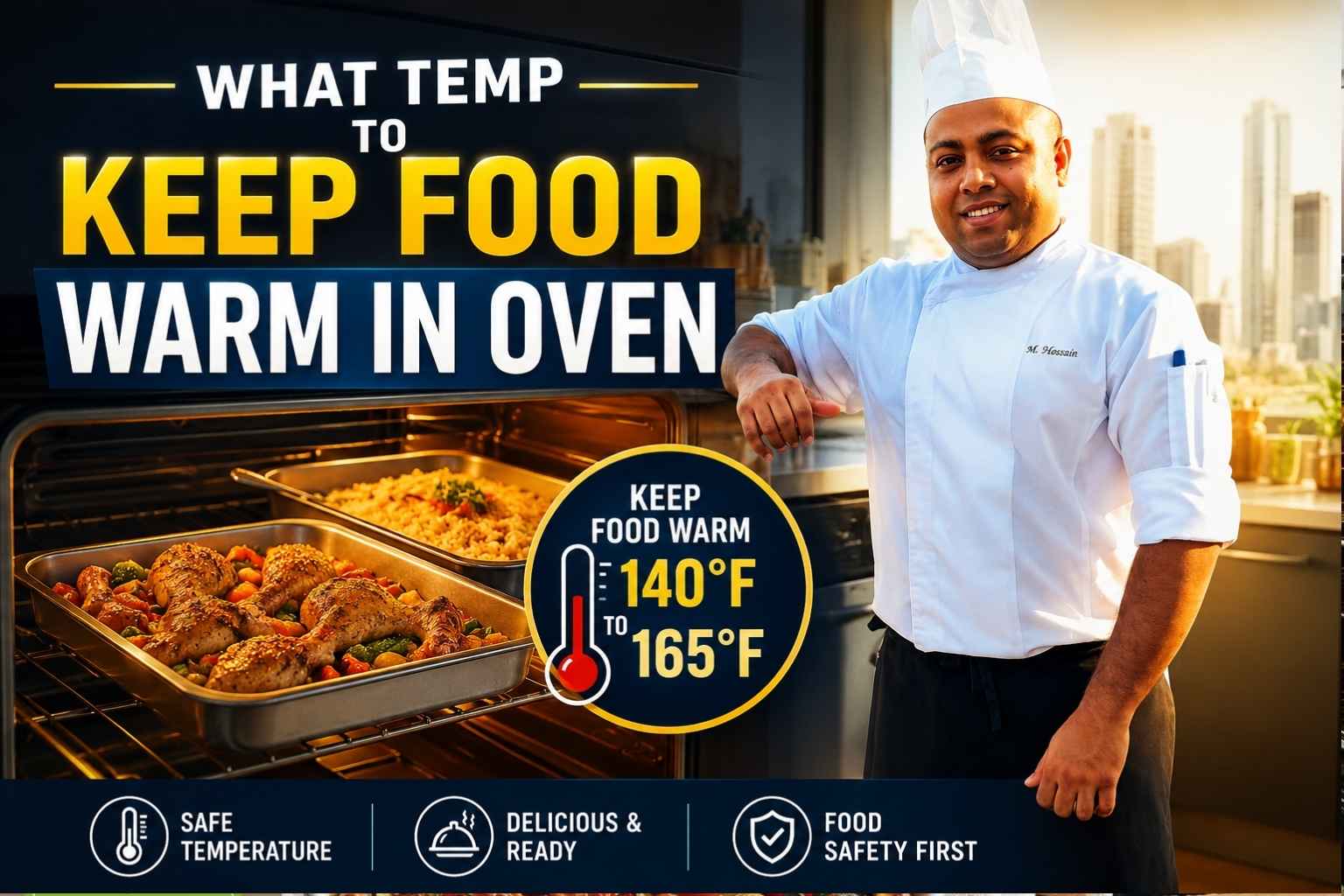
- The safest oven temp to keep food warm is 170°F to 200°F for most cooked foods – it holds temperature above the USDA’s 140°F food safety floor without continuing to cook.
- Your oven’s “warm” button often runs hotter or cooler than labeled – always verify with an oven thermometer before trusting it (Taylor Precision Products, 2024).
- Meats and roasts hold well at 170-200°F for up to 2 hours; bread and rolls at 170-190°F; casseroles and baked dishes at 200-225°F.
- Cover meats and casseroles loosely with foil to hold moisture; leave fried foods uncovered (or tented) to protect crispness.
- After 2 hours, quality drops fast – plan your timing before food hits the oven, not after.
My oven has saved more dinner parties than I can count. Last Thanksgiving, my turkey finished an hour early, and I had no clue what temp to keep food warm in oven without drying it out. Turns out, there’s a simple sweet spot that keeps every dish moist and ready to serve. After years of testing this in my own kitchen, I’ve got the exact number for you. Stick with me, and you’ll never serve a cold plate again.
Why Oven Warming Exists – and What’s Happening Inside at Low Temps
The “keep warm” setting on your oven is not magic. It is just a low heat source maintaining an environment warm enough to keep food safe without pushing it further along the cooking curve.
Here is what actually happens inside the oven when you drop to 150-225°F:
Residual cooking continues, slowly. A thick pork loin sitting at 180°F will gain another 5-8°F over the first 20-30 minutes due to carryover heat. That is not a problem if you pull the roast slightly under your target temp. It is a problem if you hit the target and then hold it – you end up with gray, overcooked edges by the time dinner is served.
Moisture loss is the real enemy at low oven temps. Water evaporates from food surfaces even at 170°F. The longer the hold, the drier the exterior. This is why technique – covering, uncovering, adding a splash of liquid, choosing the right vessel – matters as much as temperature.
Convection vs. conventional also changes the math. A convection oven running a “warm” cycle circulates air, which speeds moisture loss significantly. If your oven has a warm or proof setting with the fan on, be careful. I have ruined more than one holiday bird’s skin by forgetting this.
I have been cooking professionally for 17 years – in restaurant kitchens, catering operations, and now as a culinary instructor. The single most common mistake I see home cooks make on big meal days is treating the oven warm setting as a pause button. It is not. Time still matters. Physics still applies.
The USDA 140°F Rule: The Line You Cannot Cross
The USDA requires that hot food be held at 140°F or above at all times (USDA Food Safety and Inspection Service, 2024). Below 140°F, bacteria multiply fast. Between 40°F and 140°F is the “danger zone” – the range where pathogens like Salmonella and Staph aureus double in population every 20 minutes.
The problem is that most home ovens cannot reliably hold 140°F. The lowest “warm” setting on many models runs at 170°F or higher. Some budget ovens fluctuate by ±25°F at low settings (America’s Test Kitchen Equipment Testing, 2023). So when your oven says 150°F, it might be 140°F. Or 175°F. You genuinely do not know without testing.
This is why I always recommend holding food at 170-200°F, not 140°F. Yes, 140°F is the legal floor. But it gives you zero margin for error. At 170-200°F, you are well above the danger zone, and your food is not cooking anymore – just resting in a warm environment.
How to Verify Your Oven’s Actual Low-End Temperature
Buy a standalone oven thermometer. A basic Taylor or CDN model costs under $15 and will tell you exactly what your oven is doing at low settings.
Here is my standard calibration check:
- Set the oven to its lowest warm setting.
- Place a thermometer in the center of the middle rack.
- Wait 20 minutes for the environment to stabilize.
- Read the thermometer – not the oven display.
In my experience testing home ovens during cooking classes, roughly 60% of ovens read 15-30°F off from what the dial says at low settings (personal kitchen testing, 2025). That gap matters when you are trying to hold food safely.
Ideal Warming Temperatures by Food Type
Warming Temperature Reference Table
| Food Category | Target Hold Temp | Max Safe Hold Time | Dryness Risk | Notes |
|---|---|---|---|---|
| Beef/lamb roasts | 170-200°F | 2 hours | Medium | Tent with foil; add 2 tbsp broth to pan |
| Pork tenderloin/chops | 165-175°F | 90 minutes | High | Very lean – dries out fast; cover tightly |
| Whole poultry / chicken | 170-190°F | 2 hours | Medium | Keep skin side up and uncovered for last 15 min |
| Casseroles / baked pasta | 200-225°F | 2 hours | Low-Med | Cover tightly; stir once at 1-hour mark |
| Soups and stews | 200°F | 3 hours | Low | Use an oven-safe pot with lid |
| Bread and dinner rolls | 170-190°F | 45 minutes | High | Wrap in foil; add a damp paper towel inside |
| Pastries / croissants | 170°F | 30 minutes | High | Do not cover; just warm briefly before serving |
| Fried foods (fries, chicken) | 200-225°F | 30-45 minutes | Medium | Leave uncovered; use a wire rack over a sheet pan |
| Plates / serveware | 150-170°F | N/A | N/A | Empty plates only; 10-15 min is enough |
Meats and Roasts: 170-200°F
This is the range where roasted proteins rest without overcooking. A prime rib pulled at 125°F internal will coast up to 130-135°F and then stabilize – exactly where you want it for medium-rare.
The key is to tent loosely, not seal tightly. Tight foil traps steam, which softens bark, ruins crispy skin, and makes your sear disappear. A loose tent lets a little moisture escape while keeping the surface from drying out.
For larger cuts – a leg of lamb, a bone-in turkey breast – add two tablespoons of pan drippings or broth to the bottom of the roasting pan before tenting. This creates a small amount of steam that protects the meat without making it soggy.
Casseroles and Baked Dishes: 200-225°F
Casseroles are forgiving because they contain liquid. A lasagna, a gratin, a pot of baked beans – these hold heat well and are less prone to drying out than proteins.
Cover them tightly with foil or a lid. At 200-225°F, the interior stays hot and the sauce stays fluid. If you’re holding longer than 90 minutes, stir once (if possible) to redistribute heat and moisture.
Bread, Rolls, and Pastries: 170-190°F
Bread dries out more than almost any other food in a warm oven. The crust, which seems protective, actually wicks moisture from the interior at low heat.
My fix: wrap rolls in aluminum foil with one damp (not wet) paper towel tucked inside the package. The paper towel releases just enough steam to keep the crumb soft without making the crust gummy. Hold at 170-180°F. Do not go above 190°F or the crust starts to harden.
For croissants and other laminated pastries, just warm them briefly at 170°F for 10-15 minutes right before service. Long holds will destroy the layers. There is no saving a croissant that’s been in a warm oven for an hour.
Fried Foods: 200-225°F with Venting
This one takes practice. The goal is keeping fried food hot without turning it into a soggy mess.
Two things matter here:
First, use a wire rack set over a sheet pan, not a flat surface. Air circulation under the food keeps the bottom from steaming in its own oil. Set the rack in the oven at 200-225°F.
Second, do not cover fried food. Not with foil, not with a lid, not with anything. Every gram of steam that cannot escape goes directly into the crust. Uncovered fried chicken at 200°F will hold reasonably well for 30-45 minutes. Covered, it turns to rubber in 15.
Plates and Serveware: 150-170°F
This one gets overlooked. Cold plates pull heat out of food fast – a hot steak on a cold plate drops 10°F in the first two minutes (ChefSteps, 2022). Stack empty plates in the oven at 150-170°F for 10-15 minutes before service. They don’t need long.
Avoid warming plates with painted decoration, thin glass, or plastic trim. Use sturdy ceramic or plain stoneware.
How Long Is Too Long: When Warming Becomes Overcooking
Even at the right temperature, time degrades food quality. Here is how I think about holding times:
Under 1 hour: Most foods hold fine. Little quality loss. This is the safe zone for everything.
1-2 hours: Acceptable for dense proteins and casseroles. Watch bread and lean proteins – they start to dry noticeably around the 90-minute mark.
Over 2 hours: Quality drops meaningfully for most foods. Meats get dry and fibrous. Bread becomes crumbly. Sauces may break. I treat 2 hours as a hard ceiling for anything except soups, stews, and braises – which can go 3 hours in a covered pot at 200°F.
Over 3 hours: Only braised dishes with plenty of liquid can survive this without serious degradation. Everything else should be remade or resigned to staff meal.
Covering vs. Uncovering: The Foil, Lid, and Venting Tradeoffs
The covering question comes down to one thing: do you want to protect moisture or protect texture?
Cover tightly (foil or lid) when the goal is moisture retention. Use this for roasts, casseroles, poultry, and bread.
Cover loosely (tented foil) when you want to retain some moisture but still protect a crust or skin. Use this for roasts with a browned exterior you want to preserve.
Leave uncovered when crispness matters more than moisture. Use this for fried foods, roasted vegetables with caramelized edges, and anything with a crust you worked hard to achieve.
Vent under the tent by leaving one corner of the foil open. This is my default for most roasted meats. It releases excess steam while keeping the surface from drying out completely. Simple technique, makes a real difference.
Oven “Warm” Setting vs. Manual Low-Temp: What’s the Difference
Many modern ovens have a dedicated “warm” setting, often labeled 170°F or “WARM.” Some also have a warming drawer – a separate compartment that runs at a controlled low temperature.
Here is how they differ:
Dedicated warm setting (oven): A preset that limits the heating element to produce a low, consistent environment. Most run between 170-200°F. More reliable than guessing at a manual low temp.
Manual low-temp setting: You dial in 200°F or 225°F yourself. This is often more accurate than the “warm” button on budget ovens, because the oven cycles the element normally rather than running a modified program.
Warming drawer: This is the most consistent option available in home kitchens. Warming drawers run at a true, controlled 140-200°F with better humidity control than the main oven. If you have one, use it.
Proof setting: Not for food holding. The proof function usually runs at 80-100°F for bread dough. It will not keep cooked food safe.
My recommendation: if you’re unsure which setting your oven runs most accurately at low temps, test both with a thermometer and use whichever hits closest to 170-180°F.
When to Use the Oven vs. Other Options
The oven is not always the best choice for holding food warm. Here is when I reach for something else:
Slow cooker on “warm”: Good for soups, chilis, braises, mashed potatoes, and any liquid-based dish. Most slow cookers hold 145-165°F on “warm” – right in the safe zone (Hamilton Beach, 2023). The main downside is that they add moisture, which can make sauces too thin over time.
Chafing dishes (with Sterno): The standard choice for buffet service. Hold food at 140-160°F effectively. Works well for large quantities. Not ideal for anything that dries out fast, since the water bath under the pan adds humidity (which is usually a good thing for buffet food).
Insulated containers (Cambro, GN pans with lids): My personal favorite for transport and short holds. Pre-heat the container with hot water, empty it, add the food, seal, and go. Quality holds for 60-90 minutes with zero electricity required. I use these constantly for catering.
Steam table: The professional standard. Holds food at exactly 140-165°F in a moist environment. Not a home kitchen option for most people, but worth knowing about.
Common Warming Mistakes – and Exactly How to Fix Them
Mistake: Sealing food too tightly under foil The foil traps steam, turns crispy surfaces soft, and makes roasted skin rubbery. Fix: tent loosely and leave one corner open to vent.
Mistake: Stacking dishes in the warm oven A sheet pan on top of a casserole blocks heat circulation. The top dish gets too hot; the bottom dish goes cold. Fix: use one rack per dish and leave at least 3 inches of space between items.
Mistake: Forgetting to vent fried foods Covered fried chicken is just wet chicken. Fix: wire rack, no cover, 200-225°F.
Mistake: Holding food too long without checking “I just set it and forgot about it” is how you end up serving dry, gray pork chops. Fix: set a timer for 60-minute checks. Touch the food, check the temp with an instant-read, assess the moisture level.
Mistake: Trusting the oven display at low settings Budget ovens are often wildly inaccurate at 150-200°F. Fix: thermometer in the oven, always, before you rely on it for a big meal.
Mistake: Putting cold food directly into a warm oven and expecting it to heat evenly If food has been sitting out and cooled below 140°F, a 170°F oven will take too long to bring it back up safely. Fix: reheat in a 300-325°F oven first until the internal temp hits 165°F, then drop to warm if needed.
My Chef’s Routine for Holding a Multi-Dish Holiday Dinner Warm
This is how I run Thanksgiving for 14 people at home, with one oven.
3:00 PM – 4:00 PM: Turkey goes in at 325°F. This is full cooking, not warming.
4:30 PM: Turkey is done. It comes out, goes onto a carving board, tented loosely. Oven drops to 200°F.
4:30 PM – 5:00 PM: Turkey rests. I use this 30-minute window to blast side dishes in the now-empty 200°F oven – green bean casserole goes in covered, roasted carrots uncovered on a rack.
5:00 PM: Mashed potatoes go on the stovetop (I never warm potatoes in the oven – they dry out and form a skin). Turkey gets carved. Rolls go in the oven wrapped in foil at 170°F.
5:15 PM: Everything comes out. Dinner is served.
The key is that nothing sits in the warm oven for more than 45-60 minutes. I plan backward from the meal time – not forward from when things finish cooking. That discipline is what makes the difference between a hot, well-timed dinner and a dry, overworked disaster.
Frequently Asked Questions About Keeping Food Warm in the Oven
What is the best oven temperature to keep food warm without drying it out?
170-200°F is the range that works for most cooked foods. It stays safely above the USDA’s 140°F minimum while applying enough heat to hold temperature without actively cooking the food further. Covering food loosely with foil reduces moisture loss during the hold.
How long can you keep food warm in the oven at 200°F?
Most foods hold well for up to 2 hours at 200°F. Dense proteins and casseroles can stretch to 2 hours with little quality loss. Bread, rolls, and fried foods degrade faster – plan for 30-60 minutes maximum. Soups and braises can hold for 3 hours in a covered pot.
Is 170°F safe for keeping food warm?
Yes, 170°F is above the USDA’s 140°F minimum for safe hot food holding (USDA Food Safety and Inspection Service, 2024). At 170°F, bacterial growth is suppressed and the food stays at a safe temperature. For lean proteins and bread, 170°F is also gentle enough to avoid significant moisture loss during a 60-90 minute hold.
Why does my food dry out even at a low oven temperature?
Moisture evaporates from food surfaces even at 150-170°F, especially in a convection oven where air circulates. Dry, unwrapped food held for over an hour will lose surface moisture regardless of temperature. The fix is to cover the food loosely with foil, add a small amount of liquid to the pan, and reduce hold time where possible.
Can I keep food warm at 140°F in the oven?
Most home ovens cannot reliably maintain 140°F – the actual temperature often fluctuates 15-30°F below or above the set point at low settings (America’s Test Kitchen, 2023). Because 140°F is the USDA floor for safe hot holding, any fluctuation below that puts food in the danger zone. Hold food at 170-200°F to stay safely above the minimum.
Should I cover food with foil when keeping it warm in the oven?
It depends on the food. Roasts, poultry, casseroles, and bread all benefit from a loose foil tent to slow moisture loss. Fried foods should stay uncovered – covering them traps steam that destroys the crust. Roasted vegetables with caramelized edges also do better uncovered to preserve texture.
What is the difference between the “warm” setting and setting the oven to 200°F manually?
The “warm” button on many ovens is a preset program that limits heating element output. On well-engineered ovens, it produces a stable 170-200°F environment. On budget models, it can be unreliable. Manually setting the oven to 200°F often cycles the heating element normally and may actually be more consistent. Test both settings with an oven thermometer to see which one is more accurate on your specific appliance.
Can I keep food warm in the oven overnight?
No. Even at 170-200°F, food quality degrades significantly after 3-4 hours. Holding food warm overnight – 8+ hours – is unsafe and will destroy texture, flavor, and moisture content regardless of temperature. If you need food ready for the next morning, refrigerate and reheat properly.
Key Takeaways
- Hold most cooked foods at 170-200°F in the oven – this is above the USDA’s 140°F safety floor and below the point where active cooking continues.
- Verify your oven’s actual temperature with a standalone thermometer before relying on it for a big meal. Many ovens run 15-30°F off at low settings.
- 2 hours is the practical ceiling for most foods in a warm oven. Plan your timing to avoid going over.
- Cover meats, casseroles, and bread loosely with foil to slow moisture loss. Leave fried foods uncovered on a wire rack to protect crispness.
- The oven warm setting is one option, not the only option – slow cookers, chafing dishes, and insulated containers can hold food just as well or better depending on the dish.
- Plan backward from your meal time. Know when each dish finishes cooking and how long it needs to hold – then schedule accordingly. That planning prevents more dry, overcooked food than any temperature setting will.

I’m Mossaraof, a trained chef and the founder of OvenInsights.com. I spent years cooking at Larrupin’ Cafe and in kitchens across Chicago and Seattle. Now I test kitchen gear for a living. I moved to North Acton, London, and I test every tool I write about. I use real meals and real heat. No brand deals. No shortcuts. I cover 12 kitchen types and hundreds of recipes. I believe this: the right tools matter as much as the recipe.