At A Glance
- The oven is the single best tool for high-protein meal prep because it handles batch sizes that no skillet or stovetop burner can match – you can cook 6 lbs of protein hands-off in one session.
- A 400°F (204°C) sheet pan is the workhorse temperature for most animal proteins; plant proteins like lentils and chickpeas need stovetop or a covered bake at 375°F.
- You can run 4-5 different proteins through one oven session using staggered start times and foil tenting – no second oven required.
- Marinades that hold for 4-5 days in the fridge rely on acid, fat, and salt in the right ratio – skip the dairy-based ones if you’re prepping for a full week.
- Food safety for high-protein meal prep means hitting 165°F (74°C) internal temp for poultry, 145°F (63°C) for fish, and storing everything at or below 40°F (4°C) within two hours of cooking (USDA Food Safety and Inspection Service, 2024).
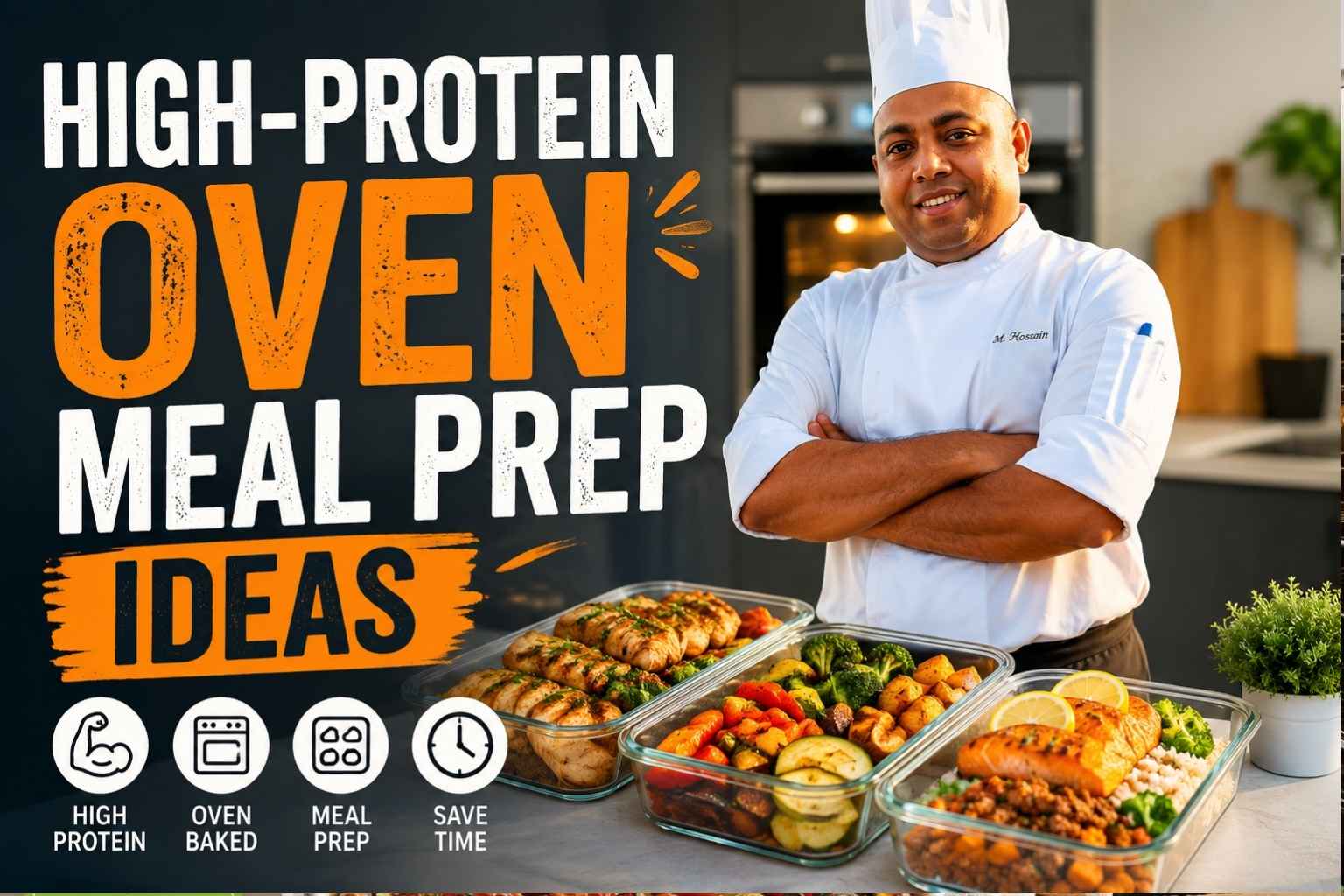
Sunday nights used to stress me out. I’d stare at empty containers, dreading a week of boring chicken and rice. Then I started batch-cooking high-protein oven meal prep ideas, and my whole week changed.
As a chef, I’ve tested dozens of prep methods in my own kitchen. The oven does the heavy lifting while you relax, and every meal comes out juicy, not dry. Stick with me, and I’ll show you my favorite recipes, tips, and shortcuts below.
Why the Oven Wins for High-Protein Meal Prep
The oven is the best tool for high-protein meal prep because it delivers consistent, ambient heat to multiple sheet pans at once – no babysitting, no flipping every two minutes, no grease spattering across your stovetop. Load it up, set a timer, and prep your containers while it does the work.
I’ve been cooking professionally for 16 years, and the shift I see home cooks make when they commit to oven-based prep is immediate. A single 30×18-inch commercial-style sheet pan holds up to 3 lbs of boneless chicken thighs laid flat. Two pans on two racks? That’s 6 lbs of cooked protein from one oven session – enough for four people eating five days a week.
The texture advantages over stovetop matter too. High dry heat pulls moisture from the surface of proteins, creating what food scientists call the Maillard reaction – the browning process that makes food taste roasted rather than boiled. When you sear chicken on the stove and then transfer it to the oven, you get that crust. When you use the oven from the start with a dry rub, you get the same result at scale.
Convection ovens (which circulate hot air with a fan) shorten cook times by 20-25% and produce even browning across the whole pan (America’s Test Kitchen, 2023). If your oven has a convection setting, use it for everything except egg-based dishes.
Protein Content Reference Table: 8 Oven-Friendly High-Protein Foods
This table covers the proteins I use most in batch prep, with real numbers from USDA FoodData Central (2024) and practical oven settings that work.
| Protein | Serving Size | Protein per Serving | Oven Temp | Cook Time |
|---|---|---|---|---|
| Chicken breast (boneless) | 4 oz (113g) | 35g | 400°F / 204°C | 22-25 min |
| Chicken thigh (boneless) | 4 oz (113g) | 28g | 400°F / 204°C | 25-28 min |
| Salmon fillet | 4 oz (113g) | 25g | 375°F / 190°C | 12-15 min |
| Ground turkey (93% lean) | 4 oz (113g) cooked | 22g | 400°F / 204°C | 20-22 min |
| Whole eggs (baked frittata) | 2 large eggs | 12g | 350°F / 177°C | 18-22 min |
| Lentils (red, oven-baked) | 1/2 cup cooked | 9g | 375°F / 190°C (covered) | 35-40 min |
| Firm tofu (roasted) | 4 oz (113g) | 9g | 425°F / 218°C | 25-30 min |
| Tempeh (sliced) | 3 oz (85g) | 16g | 400°F / 204°C | 20-22 min |
| Chickpeas (roasted) | 1/2 cup | 7g | 400°F / 204°C | 30-35 min |
| Cottage cheese bake | 1/2 cup | 13g | 350°F / 177°C | 25-30 min |
Protein values sourced from USDA FoodData Central, 2024. Cook times assume single-layer placement on a rimmed sheet pan.
The Chef’s Protein Tier List: What to Prioritize and Why
For high-protein oven meal prep, not all proteins are equal. Some hold up in the fridge for five days. Others dry out by day two. Here’s how I rank them.
Tier 1: Animal Proteins That Batch Cook Best
Boneless chicken thighs are the best all-around meal prep protein in the oven. They have more fat than breasts (about 9g per 4 oz serving), which means they stay moist when reheated – unlike breast meat, which turns chalky by day three. I bake thighs at 400°F for 25-28 minutes with a dry rub, rest them 5 minutes, then slice and store.
Ground turkey is underrated for batch cooking. Pressed into a sheet pan with parchment, seasoned, and baked at 400°F for 20 minutes, it breaks into crumbles perfectly. Use it for taco bowls, stir-fry bases, or protein salads all week.
Salmon is Tier 1 for nutrition density – it packs omega-3 fatty acids alongside 25g of protein per serving (USDA FoodData Central, 2024) – but it’s a Tier 2 prep item because it lasts only 3 days in the fridge and doesn’t freeze well once cooked. Prep salmon mid-week, not on Sunday.
Whole eggs in frittata form are the most efficient breakfast protein in the oven. A 9×13 baking dish holds 12 eggs plus vegetables. That’s 12 portions of 12-15g protein each, baked in 22 minutes.
Tier 2: Plant Proteins Worth the Oven
Firm tofu needs three things to work in the oven: pressing out water (30 minutes minimum under a weighted plate), a high temp (425°F), and space between cubes on the pan. Crowd tofu and it steams instead of roasting. Done right, it’s crispy on the outside and holds texture for 4 days.
Tempeh is the most underused plant protein in home kitchens. It’s made from fermented soybeans and packs 16g of protein per 3 oz serving (USDA FoodData Central, 2024) – nearly double the protein of tofu at the same weight. Slice it thin, marinate for 20 minutes in soy sauce, rice vinegar, and garlic, then bake at 400°F for 20-22 minutes per side.
Roasted chickpeas work best as a topping or snack – they don’t hold their crunch after day one in a container. If you want chickpeas as a meal prep protein, keep them in a separate airtight jar and add them to bowls dry.
Tier 3: Dairy-Based Protein Bakes
Cottage cheese bakes have grown in popularity because a 1/2 cup of full-fat cottage cheese has 13g of protein (USDA FoodData Central, 2024). Blend it smooth, add eggs, seasoning, and any mix-ins, pour into a muffin tin, and bake at 350°F for 25-30 minutes. They reheat well but taste best within 3 days.
Greek yogurt-based marinades add protein passively – use full-fat Greek yogurt as a marinade base for chicken or lamb before baking. The acids in yogurt tenderize meat, and the protein content of the marinade itself absorbs into the outer layers during cooking.
Sheet Pan Meal Prep by Protein Type: Temps, Times, and Mistakes
High-protein sheet pan meal prep means getting the details right for each protein category. Here’s what actually works – and where most home cooks go wrong.
Chicken: The One Mistake That Kills Your Meal Prep
The most common mistake with oven chicken is overcrowding the pan. Chicken releases steam as it cooks. If pieces are touching, that steam has nowhere to go – the surface stays wet, and you get gray, steamed chicken instead of roasted. Leave at least 1/2 inch between pieces.
For bone-in chicken thighs, start skin-side up at 425°F for 35-40 minutes with no foil. The skin crisps, the fat renders, and the meat stays moist even after 4 days in the fridge. For boneless breasts, brine them first: 1 quart of water, 1 tablespoon of kosher salt, 30 minutes minimum. That 30-minute brine increases moisture retention by roughly 10% during baking (Serious Eats, 2022).
Fish: Low and Slow, Not High and Fast
Salmon and other fatty fish go at 375°F, not 425°F. High heat contracts the protein fibers too fast and squeezes out the albumin – that white, sticky substance that appears on the surface of overcooked salmon. At 375°F, salmon is done in 12-15 minutes and stays silky.
Use the fork test: insert a fork at the thickest point and twist gently. If it flakes cleanly, pull it. If it resists, give it 2 more minutes. Don’t rely on color alone – salmon can look done on the outside while underdone in the center.
Tofu and Tempeh: The Press and Space Rule
Press firm tofu for a minimum of 30 minutes before baking. I use a tofu press (a simple weighted device), but two plates and a can of beans work fine. Remove as much water as possible, cube the tofu into 1-inch pieces, toss with 1 tablespoon of cornstarch per block, and season. The cornstarch creates a crust.
Tempeh goes straight from the marinade to the pan – no pressing needed. The firmer structure holds up to 20 minutes per side at 400°F.
Eggs: Scale Up with a Sheet Pan Frittata
A frittata is a baked egg dish – essentially an open-faced omelette finished in the oven. For meal prep, use a 9×13 baking dish oiled with 1 tablespoon of olive oil. Whisk 12 eggs with 1/4 cup of milk, salt, and pepper. Add whatever vegetables and protein you’re using. Bake at 350°F for 22-25 minutes until the center is set. Cut into 12 squares. Each square is roughly 12-15g of protein depending on mix-ins.
How to Cook 4-5 Proteins in One Oven Session
You can run multiple proteins through one oven at the same time using staggered start times, different rack positions, and foil tenting. This is how I do it every Sunday.
The method works because most proteins cook at temperatures between 375°F and 425°F. The 50°F difference between the lowest and highest is small enough that everything can share one oven set to 400°F, with cook time adjustments compensating for the temperature gap.
A Sample One-Oven, Four-Protein Session
Here’s the schedule I follow for a full week of protein prep:
- 12:00 PM – Preheat oven to 400°F. Press tofu, marinate tempeh.
- 12:30 PM – Sheet pan 1: chicken thighs (bone-in) go in on the top rack, 425°F for 35-40 min. Reduce oven to 400°F after 10 min.
- 12:45 PM – Sheet pan 2: tofu cubes and tempeh slices go in on the middle rack.
- 1:00 PM – Sheet pan 3: ground turkey crumbles go in on the bottom rack.
- 1:15 PM – Pull turkey (done at ~20 min). Tent chicken loosely with foil to slow browning while thighs finish.
- 1:20 PM – Lower oven to 375°F, add salmon on sheet pan 3 (the now-empty turkey pan).
- 1:30 PM – Pull chicken thighs (total: ~60 min for bone-in). Pull tofu and tempeh.
- 1:35 PM – Pull salmon (12-15 min at 375°F). Session complete.
Total active time: about 25 minutes of hands-on work for 5 proteins cooked.
Foil tenting means draping a loose sheet of foil over a pan during the last 10 minutes of cooking. It slows surface browning without steaming the food underneath – useful when one item is done but you need the oven for something else.
Resting rule: rest all proteins for 5 minutes before cutting or storing. Cutting immediately causes juice loss. Resting allows the internal temperature to equalize and juices to redistribute (Serious Eats, 2023).
Marinades and Dry Rubs That Stay Good for 4-5 Days
A marinade that tastes great on day one but turns sour by day three is useless for meal prep. The formulas below are built to hold.
The Fridge-Stable Marinade Formula
The ratio that works: 3 parts fat : 1 part acid : seasoning to taste.
- Fat options: olive oil, avocado oil, sesame oil (for Asian profiles)
- Acid options: lemon juice, rice vinegar, apple cider vinegar – avoid dairy-based acids (yogurt, buttermilk) for prep you’ll store more than 3 days
- Seasoning base: garlic, kosher salt, black pepper, plus one flavor direction (smoked paprika, cumin, za’atar, etc.)
Example that works on chicken, tofu, and tempeh:
- 3 tablespoons olive oil
- 1 tablespoon lemon juice
- 1 teaspoon garlic powder
- 1 teaspoon smoked paprika
- 1/2 teaspoon kosher salt
- 1/4 teaspoon black pepper
Marinate chicken for 2-4 hours minimum. Tofu and tempeh take 20-30 minutes because their surfaces absorb faster.
Dry Rubs: Better for Shelf Life
Dry rubs have no liquid, which means no microbial activity during storage. A rub-coated chicken thigh stored raw in the fridge holds for 2 days before cooking – longer than a wet marinade. After cooking, the rub creates a bark (a caramelized crust) that seals in moisture.
My go-to all-purpose rub for meal prep:
- 2 teaspoons smoked paprika
- 1 teaspoon garlic powder
- 1 teaspoon onion powder
- 1 teaspoon kosher salt
- 1/2 teaspoon cumin
- 1/4 teaspoon cayenne
Apply 1 teaspoon per 4 oz of protein, press it in, and bake. It works on chicken, turkey, salmon, and roasted chickpeas.
Macro-Friendly Meal Assembly: Pairing Proteins with Carbs and Fats
High-protein oven meal prep reaches its full value when you pair each protein with the right carbs and fats. The goal is a complete meal that hits your macronutrient targets without starting from scratch every day.
A balanced protein meal follows this structure: 30-40g protein + 30-50g complex carbs + 10-20g healthy fat per meal.
Simple Assembly Combinations
- Chicken thighs + brown rice + roasted broccoli: 400-430 calories, ~38g protein per bowl. Brown rice holds well for 5 days in the fridge, making it the best meal prep grain (Precision Nutrition, 2023).
- Salmon + quinoa + avocado slices: 380 calories, ~30g protein. Store avocado separately and add fresh at serving to avoid browning.
- Tempeh + soba noodles + sesame-dressed cucumbers: 350 calories, ~26g protein. Soba noodles (buckwheat-based) add a complete amino acid profile that complements tempeh’s plant protein.
- Baked frittata squares + sweet potato wedges: 280 calories, ~24g protein. Bake sweet potato wedges at 400°F for 25 minutes alongside your other proteins.
Food Safety Rules for High-Protein Meal Prep
Food safety for high-protein meal prep is non-negotiable. Protein-rich foods – especially cooked poultry and fish – are in the temperature danger zone (40°F to 140°F / 4°C to 60°C) where bacteria multiply fastest (USDA Food Safety and Inspection Service, 2024).
The Rules That Matter
- Reach safe internal temps: poultry to 165°F (74°C), ground meat to 165°F, fish to 145°F (63°C), pork to 145°F. Use an instant-read thermometer, not a timer.
- Cool within 2 hours: transfer cooked protein to shallow containers and refrigerate within 2 hours of pulling from the oven. Deep containers trap heat – spread food out to cool faster.
- Store at or below 40°F (4°C): keep your fridge thermometer visible and accurate.
- Eat within these windows: cooked chicken and turkey within 4 days; cooked fish within 2-3 days; cooked eggs within 4 days; roasted tofu and tempeh within 5 days (USDA FoodData Central guidelines, 2024).
- Reheat to 165°F: don’t just warm protein – bring it fully back to safe temp before eating.
What Freezes Well vs. What Doesn’t
Freeze these with confidence: cooked chicken (thighs especially), ground turkey, cooked lentils, roasted chickpeas (before they get soft in the fridge).
Don’t freeze these: cooked salmon (texture breaks down on thaw), baked egg dishes (rubbery after freezing), roasted tofu (becomes waterlogged).
Convection vs. Conventional Oven for Meal Prep: Which One to Use
Convection ovens win for meal prep when you’re cooking proteins. A conventional oven uses static heat from top and bottom elements, which creates hot spots and uneven cooking – the back of the pan often cooks faster than the front. A convection oven adds a fan that circulates hot air around the food, which evens out temperature and pulls surface moisture off faster.
The practical result: convection roasting at 375°F produces the same browning as conventional at 400°F in 20-25% less time (America’s Test Kitchen, 2023). That matters when you’re running a 90-minute prep session – you can fit in one more batch or finish earlier.
When to skip convection: baked egg dishes (frittatas, cottage cheese bakes) cook better in a conventional setting. The circulating air can puff the surface before the center sets, leaving you with an uneven bake. Switch your oven to conventional bake for anything custard-like or egg-heavy.
If your oven doesn’t have a convection setting, rotate your sheet pans 180° halfway through cook time to compensate for hot spots.
My Weekly Oven Meal Prep Routine: The Real Schedule I Follow
Every Sunday, I run a 90-minute prep session that covers five days of lunches and most dinners. Here’s the exact schedule, not a generic version.
Saturday night (10 minutes)
- Pull chicken thighs from the freezer to thaw in the fridge overnight.
- Mix two dry rubs and one marinade. Store in small jars.
Sunday, 12:00 PM – Prep starts
- Preheat oven to 400°F.
- Press two blocks of firm tofu under a weighted cutting board.
- Cube and season tofu with cornstarch and dry rub.
- Trim and season 3 lbs of bone-in chicken thighs with the smoked paprika rub.
- Start brown rice in the rice cooker (hands-off: 45 minutes).
12:30 PM – Chicken goes in on the top rack.
12:45 PM – Tofu goes in on the middle rack.
1:00 PM – Ground turkey crumbles go in on the bottom rack.
1:10 PM – Pull turkey. Oven down to 375°F. Salmon goes on the now-empty bottom rack.
1:20 PM – Pull salmon. Tent chicken with foil.
1:35 PM – Pull chicken. Let everything rest 5 minutes.
1:40 PM – Container time. I use 1-quart glass containers with snap lids. Proteins go into separate containers – I don’t pre-assemble bowls. That keeps each component fresh longer and gives me flexibility to mix and match throughout the week.
1:55 PM – Done. Everything labeled with the date, stored in the fridge. Rice cooker done by now too.
Total hands-on time: about 30 minutes. Everything else was the oven doing its job.
Common High-Protein Meal Prep Mistakes to Stop Making
- Skipping the thermometer: A visual check is not a safety check. An instant-read thermometer costs $12-15 and prevents both undercooking (food safety risk) and overcooking (dry protein by day two).
- Storing proteins in deep containers: Deep containers trap heat and slow the cooling process, which extends the time food spends in the temperature danger zone. Use wide, shallow containers – 1 to 2 inches of protein depth max.
- Marinating with dairy for long prep windows: Greek yogurt marinades are excellent for same-day or next-day cooking. For a 4-5 day prep window, the dairy turns and the flavors go flat. Use oil-and-acid marinades instead.
- Cooking salmon on Sunday: Salmon lasts 2-3 days, so prepping it Sunday means it’s borderline by Wednesday. Prep salmon Tuesday or Wednesday instead for midweek meals.
- Not resting proteins before storage: Cutting straight from the oven releases the juices before they’ve redistributed. Rest everything 5 minutes before cutting or storing – it makes a measurable difference in texture on day three.
Frequently Asked Questions About High-Protein Oven Meal Prep
How much protein should I prep per week for meal prep?
A useful starting point is 0.7-1.0g of protein per pound of bodyweight per day, depending on your activity level (Precision Nutrition, 2023). For a 160 lb moderately active adult, that’s 112-160g of protein daily. Across 5 prep days, that’s 560-800g of protein total – roughly 6-9 lbs of raw chicken thighs, or a mix of proteins from the table above.
Can I cook multiple proteins on the same sheet pan?
Yes, if they share the same cook time and temperature. Chicken thighs and bone-in drumsticks work together at 400°F. Don’t put salmon and chicken on the same pan – salmon finishes in half the time at a lower temp. Use separate pans.
How do I keep chicken breast from drying out during meal prep?
Brine it before baking: 1 tablespoon of kosher salt per quart of water, 30 minutes minimum. After baking, slice it only when cold – cutting warm breast meat loses more moisture than cutting chilled meat. Store whole when possible and slice per serving.
What’s the best container for storing high-protein meal prep?
Glass containers with airtight lids are the best long-term choice – they don’t absorb odors, don’t leach chemicals when reheated, and seal tightly enough to prevent fridge odors from affecting the food. For proteins with sauce or marinade, use containers with a locking lid rather than a simple snap lid.
How do I reheat meal-prepped proteins without drying them out?
Add 1-2 tablespoons of water or broth to the container before reheating. Cover loosely with a damp paper towel if using a microwave. Reheat chicken and turkey to 165°F internal. For fish, reheat low and slow – 275°F in the oven for 10-12 minutes, covered with foil, rather than the microwave, which overcooks the surface before the center warms.
Is it safe to meal prep chicken for 5 days?
Yes, if cooked to 165°F (74°C), cooled within 2 hours, and stored at or below 40°F (4°C). The USDA Food Safety and Inspection Service (2024) sets the safe window for cooked poultry at 3-4 days in the refrigerator. For a full 5 days, freeze the last two portions on Sunday and move them to the fridge Thursday morning.
What’s the highest-protein oven meal prep option for plant-based diets?
Tempeh is the densest plant protein for oven cooking at 16g per 3 oz serving (USDA FoodData Central, 2024). Combine it with roasted lentils and a quinoa base to build a plant-based meal that reaches 30-35g of protein per bowl – without any animal products.
Can I use an air fryer instead of a conventional oven for meal prep?
An air fryer is a small convection oven and works well for single portions. It’s not a batch-cooking tool – a standard 5-6 quart air fryer basket holds about 1 lb of chicken at a time. For meal prep at scale (3+ lbs of protein), a full-size oven with sheet pans beats the air fryer on capacity every time.
Key Takeaways
- The oven beats the stovetop for meal prep because of batch capacity, hands-off cooking, and the dry heat that creates better texture and surface browning on all protein types.
- Chicken thighs outperform chicken breasts for meal prep because their higher fat content keeps them moist through 4-5 days of refrigeration and reheating.
- Staggered start times let you cook 4-5 proteins in one 90-minute oven session without a second oven – sequence by cook time, longest first.
- Use oil-and-acid marinades (not dairy-based) for proteins stored more than 3 days. Dry rubs are even more stable.
- Hit safe internal temperatures on every protein: 165°F for poultry and ground meat, 145°F for fish. Use a thermometer, not a visual check.
- Store proteins in shallow glass containers, cool within 2 hours, and follow the USDA’s 3-4 day fridge window for cooked poultry. Freeze anything you won’t eat by day 4.
- Convection mode cuts cook times by 20-25% for protein prep. Switch to conventional only for egg-based bakes like frittatas and cottage cheese dishes.

I’m Mossaraof, a trained chef and the founder of OvenInsights.com. I spent years cooking at Larrupin’ Cafe and in kitchens across Chicago and Seattle. Now I test kitchen gear for a living. I moved to North Acton, London, and I test every tool I write about. I use real meals and real heat. No brand deals. No shortcuts. I cover 12 kitchen types and hundreds of recipes. I believe this: the right tools matter as much as the recipe.