At A Glance
- Most oven drawers are warming drawers or broiler drawers — not storage. Using them wrong can melt plastic, start fires, or ruin food.
- A warming drawer holds food at 140-200°F (60-93°C) to keep it table-ready for up to 1 hour without drying it out.
- A broiler drawer sits below the oven floor and uses bottom-up radiant heat — most home cooks skip it, which is a real mistake for certain dishes.
- Plastic bags, non-stick pans, and paper products should never go in any oven drawer, regardless of type.
- True storage-safe drawers exist on some modern ranges — check your model number before treating any drawer as a cabinet.
I opened my oven drawer last week and found an old cookie sheet, a rusty pan, and one very confused mitten. Sound familiar? So many of us treat that space like a junk drawer, but what goes in the oven drawer actually matters more than you’d think. After years in professional kitchens, I’ve learned this spot can save your sanity or ruin your cookware if you use it wrong. Let’s clear up the confusion, so you can store your gear the smart way and cook with total peace of mind.
What Is the Oven Drawer, and How Do You Know Which Type You Have?
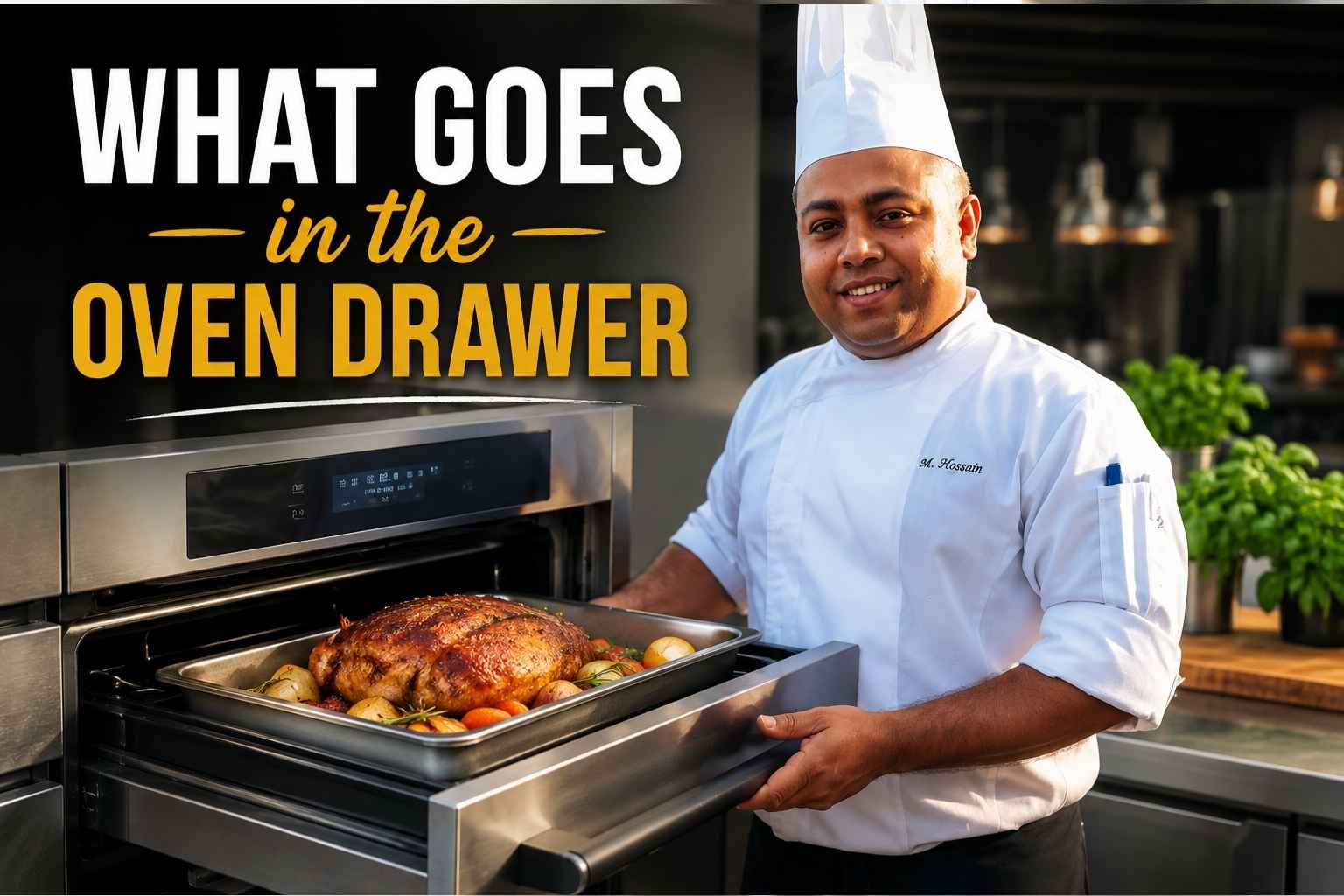
Your oven drawer is one of three things: a warming drawer, a broiler drawer, or a dedicated storage drawer. The type you have changes everything about how you should use it — and getting this wrong is one of the most common kitchen safety mistakes I see.
Here is the fast way to identify yours:
- Turn the oven off and pull the drawer open. Does it have its own temperature dial or a dedicated control on the range panel? That is a warming drawer.
- Look at the drawer ceiling. Can you see a gas burner or electric heating element directly above the drawer cavity? That is a broiler drawer.
- Is there nothing — no element, no control, just a flat metal box? That is a storage drawer, or a drawer people think is for storage but is actually a low-heat holding space near the oven’s ambient exhaust.
I have cooked professionally for over 15 years, in hotel kitchens, restaurant lines, and now in a culinary education setting. The number of home cooks who have no idea which drawer they own — and are keeping plastic storage bags inches from a 400°F heat source — still gets to me.
Pull your model number from inside the oven door frame and look it up. GE Appliances (2023) publishes drawer type information for all current models on their support site. It takes 90 seconds and removes all guesswork.
How a Warming Drawer Works: Temperature, Timing, and What to Keep There
A warming drawer is a low-temperature holding unit built into the range cabinet. It operates independently of the main oven cavity and is designed to hold cooked food at serving temperature until everything else is ready.
Ideal temperature range: 140-200°F (60-93°C), depending on the food.
Most warming drawers let you set one of three modes — low, medium, or high — which correspond roughly to 140°F, 165°F, and 200°F. The U.S. Department of Agriculture (USDA, 2024) specifies that cooked food held for serving must stay at or above 140°F to prevent bacterial growth. A warming drawer at its low setting hits exactly that floor.
What Foods Work Best in a Warming Drawer
| Food Type | Recommended Setting | Max Hold Time |
|---|---|---|
| Bread, rolls, tortillas | Low (140°F) | 45 minutes |
| Plated proteins (chicken, steak) | Medium (165°F) | 30 minutes |
| Casseroles, pasta bakes | Medium (165°F) | 45 minutes |
| Plates before service | Low (140°F) | 20 minutes |
| Roasts resting before carving | Low (140°F) | 30 minutes |
One of my most-used warming drawer tricks: I heat dinner plates in it at low for 15 minutes before service. A warm plate keeps food at the right temperature for the full meal. This is standard practice in professional kitchens and costs you nothing at home.
When Warming Becomes a Problem
The warming drawer is not a slow cooker, and it is not designed for food safety over long periods. After 60 minutes at 140°F, most proteins start to dry out significantly. After 90 minutes, the texture degrades enough to be noticeable.
America’s Test Kitchen (2022) tested holding times on roast chicken and found that moisture loss accelerated sharply after the 45-minute mark in a standard warming drawer, even when the drawer was covered loosely with foil.
Cover food loosely. Keep it moist. And do not treat the warming drawer as a second oven for anything that needs actual cooking — it cannot do that job.
How a Broiler Drawer Works: What It Is and Why Home Cooks Ignore It
A broiler drawer is a separate broiling compartment built below the oven floor. It uses direct radiant heat from a gas burner or electric element aimed downward at the food, which sits on a rack in the drawer.
Which oven brands use it? Older freestanding gas ranges are the most common culprits. Brands including older GE, Frigidaire, and Kenmore gas ranges built through the late 2000s placed the broiler below rather than inside the main oven cavity. Many budget gas ranges sold today still use this configuration (Consumer Reports, 2023).
Why Most Home Cooks Skip the Broiler Drawer
The broiler drawer is lower to the ground, uncomfortable to lean over, and poorly documented in most owner manuals. Most home cooks discover it exists when they open it looking for storage and find a rack they cannot explain.
That is a real loss. The broiler drawer does something the main oven broiler cannot: it puts the food closer to the flame, with no other oven rack positions to worry about, and the drawer’s enclosed geometry concentrates heat well.
I use the broiler drawer for bone-in chicken thighs. The proximity to the heat source means the skin crisps faster than under a top broiler, and the juices fall onto the pan below rather than burning on the oven floor. It also works well for thick-cut toast, melting cheese on nachos, and getting a quick char on peppers.
How to Use the Broiler Drawer Safely
- Pull the drawer out fully, place food on the included rack over the broiler pan.
- Set the range to broil (the broiler drawer activates when the main oven is set to broil on most older gas ranges — your manual will confirm).
- Leave the drawer open a crack (about 2 inches) to prevent heat from building up too fast and cutting the broiler element off.
- Watch constantly. Broiler drawers run hot and fast — most tasks take 4-8 minutes.
The biggest mistake I see: people close the drawer completely and walk away. The broiler will cycle off to protect itself from overheating, and you will get uneven results.
What You Should Never Put in the Oven Drawer
This section matters regardless of which drawer type you have. The oven drawer — even a “storage” drawer — sits near significant heat sources, and certain materials become dangerous in that environment.
Never Put These in Any Oven Drawer
- Plastic bags, plastic storage containers, and plastic wrap. Even in a storage drawer, the ambient heat from oven operation can deform thin plastics and release harmful chemicals. The FDA (2022) warns against heating plastic containers not rated for oven use.
- Paper bags, cardboard, and paper towels. Paper ignites at around 233°C (451°F). The ceiling of a broiler drawer during use can exceed that temperature directly above the food. Even in a warming drawer, paper left against the heat element is a fire risk.
- Non-stick pans with damaged coatings. A scratched non-stick pan placed in a broiler drawer at high heat releases polytetrafluoroethylene (PTFE) fumes, which are harmful at elevated temperatures (Environmental Working Group, 2023). Stick to cast iron, stainless steel, or manufacturer-approved broiler pans.
- Aerosol cans, lighters, or any pressurized container. This seems obvious, but I have seen it. Pressurized cans can rupture from heat.
- Oven mitts and dish towels. People shove these in the storage drawer, then forget about them. If that drawer runs warm, fabric near an ignition source is a serious problem.
Materials That Are Generally Safe
- Cast iron skillets and bare metal pans (no non-stick coating)
- Oven-safe stoneware and ceramic, when the drawer is used as a warming space
- Metal sheet pans for broiling
- Foil (used to loosely cover food in the warming drawer)
What Professional Chefs Actually Use the Drawer For
After 15 years in professional kitchens and teaching home cooks, here is how I actually use the oven drawer — and what I recommend to students.
For warming drawers:
- I use mine to proof bread dough on low heat (around 80-90°F) by placing a bowl of dough inside on a rack with a small pan of hot water nearby. The enclosed space and gentle warmth give a consistent proof that beats leaving dough on the counter in a variable-temperature kitchen.
- I use it to warm dinner plates and serving dishes before every sit-down meal. Always.
- After a large holiday roast comes out of the oven, I let it rest uncovered in the warming drawer on low for 20-25 minutes. The carryover heat in the drawer prevents the meat from cooling too fast, while the resting allows the juices to redistribute.
For broiler drawers:
- Bone-in skin-on chicken thighs: 6-7 minutes, skin side down first, then flip. The drawer’s proximity to the element means I do not need to move a rack.
- Cheese melts: open-face sandwiches and nachos under a broiler drawer get crispier edges than in a top broiler because the heat angle is different.
- Reheating pizza: 3-4 minutes in the broiler drawer on a bare rack revives leftover pizza better than the microwave or a regular oven. The bottom crisps, the cheese melts, and you get something closer to the original texture.
The habit that changed my home cooking: I stopped treating the oven drawer as a junk drawer about 8 years ago when I almost ignited a wadded-up dish towel I had shoved in there. Now I treat it as a piece of kitchen equipment, not overflow storage — and I use it almost every time I cook a full meal.
Drawer Differences by Oven Type: Gas, Electric, Freestanding, and Slide-In
Not all oven drawers behave the same way. The type of range you own affects both what the drawer is and how it performs.
Gas vs. Electric Ranges
Gas ranges with a broiler drawer use a direct-flame burner in the drawer cavity. This gives you fast, high-intensity heat, but the temperature is harder to control precisely. Electric ranges with a separate lower compartment use a resistance coil, which is slower to heat but more consistent across the surface.
Gas warming drawers (on ranges that include one) typically cycle on and off to hold temperature. Electric warming drawers tend to maintain temperature more steadily because the element can modulate. Serious Eats (2021) noted in a range comparison that electric warming drawers held food 10-15°F more consistently than gas equivalents over a 45-minute test.
Freestanding vs. Slide-In Ranges
Freestanding ranges (the most common type, with finished sides and controls at the back) are more likely to have broiler drawers, especially in budget gas models. Slide-in ranges (which sit flush between cabinets, with controls at the front) are more likely to have a dedicated warming drawer, as they tend to be mid-to-high-end models where that feature is standard.
Older vs. Modern Models
Ranges built before roughly 2005 are far more likely to have broiler drawers rather than warming drawers. If you moved into a home with an older freestanding gas range, assume broiler drawer until confirmed otherwise.
Modern ranges — especially those above $800 — commonly include dedicated warming drawers with separate temperature controls and humidity settings. Some Samsung and LG models (2022 onward) include warming drawers with a moisture dial that adds steam to slow drying (LG Electronics, 2023).
How the Drawer Affects Overall Oven Performance
This is something very few home cooks think about, and it has a real effect on baking results.
An oven drawer that sits partially open, or one used frequently while the oven is running, affects the heat distribution inside the main oven cavity. Here is how:
Heat loss through the drawer gap. If your drawer does not seal tightly when closed, warm air from the oven can escape downward into the drawer cavity. This pulls heat from the oven floor and causes the bottom of your baked goods to cook faster than the top.
Airflow disruption. In convection ovens, air circulation is engineered for a sealed cavity. An open or warped drawer breaks that airflow pattern. Serious Eats (2020) documented a 15-20°F temperature variance at the oven floor in a convection oven when the storage drawer was not fully seated.
What to do: Make sure the drawer closes completely and sits flush before baking anything that needs even heat distribution — bread, pastry, cakes. If the drawer drags or does not close flat, the gasket or the drawer track may need cleaning or adjustment.
When Using the Drawer as Storage Is Acceptable — and How to Do It Safely
Some ranges genuinely come with a storage drawer. It is typically labeled in the documentation as a “storage” compartment and lacks any heating element or proximity to one.
If your range has a true storage drawer, these items are safe to keep there:
- Flat sheet pans and half-sheet pans
- Broiler pans (the two-piece slotted type that came with your range)
- Cooling racks and wire trivets
- Cast iron lids and Dutch oven lids (the pots themselves are heavy — store them in cabinets)
- Silicone baking mats
What you should not store even in a true storage drawer:
- Plastic-handled tools that could warp if the drawer warms up during a long bake
- Any food that could attract pests
- Paper products that could become a fire risk if the drawer gap allows heat to enter
A good rule: if it would be fine in a 200°F oven, it is probably fine in a storage drawer. If it would not, keep it somewhere else.
Common Drawer Mistakes Home Cooks Make — and How to Fix Them
These are the errors I see most often, both in teaching settings and in home kitchens I have visited over the years.
Mistake 1: Using the storage drawer to store pots and pans while the oven runs. Leaving a pot in the drawer during a long bake does not necessarily cause a problem, but it can trap heat unevenly beneath the oven and interfere with temperature regulation. Take the pots out before you bake.
Mistake 2: Forgetting food is in the warming drawer. I have done this. You put bread rolls in the warming drawer before dinner, get distracted, and pull out leather rolls 90 minutes later. Set a timer the moment you put anything in the warming drawer.
Mistake 3: Treating a broiler drawer like a warming drawer. A broiler drawer runs at broiling temperatures when the oven is set to broil. Placing covered dishes in it to keep warm while the oven broils something else will not keep the food warm — it will cook it at 400-500°F.
Mistake 4: Not cleaning the broiler drawer pan. The pan under the broiler rack collects drips and grease every time you use it. Grease buildup in a broiler drawer is a fire risk. Clean the broiler pan after every use with hot soapy water, or run it through the dishwasher if it is dishwasher-safe.
Mistake 5: Assuming the drawer is cold just because the oven is off. After a long bake, the storage or warming drawer remains warm for 30-45 minutes. Do not assume it is safe to reach in without a towel or oven mitt.
My Personal Drawer Routine: What I Actually Do Every Week
Here is exactly how I use the oven drawer at home, in order of frequency:
- Every dinner with multiple dishes: I set the warming drawer to medium (165°F) about 20 minutes before we sit down. Finished dishes go in there, covered loosely with foil, while I finish the rest of the meal. Nothing arrives at the table cold.
- Weekend bread baking: I use the warming drawer on low with a small bowl of hot water to proof my dough on cold mornings. The consistent 80-85°F environment cuts my first proof time by about 25% compared to leaving the dough on the counter.
- Quick weeknight broiling: Two or three nights a week, I use the broiler drawer for chicken thighs or fish. The speed and the crisping effect are genuinely better than using the main oven for these smaller portions.
- Holiday meals: Every roast — whether a whole chicken, pork shoulder, or beef tenderloin — rests in the warming drawer on low for 20 minutes before carving. This step alone has improved the quality of my holiday cooking more than any technique change I have made.
The drawer is not a storage unit. It is one of the most useful parts of your range, and most home cooks never use it correctly.
Frequently Asked Questions About the Oven Drawer
What is the oven drawer actually for?
The oven drawer on most ranges is either a warming drawer, a broiler drawer, or — on some older and budget models — a secondary storage compartment. It is not primarily designed to store pots and pans, even though many people use it that way. Check your owner’s manual or your model number on the manufacturer’s site to confirm which type you have before using it.
How do I tell if I have a warming drawer or a broiler drawer?
Look for a separate temperature control on the range panel near the drawer — that points to a warming drawer. Then open the drawer and look at the ceiling of the cavity. A visible burner or heating coil overhead means it is a broiler drawer. If there is no element and no control, it is a storage-adjacent drawer that may still receive ambient heat from the oven above it.
Can I use the warming drawer to keep food warm for more than an hour?
You can, but the food quality declines. Most proteins dry out noticeably after 45-60 minutes at warming drawer temperatures. If you need to hold food longer, cover it tightly with foil and add a small amount of liquid (broth or water) to the dish before placing it in the drawer. The USDA (2024) requires food held for service to stay at or above 140°F, which the low setting on most warming drawers achieves.
Is it safe to store pots and pans in the oven drawer?
If your drawer is a confirmed storage drawer with no proximity to a heating element, then storing flat metal pans and broiler pans in it is fine. If your drawer is a warming drawer or broiler drawer — or if you are unsure — do not store items there. The heat risk is real, and the fire risk from paper products or certain plastics is not worth it.
What should I never put in the oven drawer?
Never put plastic bags, plastic containers, paper bags, paper towels, cardboard, aerosol cans, or dish towels in any oven drawer. Even in a storage drawer, ambient heat from a long oven session can reach temperatures that deform plastics or make combustible materials dangerous. Stick to metal and heat-safe ceramics for anything stored near the oven.
Can I proof bread dough in the warming drawer?
Yes — and it works well. Set the warming drawer to its lowest temperature (around 140°F) and let it cool down slightly with the door cracked for a few minutes before placing dough inside. Aim for an interior temperature of 75-85°F inside the drawer during proofing. A small dish of hot water in the drawer adds humidity and prevents the dough surface from drying out.
Does the oven drawer affect how evenly my oven bakes?
It can. If the drawer does not close flush, heat escapes from the oven floor and causes uneven baking — particularly in the bottom third of the oven. Before baking pastry, bread, or anything that needs even heat from below, make sure the drawer is closed completely and sitting level. If it is not, clean the drawer tracks and check whether the drawer guide rail needs adjustment.
Why does my gas range have a broiler in the drawer instead of at the top of the oven?
Older freestanding gas ranges placed the broiler in the drawer cavity because the main oven used a single large gas burner at the bottom of the cavity for heating, which left no room for a top broiler element. Adding a separate broiler drawer below was the engineering solution. Modern gas ranges typically route the gas burner differently to allow for a top broiler inside the main oven, which is why newer models often include a warming drawer instead.
Key Takeaways
- Identify your drawer type before using it — warming drawers, broiler drawers, and storage drawers are not interchangeable.
- Warming drawers hold food safely at 140-200°F for up to 45-60 minutes, depending on the food type.
- Broiler drawers use direct radiant heat for cooking — they are not for warming, and most home cooks underuse them.
- Plastic, paper, and aerosol products should never go in any oven drawer.
- A warming drawer left partially open or a storage drawer that does not close flush can affect oven baking performance through heat loss and airflow disruption.
- Chef habits worth borrowing: pre-warm your plates, rest your roasts in the drawer, and proof bread dough on the low setting.
- When in doubt about your drawer type, pull the model number and check the manufacturer’s documentation — GE, LG, Samsung, and Frigidaire all publish drawer type details online.

I’m Mossaraof, a trained chef and the founder of OvenInsights.com. I spent years cooking at Larrupin’ Cafe and in kitchens across Chicago and Seattle. Now I test kitchen gear for a living. I moved to North Acton, London, and I test every tool I write about. I use real meals and real heat. No brand deals. No shortcuts. I cover 12 kitchen types and hundreds of recipes. I believe this: the right tools matter as much as the recipe.