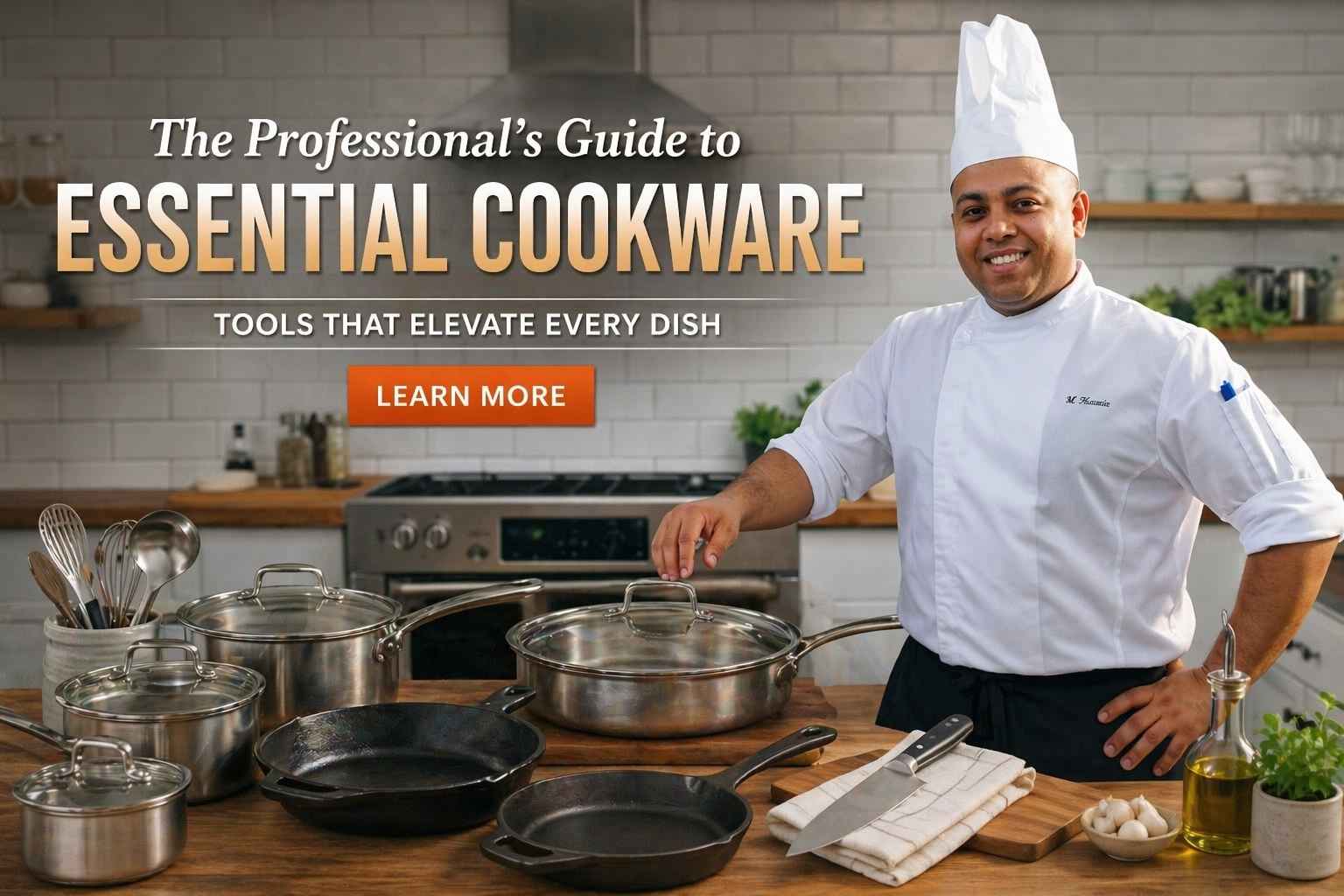
Hey, I’m Mossaraof — a professional cook and food blogger.
Do you ever feel like your kitchen tools are holding your cooking back? I still remember the burn of a cheap pan in my first Chicago kitchen. That is why I made The Professional’s Guide to Essential Cookware just for you. We will look at the best pots and pans that every home chef needs to own. Read on to build a kitchen that makes every meal a joy!
Once you have the right gear, check out my Complete Guide to Using an Oven at Home for more tips. Good tools are like a solid friend who always has your back when things get hot. I want to help you pick items that last for years and save you money too. Let’s get your kitchen ready for some real magic today!
Table of Contents
ToggleThe Core Materials: What Makes a Pan Professional?
The metal in your hand changes how your food tastes. It determines if your steak gets a crust or just turns gray and sad.
I used to think a pan was just a pan. Then I felt the difference between a thin aluminum disc and a heavy 5-ply stainless steel pot. It is all about how heat moves. In the U.S., many of us use high-BTU gas ranges or fast induction tops. You need a material that won’t buckle under that power; understanding how to choose oven-safe cookware is vital to ensure your equipment can handle those high temperatures without damage. Using the wrong material isn’t just inefficient—why warped baking sheets ruin cooking is a lesson many learn the hard way when their heat distribution goes haywire.
Stainless Steel: The Reliable Workhorse
Every pro kitchen in the states has a stack of stainless steel. It is tough as nails. You can scrub it with steel wool and it won’t care, though for your oven interiors, you’ll want to use the best oven cleaning tools that won’t scratch to keep things pristine.
- Multi-Clad Layers: Look for “Tri-Ply” or “5-Ply.” This means aluminum is sandwiched between steel.
- Non-Reactive: You can cook a heavy tomato sauce for hours. The acid won’t leach a metallic taste into your food.
- The All-Clad Factor: This brand is a staple for a reason. Their handles are a bit polarizing, but the heat is perfect.
Cast Iron: The American Legend
There is nothing like a Lodge skillet. I found one at a garage sale in Ohio that was fifty years old. After a quick scrub, it worked like new.
- Heat Retention: It takes a while to get hot. But once it is there, it stays hot. This is vital for thick-cut New York strips. For even better results with breads and doughs, the pizza stone vs. pizza steel debate highlights why high-density materials are king.
- Versatility: You can start a dish on the stove and finish it in the oven. It is consistently ranked among the best pans for oven cooking.
- The Weight: It is heavy. My wrists feel it after a long day, so investing in the best oven mitts that actually protect your hands is a must when maneuvering these 10-pound beasts.
Carbon Steel: The Chef’s Best Kept Secret
Think of this as the bridge between stainless and cast iron. It is what we use for those perfect French omelets.
- Lightweight Power: It is much easier to toss vegetables in a carbon steel pan.
- Quick Response: If you turn the flame down, the pan cools fast. This gives you more control than cast iron. While carbon steel is the pro choice for stovetops, when moving to the oven for delicate desserts, you might find yourself weighing ceramic vs. glass bakeware or deciding between baking mats vs. parchment paper in the oven.
Regardless of the pan you choose, precision is everything. If you find your sears aren’t consistent, ask yourself: do you really need an oven thermometer? (Spoiler: The answer is usually yes).
The Essential Sauté Pan vs. The Skillet
You might think these are the same thing. They are not. Using the wrong one can make a simple dinner feel like a chore.
A skillet has sloped sides for flipping and tossing. A sauté pan has tall, straight sides for liquids and volume. I keep both within arm’s reach because they serve very different masters.
Why You Need a Skillet
I use a 10-inch or 12-inch skillet for almost every meal. The flared sides let moisture escape easily. This is how you get crispy edges on your potatoes or eggs.
- Surface Area: The wide top makes it easy to get a spatula under your food.
- Ergonomics: It feels balanced. Brands like Made In have handles that don’t dig into your palm.
- Easy Pouring: The shape helps you slide a finished omelet right onto the plate.
The Power of the Sauté Pan
When I’m making a big batch of chicken thighs in a creamy sauce, I grab the sauté pan. The straight sides mean you can fit more food without crowding.
- Lid Use: These usually come with a heavy lid. It is perfect for steaming or braising.
- Less Mess: The tall sides keep grease from splashing all over your clean stove.
- Volume: It holds more liquid than a skillet. It is the king of the “one-pan” dinner.
Stock Pots and Dutch Ovens: The Slow Burn
In the winter months, my Dutch oven never leaves the stove. It is the heart of slow-cooked comfort food.
A good pot should feel like an anchor. It needs a thick bottom so your soup doesn’t burn when you walk away for five minutes. I’ve seen cheap pots scorch a broth in seconds. It’s a heartbreaking waste of ingredients.
Enameled Cast Iron
Le Creuset and Staub are famous for these. They are beautiful, but they are also incredibly functional.
- No Seasoning Required: The enamel coating protects the metal. You can soak it in the sink without worry.
- Even Cooking: It holds a simmer better than any other pot I own.
- Durability: The glass-like coating can chip if you drop it, but with care, it lasts a lifetime.
Stainless Steel Stock Pots
For boiling pasta or making a huge batch of turkey stock after Thanksgiving, you want stainless steel.
- Lightweight: Even a huge 12-quart pot isn’t too heavy when empty.
- Fast Boiling: Aluminum-core bottoms get water moving quickly.
- Brand Pick: Cuisinart makes a great multi-clad stock pot that won’t break the bank.
Heat Sources and Tool Compatibility
Your stove is the engine. Your pan is the tires. They have to work together or you are going nowhere fast.
I grew up on gas stoves. I love seeing the flame. But many newer American homes are switching to induction or electric glass tops. This changes everything about the cookware you should buy.
Gas Stoves: The Old Reliable
Gas is forgiving. The flame wraps around the bottom of the pan. It can handle pans that aren’t perfectly flat.
- Heat Control: You can see exactly how much power you are using.
- Hot Spots: Thinner pans will get “hot spots” where the flame hits. You have to keep the food moving.
Induction: The Fast Newcomer
Induction uses magnets to heat the pan directly. It is insanely fast. I can boil water in half the time it takes on gas.
- Magnet Test: If a magnet doesn’t stick to your pan, it won’t work on induction.
- Flat Bottoms: Your pans must be perfectly flat. Any wobble will lose heat.
- Precision: You can set it to a specific temperature. It is a baker’s dream for melting chocolate.
Ergonomics and Safety: Handling the Heat
A pan can have the best metal in the world, but if the handle hurts, you won’t use it. I’ve held pans that felt like a torture device after twenty minutes of sautéing.
When we talk about “ergonomics,” we really mean how the tool behaves as an extension of your arm. In a busy kitchen, your hands get sweaty, greasy, and tired. You need a grip that stays secure. You also need a weight balance that doesn’t put all the strain on your wrist.
Handle Design and Stay-Cool Tech
Most professional-grade pans use a “V” shape where the handle meets the base. This gap allows air to flow through, keeping the handle cool even when the pan is searing hot.
- Riveted vs. Welded: I always look for rivets. They are those little metal studs you see inside the pan. They are much stronger than a weld.
- The Hollow Handle: High-end brands like All-Clad use hollow handles. They stay cool longer on a standard gas range.
- Contoured Grips: Some brands use a rounded handle, while others use a “U” shape. I prefer a slight curve because it stops the pan from rotating in my hand when I pour.
Weight and Balance
Balance is more important than total weight. A heavy pan with a long, balanced handle feels lighter than a short, poorly balanced one.
- The Helper Handle: If you buy a 12-inch skillet, make sure it has a small handle on the opposite side. It makes moving a full pan of lasagna much safer.
- The Wrist Flick: Can you toss vegetables with a flick of your wrist? If the pan feels “nose-heavy,” you’ll end up with a sore forearm by dessert.
Maintenance: How to Make Gear Last a Lifetime
I still use a stainless steel pot my mother gave me in the nineties. It looks brand new. The secret isn’t magic; it is just avoiding a few common mistakes.
We live in a world that loves the dishwasher. It is easy. It is fast. But if you want to be a pro, you have to treat your pans with a little more respect. Harsh chemicals in those little detergent pods can eat away at aluminum and dull your steel.
The Myth of the Dishwasher
Just because a box says “dishwasher safe” doesn’t mean it’s a good idea. The high heat and abrasive soap can cause your pans to pit and lose their shine.
- Hand Wash Routine: I use warm water and a gentle soap. For stuck-on bits, I let it soak for ten minutes.
- Bar Keepers Friend: This is a chef’s best friend. It is a powder that removes those rainbow stains and burnt oil from stainless steel. It makes things look like they just came out of the box.
- Drying is Key: Never put a pan away wet. Water spots can lead to corrosion over time, especially on the rims where the core is exposed.
Seasoning: Not Just for Cast Iron
Most people know you have to season cast iron. But did you know carbon steel needs it too? I spent my first week in a French bistro just seasoning pans.
- The Oil Layer: You apply a thin layer of oil and heat it until it smokes. This creates a natural non-stick surface.
- Avoid Soap: Once seasoned, you only need hot water and a brush. Soap will strip away that hard-earned non-stick layer.
Investing for the Long Haul: Budget vs. Quality
You do not need a twenty-piece set. Those massive boxes are full of sizes you will never use. I always tell my friends to buy individual pieces.
In the U.S., we often see “celebrity” cookware sets at big-box stores. They look pretty. They have famous names on them. But they are often thin and use cheap coatings. You are better off buying four high-quality pans than twelve mediocre ones.
Where to Splurge
Spend your money on the items that take the most heat and the most friction. These are your “forever” tools.
- The 10-inch Stainless Skillet: This is the most used pan in any kitchen. Buy the best you can afford.
- The 5-Quart Dutch Oven: It’s a heavy beast, but it will be in your family for generations.
- The Chef’s Knife: Okay, it’s not “cookware,” but a good knife is part of the system.
Where to Save
There are some things you just don’t need to overpay for.
- Non-stick Pans: I buy mid-range non-stick pans like T-fal or Oxo. Why? Because the coating will eventually wear out no matter what you do. Replace them every two years.
- Stock Pots: If you are just boiling water for pasta, a basic stainless pot is fine. You don’t need fancy 5-ply walls for boiling water.
Summary Checklist for the American Buyer
When you are standing in the aisle of a store, or scrolling online, ask yourself these four questions. They will save you from “buyer’s remorse.”
I’ve bought plenty of gear that ended up in the back of the pantry. It was too heavy. Or it was too hard to clean. This checklist is the result of my mistakes.
- Is it Magnetic? If you have an induction stove, this is your first test. No magnet, no heat.
- How are the Rims? Flared rims make pouring easy. Straight rims lead to drips and messes on your counter.
- What is the Warranty? Professional brands like All-Clad or Lodge often have lifetime warranties. That tells you they trust their product.
- Can I Lift It? If a Dutch oven is heavy when it’s empty, imagine it full of five pounds of beef stew. Make sure you can handle the weight.
The Non-Stick Debate: Ceramic vs. PTFE
I once worked in a breakfast cafe where we went through thirty pans a year. It was madness. People often ask me which “slick” surface is actually the best for their morning eggs.
In the U.S., we are seeing a huge shift toward ceramic coatings. People want to avoid chemicals like PFOA. While ceramic is great for the environment, it doesn’t always have the “slip” of traditional coatings. I keep one of each in my kitchen for different tasks.
The Truth About PTFE (Teflon)
This is the classic non-stick. It is incredibly slippery. If you want a fish fillet to slide right out, this is the gold standard.
- Heat Limits: Never use high heat. It ruins the coating and can release fumes. Keep it on medium or low.
- Tool Choice: Only use silicone or wood. One scratch from a metal fork is the beginning of the end.
- Longevity: Expect eighteen months of peak performance. After that, it becomes a regular pan.
The Rise of Ceramic Cookware
Brands like GreenPan have made ceramic very popular in American homes. It is made from sand and is generally safer at higher temperatures.
- The “Sticky” Problem: Ceramic starts off amazing. However, it can lose its non-stick properties faster than PTFE if you aren’t careful.
- Cleaning: You must remove every bit of burnt oil. If a layer of grease bakes on, the pan will start to stick forever.
The Science of Searing: Why Your Meat Sticks
I’ve seen home cooks panic when a chicken breast won’t flip. They think the pan is broken. Usually, it’s just physics doing its job.
The secret to a professional sear is patience. When cold meat hits a hot stainless steel pan, it bonds to the metal. This is called “adhesion.” If you try to force it, you will tear the meat. If you wait, the meat will naturally “release” once a crust forms.
The Leidenfrost Effect
This is a fancy name for a simple trick. I do this every time I cook. Drop a bead of water into your hot pan.
- The Test: If the water sizzles and disappears, the pan is too cold. If the water beads up and dances like a marble, it is perfect.
- Why it Works: A tiny layer of steam forms under the water (or your food). This acts like a cushion to prevent sticking.
Controlling the Smoke Point
Every oil has a limit. In the States, we love our olive oil, but it’s terrible for high-heat searing.
- High Heat Oils: Use Avocado, Grapeseed, or Canola oil for steaks.
- Flavor Oils: Save the extra virgin olive oil for finishing or low-heat sautéing.
- The Butter Trick: Add butter at the very end. If you add it too early, the milk solids will burn and turn bitter.
Specialized Gear: Do You Really Need a Wok or Griddle?
I love a good gadget, but my kitchen is small. I have to be picky. Most American stoves aren’t built for a traditional round-bottom wok.
You have to look at what you actually cook every week. If you make pancakes every Sunday, a griddle is a godsend. If you only make stir-fry once a year, a large skillet will work just fine. Don’t let your cabinets get cluttered with “one-hit wonders.”
The Flat-Bottom Wok
If you have an electric or induction stove, you need a flat bottom. It’s the only way to get enough heat transfer.
- Carbon Steel is King: Don’t buy a non-stick wok. You need high heat to get that “breath of the wok” (Wok Hei) flavor.
- Versatility: I use my wok for deep frying too. The shape uses less oil than a wide pot.
Reversible Griddles
A cast iron griddle that sits over two burners is a game changer for big families.
- Breakfast Station: You can do bacon, eggs, and pancakes all at once.
- The Flip Side: Most have a ribbed side for “grilling” steaks indoors. It’s great for those snowy nights when you can’t go outside to the grill.
Decoding the Price Tag: Why Does That Pan Cost $200?
I used to wonder why people paid so much for a single pan. Then I cut one in half. The difference is literally on the inside.
Cheap pans are often “impact-bonded.” This means a thick disc of metal is just slapped onto the bottom of a thin pot. High-end gear is “fully clad.” The heat-conducting core goes all the way up the sides. This prevents the edges of your sauce from burning while the middle is cold.
The Cost of Labor and Location
In the U.S., brands like All-Clad or Heritage Steel are made domestically. You are paying for higher labor standards and better quality control.
- Finish Quality: Cheaper pans often have sharp edges or loose handles.
- Heat Consistency: A $200 pan will have almost zero temperature difference between the center and the corners.
- Resale Value: Believe it or not, high-end cookware holds its value. People buy used Le Creuset for nearly full price!
Is “Copper Core” Worth It?
Copper is the fastest heat conductor. It is also the most expensive.
- The Pro Choice: If you do delicate candy making or French sauces, copper is unbeatable.
- The Downside: It is high maintenance. It tarnishes quickly and requires constant polishing to look good. For 90% of American home cooks, stainless steel is plenty.
Regional Cooking Habits and Your Gear
The United States is huge. The way I cook in a humid kitchen in Florida is totally different from how I cooked during a dry winter in Denver. Your climate actually changes how your pans behave.
When you live at high altitudes, water boils at a lower temperature. In humid areas, your cast iron might rust overnight if you don’t dry it properly. You have to pick your tools based on where you live and what your local environment demands.
High-Altitude Challenges
If you are in the Rockies, your stews will take longer to tenderize. The air is thinner and drier.
- The Pressure Cooker Advantage: Brands like Instant Pot are a lifesaver here. They trap moisture and force heat into the food.
- Tighter Lids: Look for heavy lids that create a true seal. This prevents your braising liquid from evaporating before the meat is soft.
Humidity and Rust Prevention
I spent a summer in New Orleans. I learned very quickly that raw steel and iron are “living” materials.
- Stainless Steel is King: In salty, humid coastal air, stainless steel stays beautiful while other metals pit and corrode.
- Oven-Drying: After washing your cast iron, don’t just use a towel. Put it on a warm burner for two minutes to evaporate every single molecule of water.
Professional Shortcuts: Kitchen Hacks I Use at Home
You don’t need a degree to cook like a pro. You just need to know the shortcuts we use to save time and effort.
In a restaurant, we don’t have time for fussy gear. We need things that work fast. I’ve brought these habits into my own home kitchen, and they have changed the way I look at a Tuesday night dinner. It’s about working smarter, not harder.
The “Sizzle” Placement
Most people put too much food in the pan at once. This is the biggest mistake you can make.
- Crowding the Pan: If the pieces touch, they steam. If they have space, they sear.
- The “Two-Pan” Rule: If I’m cooking for a family of four, I often use two 10-inch skillets instead of one giant 12-inch one. It gives the food more “breathing room.”
Deglazing: Turning “Burnt” into “Best”
After you sear meat, you’ll see brown bits stuck to the bottom. We call this the “fond.” It is pure flavor gold.
- The Technique: While the pan is hot, pour in a splash of wine, stock, or even water.
- The Tool: Use a wooden spoon to scrape the bits up. They will melt into a sauce that tastes like it took five hours to make.
Safety First: Avoiding Common Kitchen Disasters
A kitchen is a dangerous place if you aren’t paying attention. I’ve seen more accidents from dull knives and loose handles than from actual fire.
When you buy professional gear, it’s built to be safe. But you still have to follow the rules. In the U.S., we love our big, powerful appliances. That power comes with a responsibility to keep your workspace organized and your tools in top shape.
The Dangers of Thermal Shock
I once saw a cook take a hot glass pan and put it in a cold sink. It exploded like a grenade.
- Let it Cool: Never put a hot pan directly into cold water. It can warp the metal or shatter ceramic and glass.
- Wait Five Minutes: Give your pan time to breathe before you start the cleaning process.
Proper Handle Orientation
This is a basic rule, but people forget it when they are busy.
- Inward, Not Outward: Always turn your pan handles toward the center or back of the stove.
- The “Snag” Factor: You don’t want a loose sleeve or a passing child to catch a handle and pull a gallon of boiling pasta water onto the floor.
Final Thoughts: Building Your Perfect Collection
At the end of the day, your kitchen should be a place of joy, not a storage unit for unused metal.
I’ve spent thousands of hours standing over a stove. My favorite pans aren’t the most expensive ones; they are the ones that feel right in my hand. Start small. Buy one great skillet and one solid pot. Learn how they react. Learn their quirks.
The Minimalist Pro Set
If I had to start my kitchen over today with nothing, here is what I would buy:
- One 10-inch Stainless Steel Skillet: For everything from eggs to steak.
- One 12-inch Cast Iron Skillet: For deep searing and baking.
- One 4-Quart Stainless Saucepan: For grains, sauces, and reheating soup.
- One 6-Quart Enameled Dutch Oven: For big Sunday dinners and slow roasts.
The Quality Over Quantity Rule
It is tempting to buy those 15-piece sets for $199. Please, resist the urge. You will likely use three of those pans and the rest will just collect dust. Invest in quality. Buy pieces that you can pass down to your kids.
Cooking is a skill that grows with you. Your tools should be able to make that journey alongside you. Whether you are a pro chef or just someone making a grilled cheese, you deserve gear that makes the job easier.
Now, get in the kitchen and start cooking. The stove is waiting!
FAQs: The Professional’s Guide to Essential Cookware
What is the most important pan in a professional kitchen?
Most chefs start with a 10-inch stainless steel skillet. It handles high heat and lasts forever. It is the core of The Professional’s Guide to Essential Cookware.
Can I use metal tools on my professional pans?
You can use metal on stainless steel or cast iron. Avoid metal on non-stick surfaces like T-fal. Scratches will ruin the coating and make food stick fast.
Is expensive cookware like All-Clad worth the price?
Yes, high-end brands heat very evenly. Cheap pans often have hot spots that burn your food. A good pan is a tool that stays in your family for years.
How do I stop my meat from sticking to the pan?
Let the pan get hot before adding oil. Wait for the meat to sear and release naturally. Do not pull it too early or it will tear and stay stuck.
Should I buy a full cookware set or single pieces?
Buy single pieces to save money and space. Most sets have pans you will never use. Focus on one great skillet and one heavy pot to start your collection.