At A Glance
- Warping happens when metal heats and cools unevenly. Hot spots expand faster than cool spots, and the sheet buckles under the stress (America’s Test Kitchen, 2022).
- A warped sheet is not just ugly. It tilts your pan, so oil, marinade, and butter run to one low corner instead of coating your food evenly.
- Thin, cheap sheets (usually under 18-gauge steel or thin aluminum) warp fast. Heavy-gauge aluminum or aluminized steel resists it.
- The two habits that cause the most damage: putting a cold sheet straight into a hot oven, and rinsing a hot sheet under cold water.
- Most warps can be tapped back into shape at home. A sheet that rocks badly after that, or has deep permanent bends, should be replaced.
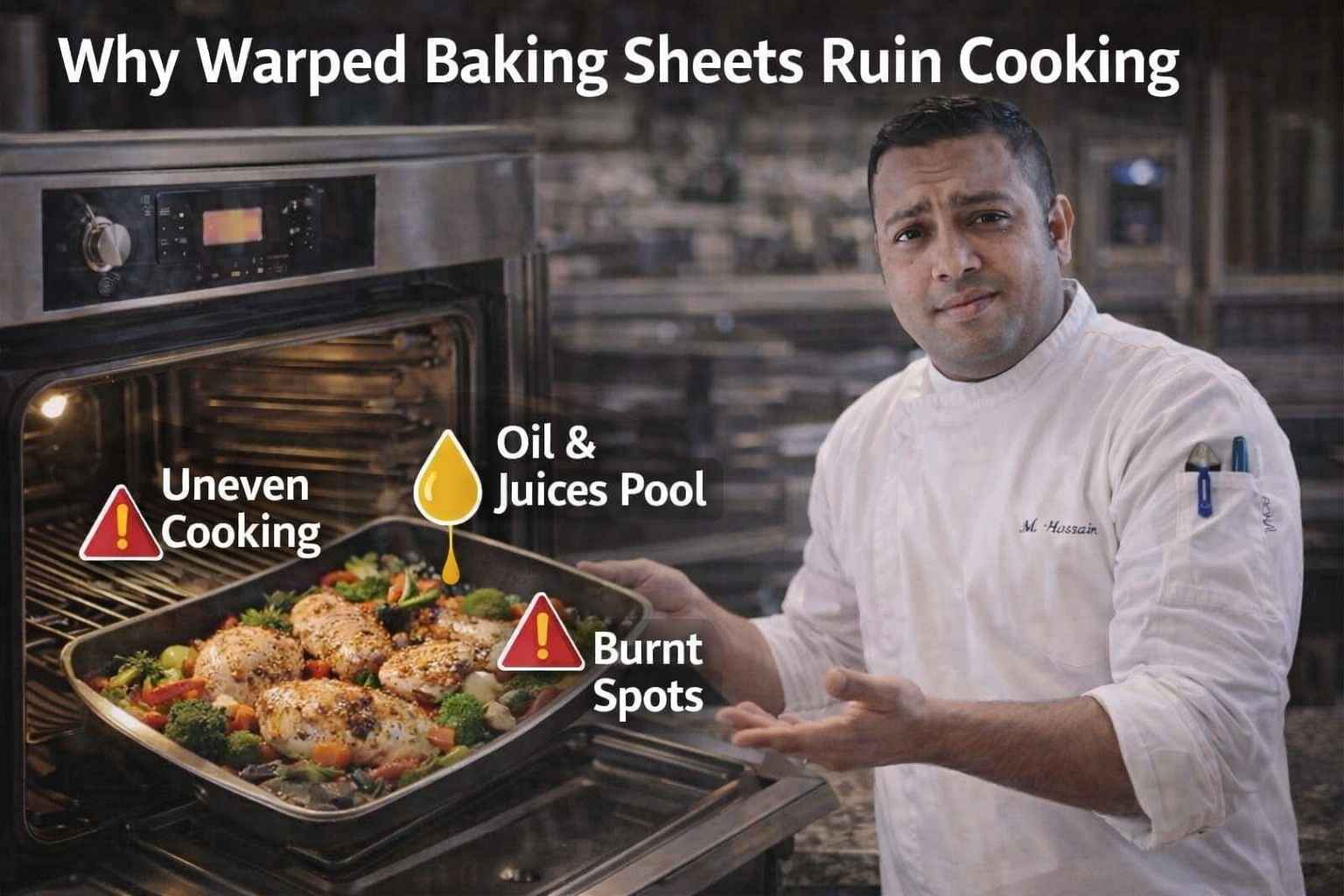
Nothing kills the joy of a perfect meal like that loud “pop” in a hot oven. I have spent years in busy kitchens and know exactly Why Warped Baking Sheets Ruin Cooking by making your food cook unevenly. In this post, I will share how to spot a bad pan before it fails. Check out my Professional’s Guide to Essential Cookware to learn more. Let’s make sure your next tray of roasted veggies stays flat and delicious!
What Actually Causes a Baking Sheet to Warp?
A baking sheet warps because the metal heats unevenly, and metal that heats unevenly expands unevenly. When one part of the pan gets hotter faster than the rest, it pushes and pulls against the cooler metal next to it. That stress bends the sheet. You usually hear it before you see it: a loud pop or bang from inside a hot oven (America’s Test Kitchen, 2022).
I’ve cooked in restaurant kitchens for over 15 years, and I still remember the first time a sheet pan popped so loud my sous chef thought a rack had fallen. It hadn’t. It was just a pan giving up under thermal stress.
Thermal Shock: The Main Trigger
Thermal shock is a sudden, large jump in temperature. Pull a sheet pan straight from the fridge and slide it into a 425°F oven, and you’ve just asked one thin piece of metal to handle a 350-degree jump in seconds. The center of the pan, sitting right over the heating element or closest to the oven fan, heats first. The rim and corners lag behind. That gap in temperature is what bends the metal (Daily Meal, citing America’s Test Kitchen food scientist Steve Dunn, 2023).
Uneven Heat Exposure
Ovens are not uniform boxes of heat. Most home ovens run hotter near the back, near the heating element, or near the fan in a convection model. If your food only covers part of the pan, the bare metal heats faster than the covered metal, and that mismatch is enough to cause a buckle (America’s Test Kitchen, 2022).
Sheet Gauge and Thickness
Gauge is just a number that tells you how thick the metal is. Lower gauge numbers mean thicker metal. A thick, heavy sheet resists warping because it takes more heat, and more time, to create a big temperature gap across it. A thin sheet heats and cools almost instantly, which means small temperature differences turn into visible warps much faster.
Rapid Temperature Changes After Baking
Warping doesn’t only happen going into the oven. Pulling a hot sheet out and rinsing it under cold tap water is one of the fastest ways to warp a pan, because you’re forcing a huge temperature drop in seconds (America’s Test Kitchen, 2022).
The Science of Metal Expansion, in Plain Terms
Metal expands when it heats up and shrinks when it cools down. This is normal. Every baking sheet expands a little every time you use it. The problem isn’t expansion itself. The problem is uneven expansion.
Picture the metal as a grid of tiny sections. When every section heats at the same rate, they all expand together, and the sheet stays flat. When one section heats faster than its neighbor, it tries to expand while the neighbor holds it back. That tug-of-war is thermal stress, and it’s strongest right where the flat base of the pan meets the raised rim, which is exactly where most warps start (Baking Bakewares, 2025).
A well-made pan can absorb this stress and spring back flat once the whole sheet reaches an even temperature again. A thin or low-quality pan can’t. It bends, and sometimes it stays bent.
Why Warping Is Not Just a Cosmetic Problem
A warped sheet does not just look bad sitting in your cabinet. It changes how heat reaches your food, and that changes how your food cooks. Here’s what actually happens on a bent pan.
It Breaks Contact With the Oven Rack
A flat sheet sits evenly on the rack, so hot air moves under it the same way everywhere. A warped sheet rocks or arches, so parts of it sit closer to the rack and parts lift slightly away. The lifted areas get less direct heat, and the food there cooks slower and browns less.
It Tilts the Whole Surface
Once a pan bows, one end sits lower than the other. Anything liquid on that pan, oil, melted butter, pan juices, rolls downhill to the low corner. Meanwhile the high corner runs dry.
It Creates Real Hot Spots
Warping is often a sign that a pan already has thermal inconsistency built into it. A pan that warps easily will keep developing hot and cool zones every time you use it, which means the unevenness compounds bake after bake (Serious Eats-style testing summarized by Stripes & Willows, 2026).
How a Warped Sheet Wrecks Specific Foods
Cookies
Cookies need even, flat contact with the pan to spread and bake at the same rate. On a warped sheet, cookies on the tilted low side spread more and brown faster, because melted butter pools there and the pan sits closer to the heat source. Cookies on the high side stay pale and underbaked. You end up pulling one tray and getting two different batches off it.
Roasted Vegetables
Roasting depends on vegetables sitting in a thin, even layer with good contact to the hot metal. On a warped sheet, oil and released moisture slide to the low corner. Vegetables sitting in that pooled liquid steam instead of roast, so they turn soft and pale instead of caramelized. The vegetables on the high, dry side can scorch before the pooled ones even brown.
Sheet-Pan Dinners
A one-pan chicken-and-vegetable dinner is the worst case for a warped sheet, because you’ve got meat, oil, and vegetables all interacting with tilt at once. Juices from the protein run toward the low corner, drowning whatever vegetables sit there while the far end dries out.
Bacon
Bacon renders a large amount of fat fast. On a flat sheet, that fat spreads thin and the bacon crisps evenly. On a warped sheet, the fat rushes to the low corner and pools, which means bacon sitting in the pool partially fries in deep fat while bacon on the high side crisps normally. You get soggy strips and crisp strips off the same tray, and a pool of hot grease sitting right at the edge, which is its own hazard.
Thin vs. Heavy-Gauge Sheets: Why Cheap Pans Warp Faster
Gauge numbers work backward from what most people expect. A lower number means thicker, stronger metal. A higher number means thinner metal that bends more easily.
Cheap, dollar-store sheet pans are often 22-gauge or thinner. That thin aluminum heats almost instantly, which sounds good, but it also means the temperature swings from center to edge happen faster and harder, so the pan warps sooner. A commercial-grade sheet pan, the kind used in restaurant kitchens, usually runs 18-gauge or lower, sometimes 16-gauge for full sheet pans that see heavy daily use.
My rule of thumb from 15 years of buying pans: if a baking sheet feels light enough to flex with one hand while it’s sitting empty on your counter, it will warp in your oven. A quality sheet pan should feel solid and barely bend at all under hand pressure.
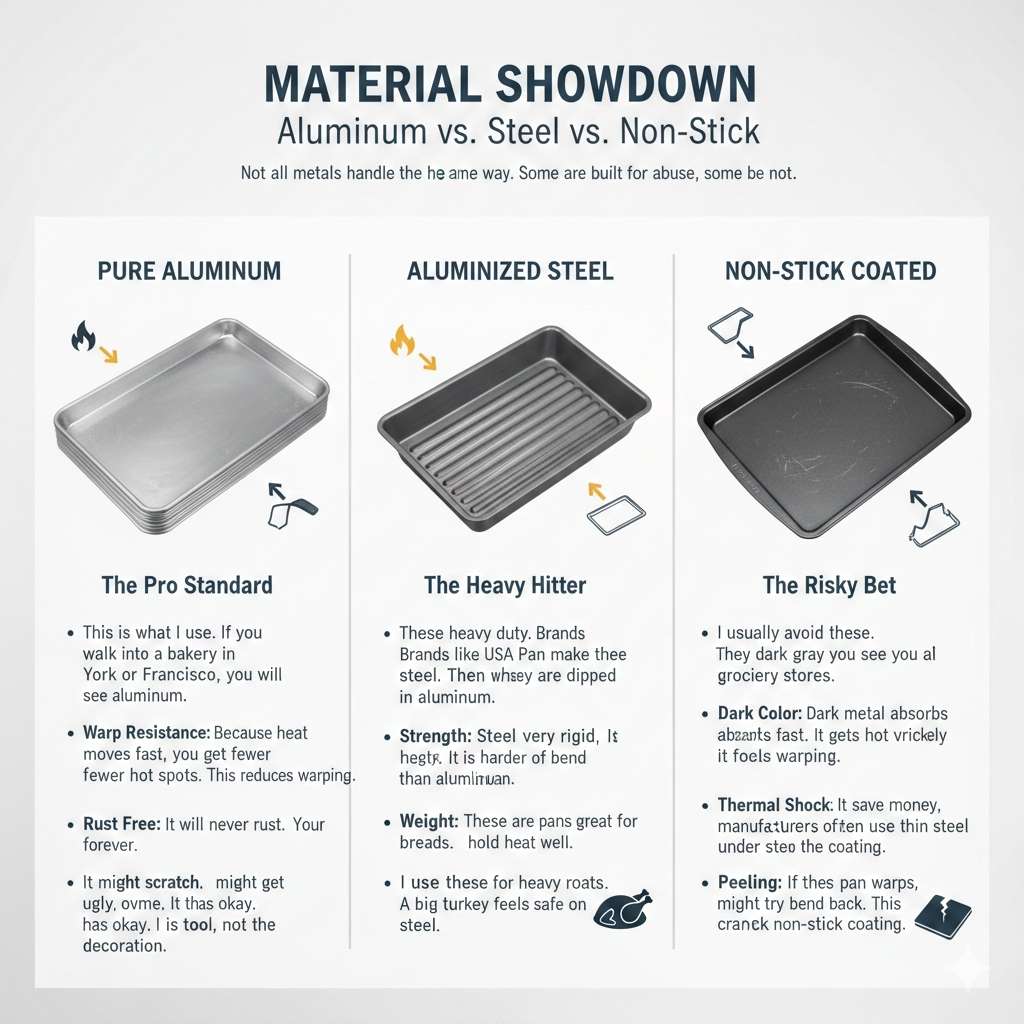
Baking Sheet Material Comparison Table
| Material | Warp Resistance | Heat Conduction | Best Uses |
|---|---|---|---|
| Aluminum (heavy-gauge) | High, if gauge is 18 or lower | Excellent, heats and cools fast | Cookies, pastries, anything needing even browning |
| Aluminized steel | Very high | Good, slightly slower than pure aluminum | Commercial kitchens, sheet-pan dinners, roasting |
| Stainless steel | High | Slower, less even than aluminum | Acidic foods, roasting meat, long oven use |
| Non-stick coated (thin aluminum core) | Low to moderate | Good, but coating can degrade with high heat | Light baking, easy-release foods, occasional use |
Aluminized steel and heavy-gauge aluminum are the two materials I trust most in a working kitchen. Thin non-stick sheets are the ones I see warp within a year of daily use, especially once the coating starts breaking down from high oven temperatures.
The Most Common Warping Mistakes I See in Real Kitchens
Putting a Cold Sheet Straight Into a Hot Oven
This is the single most common cause I’ve watched happen, in professional and home kitchens alike. Line a cookie sheet with dough, park it in the fridge to chill, then slide it directly into a fully preheated oven. That’s a huge, sudden temperature jump concentrated on one piece of thin metal.
Cooling a Hot Sheet Under Cold Water
Pulling a sheet straight from a 425°F oven and running it under the tap to clean it fast is asking for a warp. The shock is just as strong going from hot to cold as it is going from cold to hot (America’s Test Kitchen, 2022).
Uneven Oven Heat
Older ovens, and ovens without convection fans, often run hotter in the back or near the element. If you always place your pan the same way, one section of every pan you own is taking more heat over its lifetime than the rest.
Overcrowding One Side of the Pan
When food only covers half the sheet, the bare half heats faster than the covered half. That gap in temperature is enough to trigger a warp, even in a mid-quality pan (America’s Test Kitchen, 2022).
How to Test a Sheet for Warping
The Flat-Surface Test
Set the sheet upside down on a flat counter or table. Press down gently in the center and at each corner. A flat pan stays still. A warped pan rocks, or one corner lifts while you press the opposite side.
The Wobble Test
Spin the pan slightly on the counter, still upside down. A flat pan sits solid and doesn’t move. A warped pan will rock back and forth or spin slightly on its high points, the same way a wobbly table does.
If a pan fails either test, treat it as warped, even if you can’t see the bend by eye. Small warps are often invisible until you load them with food and watch the liquid run to one side.
Can a Warped Sheet Be Fixed?
Often, yes. Here’s the method America’s Test Kitchen tested and I’ve used myself with good results (America’s Test Kitchen, 2022):
- Heat the empty sheet in a 200°F oven for about 10 minutes, until it’s warm to the touch.
- Lay a towel on a hard, flat surface, like a countertop or concrete floor.
- Place the warm pan upside down on the towel.
- Cover the pan with a second towel to protect the surface.
- Tap gently and evenly with a mallet or rolling pin until the pan lies flat again.
This works because warm metal is slightly more flexible, and gentle, even pressure reverses the same kind of stress that caused the bend in the first place.
When to stop trying and just replace it: if a pan has deep, sharp bends rather than a gentle bow, if it’s warped in more than one spot, or if it keeps returning to the same bent shape after multiple fix attempts, it’s done. Thin metal that’s warped repeatedly has fatigued, and it will keep bending no matter what you do.
How to Prevent Warping
Let pans come to room temperature before they hit a hot oven. If your dough was chilling in the fridge, take the pan out and let it sit five to ten minutes before it goes into a fully preheated oven, if your recipe allows it.
Never rinse a hot pan in cold water. Let it cool on the stovetop or a heatproof surface first. Wash it once it’s near room temperature.
Cover the full pan, or size down. If your food only fills half a sheet, switch to a smaller pan, like a quarter sheet, instead of leaving bare metal exposed to direct heat.
Buy heavy-gauge pans from the start. Spending more upfront on an 18-gauge aluminum or aluminized steel sheet pan saves you from replacing a warped $12 pan every year.
Store pans flat, not stacked at odd angles. Pans stored crooked in a cabinet, wedged against other cookware, can develop a slight permanent bend even without heat involved.
When a Warped Sheet Is Dangerous vs. Just Annoying
Most warping is just annoying. Uneven cookies, pale vegetables, a pan that rocks a little on the counter. That’s a quality problem, not a safety problem.
It becomes dangerous when liquid pools deep enough to overflow. A sheet pan loaded with bacon, sausage, or a fatty roast can release a lot of grease. If that grease pools in one low corner instead of spreading thin across the pan, it can rise high enough to spill over the rim, either onto the oven floor, where it can smoke or catch fire, or onto your hands and forearms when you pull the pan out.
If you notice liquid pooling more than about a quarter-inch deep in one corner, that pan needs to come out, cool, and either get fixed or replaced before you use it again for anything with a lot of rendered fat or liquid.
My Personal Routine for Buying, Testing, and Rotating Baking Sheets
After 15 years of running lines and testing home recipes, here’s exactly what I do.
Buying: I only buy heavy-gauge aluminum or aluminized steel, and I check the listed gauge before I check the price. I skip anything advertised mainly on its non-stick coating, because that coating is usually sitting on thin metal underneath.
Testing before first use: Every new sheet gets the flat-surface test on my counter before it ever touches food. If it rocks out of the box, it goes back.
Rotating: I run two full sheet pans for every one pan a home cook might own, and I alternate them. That way no single pan is taking constant thermal cycling every single day, which extends the life of both.
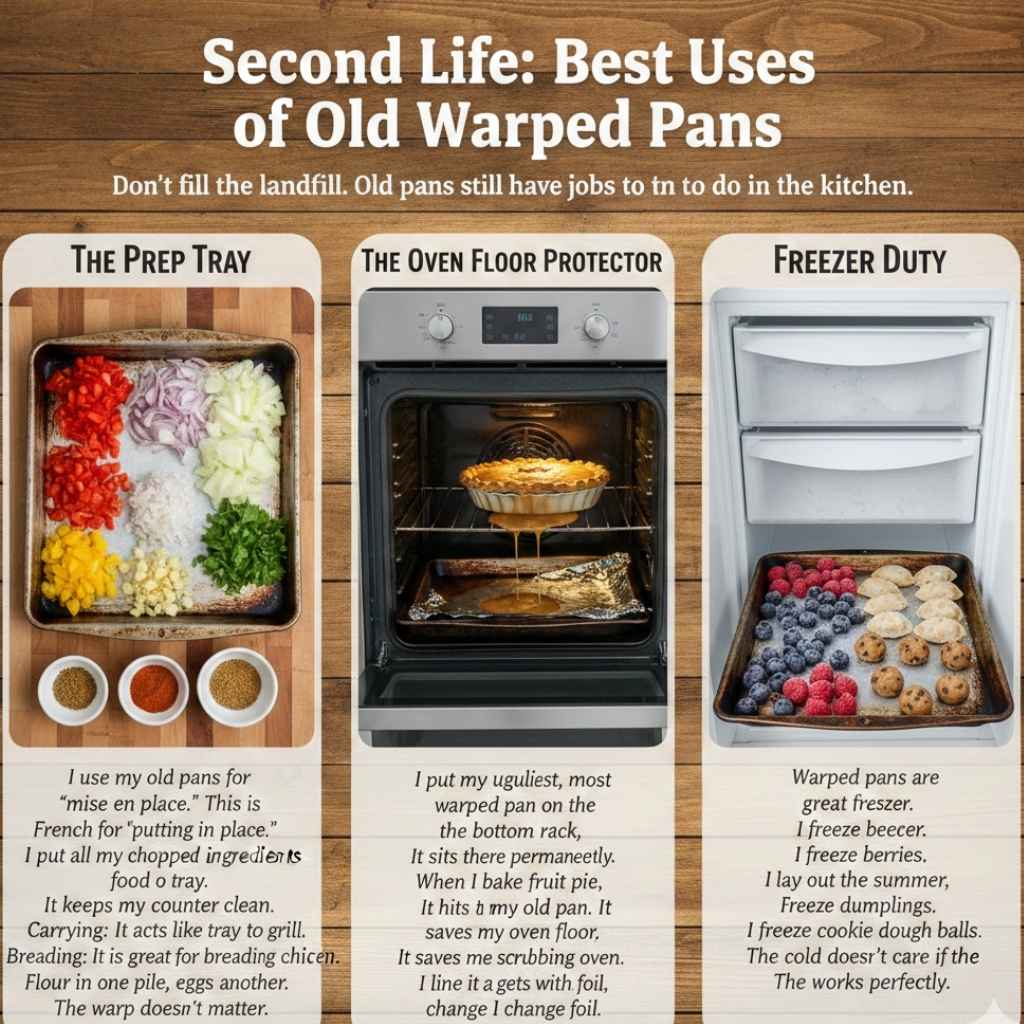
Retiring: Once a pan needs the mallet fix more than twice, I retire it to non-oven use, like organizing pantry items or as a drip tray, and I buy a replacement. A pan that’s fatigued once will fatigue again, usually faster the second time.
Key Takeaways
- Warping comes from uneven heating, most often triggered by thermal shock, thin metal, or bare spots on the pan.
- It’s not cosmetic. A warped pan tilts, so heat and liquid both shift toward one low corner, which throws off browning and cooking time.
- Heavy-gauge aluminum and aluminized steel resist warping far better than thin aluminum or thin non-stick pans.
- Avoid the two biggest triggers: cold pan into a hot oven, and a hot pan under cold water.
- Test with the flat-surface and wobble tests, fix mild warps with gentle heat and a mallet, and replace pans with deep or repeated bends.
Sources referenced:
- America’s Test Kitchen, “Why Do Baking Sheets Warp? And How to Fix Them” (2022):
- America’s Test Kitchen, “The Reason You Shouldn’t Throw Away Your Old Sheet Pan” (2022):
- Nordic Ware, “Why Baking Sheets Warp in the Oven + How to Prevent It” (2025):
- The Daily Meal, “It Only Takes 10 Minutes to Fix a Warped Baking Sheet” (2023):
FAQs: Why Warped Baking Sheets Ruin Cooking
Why do warped baking sheets cause uneven cooking?
A warped pan creates hot spots. Food in the low areas gets too much heat. This leads to burnt edges while the middle stays raw. Consistent flat surfaces ensure your meals cook at the same rate.
Can a warped baking sheet ruin my cookies?
Yes, it can. Dough slides into the low spots of a bent pan. Your cookies will merge into one big mess. Using flat pans keeps your treats the right shape and helps them bake evenly.
Is it safe to use a pan that pops in the oven?
It is usually safe, but it is annoying. That loud pop means the metal is under stress. This sudden movement can spill hot oil or toss food. It is a sign your pan may soon ruin your cooking.
Does pan thickness prevent warping?
Thick pans handle heat better than thin ones. Look for heavy-gauge rimmed sheets to avoid a twist. High-quality metal stays flat. This helps you avoid the common ways warped baking sheets ruin cooking.
How can I fix a bent baking sheet?
You can try to bend it back, but it rarely stays flat. Once the metal warps, it likes to pop back to that shape. Buying a professional-grade pan is the best way to ensure your food cooks perfectly every time.

I’m Mossaraof, a trained chef and the founder of OvenInsights.com. I spent years cooking at Larrupin’ Cafe and in kitchens across Chicago and Seattle. Now I test kitchen gear for a living. I moved to North Acton, London, and I test every tool I write about. I use real meals and real heat. No brand deals. No shortcuts. I cover 12 kitchen types and hundreds of recipes. I believe this: the right tools matter as much as the recipe.