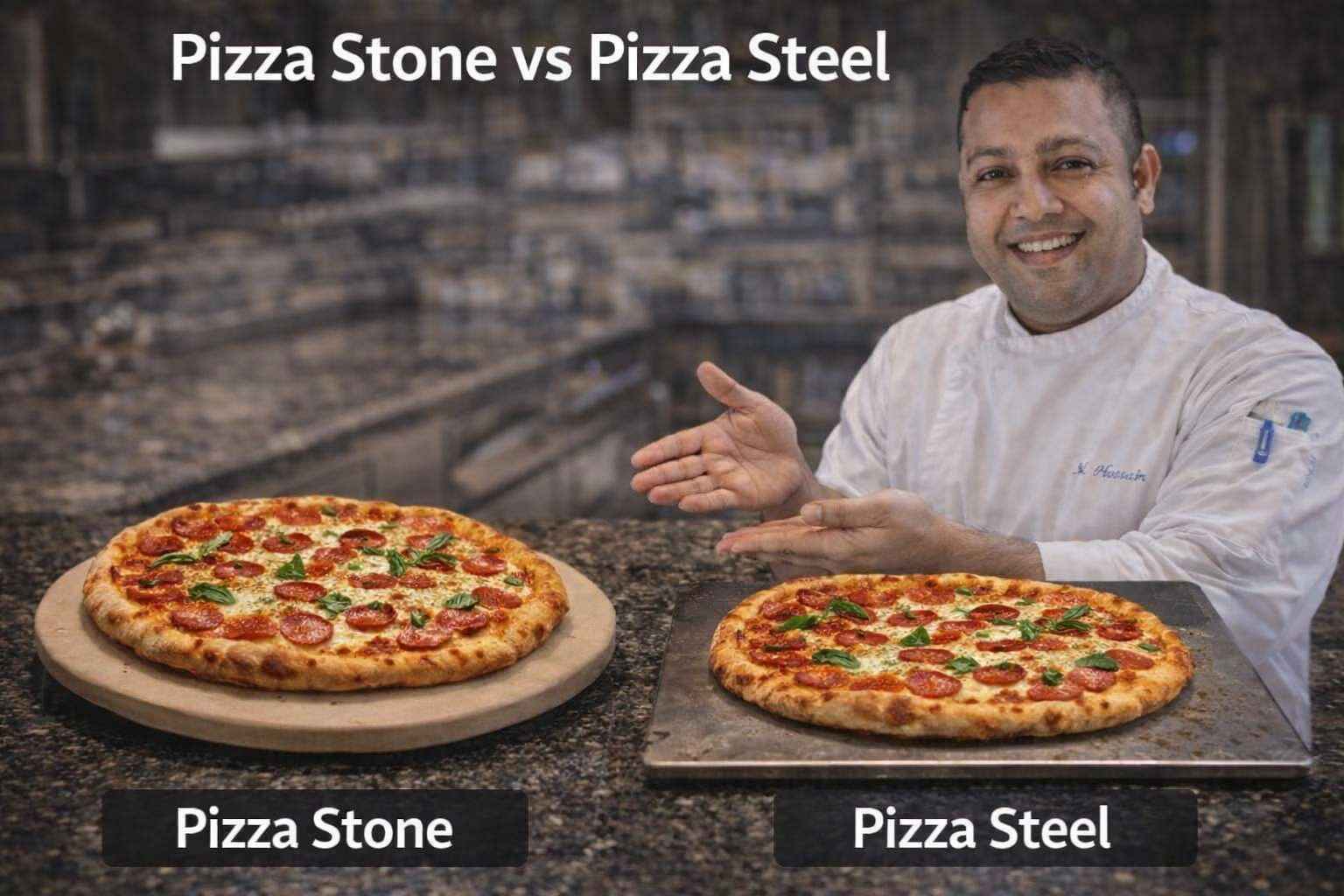
Hi, I’m Mossaraof. Do you dream of a crust that stays crisp and never gets soggy? In my years of baking, I have seen how the choice of Pizza Stone vs Pizza Steel can change your home slice. I will show you which one holds the heat best for that perfect bite. Read my Professional’s Guide to Essential Cookware for more top gear picks. Let’s find out which tool will make your kitchen feel like a real pizza shop!
The Science of Heat: Why Your Oven Needs Help
A standard oven is just a metal box with a heating element. Air moves the heat around. But air is lazy.
Thermal Conductivity Explained
Heat moves at different speeds. Think about touching a piece of wood in the sun. It feels warm.
Now touch a piece of metal in the sun. It burns you.
That is conductivity. The metal shoots heat into your hand fast.
- The Stone: It is like the wood. It releases heat slowly.
- The Steel: It is like the metal. It dumps heat fast.
- The Result: Steel cooks faster.
Your dough needs a shock. The yeast needs heat to rise. We call this “oven spring.”
If the heat is slow, the dough stays flat. If the heat is fast, the dough puffs up.
Thermal Mass and Heat Retention
This is about staying power. When you open the oven door, heat escapes.
The air temp drops. Your tool needs to stay hot.
A heavy tool holds more energy. We call this a “heat battery.”
- Thickness: A thick stone holds a lot.
- Density: Steel is denser than stone.
- Recovery: Steel gets hot again faster.
I learned this during a Super Bowl party. I had to make five pizzas.
By the third pizza, the stone was cool. The crust was pale. The steel kept working.
The Pizza Stone: The Traditional Choice
This is what we all started with. It feels like an old-world baking tool.
Material Composition
Most stones are made of clay or cordierite.
Clay is the old style. It is very fragile. It breaks easily.
Cordierite is a mineral. It is tough. It handles high heat better.
It feels like rough brick. It is porous.
- Pores: It has tiny holes.
- Moisture: It sucks water from the dough.
- Crisp: This creates a dry, crisp bottom.
The Pros of the Stone
I still love my stone for some things. It is gentle.
It mimics a brick oven. It bakes evenly.
It is also cheap. You can find one at Target for $30.
It is light. I can lift it with one hand.
- Cost: Very affordable.
- Weight: Easy to move.
- Texture: Great for bread.
The Cons (The Heartbreak Factor)
I mentioned the “pop” earlier. Stones break.
It is a matter of “when,” not “if.” Thermal shock kills them.
If you put a cold stone in a hot oven, it cracks. If you spill cold sauce on a hot stone, it cracks.
You cannot wash them with soap. The soap gets in the pores. Your next pizza will taste like soap.
- Fragile: One drop and it is gone.
- Stains: Grease creates ugly spots.
- Slow: It takes longer to cook.
The Pizza Steel: The Heavyweight Challenger
This is basically a slab of industrial metal. It feels like a weapon.
Material Composition
This is A36 carbon steel. It is simple stuff.
It is the same steel used in skyscrapers. It is very conductive.
It cooks 15 to 20 times faster than stone. That is a huge number.
- Solid: It is one piece.
- Magnetic: It is pure iron and carbon.
- Tough: You cannot break it.
The Pros of Steel
If you want “leopard spots,” you need steel.
Those are the black charred bubbles on the crust. They taste like smoke and yeast.
My home oven only goes to 550°F. Stone cannot char at that temp. Steel can.
Steel cooks a pizza in 5 minutes. A stone takes 10.
- Speed: Dinner is ready faster.
- Char: Better flavor.
- Durability: It lasts forever.
I could drop this from my roof. It would break the sidewalk. The steel would be fine.
The Cons (The Heavy Lift)
My steel weighs 20 pounds. It is a beast.
Moving it is a workout. You have to be careful.
If you drop it on your toe, you go to the hospital.
It is also expensive. Steel costs money. A good one is $80 or more.
- Weight: Hard to handle.
- Price: An investment.
- Rust: It can rust if wet.
Performance Showdown: The Taste Test
I baked identical dough balls on both surfaces. The results surprised me.
The New York Style Slice
I love a big, foldable slice. It needs a sturdy bottom.
On the stone, it was good. It was crunchy. But it took 12 minutes.
The cheese separated a bit. The oil pooled on top.
On the steel, it took 6 minutes. The bottom was dark brown.
The cheese was still creamy. The crust held its shape.
- Winner: Steel.
- Why: Speed preserves the cheese.
The Neapolitan Attempt
This is the holy grail. Soft, puffy, spotted crust.
True Neapolitan needs 900°F. My oven cannot do that.
On the stone, the crust got hard. It was like a cracker. It dried out too much.
On the steel, I got a massive puff. The dough exploded up.
It was still soft inside. It was 90% close to the real thing.
- Winner: Steel.
- Why: Massive heat transfer.
Frozen Pizza (The Weeknight Reality)
Let’s be real. Sometimes I bake a Digiorno.
I tried it on the steel. It burned. The bottom was black before the middle was hot.
Steel is too aggressive for frozen pizza.
The stone was perfect. It warmed up the crust. It crisped the bottom gently.
- Winner: Stone.
- Why: Gentle heat.
Usability in a Real American Kitchen
We have to live with these tools. How do they fit into daily life?
Preheat Times and Energy Bills
You cannot just turn the oven on and bake. You have to wait.
The tool needs to soak up heat. This is “saturation.”
For a stone, I wait 45 minutes. For steel, I wait an hour.
- Summer: In July, this is hard.
- Heat: The kitchen gets hot.
- Bill: It uses a lot of gas or power.
Steel is faster to recover. If you bake back-to-back, steel wins.
Cleaning and Care
I spilled cheese on my stone last week. It turned black.
I scraped it. But I was scared to chip it. The stain is still there.
Steel is easier. I use a metal scraper. I scrape it hard.
If it gets messy, I scrub it with steel wool. Then I re-season it.
- Seasoning: Like a cast iron pan.
- Oil: Rub oil on it. Bake it.
- Patina: It gets blacker and better over time.
Storage Solutions
I have a small kitchen. I hate clutter.
I leave my stone in the oven. I put it on the bottom rack.
It helps regulate the oven temp. It stops hot spots.
The steel is heavy. I leave it in there too.
But if I need to roast a turkey, I have to move it.
- Warning: Let it cool down.
- ** toes:** Watch your feet.
- Space: It takes up one rack.
Versatility: What Else Can They Do?
I don’t like “unitaskers.” I want my gear to do double duty.
Baking Bread (Sourdough and Baguettes)
I bake sourdough on Sundays. The steel gives a great jump.
But sometimes, it burns the bottom. Bread bakes for 40 minutes.
Steel is too hot for that long. The bottom gets charcoal black.
The stone is better for bread. It is gentle. It gives a nice golden bottom.
- Tip: Put parchment paper under the loaf.
- Steam: Use a pan of water.
- Result: Stone wins for thick loaves.
Cold Applications
You can freeze these tools. It sounds weird, but it works.
I put my stone in the freezer. Then I put it on the table.
I serve cheese and meat on it. It keeps the food cold for an hour.
Steel does not work as well for this. It warms up too fast in the air.
- Serving: Stone looks nice.
- Temp: Keeps sushi cold.
- Look: Rustic vibe.
Factors to Consider Before You Buy
Don’t just buy what looks cool. Think about your specific kitchen.
Your Oven Type
Do you have gas or electric?
Gas ovens vent moisture. They are great for roasting.
Electric ovens hold steam. They are great for baking.
If you have an old oven that only hits 450°F, you need help.
- Low Temp: Buy Steel. It boosts the power.
- High Temp: If you have 550°F, Stone is okay.
- Size: Measure your rack width.
Your Budget
Money matters. A stone is a low risk.
If you break it, you lost $30. It is annoying, but okay.
A steel is an investment. It is $80 to $100.
But you only buy it once. It is a lifetime purchase.
- Short Term: Stone is cheap.
- Long Term: Steel is value.
Family Size
Are you cooking for one? Or a party?
For one pizza, stone is fine. You bake, you eat.
For a party, you need speed. You need recovery time.
Steel is the party king. You can launch pies every 6 minutes.
- Volume: Steel handles crowds.
- Solo: Stone is sufficient.
Brands I Have Used and Trusted
I have bought a lot of junk. Here are the ones that survived my testing.
Top Pizza Stones
Old Stone Oven makes a classic one. It is rectangular.
It fits most racks. It is thick enough.
FibraMent is a pro brand. It is a composite stone.
It is very strong. It has even heat. But it is pricey.
Top Pizza Steels
Baking Steel is the original. It is made in the USA.
It is heavy duty. It is perfectly flat. I love mine.
NerdChef is another good one. They have different thicknesses.
- Thickness: Get 1/4 inch or 3/8 inch.
- Source: Avoid cheap knockoffs.
- DIY: You can buy A36 plate at a metal yard. Clean it well.
Final Verdict: Which One Wins?
If I had to throw one away and keep the other, here is my choice.
The Winner for Beginners
The Pizza Stone.
It is cheap. It improves your pizza 50%.
It is a great start. Learn to manage the heat. Learn to launch the dough.
If it breaks in two years, upgrade then.
The Winner for Obsessive Pizza Geeks
The Pizza Steel.
It is the only way. You need that heat transfer.
It gives you the char. It gives you the puff.
It turns a home oven into a fake wood-fired oven.
My Personal Setup
I actually use both. I am a geek.
I put the steel on the top rack. I put the stone on the bottom.
I bake on the steel. The stone below holds heat.
It creates a hot chamber. The oven temperature stays stable.
This gives me the best of both worlds.
Next Steps
Go look at your oven. Check the max temp.
Measure the rack. See what fits.
Then make a choice. Do you want crunch? Or do you want char?
Go grab some flour. Let’s make some dough. Good luck!
FAQs: Pizza Stone vs Pizza Steel
What is the main difference between a pizza stone and a pizza steel?
The key difference in pizza stone vs pizza steel is heat transfer. A pizza steel gets hotter and cooks pizza faster. A pizza stone heats slower but gives a more even bake.
Does pizza steel cook pizza faster than a pizza stone?
Yes. In the pizza stone vs pizza steel debate, pizza steel cooks faster. Steel holds more heat and sends it to the dough quickly, giving crisp crust in minutes.
Is pizza stone or pizza steel better for crispy crust?
A pizza steel often makes a crispier crust. In pizza stone vs pizza steel, steel transfers heat faster, which helps the bottom cook quickly and brown well.
Which lasts longer: pizza stone or pizza steel?
Pizza steel usually lasts longer. In the pizza stone vs pizza steel choice, stones can crack from heat or drops, while steel is strong and rarely breaks.
Is pizza stone or pizza steel better for beginners?
A pizza stone is often easier for beginners. In pizza stone vs pizza steel, stone is more forgiving and gives steady heat, which helps new pizza makers learn.

I’m Mossaraof, a trained chef and the founder of OvenInsights.com. I spent years cooking at Larrupin’ Cafe and in kitchens across Chicago and Seattle. Now I test kitchen gear for a living. I moved to North Acton, London, and I test every tool I write about. I use real meals and real heat. No brand deals. No shortcuts. I cover 12 kitchen types and hundreds of recipes. I believe this: the right tools matter as much as the recipe.