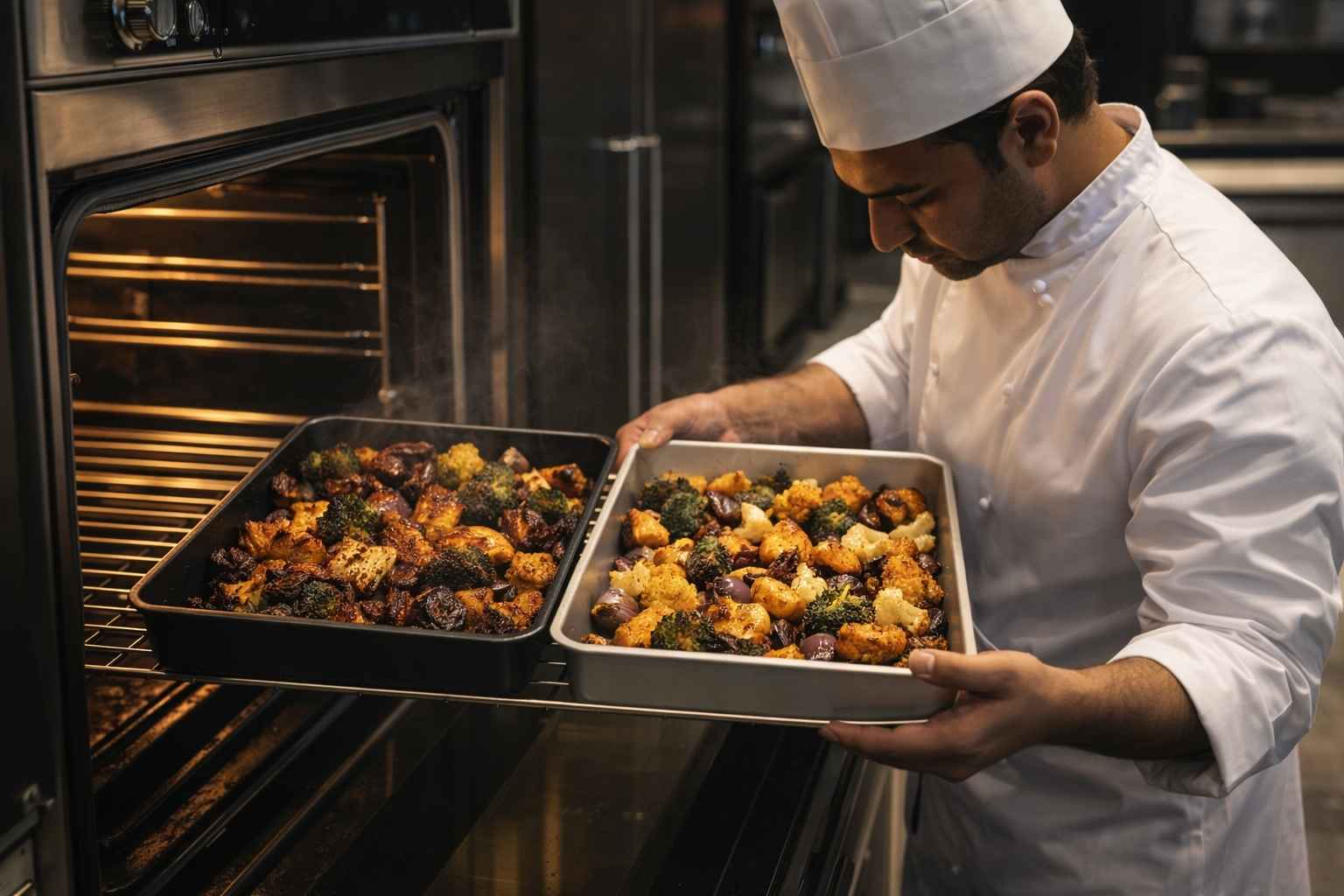
Hi, I’m Mossaraof. Ever ruined a good roast because your pan warped in the high heat? I’ve spent years in busy kitchens and seen which gear actually survives the heat. To save you the heartbreak, I’ve rounded up the Best Pans for Oven Cooking I Actually Trust for my own home meals. You can find more tips in my Professional’s Guide to Essential Cookware. Stick with me to find your new kitchen hero!
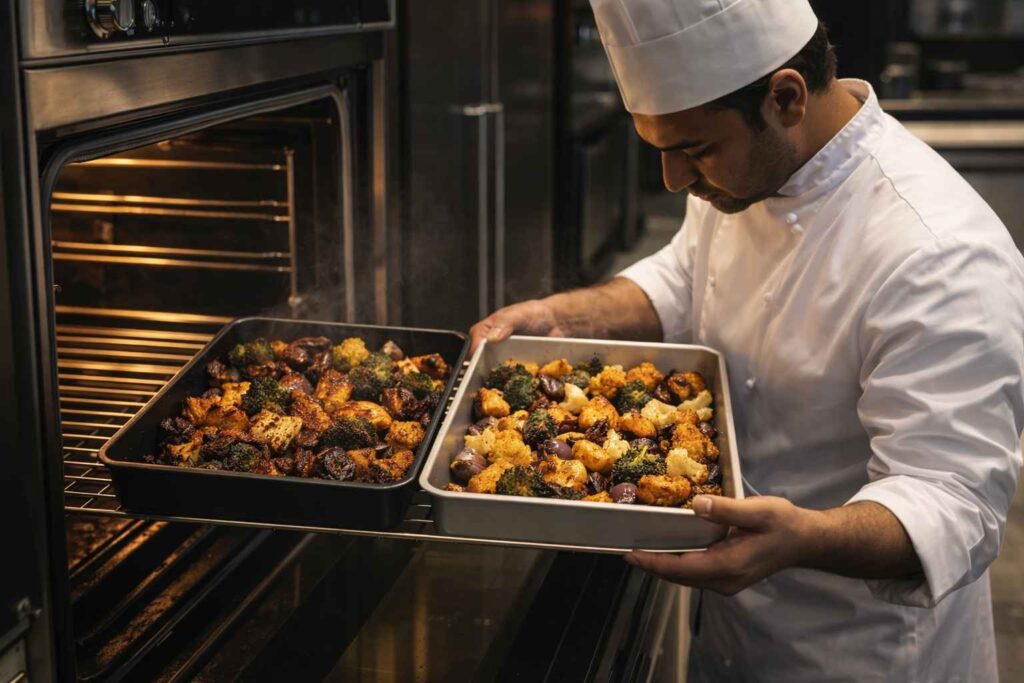
🧱 Material Matters: What Oven-Safe Really Means
Not all oven-safe labels are honest. I’ve seen pans say 400°F-safe and buckle at 375°F.
🛠️ Cast Iron — The King of Oven Cooking
I’ve used my Lodge cast iron skillet in just about every state I’ve cooked in. In my Chicago apartment, I seared steaks before sliding them into the oven—juicy inside, crusty outside. In Arizona, I roasted potatoes with rosemary and garlic till the edges blistered.
- Heavy, solid, nearly indestructible
- Holds heat like a champ, perfect for one-pot meals
- Needs seasoning (I forgot once—big mistake, stuck food everywhere)
- Rusts if left wet—especially in humid climates like Florida
Even better? It goes from oven to table looking rustic and cozy.
💪 Stainless Steel — My Go-To for Sheet Pan Dinners
Stainless steel pans are my backup singers. Not flashy, but always reliable.
When I meal-prepped roasted veggies in bulk during Midwest snowstorms, my Cuisinart roasting pan never flinched. And when I baked salmon with lemon and herbs, cleanup was easier than I expected.
- Doesn’t react with acidic foods
- Safe at high temps (some up to 600°F)
- Handles get blazing hot—always grab a mitt
- Not nonstick, so oil up if you want easy release
If I had to roast on short notice, I’d grab stainless without thinking twice.
🥴 Nonstick — Read the Fine Print
I’ve melted more nonstick pans than I care to admit.
One night in Tampa, I baked meatballs on a cheap pan that claimed to be oven-safe. At 375°F, it started smoking. Turned out the handle was only silicone-coated plastic.
- Great for frittatas and baked eggs—low heat only
- Most max out around 350°F to 400°F
- Coating wears down if you overuse or broil
- Easy to clean but doesn’t last long with frequent oven use
Now I only use nonstick in the oven when I know I’ll stay under 350°F.
🪵 Glass and Ceramic — Pretty but Temperamental
I love the look of glass and ceramic bakeware—especially Emile Henry and Pyrex. But they have quirks.
In winter, I once pulled a ceramic dish straight from the fridge and into a preheated oven. Boom—cracked right down the middle.
- Great for baked pasta, cobblers, and casseroles
- Sudden temp changes = dangerous (glass shatter risk is real)
- Easy to clean, doesn’t react with acidic sauces
- Not ideal for broiling or high-heat roasting
If you use these, bring them to room temp first. Learned that the hard way.
🧡 Aluminum — Lightweight Workhorse with Caveats
Aluminum’s the friend who shows up even if you forgot to invite them.
I’ve used Nordic Ware half sheets for cookies, bacon, and roasted broccoli at least three times a week. They’re light, affordable, and dependable—but not perfect.
- Can warp under high heat (especially under broilers)
- Raw aluminum reacts with lemon juice and tomatoes
- Anodized versions are sturdier and safer
- I line mine with parchment to prevent sticking and browning issues
I’ve warped a few baking sheets at 450°F, but for everyday use, they’re hard to beat.
🔥 Know Your Heat: What Temperatures Your Pans Can Handle
Even if a pan says “oven-safe,” I never trust it until I’ve tested it.
Some manufacturers slap a temp rating on the box, but that doesn’t always match real-life cooking—especially in ovens like my old GE in Florida that ran hotter than it said. I once set it to 400°F and ended up with charred chicken and a melted pan handle.
If you’ve ever smelled burning rubber instead of dinner, you know what I mean.
🕯️ Manufacturer Ratings vs. Real Use
I always look at the temp rating now. But even then, I treat it as a soft cap, not a green light.
Here’s what I’ve learned:
- Cast iron and stainless steel? Usually safe up to 500°F
- Nonstick pans? Many top out at 350–400°F (especially with silicone or plastic parts)
- Ceramic and glass? Varies wildly—check labels and don’t assume
In Arizona, I once preheated my Whirlpool oven to 425°F for a roast. The pan claimed to be safe up to 450°F, but it had a weird lacquered wooden handle. Halfway through the roast, I noticed smoke curling from the edge of the oven door. That was the last time I trusted a wood-handled “oven-safe” skillet.
🔎 Always double-check the handle, too. It’s not just the pan body that matters—handles, lids, and knobs have their own limits.
🌡️ Broiler-Safe? That’s a Whole Different Beast
The broiler is basically a culinary blowtorch. And it doesn’t play nice.
I’ve broiled steaks, crisped cheesy bread, and finished pork ribs under the broiler. But I’ve also ruined pans doing it.
- Cast iron and stainless steel: Yes, with confidence
- Nonstick pans: Never—coatings can bubble or flake
- Glass and ceramic: Avoid completely (risk of cracking or shattering)
- Aluminum sheet pans: Only if they’re heavy-duty and without coatings
One night in my Chicago apartment, I broiled short ribs in a cheap aluminum tray. Big mistake. The pan warped mid-cook, and one rib slid to the side, splashing hot grease into the bottom of the oven. Cue fire alarm.
That’s when I started broiling only with cast iron or my thick stainless roasting pan. They can take the heat—literally.
If your oven has a strong top broiler element (some LG and Samsung models really pack a punch), don’t risk delicate pans. I always use oven mitts, open the door carefully, and keep a close eye—especially with sugar, fat, or cheese involved.
💥 Hidden Dangers in “Oven-Safe” Marketing
Let’s talk fine print.
I’ve bought pans marked oven-safe to 500°F—then noticed a little asterisk on the back of the packaging: “base only.” Turns out, the handle was only safe to 350°F.
Here’s what I always look for now:
- No rubber or silicone inserts
- Metal knobs on lids, not plastic
- No decorative wooden accents (learned that lesson twice)
- Riveted, not screwed handles—screws can loosen from repeated heat cycles
Also: U.S. brand labels are often more conservative in their ratings due to liability. I’ve found that many European or imported pans (especially ceramic ones) list higher temp limits—but they don’t always match U.S. oven quirks.
My advice? Under-promise, over-deliver. I never push a pan to its limit unless I’ve tested it first.
Oven Pan Mistakes I’ve Made (So You Don’t Have To)
This section should probably be called “How I Learned Everything the Hard Way.”
Over the years, I’ve warped pans, cracked dishes, set off smoke alarms, and once even had a lid explode. Some of these were painful. A few were funny in hindsight. But all of them taught me what not to do with oven cookware.
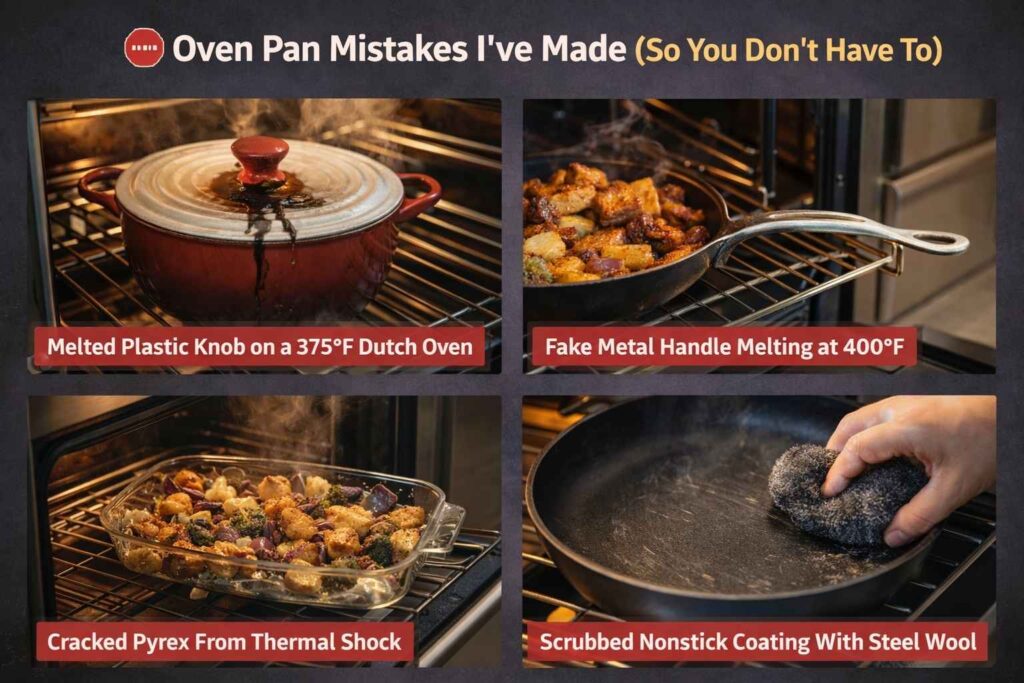
🔥 Putting Non-Oven-Safe Lids or Handles in the Oven
This one bit me more than once.
One Sunday night in Florida, I threw my leftover pot roast into the oven to reheat. The Dutch oven was fine—enameled cast iron. But the lid had a plastic knob I hadn’t noticed. At 375°F, it started to melt. The smell was awful. The food? Saved, barely.
Same thing happened years ago in New York with a skillet that had a fake metal handle—it looked like stainless steel but was just coated plastic. I baked chicken thighs at 400°F. The handle turned soft and droopy like a marshmallow.
Lesson learned:
- Always check the lid knobs, especially on ceramic or Dutch ovens
- If it looks plastic, it probably is—even if it’s shiny
- Metal handles only go in my oven now
💧 Drastic Temperature Swings
This one’s sneaky and seasonal. In winter, I tend to keep leftovers in the garage fridge (coldest spot in my Chicago apartment). One time I pulled a Pyrex dish straight from there and popped it into a preheated 425°F oven.
I barely shut the door before it cracked—pop!—and sent chicken and potatoes sliding across the rack. Not fun.
Sudden temperature changes = thermal shock = broken pans.
To avoid it:
- Let glass and ceramic pans come to room temp first
- Never place a hot pan on a cold granite countertop (I’ve cracked one like that, too)
- Use metal pans for anything going from fridge to oven
This is especially important in colder U.S. climates where room temp might mean 50°F in the winter. I’ve gotten impatient—and paid for it.
🧽 Cleaning Mistakes That Ruin Oven Pans
Let’s talk cleaning—because how you clean pans matters just as much as how you cook with them. I’ve trashed more pans in the sink than in the oven.
Here’s what’s gone wrong for me:
- Soaking cast iron overnight because I was “too tired to scrub”—woke up to rust spots
- Scrubbing nonstick with steel wool—lost half the coating in 10 minutes
- Running stainless through the dishwasher without drying it—ended up with rainbow stains and weird spots
Now I do things differently:
- For cast iron: hot water, soft sponge, kosher salt scrub, re-oil
- For stainless: Barkeeper’s Friend if needed, rinse and dry fully
- For nonstick: warm water, soft cloth, no soaking
Even the best oven-safe pans can lose their edge if you clean them wrong. And nothing ruins a good bake faster than a warped or sticky surface.
🏆 My Favorite Oven-Safe Pans (Tested in Real U.S. Kitchens)
Let’s be honest—half the pans I’ve owned haven’t lasted more than a few years.
Some warped under high heat. Some chipped. Some just didn’t feel right. But the ones that survived my wild Sunday cooking marathons, meal preps during Midwest snowstorms, and weeknight rushes in Florida humidity? These are the real keepers.
🥘 Best Overall — Lodge Cast Iron Skillet
If I had to pick just one oven-safe pan to keep forever, it’s this one.
I’ve baked cornbread in it. I’ve roasted bone-in chicken thighs with lemon and garlic. I even made upside-down pineapple cake in it once—turned out shockingly well.
What I love:
- Solid, American-made, naturally nonstick when seasoned right
- Retains heat beautifully—no hot spots
- Works in any oven (even under broilers)
- Lasts a lifetime if you treat it well
Downsides? It’s heavy. Like, “don’t drop it on your foot” heavy. And in humid states like Florida, you must dry and oil it after washing or it’ll rust in a day.
🥧 Best for Baking — USA Pan Aluminized Steel
Brownies, banana bread, sheet cakes—I use these pans for all my baked goods.
They don’t warp. They don’t stick. They don’t make the edges too dark while leaving the center raw. I love the feel of them—sturdy but not too heavy.
Why I keep reaching for them:
- Corrugated surface helps with airflow and even baking
- Silicone-based nonstick coating (no Teflon)
- Oven-safe to 450°F
- Made in the USA
I’ve used them in both electric and gas ovens—no weird smells, no coating flaking off. I did accidentally leave one soaking overnight and noticed a little edge rust. My bad.
🍲 Best for Casseroles — Staub Enamel Dutch Oven
This one feels like a splurge, but I use it constantly.
When I make braised short ribs in the oven—or any low-and-slow Sunday roast—this is what I use. The heavy lid keeps moisture in, and the enamel coating makes cleanup easy.
Here’s what I love:
- Enamel-coated cast iron (no need to season)
- Keeps heat and moisture locked in
- Oven-safe to 500°F
- Gorgeous enough to go from oven to table
It’s expensive, sure. But I’ve had mine for 7 years, and it still looks brand new. I did chip the enamel once by dropping the lid—so be careful on tile floors.
🍗 Best Sheet Pan — Nordic Ware Naturals
This is my weekday workhorse. I roast veggies, salmon, chicken thighs, even heat up leftover pizza on it.
They’re lightweight, reliable, and easy to clean. I keep two on rotation and use them more than any other item in my kitchen.
Why they work:
- Pure aluminum = fast, even heat
- Won’t rust
- Doesn’t buckle easily (though I did warp one under the broiler—my fault)
- Affordable and made in the USA
I always line mine with parchment paper or a silicone baking mat. Makes cleanup faster and prevents browning spots.
🧂 How Cooking Habits Change What “Best” Really Means
The truth? “Best” is personal. It depends on how often you cook, what you cook, and where you live.
I’ve gone through seasons in life where I cooked full meals daily, and others where I barely touched the oven for a week. Each stage needed different pans—and I learned that the hard way when I overbought for a lifestyle I didn’t have.
👨👩👧👦 Family Meals vs. Solo Cooking
When I was cooking for a full table—Sunday roasts, casseroles, big breakfasts—I relied on larger, deeper pans. My Staub Dutch oven was my MVP.
But in Arizona, where I live alone now, I cook smaller meals more often. That changed everything.
What I use now for solo cooking:
- Quarter sheet pans (Nordic Ware makes a great one)
- 8×8 baking dishes for quick lasagna or brownies
- Mini cast iron skillets—perfect for single-portion bakes
What I used for family-style meals:
- Full-size cast iron skillet (Lodge 12″)
- Deep ceramic casserole pans
- Large stainless roasting pan with rack (for turkey, brisket, pork shoulder)
The size of your meal matters. If I bake just two salmon fillets, I don’t need a big roasting pan—it dries them out. A smaller, tighter pan keeps the juices in.
🍞 Baking vs. Roasting vs. Broiling
Each type of cooking asks for a different kind of pan. I’ve learned this the smoky way.
In Chicago winters, I baked a lot—banana bread, lasagna, cobblers. Now in Arizona, I roast more (faster, lighter, less moisture). And when I need crisp or char? That’s where the broiler tests my gear.
My setup now looks like this:
- For baking: USA Pan steel bakeware, glass loaf pans
- For roasting: cast iron skillet or ceramic baking dish
- For broiling: thick stainless steel pans or bare cast iron only
A few times, I tried broiling chicken wings in a nonstick sheet pan. The coating started to bubble, and the smell was awful. That’s when I labeled that pan “bake only.”
If you do a lot of broiling, skip the fancy pans—go for rugged, heavy, and uncoated.
🌎 Where You Live Affects What Works
Regional climate plays a bigger role than I used to think.
In Florida, humidity ruined my cast iron twice before I figured out I had to oil it after every wash—even if I wasn’t cooking again for a week. I kept a tiny bottle of grapeseed oil next to the sink just for that.
In Illinois, cold winters meant glass bakeware cracked more easily. I once shattered a Pyrex dish just by rinsing it under cold water too soon. My bad.
In Arizona, the dry heat makes oven preheat times shorter, and things crisp faster. I lean into enamel and stainless now because they don’t rust and heat evenly.
Here’s what I’ve found:
- Humid climates: Avoid bare cast iron unless you’re diligent
- Cold areas: Be gentle with glass and ceramic (let them warm up first)
- Dry heat: Stainless and enamel-coated pans shine
Where you live isn’t just background—it changes how your pans behave, how long they last, and how they feel in your hands.
🧤 Handle This: What to Know About Pan Handles
I used to ignore handles. If the pan was oven-safe, I assumed the handle was too. I learned the hard way—that’s not always true.
From scorched silicone to surprise meltdowns, I’ve made all the handle mistakes. And when you’re pulling a 425°F dish from a steamy oven, that’s not when you want to guess.
🪵 Stay-Cool Handles Are Mostly a Myth
Let’s bust this one: no handle stays cool in a hot oven.
“Stay-cool” only means it won’t get hot on the stovetop. Once it’s inside an oven, everything heats up. I once grabbed a skillet barehanded after 30 minutes at 375°F. The burn had ridges from the metal.
Even silicone handles? They can melt—especially if your oven’s running hot or uneven. I had one disintegrate at the edge where it touched the rack.
What I trust now:
- Solid stainless steel handles
- Cast iron handles (tough and heat-tolerant, but need mitts)
- Silicone sleeves I can remove before oven use
My rule now: never bare-hand any handle coming out of the oven. No matter what the label says.
💥 Riveted vs. Welded vs. Screwed
The construction of the handle matters more than I thought.
Years ago, I bought a cheap roasting pan with screwed-on handles. During Thanksgiving dinner (classic), the right handle loosened mid-lift. Turkey almost went airborne. I caught it—barely. But the stuffing was a goner.
Here’s what I’ve learned from using dozens of pans:
- Riveted handles (like on All-Clad or Cuisinart): strong, durable, secure
- Welded handles: often smooth but can snap under heavy weight
- Screwed-on handles: loosen over time with oven use, especially under load
For heavy-duty pans—roasters, cast iron, or full casseroles—I always go for rivets. I’ve had zero issues since switching.
If I hear a rattle when I lift a pan? That one’s retired from oven duty immediately.
🧽 Cleaning Oven-Safe Pans Without Ruining Them
The meal’s over. The kitchen smells amazing. The sink? A war zone.
Cleaning oven pans is where I’ve made some of my worst mistakes. And it wasn’t out of laziness—it was because I didn’t know better.
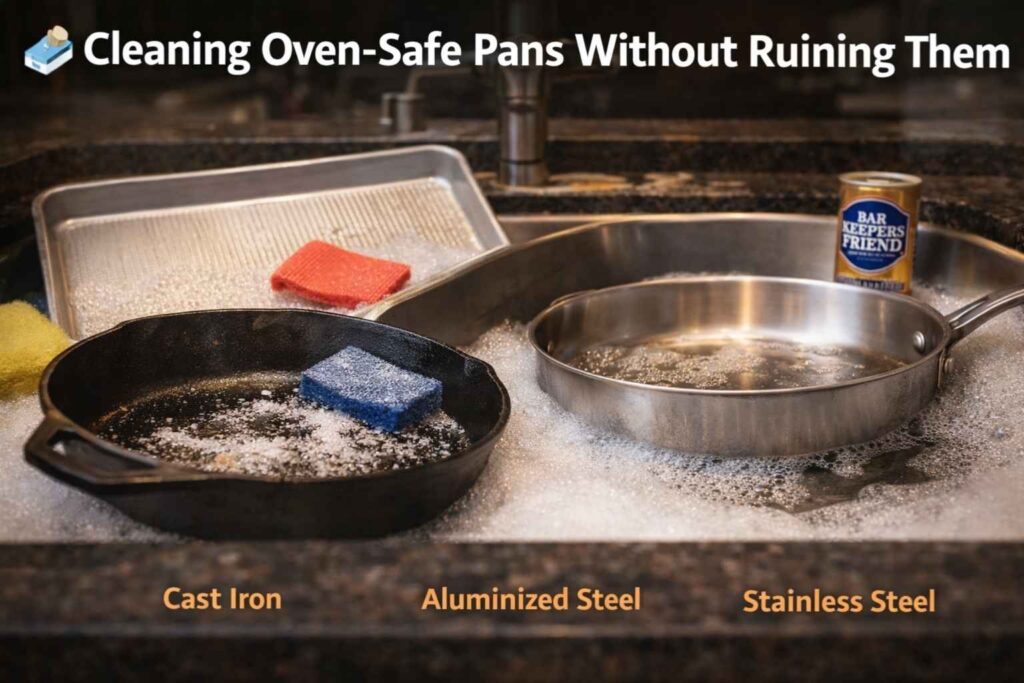
Some pans need tough love. Others need a gentle touch. I learned which is which the hard way.
🧼 What Works for Cast Iron
Cast iron is my favorite pan to cook in—and the easiest to ruin during cleanup.
Early on, I thought I had to scrub it clean like a regular pan. Big mistake. I stripped the seasoning clean off a perfectly broken-in skillet using soap and a scrubby pad. Took me weeks to get it back to how it was.
Here’s my cast iron cleaning ritual now:
- Never use soap. Ever.
- Let it cool slightly, then rinse with warm water
- Use coarse kosher salt and a rag or sponge to scrub
- Dry completely—heat it briefly on the burner if needed
- Wipe a thin layer of oil inside and out before storing
I re-season mine monthly—especially in Florida, where humidity messes with the seasoning if I skip a week.
🧼 Stainless and Aluminum Care
Stainless pans look tough, but they show every mistake.
I used to leave them soaking in the sink overnight. That left cloudy spots and rainbow stains I couldn’t scrub off.
Now I do this:
- Rinse right after use (don’t let stuff crust on)
- Use Barkeeper’s Friend or baking soda paste for stubborn spots
- Rinse and dry immediately with a towel
For aluminum sheet pans, I skip the harsh cleaners. A soft sponge and warm water do the trick. Over-scrubbing ruins the finish and leads to sticking.
Bonus tip: I line my baking sheets with parchment paper or a silicone mat now. Cuts cleanup in half and keeps them looking new.
🧼 Dishwasher or No?
Ah, the dishwasher debate. I’ve had this argument in more than one rental kitchen.
Here’s my stance, after years of melted handles and dulled finishes:
- Nonstick: Never. The coating breaks down fast.
- Cast iron: Absolutely not. Strips seasoning and invites rust.
- Stainless steel: Yes, but only if I dry it right away.
- Enamel-coated (like Staub): Safe, but I still hand wash to protect the shine.
I get the temptation—dishwashers are convenient. But every time I’ve thrown in the wrong pan, I’ve regretted it.
Now, I do a quick soak, wipe-down, and dry. It adds five minutes to cleanup but saves years of use.
🛍️ Oven-Safe Pan Shopping Tips (What I Look For Personally)
Pan shopping isn’t as simple as reading the box. If it were, I wouldn’t have a cabinet full of regrets.
Now, I shop with a checklist in my head. Not just oven temperature—handle material, weight, finish, and even how the pan feels in my hands.
🛒 Look Beyond the Packaging
The biggest lesson? “Oven-safe” means nothing if the details don’t add up.
I once bought a baking dish that said safe to 500°F. The fine print? That was just the base. The lid had a plastic knob and the handles were painted wood.
Here’s what I inspect now before buying:
- What’s the maximum temp rating, and is it for all parts?
- Is the handle metal, silicone, or something suspicious?
- If there’s a lid, what’s the knob made of?
- Does the brand have a rep for accurate labeling? (I trust Lodge, Staub, USA Pan, Nordic Ware)
If I’m shopping in person, I flip it over. If I’m online, I zoom in on user reviews—especially the ones with photos and disasters.
🛒 Check Temp Ratings Carefully
Even now, I see brands push the limits. Some nonstick pans say 450°F safe, but reviewers report peeling at 400°F.
My rule of thumb:
- 450°F or higher for roasting, baking, and all-purpose use
- 500°F+ only for broiling or high-heat searing
- Skip pans that cap at 350°F unless you only bake soft stuff (cakes, custards, low-temp frittatas)
I once ruined a pricey nonstick pan by roasting butternut squash at 425°F. The coating bubbled and flaked like burnt paint.
If a pan can’t survive at least 400°F, I don’t buy it—no matter how nice it looks.
🛒 Feel the Weight and Balance
This one’s more personal, but I can’t ignore it. Some pans are awkward. They might be safe, but they don’t feel good in my hands.
I test for:
- Even weight—not too front- or back-heavy
- A secure handle—especially when the pan’s full
- A size that fits my oven without crowding
Heavy doesn’t always mean better. I cracked a tile once dropping a full Staub Dutch oven. I love it, but it’s not ideal for folks with wrist issues or small ovens.
For everyday use, I like pans that feel sturdy but don’t make me grunt when I lift them with one hand.
🔁 Pans I Regret Using in the Oven
Even after years of cooking professionally, I’ve still picked some real losers.
Some were impulse buys. Some came from well-meaning family. Some just looked cool. And all of them taught me exactly what not to put in the oven.
🙈 Cheap Nonstick with Plastic Handles
This is the one I see everywhere—big box store specials with a glossy black nonstick surface and molded plastic handles.
I had one I used to reheat frozen fries on a lazy Friday night in Florida. The fries came out fine. The handle? Not so much. It melted just enough to sag sideways—and left a smoky smell that took two days to clear.
Another time, I used one to bake a pan of meatballs at 400°F. The coating bubbled and flaked, sticking to the bottom of every single meatball. I tossed both the pan and the batch.
Never again. If the handle isn’t oven-safe to at least 400°F—and the coating isn’t up for real heat—it stays out of my cart.
🙈 Glass Lids That Claimed “Oven-Safe”
This one still annoys me. I bought a beautiful ceramic baking dish with a glass lid. It said oven-safe to 425°F.
Keyword: “said.”
I made a chicken and rice bake on a chilly Midwest night. About 20 minutes in, I heard the crack. I opened the oven and the lid had spiderwebbed across—completely shattered but still mostly intact. Rice was ruined.
The label said “tempered glass,” but I’ve learned that doesn’t mean shock-resistant. Now I only use bare metal lids or leave the lid off entirely if I’m not 100% sure.
🙈 “Decorative” Ceramic Pans from Discount Stores
They look adorable. The kind you’d put on the Thanksgiving table and hope someone compliments.
But the two I bought couldn’t handle even 375°F. One developed a crack on the first use. The second one chipped at the corner when I set it on a wire rack fresh from the oven.
Cute doesn’t equal capable. These days, I stick to brands I know and trust—especially for ceramics. (Emile Henry and CorningWare have served me well.)
🧠 Final Thoughts on Choosing the Best Pans for Oven Cooking
At this point, I’ve cooked in a dozen U.S. kitchens—from a cramped electric oven in my sister’s New York apartment to a wide gas beast in my Arizona home.
I’ve scorched pans, cracked dishes, burned hands, and dropped more than one tray of food onto the kitchen floor. (There was a three-layer lasagna incident I still don’t talk about.)
But all of that helped me figure out what really matters in an oven-safe pan.
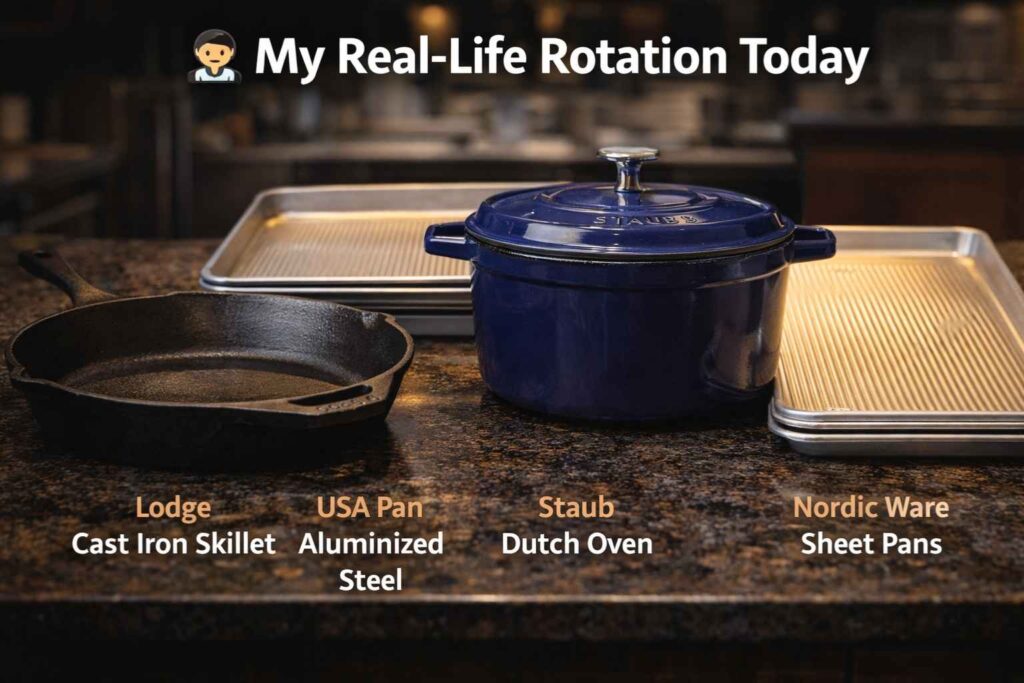
🧑🍳 My Real-Life Rotation Today
These days, I don’t reach for the fanciest or the trendiest. I reach for what works:
- Lodge cast iron skillet: for crisp roasts, cornbread, searing
- USA Pan aluminized steel pans: for baked goods that don’t stick
- Staub Dutch oven: for anything low and slow
- Nordic Ware sheet pans: for daily roasting, baking, even reheating
And when I shop for something new, I ask myself:
- Will it survive my oven, my habits, and my sloppy cleaning days?
- Is it built to handle 425°F without flinching?
- Does it feel solid in my hands—without needing a gym membership?
- Will it last long enough to justify the space it takes in my cabinet?
🤔 What “Best” Really Means in Practice
The best pans for oven cooking aren’t just the ones with the highest temp rating. They’re the ones that make your cooking easier—not harder.
They:
- Handle heat honestly, without warping or melting
- Fit your oven and your lifestyle
- Clean up without a battle
- Don’t surprise you in the middle of a busy weeknight dinner
They’re not perfect. Some scratch. Some discolor. Some get better with age—like that cast iron I nearly gave up on, and now won’t cook without.
If you’re starting your oven pan journey, I hope this helped you skip the trial and error (or at least dodge a few smoking handles and shattered lids).
And if you’ve already got your favorites? Hang onto them tight. A good oven-safe pan is a kitchen relationship worth keeping.
FAQs: Best Pans for Oven Cooking
What are the best pans for oven cooking at home?
The best pans for oven cooking are cast iron, stainless steel, and ceramic. They handle high heat well and cook food evenly without warping or burning.
Can I use regular frying pans in the oven?
Some frying pans are oven-safe, but only if the handle is metal. Always check the pan label before oven cooking to avoid damage or safety issues.
Are nonstick pans safe for oven cooking?
Most nonstick pans are safe only up to 400°F. For higher heat, the best pans for oven cooking are cast iron or stainless steel instead.
Which pan material works best for even oven cooking?
Cast iron works best for even oven cooking because it holds heat well. It’s ideal for roasting, baking, and slow oven meals.
Do oven-safe pans affect cooking time or results?
Yes, oven-safe pans affect results. Heavy pans cook slower but more evenly, while thin pans heat fast and may cause uneven browning.

I’m Mossaraof, a trained chef and the founder of OvenInsights.com. I spent years cooking at Larrupin’ Cafe and in kitchens across Chicago and Seattle. Now I test kitchen gear for a living. I moved to North Acton, London, and I test every tool I write about. I use real meals and real heat. No brand deals. No shortcuts. I cover 12 kitchen types and hundreds of recipes. I believe this: the right tools matter as much as the recipe.