At A Glance
- Children as young as 4 can safely help in the kitchen – the key is matching the task to the child’s age and motor skills, not waiting until they’re “old enough.”
- The oven door can reach 300°F (149°C) on the outside during normal baking – this is the burn hazard most parents never think about (American Burn Association, 2024).
- Gas ovens respond faster to temperature changes but electric ovens run more consistently – for teaching, electric wins.
- Set up the environment before the oven turns on: position, clothing, tools, and rules all go first.
- A calm, specific response plan for burns and smoke – not panic – is the skill every child needs alongside how to bake.
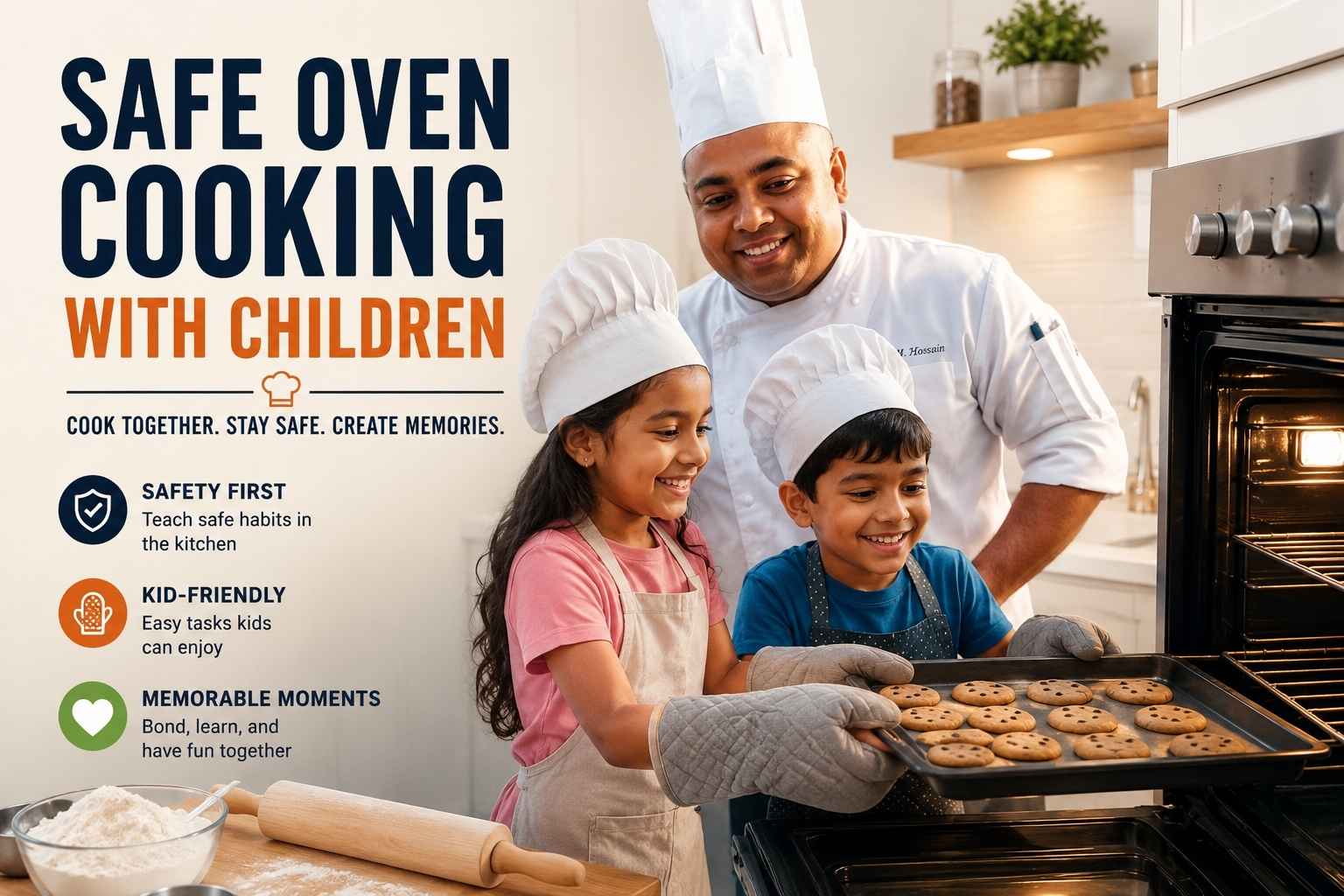
My daughter almost grabbed a hot pan last week. My heart stopped for a second, and that’s when I knew I had to get serious about safe oven cooking with children. I’ve been in kitchens my whole career, but cooking with kids around is a whole different game. Today, I’ll share the simple rules that keep my own kitchen safe and fun. Grab a cup of coffee, and let’s make your oven time worry-free too.
Why Cooking with Kids Is Worth the Mess
Teaching a child to cook is one of the highest-value things you can do with them. I don’t say that lightly. I’ve spent 15 years in professional kitchens – from hotel banquets to restaurant lines to private dining – and the last five years of that running cooking classes for families. The kids who learn to cook early show up differently. They’re more confident around food. They read recipes like instruction sets. They estimate quantities without a second thought. They understand why vegetables need salt.
The research backs this up. Children who cook regularly at home are more likely to eat a varied diet and maintain healthy eating habits into adulthood (Family Meals Study, USDA, 2023). Cooking also teaches fractions, timing, measurement, and cause-and-effect in a way that sticks because it’s tied to something they want to eat.
But none of that matters if a child burns their hand or panics around heat. So before we get to technique, we get to safety – and I mean real safety, not the generic “supervise your child” advice that tells you nothing.
The Real Oven Dangers Parents Underestimate
Most parents worry about the wrong things. They picture their child pulling a hot dish off the rack and dropping it. That does happen. But the burns I see most in my classes – and in burn center data – come from three places parents rarely think about.
The oven door glass. During a 375°F (190°C) bake, the outer glass of a standard oven door reaches 150-200°F (65-93°C). A child who steadies themselves against it while peering inside gets a palm burn in under a second. I’ve seen it happen twice in my own classes. The fix is simple: never let a child touch the door glass. But you have to tell them explicitly, because they don’t know the glass is hot just by looking at it.
Steam when opening the door. When you open a hot oven, a burst of steam exits first – before the dry heat hits you. Adults learn to turn their face away instinctively. Children don’t know to do this. Teach it as a step, not an afterthought: crack the door, wait two seconds, then open fully.
Rack position. A child pulling a heavy dish off a lower rack must bend forward over the door, which is now a 300°F obstacle at chest height. If the dish tips, the instinct is to catch it by grabbing whatever is closest – which is often the door or the rack itself. Always pull racks out before lifting, and always position a second adult or the chef-teacher at the oven when a child handles hot dishes.
Other hazards that deserve attention:
- Oven mitts that are too large slip off mid-transfer
- Silicone grips that look heat-safe but aren’t rated for oven temperatures
- Loose sleeves catching on rack edges
- Long hair hanging forward over an open oven
Child Readiness by Age: What Kids Can Safely Do at the Oven
This table is based on developmental benchmarks from the American Academy of Pediatrics (AAP, 2024) combined with what I’ve observed teaching hundreds of children across five years of classes. Use it as a guide, not a rule – some 8-year-olds have the fine motor skills of a 10-year-old, and vice versa.
| Age Range | Appropriate Oven Tasks | Supervision Level | No-Go Zones |
|---|---|---|---|
| 4-6 | Watching through the oven window, pressing the timer button, helping carry (cool) baking sheets to the counter | Parent handles all oven interaction; child stays 3 feet back | No contact with oven door, racks, or dishes |
| 7-9 | Placing a pan on a rack that’s been pulled OUT by an adult, learning to use oven mitts with help, reading the oven light to know when it’s preheated | Adult in arm’s reach at all times | No solo oven door opening, no transferring hot dishes |
| 10-12 | Opening oven door with supervision, placing and removing pans from middle rack with proper mitts, checking doneness with a toothpick or thermometer | Adult present in kitchen, watching actively | No reaching into back of oven, no handling liquids in hot pans (casseroles, braises) |
| 13-14 | Supervised solo baking, adjusting rack positions before preheating, using an instant-read thermometer on hot dishes, basic troubleshooting (oven too hot, underbaked) | Adult nearby, available to step in | No leaving the kitchen while something is in the oven; no frying or open-flame tasks without specific training |
The “graduation model” I use in my classes works on trust built over time. A child doesn’t move to the next stage because they hit a birthday – they move when they can explain why a rule exists, not just what it is.
How to Set Up a Safe Kitchen Before the Oven Turns On
Safe oven cooking with children starts 15 minutes before the oven is even on. Setup is not optional. This is the step most home cooks skip, and it’s where most accidents originate.
Positioning. Before preheating, set up a stable step stool if your child needs one to see the counter. The stool should have a non-slip base and be wide enough that they can stand squarely without twisting. Never let a child stand on a chair – the legs shift.
Clothing. Sleeves must be short or rolled tightly above the elbow. I keep a small supply of hair elastics in my teaching kitchen and use them to roll up loose cuffs. No flowing fabric near an oven – this applies to adults too. If a child is wearing a hoodie, they change or put on an apron. Long hair gets tied back before the oven goes on.
Footwear. Closed-toe shoes only. Dropped pans, spilled liquids, broken dishes – all of these land on feet. Socks on a kitchen floor are a slip hazard.
Tools positioned in advance. Set the oven mitts, a flat trivet, and the baking sheet in specific spots before any heat is involved. A child who knows where everything lives doesn’t have to search for the trivet while holding a hot pan.
The briefing. I always do a one-minute verbal briefing with child students before we turn the oven on. It covers: where to stand, what not to touch, what to do if something drops, and who to call if something seems wrong. Kids take this seriously when you treat it like a real briefing and not a lecture.
Gas vs. Electric Ovens: Which Is Safer Around Children?
For teaching children to cook, electric ovens are safer and easier to manage. Here’s why.
Gas ovens have an open flame in the broiler drawer or bottom of the oven cavity. That flame ignites with a click that some children find alarming, and on older models, the ignition can take several attempts – meaning gas is present in the cavity briefly before it lights. Electric ovens have no open flame, no ignition process, and no gas supply to manage.
Electric ovens also hold temperature more consistently. Gas ovens run hot near the back and cooler near the door, which means rack positioning matters more and results are less predictable. For a child learning to bake, a consistent oven means more successful results – and successful results build confidence.
That said, if you have a gas oven at home, it’s entirely workable. The key additions:
- Always turn the oven on yourself and confirm ignition before a child approaches
- Teach the child to listen for the click-ignition sound and understand what it means
- Keep the area around the broiler drawer clear
According to the National Fire Protection Association, cooking fires are the leading cause of home fires and injuries, and they are most common when someone leaves the kitchen during cooking (NFPA, 2024). That rule – never leave the kitchen while the oven is on with a child present – applies to all oven types.
Teaching Kids to Read Oven Temperatures and Understand Preheating
Children grasp oven temperature better when you connect it to something real. I tell my students that 325°F (163°C) is a “patient oven” – it cooks gently and slowly. 425°F (218°C) is an “urgent oven” – it browns fast and you have to watch it. This gives them a mental model for why temperature matters, not just which numbers to hit.
How to teach preheating safely:
- Have the child watch you set the temperature. Say the number out loud: “We’re setting 375 degrees.”
- Explain that the oven is “getting ready” and cannot be used until it reaches that temperature.
- Show them the preheat indicator – the light, the beep, or the display that changes. “When that beep happens, the oven is ready. Not before.”
- Explain the 5-minute rule: even after the preheat signal, wait an additional 5 minutes. Most home ovens cycle to the target temperature but need a few extra minutes for the walls and racks to absorb the heat fully. King Arthur Baking recommends this approach for consistent baking results (King Arthur Baking, 2023).
- Never open the oven during preheat to check. The temperature drops immediately and extends the preheat time – and it teaches the wrong habit.
Oven thermometers are a great teaching tool here. Place one inside the oven and let the child watch the reading on the dial versus the oven’s display. They’ll quickly learn that most home ovens run 25-50°F off from what the dial says (America’s Test Kitchen Kids, 2022).
Oven Mitts and Heat-Safe Tools for Small Hands
Standard adult oven mitts are the wrong tool for most children under 12. A mitt that extends past the wrist on an adult hangs below the elbow on a 9-year-old. A loose mitt rotates during a grip change – and that’s when hot pans get dropped.
What actually works for small hands:
- Silicone finger gloves rated to 450°F (232°C) – these are snug and don’t rotate. Look for ones with a textured grip surface. Brands like Ove’ Glove make youth-adjacent sizes, though you may need to try a few options.
- Silicone oven mitts in a smaller size – measure from the base of the palm to the tip of the longest finger and look for a mitt that matches within an inch.
- A folded kitchen towel is not an oven mitt. I cannot stress this enough. Towels have no insulation rating, they transfer steam heat instantly when damp, and they bunch. They are emergency tools, not teaching tools.
I also use silicone-grip trivets (not folded towels, not cooling racks placed directly on wood) and I position them before the oven opens. The child places the pan, then lets go. They do not carry it across the kitchen.
For pans, heavy-gauge aluminum or light commercial sheet pans are easier for children to grip than glass casserole dishes, which are heavier, harder to grip, and more dangerous if dropped. Start with sheet pans and muffin tins.
What to Do When Something Goes Wrong: A Calm Response Plan
Every child I teach gets this as a verbal script before we start. Panic is the enemy – a clear plan prevents it.
For a minor burn (redness, no blistering):
- Move away from the heat source immediately.
- Run cool (not cold) water over the burn for 10 minutes. No ice. No butter. No toothpaste.
- Tell an adult.
- If there’s blistering or the burn is larger than 2 inches, call 911 or go to urgent care.
The American Burn Association is explicit: cool running water for 10 minutes is the correct first treatment for minor burns. Ice constricts blood vessels and makes tissue damage worse (American Burn Association, 2024).
For smoke or something burning in the oven:
- Turn off the oven.
- Do not open the oven door if there is active smoke or flame inside – opening it feeds oxygen to the fire.
- Move away. Call an adult.
- If smoke continues to billow out, leave the kitchen and call 911.
I tell my students: the job is not to fix it. The job is to stop the problem from getting bigger and get an adult. That reframe takes pressure off the child to be a hero.
For a dropped pan:
- Step back. Never try to catch it.
- If hot food has spilled on the floor, don’t step in it.
- Tell an adult before picking anything up.
I practice this verbally – not just once, but as a quick review at the start of each class. Scripts become reflexes when you repeat them enough.
My Routine for Cooking with Kids: What I Actually Do
After five years and hundreds of sessions, here is my standard setup when I cook with children. This is not a theoretical best practice – this is what I do, every time.
Before the session:
I set up the kitchen before the child enters. Mitts at the right station. Trivet on the counter. Rack positioned in the middle before the oven goes on. Any top-rack or bottom-rack baking gets adjusted cold, not during a session. I turn the oven on myself and confirm it’s preheating before I bring the child in.
During preheat:
We work on prep – mixing, measuring, portioning – while the oven gets to temperature. This gives the child something to do and keeps them away from the oven during the heating cycle. When the oven beeps, I wait five more minutes. I explain this to the child every time. They remember it.
At the oven:
I stand at the child’s side, not behind them. Side position lets me reach the pan if something goes wrong without having to reach over them. I narrate what I’m doing: “I’m pulling the rack out before we put the pan on it. Notice I’m not reaching inside the oven – the rack comes to us.” The first time we do any oven task together, I do it while they watch. The second time, we do it together. The third time, they do it while I watch.
During the bake:
We set a timer. We do not return to the oven until the timer goes off, unless there’s a visible problem. We do not open the oven to check on things mid-bake unless the recipe calls for it. I use this time to clean up prep, which also teaches the habit of cleaning as you go.
When it comes out:
I open the door. I pull the rack out. The child places mitts on before I hand off – never mid-transfer. Pan goes directly to trivet. No detours.
When to Hand Over Control: The Graduation Model
Handing over the oven is the moment every parent-teacher dreads. I use a specific three-part test before I step back.
Part 1: Can they explain it? Ask the child: “Why do we pull the rack out before we put the pan on?” or “Why do we not open the oven during preheat?” If they can explain the reason, not just the rule, they’ve internalized it.
Part 2: Have they done it correctly, five times in a row? Not four. Five. Motor skills need repetition to become automatic, especially for younger children. America’s Test Kitchen Kids research on cooking skill development suggests that children need 5-7 repetitions of a physical kitchen task before it moves from conscious to automatic (America’s Test Kitchen, 2023).
Part 3: Are they calm doing it? A child who is nervous is a child who might freeze or rush. Wait until the task feels routine for them before reducing supervision.
When they pass all three, they get “solo status” on that specific task – not on the whole oven. A child can have solo status on placing muffin tins but still need supervision for casseroles. That’s fine. Graduation is task-specific, not age-specific.
Frequently Asked Questions About Oven Safety for Kids
At what age can a child start using the oven?
With supervision and proper setup, children as young as 7 can begin assisted oven tasks – like placing a pan on a pulled-out rack. Solo oven use should not happen until at least 12-13, and only after demonstrated competency on specific tasks. The AAP recommends adult supervision for all oven use by children under 12 (American Academy of Pediatrics, 2024).
How do I know if my child is ready for oven tasks?
Look for three things: the ability to follow multi-step instructions without reminders, enough hand strength to grip a pan steadily, and the ability to stay calm around heat. A child who gets excited and unpredictable near hot surfaces is not ready yet – and that’s fine. Start with cold tasks (mixing, portioning, decorating) and build from there.
What burns are normal when learning to cook?
Minor nicks and brief touches on warm (not hot) surfaces happen. They’re learning moments. A touch on a 200°F pan hurts and leaves a small red mark – treat it with cool water for 10 minutes. Burns involving blistering, large surface area, or contact with anything above 300°F need medical attention. If you’re unsure, call Poison Control (1-800-222-1222) – they also handle burn questions and can advise in real time.
Is it safe to let my child bake alone at home?
At 13-14, with demonstrated competency on specific tasks, yes – for simple baking like cookies, muffins, and simple sheet-pan recipes. The rule I give families: the child must be able to verbalize the response plan for burns and smoke before they bake without an adult in the house. If they can’t say it clearly, they’re not ready.
Why do professional chefs say gas is better if electric is safer for kids?
Gas ovens give chefs more immediate temperature control – the flame responds to a dial turn in seconds, while electric elements take minutes to adjust. For professional cooking at high speed, that responsiveness matters. For teaching a child to bake, it doesn’t. The consistency and safety of electric wins for the home teaching environment.
What should kids wear when using the oven?
Short or tightly rolled sleeves, a close-fitting apron (not a baggy bib), hair tied back, and closed-toe shoes. No jewelry on wrists or hands. This isn’t about being strict – a loose sleeve near a rack edge is a real catch risk, and long hair falling forward over an open oven is a fire hazard.
How do I handle it when my child gets scared of the oven?
Don’t push past it. Fear of heat is a useful instinct that keeps children safe – the goal is respect, not fearlessness. Let the child set the pace. Keep them involved in all the non-oven steps. When they say they want to try an oven task, start with the least intense version: opening the door briefly with you holding it, then stepping back. Fear usually shrinks as competence grows.
What resources support children learning to cook safely?
America’s Test Kitchen Kids publishes age-graded recipes and technique guides specifically designed for children and family cooking (America’s Test Kitchen, 2023). The King Arthur Baking blog has a dedicated section for young bakers with tested recipes and safety notes. The NFPA provides free home fire safety guides that include kitchen-specific rules (NFPA, 2024).
Key Takeaways
- Match oven tasks to developmental readiness, not just age – look for specific skills, not birthdays.
- The oven door glass, steam on opening, and rack position are the three most underestimated burn hazards around children.
- Electric ovens are safer and more consistent for teaching than gas.
- Set up the environment completely – position, clothing, tools, and rules – before the oven turns on.
- Use the three-part graduation test (explain it, do it five times correctly, stay calm) before reducing supervision.
- Every child who enters your teaching kitchen needs a verbal response plan for burns and smoke before they start – not after.
- Small-hand silicone mitts and snug silicone gloves outperform standard adult oven mitts for children under 12.
- The goal is a child who understands why the rules exist, not just what they are. That understanding is what keeps them safe when you’re not watching.

I’m Mossaraof, a trained chef and the founder of OvenInsights.com. I spent years cooking at Larrupin’ Cafe and in kitchens across Chicago and Seattle. Now I test kitchen gear for a living. I moved to North Acton, London, and I test every tool I write about. I use real meals and real heat. No brand deals. No shortcuts. I cover 12 kitchen types and hundreds of recipes. I believe this: the right tools matter as much as the recipe.