I once burned a whole batch of cookies because I trusted a recipe from an old British cookbook. My oven was set in Fahrenheit. The recipe used Celsius. That little mix-up taught me why a good Oven Temperature Conversion Guide (F to C) is worth its weight in gold.
I’ve baked and cooked for years, and this mistake happens to so many of us. Recipes come from all over the world now, and ovens don’t all speak the same language. Stick with me, and I’ll walk you through easy, reliable ways to convert F to C every single time. By the end, you’ll never second-guess your oven dial again.
At A Glance
- To convert Fahrenheit to Celsius, subtract 32, then multiply by 5/9. For a fast mental shortcut, subtract 32 and divide by 2 – your result will be within 5°C of the exact figure.
- Most recipes tolerate a 5°C rounding error with no effect on the final dish. Pastry and bread baking are the exceptions – those need accuracy within 3°C.
- Fan-assisted (convection) ovens run 20°C hotter than the stated setting. Drop 20°C (or 25°F) when converting from a conventional oven recipe to a fan oven.
- An oven thermometer is more useful than any conversion table. Most home ovens are off by 10-25°C from the dial (Taylor Precision Products, 2024).
- Gas mark equivalents do not map neatly to Celsius – use the table in this guide, not rough mental math.
Why Fahrenheit-to-Celsius Confusion Happens in Real Kitchens
The confusion comes from one core fact: the US uses Fahrenheit, almost every other country uses Celsius, and recipe writers do not always tell you which system their oven was calibrated to.
I learned this the hard way in 2009. I was staging at a restaurant in London after eight years cooking in New York. My chef handed me a BBC Good Food recipe for a pork belly that called for 180°C. I converted it to 356°F, dialed my oven to 350°F (the nearest practical setting), and assumed I was fine. The belly came out underdone. What I had missed: the recipe was written for a fan oven. The correct conversion was 180°C fan, which equals around 200°C conventional, which equals 400°F. I was off by 50°F.
Three things cause conversion errors in real kitchens.
Different temperature standards by country. The US, Belize, and a handful of other countries use Fahrenheit. The UK, Australia, Europe, and most of Asia use Celsius. Recipe developers write for their home ovens.
Appliance manufacturing differences. Ovens sold in the US are calibrated and labeled in Fahrenheit. Ovens sold in the UK and Europe show Celsius. The same physical oven, made by the same manufacturer, ships with different dials. This is not a small detail – it means a recipe photo that looks identical to your kitchen might be describing a completely different thermal environment.
Gas mark equivalents. UK recipes from before 2000 often list temperatures as gas marks – a separate scale that runs from Gas Mark 1 to Gas Mark 9. Gas marks do not convert cleanly to either Celsius or Fahrenheit. You need a reference table.
The Conversion Formula – and Why Chefs Round It
The exact formula for converting Fahrenheit (F) to Celsius (C) is:
C = (F – 32) x 5/9
To go the other way, from Celsius to Fahrenheit:
F = (C x 9/5) + 32
That math is exact. The problem is that ovens are not.
Home ovens cycle on and off to hold temperature. At any given moment, the internal temperature swings 10-15°C above and below the dial setting (America’s Test Kitchen, 2023). That swing is larger than the rounding error between 177°C and 180°C. So when a recipe calls for 350°F, converting it to exactly 176.67°C is pointless. Your oven will not hold 176.67°C. It will hold somewhere between 165°C and 190°C depending on where you are in the heating cycle.
This is why professional chefs round to the nearest 5°C. It is not sloppiness – it is a recognition that the measurement system we are working with has a real-world tolerance.
The Fast Mental Shortcut I Actually Use
Subtract 32, then divide by 2. This gives you a number that is 2-5°C off the exact figure. For most cooking, that is close enough.
- 350°F: (350 – 32) / 2 = 159°C. Exact answer: 177°C. Close enough for roast chicken.
- 425°F: (425 – 32) / 2 = 196°C. Exact answer: 218°C. Not close enough for puff pastry – use the table.
For baking, use the table. For everything else, the shortcut works.
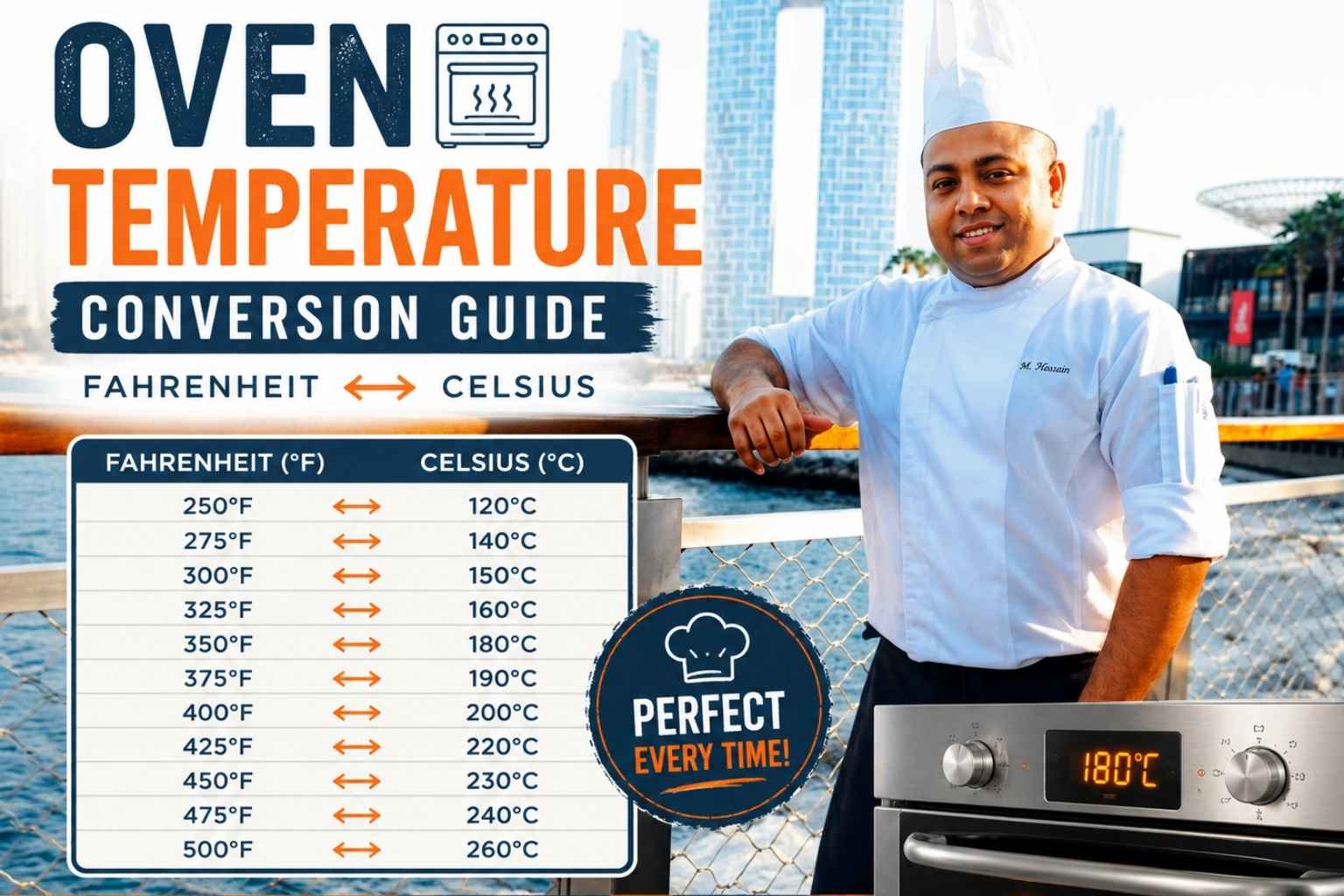
The Complete F-to-C Oven Temperature Conversion Table
This table covers every standard oven temperature from 250°F to 500°F. The “practical Celsius” column is what you should actually dial in. The gas mark column uses the standard UK scale (BBC Good Food, 2025).
| Fahrenheit | Exact Celsius | Practical Celsius | Gas Mark | Temperature Range | Common Use |
|---|---|---|---|---|---|
| 250°F | 121°C | 120°C | Gas Mark 1/2 | Very low | Drying meringues, keeping food warm |
| 275°F | 135°C | 135°C | Gas Mark 1 | Very low | Low-and-slow pork shoulder, confit |
| 300°F | 149°C | 150°C | Gas Mark 2 | Low | Braised short ribs, slow-roast lamb |
| 325°F | 163°C | 165°C | Gas Mark 3 | Moderate-low | Cheesecake, custard, pound cake |
| 350°F | 177°C | 175°C | Gas Mark 4 | Moderate | Most cakes, muffins, cookies, roast chicken |
| 375°F | 191°C | 190°C | Gas Mark 5 | Moderate | Banana bread, dinner rolls, roast vegetables |
| 400°F | 204°C | 200°C | Gas Mark 6 | Moderately hot | Pizza, sheet-pan dinners, roast potatoes |
| 425°F | 218°C | 220°C | Gas Mark 7 | Hot | Searing roasts, crusty bread, baked fish |
| 450°F | 232°C | 230°C | Gas Mark 8 | Very hot | Neapolitan pizza, high-heat steak finishing |
| 475°F | 246°C | 245°C | Gas Mark 9 | Extremely hot | Artisan bread (initial blast), flatbreads |
| 500°F | 260°C | 260°C | Gas Mark 9+ | Max heat | Pizza stones, self-cleaning-level heat |
When rounding matters: Puff pastry, croissants, choux, and soufflés are sensitive to 5-10°C differences. Use the exact Celsius figure for these and verify with an oven thermometer.
When rounding does not matter: Braises, roasts, most cookies, sheet-pan vegetables, and casseroles. A 5°C difference affects cook time by two to three minutes per hour, which you compensate for by checking doneness, not by recalibrating.
How to Convert by Temperature Range – With Specific Use Cases
Oven temperature conversion is not just a math problem. Different temperature ranges have different stakes. Here is how I think about each one.
Low and Slow (250-325°F / 120-165°C, Gas Mark 1/2-3)
This range is for collagen-heavy proteins and long braises. Pork shoulder, lamb shank, beef short ribs, and duck confit all live here.
At these temperatures, a 10°C conversion error shifts your cook time by 20-30 minutes over a 4-hour braise. That is manageable. I check internal temperature with a probe, not the oven dial, at this range. The conversion table matters less here than at higher temperatures.
Altitude note: If you cook above 1,500 meters (about 5,000 feet), water boils at around 95°C instead of 100°C. For braises, that means liquids simmer at lower heat, and collagen breakdown slows. Add 30 minutes per hour of cook time for high-altitude braising (King Arthur Baking, 2024).
Standard Baking (325-375°F / 165-190°C, Gas Mark 3-5)
This is the most crowded temperature range in baking. Most cakes, cookies, quick breads, and dinner rolls sit here.
At 350°F/175°C, a conversion error of 10°C shortens baking time by about 5-7 minutes for a standard cake (Serious Eats, 2023). That is enough to brown the outside before the center sets. For structured baked goods, dial in your conversion within 5°C and set a timer for 5 minutes before the recipe says to check.
Custards and cheesecakes are the most sensitive items in this range. They cook by protein coagulation, and 10°C too high turns a smooth custard into a grainy one. For these, exact Celsius matters.
High-Heat Roasting (400-450°F / 200-230°C, Gas Mark 6-8)
This range is for roast chicken, roast vegetables, pizza, and high-heat bread crusts.
At 425°F/220°C, a 10°C error is about a 5-minute difference in roast time for a 1.5 kg chicken. You compensate with a thermometer, not math. The conversion table mostly serves as a starting point here.
One exception: artisan sourdough bread. Serious Eats and King Arthur Baking both recommend starting a Dutch oven loaf at 500°F/260°C for the first 20 minutes to generate steam and oven spring (King Arthur Baking, 2025). At this temperature, 10°C does change the crust color and thickness. Use the exact figure.
Broiling and Grilling (475-500°F+ / 245-260°C+, Gas Mark 9+)
Broilers and grill settings do not follow standard conversion logic. Most broilers operate at full heat, typically 550-600°F (288-315°C) regardless of what the dial says (America’s Test Kitchen, 2023). Distance from the heat element matters more than temperature here.
For recipes that say “broil at 500°F,” treat that as “set to max broil” and use rack position to control intensity.
Fan Oven Conversions – The “Minus 20°C” Rule
A fan-assisted oven (also called a convection oven) uses a fan to circulate hot air. That circulation makes the oven run hotter and faster than a conventional oven set to the same temperature.
The standard rule: drop 20°C (or 25°F) when converting a conventional oven recipe to a fan oven.
So a recipe calling for 200°C conventional becomes 180°C fan. A recipe calling for 400°F conventional becomes 375°F in a convection oven.
This rule is reliable for most baking and roasting. There are two situations where it needs adjustment.
Very short cook times (under 15 minutes). The fan effect is less pronounced for quick items like cookies or thin flatbreads. Drop 10°C instead of 20°C for items that cook in under 15 minutes.
Moisture-sensitive items. Fan ovens dry out the surface faster than conventional ovens. For custards, cheesecakes, and bread puddings, I do not use a fan oven at all. The forced air forms a crust on the surface before the interior sets.
If your oven has both conventional and fan settings and a recipe does not specify, default to conventional for baking, fan for roasting.
Why Your Oven Dial Is Probably Wrong – and How to Check
Most home ovens are not calibrated to the temperature shown on the dial. A 2024 study by Taylor Precision Products tested 200 home ovens and found that 67% were off by more than 10°C, and 31% were off by more than 25°C. The oven might say 180°C and actually run at 155°C or 205°C.
This is a bigger source of baking failure than conversion errors.
How to check your oven’s actual temperature:
- Buy an oven thermometer. A basic bi-metal dial thermometer from Taylor Precision Products or CDN costs around $15 USD and is accurate to within 2°C (Taylor Precision Products, 2024).
- Place it in the center of the oven, not near the door or the back wall.
- Set your oven to 180°C/350°F and let it run for 20 minutes.
- Read the thermometer without opening the door. Look through the oven window with a flashlight.
- Note the difference between the dial and the thermometer reading. That is your oven’s offset.
If your oven runs 15°C hot, adjust all your recipes up by 15°C. Write that number on a piece of tape and stick it inside the oven door.
Hot spots are a separate issue. Most ovens heat unevenly – the back tends to run hotter than the front, and the top element may be more powerful than the bottom. The fix is to rotate your pans halfway through cook time. This is not a conversion problem – it is an oven behavior problem that applies regardless of whether you cook in Celsius or Fahrenheit.
Common Conversion Mistakes – and the Exact Fix for Each
After 15 years in professional kitchens, I have seen these same mistakes over and over. Each one has a direct fix.
Mistake 1: Converting the recipe temperature but not the fan setting. A recipe calls for 200°C conventional. You have a fan oven. You dial in 200°C because the conversion “is already in Celsius.” The dish browns too fast. The fix: Always drop 20°C for fan ovens, even when the recipe is already in Celsius.
Mistake 2: Using an online converter that rounds incorrectly. Some online tools round 350°F to 180°C (correct) and some round it to 175°C (also acceptable). The issue is when you use different tools for different recipes and end up with inconsistent reference points. Pick one table and use it every time. Use the one in this article.
Mistake 3: Ignoring altitude when baking. At 1,500 meters above sea level, leavening gases expand faster and liquids evaporate more quickly. A cake recipe calibrated at sea level will rise too fast and collapse at altitude. King Arthur Baking’s altitude adjustment guide recommends reducing baking powder by 15-25% and increasing liquid by 2-4 tablespoons per cup of flour at elevations above 1,500 meters (King Arthur Baking, 2024). Temperature conversion alone does not fix altitude baking – you need to adjust the recipe.
Mistake 4: Trusting the oven’s preheat signal. The preheat indicator on most ovens signals when the air near the thermostat reaches the target temperature. The oven walls and floor may still be 20-30°C below that. For bread, pizza, and anything on a baking stone, wait an extra 15-20 minutes after the preheat signal before loading the oven.
Mistake 5: Applying the minus-20°C fan rule to broiling. The fan offset rule applies to standard baking and roasting temperatures. Broilers run at full heat regardless, so the fan does not add meaningful temperature. Skip the offset for broiling.
My Personal Conversion System After 15 Years
I do not rely on memory for temperature conversion. Memory is unreliable under pressure, and getting it wrong means a wasted dish and wasted time.
Here is my actual system.
I keep a laminated conversion card inside my oven door. It shows Fahrenheit, practical Celsius, gas mark, and a fan-adjusted Celsius column. It cost nothing to make and has saved me from errors more times than I can count. The table earlier in this article is exactly what that card shows.
For on-the-fly conversion without a reference, I use the subtract-32-divide-by-2 shortcut. I know it is slightly off, and I adjust up or down by 5°C based on whether the dish is forgiving or precise.
I own two oven thermometers. One stays in the main oven, one in the smaller top oven. I glance at them every time I open the oven door. My main oven runs 12°C hot. I have known that for three years and I automatically add 12°C to every recipe.
For any recipe from a UK source, I assume Celsius and check for a gas mark reference. If the recipe says “Gas Mark 4,” I use 180°C conventional or 160°C fan, not the Fahrenheit conversion.
For any recipe from a US source, I assume Fahrenheit. I convert using the table, check whether the recipe specifies conventional or convection, and adjust.
That system works. It is specific. It removes guesswork.
Frequently Asked Questions About Oven Temperature Conversion
What is the formula to convert Fahrenheit to Celsius for oven temperatures?
The exact formula is C = (F – 32) x 5/9. For a fast kitchen estimate, subtract 32 and divide by 2. That shortcut gives a result within 5°C of the exact figure, which is close enough for most cooking. For baking pastry or bread, use the exact formula or the conversion table in this guide.
How do I convert 350°F to Celsius for baking?
350°F converts to exactly 176.67°C. In practice, set your oven to 175°C. If you are using a fan oven, drop to 155°C. 350°F / 175°C is the most common baking temperature for cakes, muffins, and cookies.
What is 180°C in Fahrenheit?
180°C equals 356°F. In most recipes, this is treated as equivalent to 350°F. Use 350°F on a US oven when a recipe calls for 180°C conventional. If the recipe specifies fan at 180°C, use 375-400°F on a conventional US oven, because fan ovens run hotter.
Why do UK recipes list gas marks instead of Celsius or Fahrenheit?
Gas marks were the standard temperature scale for gas ovens sold in the UK from the 1920s through the 1980s. The scale runs from Gas Mark 1 (around 140°C) to Gas Mark 9 (around 240°C). Older UK cookbooks and some current BBC Good Food recipes still use this scale. Gas marks do not convert to whole-number Celsius equivalents, which is why a reference table is the only reliable tool.
How much do I reduce the temperature for a fan oven when converting a recipe?
Drop 20°C (about 25°F) from the recipe’s stated temperature when converting from a conventional oven recipe to a fan oven. So 200°C conventional becomes 180°C fan, and 400°F conventional becomes 375°F in a convection oven. For items that cook in under 15 minutes, drop only 10°C.
Does altitude affect oven temperature conversion?
Altitude affects baking chemistry but not the conversion math itself. At altitudes above 1,500 meters, leavening gases expand faster and water evaporates more quickly. You may need to reduce leavening agents by 15-25% and increase liquid in the recipe. The oven temperature conversion stays the same – the recipe ingredients need adjustment, not the temperature.
How accurate does my oven temperature need to be for good results?
For most roasting and braising, within 10-15°C is fine. For standard cakes, cookies, and bread, within 5-10°C. For pastry, custard, choux, and soufflés, within 3-5°C. The way to achieve that level of accuracy is an oven thermometer, not a more precise conversion calculation. Most home ovens are off by 10-25°C from the dial setting (Taylor Precision Products, 2024), so thermometer verification matters more than formula precision.
What is the easiest way to memorize common oven temperature conversions?
Memorize these four anchor points, and you will cover 80% of recipe temperatures.
- 325°F = 165°C (moderate, cheesecake and custard)
- 350°F = 175°C (standard baking, most cakes)
- 400°F = 200°C (hot roasting, pizza)
- 450°F = 230°C (very hot, artisan bread, searing)
Everything else falls between or outside these points. Use the table in this guide for anything you are unsure about.
Key Takeaways
- The exact formula is C = (F – 32) x 5/9. The fast shortcut is subtract 32, divide by 2 – use it for roasting, not for baking pastry.
- Round to the nearest 5°C for practical oven use. Home ovens swing 10-15°C during normal operation, so precision below 5°C is meaningless without an oven thermometer.
- Fan oven conversions require a 20°C reduction from conventional oven temperatures. This rule applies to baking and roasting, not to broiling.
- Gas marks are a separate UK scale that does not convert cleanly to Celsius or Fahrenheit – use a reference table, not mental math.
- An oven thermometer tells you what your oven actually does, which is more useful than any conversion formula. Two-thirds of home ovens are off by more than 10°C (Taylor Precision Products, 2024).
- Altitude adjustments affect recipe ingredients at elevations above 1,500 meters – the temperature conversion itself stays the same, but leavening and liquid amounts need calibration.
- Keep a printed conversion card inside your oven door. It removes the mental load and prevents errors when you are working fast.

I’m Mossaraof, a trained chef and the founder of OvenInsights.com. I spent years cooking at Larrupin’ Cafe and in kitchens across Chicago and Seattle. Now I test kitchen gear for a living. I moved to North Acton, London, and I test every tool I write about. I use real meals and real heat. No brand deals. No shortcuts. I cover 12 kitchen types and hundreds of recipes. I believe this: the right tools matter as much as the recipe.