At A Glance
- One roast chicken (4-5 lbs) gives you about 4 cups of meat, enough for 5 full meals across a week.
- Cooked chicken stays safe in the fridge for 3-4 days and in the freezer for up to 4 months (USDA FoodSafety.gov, 2024).
- The carcass alone makes 2-3 quarts of stock. That stock is the base for meal #1 and adds flavor to two other meals.
- Always reheat leftover chicken to 165°F (74°C), then stop. Overcooking is the most common mistake home cooks make with leftovers.
- Each of the 5 meals uses a different cut of meat and a different flavor profile, so nothing tastes like “the same chicken again.”
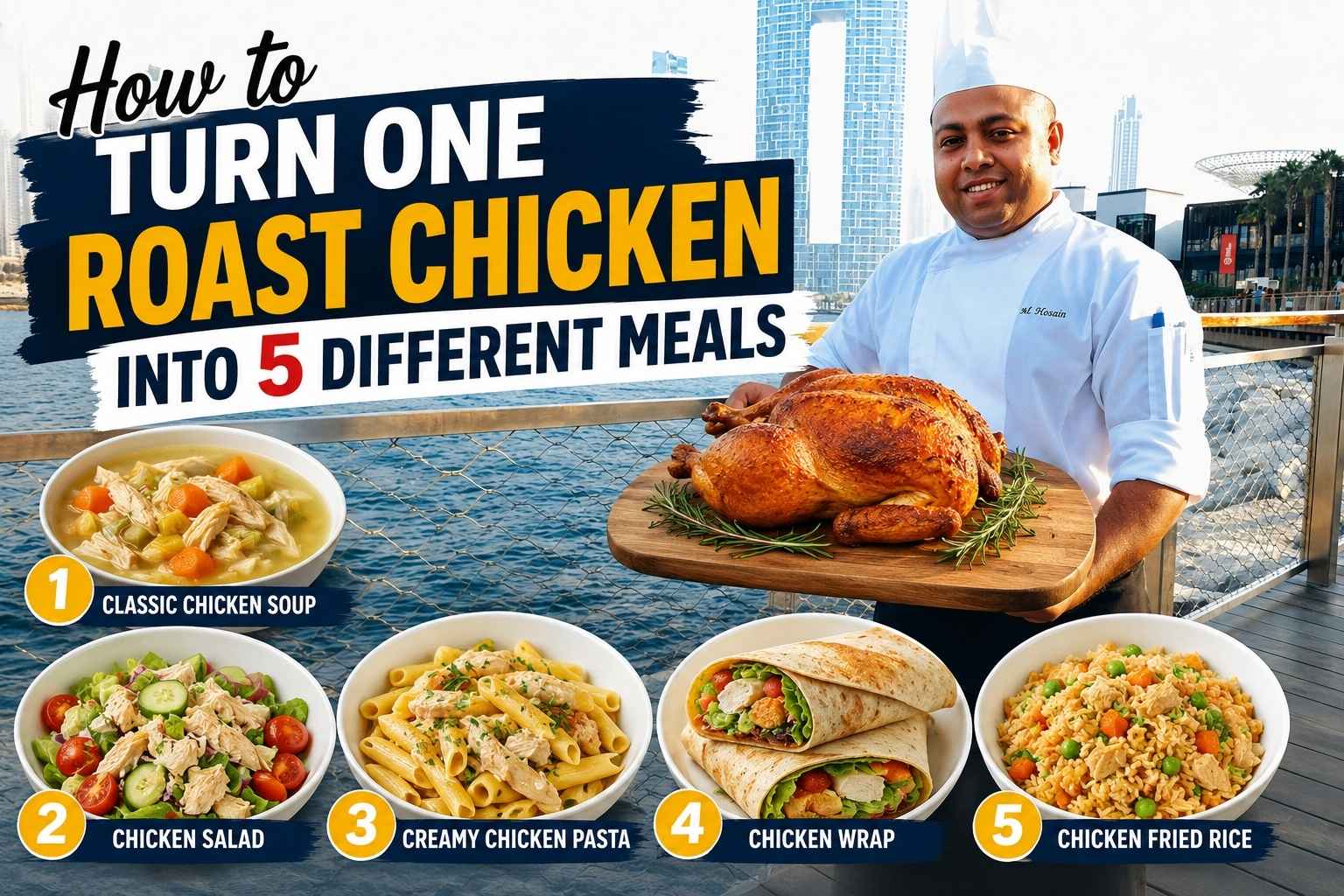
How to Turn One Roast Chicken into 5 Different Meals is one of my favorite ways to save time, cut food waste, and keep dinner fun. I started doing this on busy weeks, and it made meal planning feel easy instead of stressful. In this guide, I will share simple ideas, smart storage tips, and easy recipes that help one roast chicken become five tasty meals. Let’s get started and make every bite count.
Why One Roast Chicken Can Feed Your Family All Week
A 5-pound roast chicken gives you about 4 cups of cooked meat, or roughly 20 ounces. Split across 5 meals for a family of four, that’s 15 to 20 servings of protein from a single bird.
Here’s the math. A whole chicken usually costs $8 to $12. Buy that same 20 ounces as boneless chicken breast, and you’d pay $15 to $20 for the meat alone, with no carcass left for stock. One chicken does the job of two separate purchases.
Food waste is a real cost too. The USDA estimates that 30 to 40 percent of the food supply in the US goes to waste, much of it at the household level (USDA, 2024). A chicken carcass tossed straight in the trash is part of that number.
I ran professional kitchens for over 15 years before I started cooking mostly for my own family. In a restaurant, nothing gets thrown out. Bones become stock. Skin gets crisped and used as a garnish. Even wing tips go into the pot. That mindset works just as well at home, and it pays off fast.
How Long Roast Chicken Stays Safe to Eat (And How to Store It Right)
Cooked chicken stays safe in the fridge for 3 to 4 days. In the freezer, it stays safe to eat indefinitely, but quality starts to drop after about 4 months (USDA FoodSafety.gov, 2024). Always reheat it to an internal temperature of 165°F (74°C) before eating.
Here’s how I store chicken the same night I roast it. First, I pull all the meat off the bones while it’s still warm. This takes about 10 minutes. Then I split the meat into shallow containers, no more than 2 inches deep. Shallow containers cool faster than one deep bowl. The carcass goes into its own bag.
Why does this matter so much? Bacteria grow fastest between 40°F and 140°F (4°C and 60°C). The USDA calls this range the danger zone (USDA FoodSafety.gov, 2024). A whole chicken left on the counter can sit in that zone for hours. Shredded meat in a shallow container drops below 40°F in under an hour.
One more rule, and it’s simple: label everything. Write the date on the lid with a marker. Chicken roasted on Sunday is safe through Wednesday or Thursday. After that, freeze it or toss it.
How to Break Down a Roast Chicken for Maximum Meat
Most home cooks stop after pulling the breasts, thighs, and legs. That leaves real meat behind. The back, the wings, and two small round pieces near the spine called oysters are worth pulling too, and they make a noticeable difference in your total yield.
Here’s my routine for breaking down a bird.
I start with the legs and thighs. I pull the meat off in big pieces and set it aside for meal 5, the pot pie, because dark meat holds up best to a second round of cooking.
Next comes the breast. I slice or shred it depending on the meal. Breast meat dries out fastest, so I save it for meals that don’t need long reheating, like sandwiches and tacos.
Then I flip the bird over and find the oysters. These are two small, round pieces of dark meat tucked into shallow hollows where the thigh meets the backbone. Most cooks never notice them. They’re tender and rich, and I usually eat them on the spot as a reward for doing the work.
Last, I run my fingers along the back and ribs for any thin strips of meat left clinging to the bone. These scraps go toward the fried rice. Nothing with meat still on it goes into the stock pot. The stock pot is for bones, skin, and fat only.
5-Meal Game Plan at a Glance
Here’s the full plan for one chicken, broken into 5 meals. Use this table to plan your week before you start cooking, so you know how much meat to save for each one.
| Meal | Leftover Chicken Needed | Prep Time | Best For |
|---|---|---|---|
| 1. Carcass Soup or Congee | Bones, skin, fat (meat optional) | 15 min active, 3-4 hr simmer | Freezer-friendly, sick-day comfort |
| 2. Chicken Salad or Sandwiches | 1.5-2 cups, diced breast | 10 min, no cooking | Quick lunch, no reheating |
| 3. Chicken Tacos or Quesadillas | 1.5 cups, shredded thigh | 20 min | Weeknight dinner, kid-approved |
| 4. Chicken Fried Rice or Grain Bowl | 1 cup, mixed scraps | 15 min | Using up odds and ends, one pan |
| 5. Chicken Pot Pie or Casserole | 1.5-2 cups, dark meat | 30 min prep, 35-40 min bake | Freezer-friendly, weekend dinner |
Notice that meal 1 doesn’t compete with the others for meat. It runs almost entirely on bones. Plan your stock first, then split the actual meat across meals 2 through 5 based on what’s left.
Meal 1: Carcass Soup or Congee (The Most Important Meal of the Week)
This meal turns bones into dinner. Simmer the leftover carcass with water and a few vegetables, and you get a pot of soup or congee that costs almost nothing to make.
How to Make Chicken Noodle Soup from the Carcass
Break the carcass into 2-3 pieces and add it to a large pot with cold water, onion, carrot, celery, a bay leaf, and a few peppercorns. Bring to a boil, then drop to a low simmer for 3-4 hours. Strain out the solids, then return the stock to the pot. Add egg noodles, shredded reserved chicken, and fresh carrots and celery. Simmer for 10 minutes until the noodles are tender. Finish with salt, pepper, and a squeeze of lemon.
How to Make Congee Instead
For congee, skip the noodles. Simmer 1 cup of rice directly in the strained stock for 45-60 minutes, stirring now and then, until it turns thick and creamy. Top with shredded chicken, sliced scallions, a soft-cooked egg, and a splash of soy sauce.
I learned to make congee from a line cook I worked with early in my career. He brought a thermos of it for breakfast most mornings, and it converted me fast. Now it’s my go-to whenever leftover chicken meets a cold I’m fighting off.
Meal 2: Cold Chicken Salad and Sandwiches (Zero-Cook Lunch)
This is the easiest meal on the list. No stove, no oven. Dice or shred 1.5 to 2 cups of breast meat, mix it with a simple dressing, and lunch is ready in 10 minutes.
A Simple Chicken Salad Base
Mix together mayonnaise, a spoonful of Greek yogurt, Dijon mustard, lemon juice, salt, and pepper. Fold in the diced chicken along with chopped celery, red onion, and something sweet like grapes or diced apple. Fresh dill or tarragon adds a lift if you have it on hand.
Turning It Into a Sandwich
Pile the chicken salad onto toasted bread, roll it into a wrap, or spoon it over a bed of greens for a lighter option. The Kitchn (2023) points out that a crunchy add-in, like celery or apple, is what keeps chicken salad from feeling heavy or one-note.
I always save breast meat for this meal specifically. It’s the driest cut after roasting, and a creamy dressing is the best way to bring moisture back without reheating, which would only dry it out further.
Meal 3: Chicken Tacos, Quesadillas, or Enchiladas (New Flavors, Same Chicken)
This meal changes the flavor completely. Shred about 1.5 cups of chicken, ideally thigh meat, and toss it with a spice mix and a little liquid. In 20 minutes, it won’t taste anything like Sunday’s roast.
A Quick Spice Mix and Sauce
Combine cumin, chili powder, smoked paprika, garlic powder, and a pinch of oregano. Toss the shredded chicken with the spices, plus 2-3 tablespoons of salsa or leftover chicken stock and a squeeze of lime. Warm everything in a skillet over medium heat for 5-8 minutes, until heated through and lightly saucy.
Tacos, Quesadillas, or Enchiladas: Pick Your Format
For tacos, warm tortillas and top with the chicken, diced onion, cilantro, and a wedge of lime. For quesadillas, layer the chicken with cheese between two tortillas and griddle until crisp. For enchiladas, roll the chicken in tortillas, cover with sauce and cheese, and bake at 375°F for 20 minutes until bubbly.
Serious Eats (2024) makes a good point about reheated chicken: adding it to a sauce or liquid before applying heat keeps it from drying out, compared to reheating it dry in a pan or microwave.
Meal 4: Chicken Fried Rice or Grain Bowl (For the Odds and Ends)
This meal is for the small bits left over. About 1 cup of diced chicken, mixed cuts and all, works perfectly here. Fried rice or a grain bowl hides any uneven pieces and puts day-old rice to good use.
Why Day-Old Rice Works Best
Fresh rice is too wet for frying and tends to clump. Cold, day-old rice has dried out slightly overnight, so the grains separate cleanly when they hit a hot pan. This tip comes up often in fried rice guides, including Serious Eats (2024), and it makes a real difference in texture.
Building the Dish
Heat a wok or large skillet until it’s very hot, with a bit of neutral oil. Scramble an egg first and set it aside. Add the cold rice and break up any clumps. Stir in the chicken, frozen peas and carrots, soy sauce, and a drizzle of sesame oil. Toss everything together, then fold the egg back in and finish with sliced scallions.
For a grain bowl version, swap the rice for cooked quinoa or farro, then top with the chicken, roasted vegetables, a fried egg, and a soy-sesame dressing.
Meal 5: Chicken Pot Pie or Casserole (The Dark Meat’s Best Use)
This is where dark meat shines. Use 1.5 to 2 cups of thigh, leg, and back meat. Dark meat carries more fat than breast meat, so it stays moist through a second round in the oven.
The Filling
Start a roux with butter and flour, then whisk in chicken stock from meal 1, along with a splash of milk or cream. Once it thickens, stir in the chicken, peas, carrots, and a pinch of thyme. Season with salt and pepper to taste.
Topping Options
A store-bought pie crust works fine here. America’s Test Kitchen (2023) found that pre-made crusts perform well against homemade in blind taste tests for pot pie, so don’t feel like you’re cutting corners. A biscuit topping turns this into a casserole, and a layer of mashed potatoes turns it into a shepherd’s pie. Bake at 400°F for 35-40 minutes, until the top is golden and the filling bubbles at the edges.
My favorite trick: assemble a second pie unbaked and freeze it. Bake it straight from frozen at 375°F for an extra 15-20 minutes on a busy weeknight.
How to Turn the Carcass into Stock, Step by Step
Stock from a roasted carcass takes about 10 minutes of hands-on work and 3 to 4 hours of mostly unattended simmering. Here’s exactly how I do it, every single week.
- Break the carcass into 2-3 pieces. Smaller pieces fit the pot better and release flavor faster.
- Put the bones, skin, and any drippings into a large pot. Cover with cold water by about 2 inches, roughly 3-4 quarts for one carcass.
- Add a roughly chopped onion, carrot, and celery stalk, plus a bay leaf and a few peppercorns. Skip salt for now. You’ll season the final dish, not the stock.
- Bring it to a boil, then drop the heat right away to a low simmer. A few gentle bubbles is all you need.
- Simmer uncovered for 3 to 4 hours. Skim off any foam that rises in the first 30 minutes.
- Strain through a fine mesh strainer and discard the solids.
- Cool the stock, then portion it into containers or freezer bags.
Because the bones are already roasted, you get deep flavor without an extra roasting step. Cook’s Illustrated (2022) recommends roasting raw bones before simmering for exactly this reason, and a roast chicken carcass has already done that work for you.
How to Store Each Meal So Nothing Goes to Waste
Each meal has its own shelf life. Stock and raw shredded chicken last the longest. Anything made with mayonnaise or a cream sauce should be eaten within a few days or frozen before assembly, not after.
Here’s how long each component holds up:
- Stock: 4-5 days in the fridge, or up to 6 months in the freezer (USDA FoodSafety.gov, 2024).
- Chicken salad: 3-4 days in the fridge. Mayo-based salads don’t freeze well.
- Taco filling: 3-4 days in the fridge, or up to 3 months in the freezer.
- Fried rice: 3-4 days in the fridge. It freezes, but the texture suffers.
- Pot pie filling (unbaked): up to 3 months in the freezer, baked straight from frozen.
When you freeze anything, lay the bag flat so it freezes quickly and stacks easily. Write the contents and the date on every container before it goes in. A marker and a roll of tape solve more kitchen problems than people realize.
Common Mistakes When Repurposing Roast Chicken (And How to Fix Them)
- Overcooking reheated chicken until it’s dry. Reheat gently with added liquid, like sauce or stock, covered, in a 300°F oven or a covered pan. Stop at 165°F (74°C). Going past that point dries the meat out fast.
- Letting the whole chicken cool on the counter before storing it. Pull the meat off the bones within 2 hours of cooking and store it in shallow containers, as covered earlier.
- Throwing the carcass straight in the trash. Even a small carcass makes 1-2 quarts of stock. If you’re short on time, freeze it raw and simmer it later.
- Making every meal taste the same. Change the spice profile and the cooking method each time: cumin and lime for tacos, thyme and cream for pot pie, soy and ginger for fried rice.
- Skipping the date label. Write the contents and date on every container. A week from now, you won’t remember which container is which.
My Sunday-to-Weekday Routine for Zero-Waste Chicken Meals
Here’s exactly what I do most weeks, start to finish.
Sunday afternoon, I roast the chicken and we eat it for dinner with simple sides. That night, before bed, I strip every bit of meat off the bones. It takes about 15 minutes while I’m already cleaning the kitchen.
I split the meat into three containers: breast meat for sandwiches or tacos, thigh and leg meat for pot pie, and small scraps for fried rice. The carcass goes into a pot with water and vegetables, and I let it simmer while I do something else entirely.
Monday morning, I strain the stock into containers and put it in the fridge. Monday night is usually soup, since the stock is already done.
Tuesday is chicken salad for lunches. Wednesday is tacos. Thursday is fried rice, using whatever vegetables are about to turn. Friday, I pull a pot pie filling from the freezer, made the previous week, and bake it for a low-effort dinner.
By the next Sunday, the freezer has a new pot pie filling ready to go, and the cycle starts again.
Frequently Asked Questions
How long does leftover roast chicken last in the fridge?
Cooked chicken stays safe in the fridge for 3 to 4 days when stored in a sealed container below 40°F (USDA FoodSafety.gov, 2024). After that, freeze it or throw it out. Check for off smells or sliminess before eating, even within that window.
Can I freeze roast chicken meat?
Yes. Shredded or diced chicken freezes well for up to 4 months without much loss in quality (USDA FoodSafety.gov, 2024). Freeze it flat in a sealed bag with the air pressed out, then thaw it in the fridge overnight before using.
What’s the best way to reheat chicken without drying it out?
Add a splash of liquid, like stock, sauce, or even water, before reheating. Cover the dish and heat it gently, either in a 300°F oven or a covered pan on the stove. Reheat to 165°F (74°C) and then stop.
Can I use a store-bought rotisserie chicken instead of roasting my own?
Yes, completely. A rotisserie chicken works for every meal in this guide. It’s already cooked and seasoned, and it often costs less than a raw whole chicken. Just follow the same cooling and storage steps once you get it home.
How much meat does one roast chicken actually yield?
A 5-pound chicken gives you roughly 4 cups of cooked meat, or about 20 ounces. That’s roughly 2 cups of breast meat and 2 cups of thigh, leg, and back meat combined. Yields vary slightly by bird size and how thorough your breakdown is.
Is it safe to make stock from a carcass that’s been in the fridge for a few days?
Yes, as long as it’s within 3 to 4 days of roasting and has been stored properly (USDA FoodSafety.gov, 2024). You can also freeze the raw carcass right after dinner and make stock whenever you have time.
If I don’t want to make all 5 meals, which ones freeze best?
Stock and pot pie filling freeze the best, since both are meant to be reheated with added liquid or sauce. Chicken salad and fried rice don’t freeze well. Taco filling freezes okay but tastes best within a month.
Do I need to remove the skin before storing leftover chicken?
No, but it helps to separate it. Skin and fat are great additions to the stock pot, where they add flavor. If you’re storing meat for sandwiches or salads, removing the skin first gives you a better texture.
Key Takeaways
- One roast chicken (4-5 lbs) yields about 4 cups of meat, enough for 5 meals across a week.
- Cool and store chicken within 2 hours of cooking, in shallow containers, labeled with the date.
- Cooked chicken keeps 3-4 days in the fridge and up to 4 months in the freezer (USDA FoodSafety.gov, 2024).
- The carcass makes 2-3 quarts of stock with 3-4 hours of mostly hands-off simmering.
- Match the cut to the meal: breast for cold dishes, dark meat for pot pie, scraps for fried rice.
- Change the seasoning every time, so no meal tastes like “leftovers again.”

I’m Mossaraof, a trained chef and the founder of OvenInsights.com. I spent years cooking at Larrupin’ Cafe and in kitchens across Chicago and Seattle. Now I test kitchen gear for a living. I moved to North Acton, London, and I test every tool I write about. I use real meals and real heat. No brand deals. No shortcuts. I cover 12 kitchen types and hundreds of recipes. I believe this: the right tools matter as much as the recipe.