At A Glance
- Silicone baking mats (like Silpat) are the best all-around substitute for parchment paper in the oven, handling temperatures up to 480°F (America’s Test Kitchen, 2024).
- A well-greased pan works fine for most roasted vegetables, proteins, and pan cookies – you do not always need parchment at all.
- Never use wax paper in the oven. It smokes, burns, and can catch fire above 200°F (FDA, 2023).
- Aluminum foil is good for proteins and roasted vegetables but produces crispier, darker browning than parchment – plan for that difference.
- Gas ovens run hotter and have more hot spots than electric ovens, so your substitute choice matters more when you’re cooking with gas.
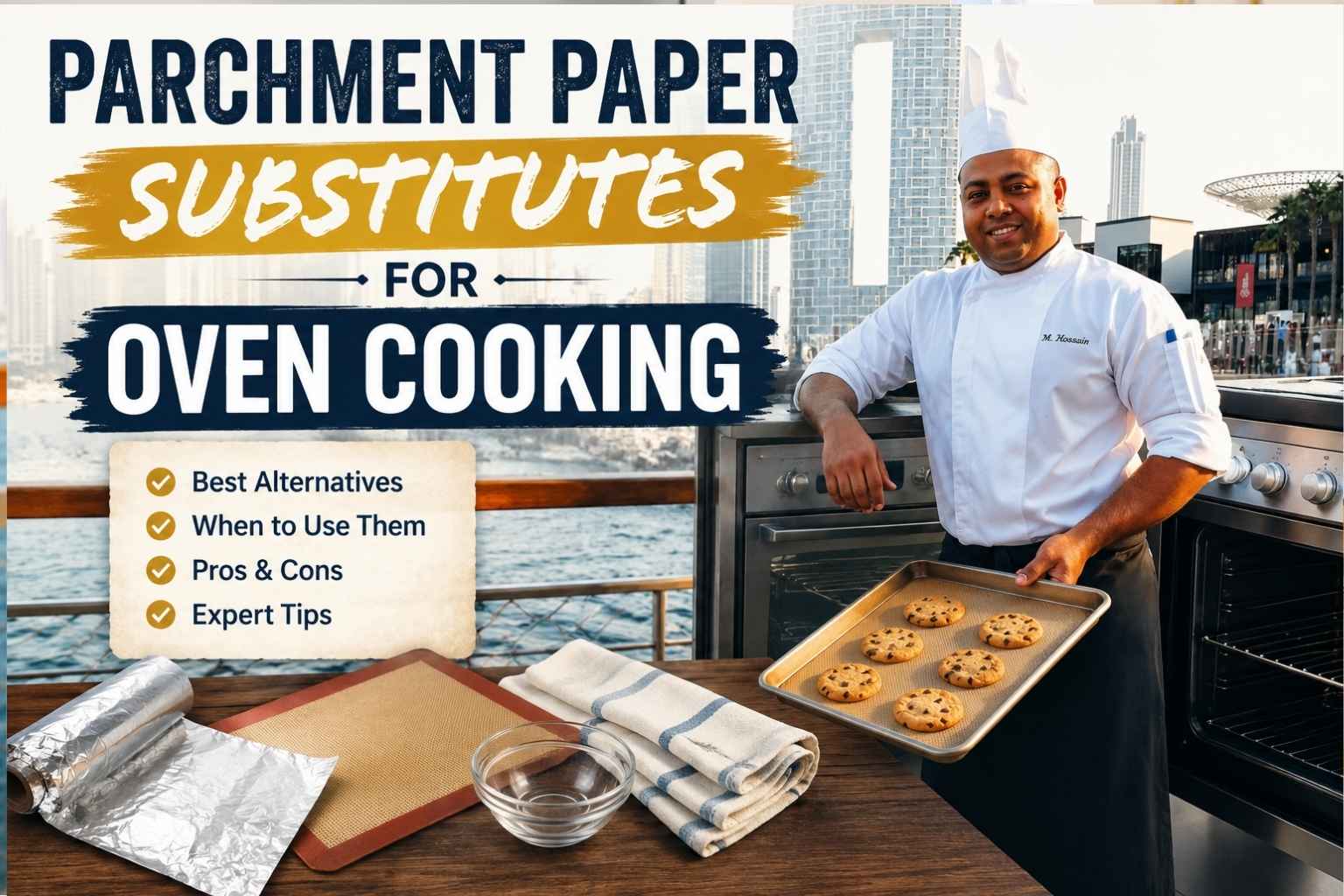
I have reached for parchment paper more times than I can count, only to find the box empty. That is why I started looking for Parchment Paper Substitutes for Oven Cooking that are safe, simple, and easy to use. After plenty of baking, roasting, and testing, I found several great options that work well for different foods. In this guide, I will help you choose the best substitute, avoid common mistakes, and cook with confidence, even when parchment paper is not in your kitchen.
Quick-Reference: Parchment Paper Substitutes at a Glance
| Substitute | Best Use Cases | Heat Limit | Non-Stick Rating | Reusable? |
|---|---|---|---|---|
| Silicone baking mat (Silpat) | Cookies, macarons, roasted veg | 480°F / 249°C | Excellent | Yes (2,000+ uses) |
| Aluminum foil (greased) | Proteins, roasted veg, sheet pan meals | 500°F+ / 260°C+ | Good (when greased) | No |
| Greased pan (butter/oil) | Cookies, cakes, roasted veg, bread | Pan’s limit | Good | Yes (it’s the pan) |
| Wax paper | Cold prep only – NOT oven use | ~200°F / 93°C | Good (cold) | No |
| Reusable non-stick liner | Cookies, sheet pan meals | 450-500°F varies | Good | Yes (hundreds of uses) |
| Bare metal pan | Proteins, roasted veg, bread | Pan’s limit | Poor (without grease) | Yes |
| Cornmeal/flour dusting | Bread, pizza, freeform loaves | Pan’s limit | Moderate | No |
What Parchment Paper Actually Does in the Oven
Parchment paper does four specific things. Once you understand each one, you can pick the right substitute for any job.
Non-stick release. Parchment is treated with silicone, which means nothing bonds to it – not cookies, not cheese, not caramelized sugar. This is its biggest job and the hardest one to replicate (King Arthur Baking, 2023).
Moisture barrier. It traps steam under the paper, which keeps the bottom of baked goods from drying out or over-crisping. This matters most for cookies and cakes.
Heat distribution. Parchment sits between the hot metal pan and your food, softening the direct heat transfer. That’s why cookies baked on parchment have flatter, more even bottoms than those baked on bare metal.
Cleanup. This one’s obvious. Lift the paper, toss it, done.
When you understand what the paper does at each task, it becomes clear that no single substitute does all four equally well. You pick based on what matters most for that specific cook.
When You Actually Need Parchment (and When You Don’t)
You genuinely need parchment paper – or a silicone mat – for delicate items. Macarons, tuiles, thin butter cookies, meringues. These stick to almost everything else.
You also need it when baking anything with high sugar content that caramelizes on the pan. Think sticky buns, cinnamon rolls, or cookies with jam centers. Once caramelized sugar cools on bare metal, you’re scrubbing for a long time.
Everything else? You probably don’t need parchment. I’ve roasted vegetables, cooked chicken thighs, baked focaccia, and made sheet pan dinners for 200 guests without a single sheet of parchment. A well-prepared pan handles most of that without any problem.
The “always use parchment” advice comes from cooking shows where cleanup is irrelevant and waste is invisible. In a real kitchen, you reach for the right tool, not the default tool.
Each Substitute, Explained by a Chef Who Has Tested Them All
Silicone Baking Mats: The Closest to Parchment
A silicone baking mat – the most popular brand is Silpat – is the best general-purpose parchment substitute. It handles heat up to 480°F, provides a reliable non-stick surface, and lasts for over 2,000 uses (America’s Test Kitchen, 2024).
I keep two full-sheet Silpats in my home kitchen. They handle everything from sugar cookies to roasted broccoli to sheet pan salmon. The only thing I’ve found they don’t do as well as parchment: cookies spread slightly more on silicone because the mat insulates heat a little differently. If you want a crisper cookie bottom, parchment gives you more control.
For bread and pizza baked directly on the mat, results are excellent. Silicone doesn’t absorb moisture the way a bare metal pan would, so you get a similar steam effect to parchment.
Temperature warning: Do not use silicone mats above their rated limit. Beyond 480°F, the material degrades and can off-gas. Most home baking stays well under this, but if you’re blasting a pan under the broiler, remove the mat first.
Aluminum Foil: The Wrong Tool for Cookies, the Right Tool for Everything Else
Aluminum foil is not a parchment substitute for baking delicate items. It conducts heat directly to the food, which means faster browning on the bottom. Cookies baked on foil come out darker and crispier on the underside than anything baked on parchment (Cook’s Illustrated, 2022).
That said, for proteins and vegetables, foil is excellent. It’s what I reach for when I want a good sear on the bottom of chicken thighs or when I need easy cleanup after roasting asparagus with olive oil and parmesan. Just grease it lightly with cooking spray or oil.
For lining a pan under something fatty (bacon, sausage, anything with a lot of rendered fat), foil is better than parchment because it holds up against pooling fat at high heat without softening.
One thing most people don’t know: Highly acidic foods (tomatoes, citrus, vinegar-based marinades) can react with aluminum foil, especially at high heat. The foil won’t catch fire, but it can leave a metallic taste and in some cases, small amounts of aluminum can leach into the food (FDA, 2021). For acidic dishes, use a greased pan or silicone mat instead.
A Greased Pan: The Most Underrated Option
A well-greased pan – butter, neutral oil, or cooking spray – is what professional kitchens use for 80% of baking. The idea that every home bake needs parchment paper is partly a product of cooking media where cleanup is not a consideration.
For cookies, grease the pan with butter and lightly dust with flour. This is the classic French method, and it works. Cookies release cleanly and the flour helps prevent sticking even on sticky doughs (Jacques Pépin, “La Technique,” 1976).
For cakes, butter the pan and flour it, or use cocoa powder for chocolate cakes so you don’t get white dust on the sides. Cakes release beautifully if the pan is prepared properly.
For bread, oil the pan generously. I use about a tablespoon of olive oil in a 9×5 loaf pan, spread all the way up the sides. No sticking, great crust.
The main downside of a greased pan: cleanup takes longer than lifting off a sheet of parchment. That’s a real consideration if you’re baking in volume.
Wax Paper: Do Not Use This in the Oven
I learned this the hard way in my second year cooking professionally. I grabbed wax paper instead of parchment by mistake, loaded a sheet of butter cookies into a 375°F oven, and had smoke rolling out in under three minutes.
Wax paper is coated with paraffin wax, not silicone. Paraffin wax melts and burns in the oven. At temperatures above 200°F, the wax starts to melt. By 350-375°F, it smokes. Higher than that, it can ignite (FDA, 2023).
The labels look similar. The rolls look similar. Double-check before you put it in the oven. Wax paper is excellent for cold prep work: wrapping dough, rolling out pastry on a cold surface, separating burger patties. It has no place near oven heat.
Reusable Non-Stick Liners
These are thin, fibrous mats made from fiberglass and coated with PTFE (polytetrafluoroethylene), the same non-stick material used in some pans. Brands like Reynolds and several store-brand versions are widely available (Good Housekeeping, 2024).
They work well for sheet pan cooking. Non-stick performance is good for cookies and roasted vegetables. They’re thin enough to cut to size for smaller pans, which silicone mats generally can’t do without special scissors and wasted material.
The downside: most PTFE-coated liners start to degrade above 450-500°F, and some off-gas at those temperatures. I check the manufacturer rating before using them near the broiler. For everyday baking at 325-400°F, they’re a solid, affordable choice.
Bare Metal Pans: When the Pan Is the Point
Sometimes the right answer is a bare metal pan with nothing between the food and the metal. Browning is faster, bottoms get crispier, and you get more Maillard reaction on the surface.
For roasted potatoes, a bare metal pan (or cast iron) beats parchment every time. The direct contact with hot metal creates a crust that parchment-lined pans can’t match. I use a thin layer of oil and preheat the pan in the oven before adding the potatoes – this gives me a sear on contact.
For proteins cooked to high internal temperature (whole chicken, pork loin, thick fish fillets), bare metal or cast iron is better than parchment. The rendered fat naturally prevents sticking after the first few minutes of cooking.
Cleanup is harder, yes. That’s the trade-off for a better crust.
Cornmeal and Flour Dusting: The Baker’s Secret for Bread and Pizza
For freeform loaves, artisan bread, and pizza, a dusting of cornmeal or flour on the pan gives just enough non-stick surface to allow the dough to slide off after baking.
Cornmeal works better than flour for pizza because it doesn’t burn as easily at high temperatures (400-500°F) and gives the bottom of the crust a slight crunch that most pizza lovers want. Use about 2 tablespoons spread across a sheet pan or pizza stone (King Arthur Baking, 2024).
Flour dusting is better for bread loaves where you want a cleaner, softer bottom. Too much cornmeal under a delicate loaf can make the bottom gritty.
This method doesn’t work for cookies or anything with butter or sugar in the dough – it’s purely for lean bread doughs.
Temperature Limits: What Happens When You Go Too High
Most baking happens between 300°F and 450°F, which is the safe range for silicone mats, foil, greased pans, and reusable liners. The issues come when people use substitutes near the broiler or in high-heat searing situations.
| Material | Safe Zone | What Goes Wrong Above Limit |
|---|---|---|
| Silicone mat | Up to 480°F | Degrades, possible off-gassing |
| PTFE liner | Up to 450-500°F (check label) | Degrades, off-gassing |
| Wax paper | Do not use in oven | Melts, smokes, fire risk above 375°F |
| Aluminum foil | 500°F+ | Safe at high heat, but acidic foods react |
| Greased pan | Pan’s rated limit | Oil smokes above smoke point |
| Cornmeal | Pan’s rated limit | Burns if used too thin or without oil |
One detail worth knowing about oil smoke points: if you’re greasing a pan with butter, it smokes around 350°F (The Spruce Eats, 2023). For high-heat cooking (425°F+), use refined avocado oil, grapeseed oil, or cooking spray with a higher smoke point.
Which Substitute Works Best for Each Dish
Cookies
Best: Silicone baking mat or parchment. Second best: Greased and floured pan. Avoid: Foil (bottoms brown too fast), wax paper (fire hazard), bare metal (sticking).
For drop cookies like chocolate chip, a silicone mat gives results almost identical to parchment. For thin, delicate cookies (tuiles, lace cookies, florentines), stick with parchment – silicone gives slightly less precise edges.
Bread
Best: Greased pan, or parchment for freeform loaves. Second best: Cornmeal dusting for artisan bread. Avoid: Silicone mats for very wet sourdough doughs (the dough can slide before it sets).
For sandwich bread in a loaf pan, grease the pan well and you don’t need parchment at all. For a boule or batard baked on a sheet pan, parchment or a light cornmeal dusting gives you the best transfer from proofing basket to pan.
Roasted Vegetables
Best: Bare metal pan or foil. Second best: Silicone mat. Avoid: Parchment (traps too much steam, vegetables steam instead of roast).
This is one area where parchment is actually the wrong choice. Parchment holds moisture under the vegetables, which prevents the browning and caramelization you want. A bare metal pan with a thin coat of oil – and space between the vegetables – gives far better results (Serious Eats, 2023).
Proteins (Chicken, Fish, Pork)
Best: Bare metal pan or foil-lined pan. Second best: Greased pan. Avoid: Silicone mats at temperatures above 400°F for long cooks.
Proteins rendered fat onto the pan as they cook, which mostly handles non-stick on its own. A foil-lined pan makes cleanup easy and still gives good browning.
Delicate Pastries (Macarons, Meringues, Choux)
Best: Parchment paper. If you don’t have it, a silicone mat. No real substitute: These items need the precise surface control that only parchment or silicone provides.
Don’t try to bake macarons on greased foil or a greased pan. They will stick, crack, and tear. This is the one category where I’d send someone to the store before improvising.
Gas vs. Electric Ovens: How Your Oven Type Changes the Equation
Gas ovens burn hotter near the bottom and have uneven heat distribution across the oven floor. Hot spots are real and common (America’s Test Kitchen, 2023). This means your substitutes interact differently with gas heat.
In a gas oven, aluminum foil on the bottom rack can reflect heat back up and cause uneven browning. Silicone mats handle gas oven heat well because they moderate the direct heat transfer to the pan. If you have a gas oven, always rotate your pans halfway through baking when using any substitute.
Electric ovens heat more evenly, especially convection electric models. Substitutes work more predictably because the heat is consistent. If you’re getting uneven browning on a substitute in an electric oven, the substitute isn’t the problem – check your oven calibration.
One specific issue with gas ovens: the pilot flame and burner cycle can create bursts of higher heat. If your bottom-rack cookies are burning but the tops look fine, a silicone mat will buffer that direct heat better than foil or a greased pan.
Common Mistakes with Parchment Substitutes
Using foil without greasing it. Foil alone is not non-stick. It needs oil or cooking spray for any baked item with sugar, protein, or starch. I see this in home kitchens constantly – the cook pulls the foil off and half the food stays stuck to it.
Reusing silicone mats without cleaning them. Silicone mats absorb odors and can transfer flavors between uses. A mat used for garlic-roasted vegetables should be washed before going under sugar cookies. Wash with warm soapy water after every use (Silpat, 2024).
Using a greased pan without flour for sticky doughs. Grease alone is not enough for doughs with high sugar content. Butter plus flour or butter plus cocoa powder gives you a proper release layer.
Overfilling the pan when using a substitute. Parchment gives a small buffer of air between food and metal. When you remove that buffer with a substitute, overcrowding causes uneven cooking and more sticking. Leave more space between items on a greased or foil-lined pan.
Putting a cold silicone mat into a screaming-hot oven. If you preheat an empty pan, remove the silicone mat first. Rapid thermal shock won’t destroy a quality mat immediately, but repeated exposure shortens its life significantly (America’s Test Kitchen, 2024).
Environmental and Cost Comparison
Parchment paper is single-use. A standard roll of 50 square feet runs about $4-6 (Amazon, 2026). If you bake twice a week and use one sheet per session, that’s roughly one roll every two to three months, or $20-36 per year.
A quality silicone baking mat (Silpat full sheet) costs $25-35 and lasts 2,000+ uses. Over two years of regular baking, the silicone mat costs less than the parchment.
Reusable PTFE liners are cheaper upfront ($8-15) but have a shorter lifespan and limited temperature range. They’re a good middle option if you’re not ready to invest in silicone.
From an environmental standpoint, silicone mats produce dramatically less waste. Parchment paper is not easily recyclable due to its silicone coating, so most of it goes to landfill (EPA, 2023).
My recommendation: buy one quality full-sheet silicone mat and one half-sheet. Keep a roll of parchment for delicate pastries and one-off jobs where you need the paper’s specific properties. This hybrid approach is what most serious home bakers and professionals use.
My Personal Go-To Substitutes by Cooking Scenario
I’ve been cooking professionally for over 15 years. Here’s exactly what I reach for when parchment isn’t available:
Cookies (regular drop cookies): Silicone mat, every time. The results are nearly identical to parchment, the mat lasts for years, and cleanup is one wipe with a wet cloth.
Cookies (thin or very delicate): I go to the store and buy parchment. There is no good substitute for lace cookies or tuiles. The wax paper disaster I mentioned earlier taught me to always keep a backup roll.
Bread (loaf pan): Greased pan with a light coat of oil. I don’t need anything else. For sourdough boules or batards, I use cornmeal on the bottom.
Roasted vegetables: Bare metal sheet pan with oil. No liner at all. The direct metal contact is what gives you proper caramelization.
Sheet pan dinners (proteins and vegetables together): Foil, lightly oiled. Easy cleanup, good browning, handles the fat well.
Pizza: Cornmeal directly on the stone or steel. Non-negotiable. No parchment, no mat.
Fish: Foil, always. It handles the moisture that fish releases better than any other option.
Frequently Asked Questions About Parchment Paper Substitutes
Can I use wax paper instead of parchment in the oven?
No. Wax paper is coated with paraffin wax, which melts and smokes at oven temperatures. Above 375°F, it can catch fire. Use wax paper only for cold prep work like wrapping dough or rolling pastry on a cold countertop (FDA, 2023).
Is aluminum foil a safe substitute for parchment paper?
Yes, with two conditions. First, grease it before use – foil alone is not non-stick. Second, avoid using foil with highly acidic foods like tomatoes or citrus at high heat, as the acid can react with the aluminum and affect the flavor of your food (FDA, 2021).
How do I keep cookies from sticking without parchment paper?
Use a silicone baking mat for the best results. If you don’t have one, butter the pan generously and lightly dust it with all-purpose flour, tapping out the excess. This creates a proper release surface for most cookie doughs (King Arthur Baking, 2023).
Can I use a paper bag or brown paper in the oven instead of parchment?
No. Brown paper bags and paper grocery bags are not heat-treated for oven use. They can catch fire or release inks and chemical treatments into your food at oven temperatures. Only use paper products specifically labeled as oven-safe.
What is the best reusable substitute for parchment paper?
A silicone baking mat is the best reusable option. It lasts 2,000+ uses, handles temperatures up to 480°F, and provides non-stick performance close to parchment. The upfront cost is higher, but it pays for itself within a year of regular baking (America’s Test Kitchen, 2024).
Do silicone baking mats work the same as parchment paper for all recipes?
Almost, but not exactly. Cookies baked on silicone mats spread slightly more and can have softer bottoms than those baked on parchment. For most baking, the difference is minor. For precision baking (macarons, tuiles, palmiers), parchment gives more predictable results. For roasting and sheet pan cooking, silicone mats work just as well.
Can I grease parchment paper if I run out?
You don’t need to. Parchment is already silicone-treated and non-stick. Adding grease to parchment doesn’t improve its performance and in some cases can make baked goods spread more or brown unevenly on the bottom.
What if I have no parchment and no substitute at all?
For most roasted vegetables and proteins, a clean, well-seasoned pan or cast iron does the job. For cookies and cakes, butter the pan generously and dust it with flour. The result may not be perfect, but most things will release cleanly if the pan prep is thorough.
Key Takeaways
- Parchment paper does four jobs: non-stick release, moisture barrier, heat buffer, and easy cleanup. Each substitute handles some of these better than others.
- Silicone baking mats are the best all-purpose parchment substitute for baking at home.
- A greased and floured pan is a reliable substitute for cookies, cakes, and bread.
- Foil works well for proteins and vegetables but browns bottoms faster.
- Never put wax paper in the oven. The risk of fire is real, not theoretical.
- Roasted vegetables don’t need any liner. A bare metal pan gives better caramelization.
- Gas ovens run hotter and less evenly, so rotate pans and choose heat-buffering substitutes like silicone mats.
- One quality silicone mat plus a backup roll of parchment covers 95% of home cooking needs.

I’m Mossaraof, a trained chef and the founder of OvenInsights.com. I spent years cooking at Larrupin’ Cafe and in kitchens across Chicago and Seattle. Now I test kitchen gear for a living. I moved to North Acton, London, and I test every tool I write about. I use real meals and real heat. No brand deals. No shortcuts. I cover 12 kitchen types and hundreds of recipes. I believe this: the right tools matter as much as the recipe.