At A Glance
- Neither tool wins outright. The stovetop wins on speed and control. The oven wins on even heat and hands-off cooking.
- A stovetop heats food through direct contact (conduction). An oven heats food with hot air and hot walls (convection and radiant heat).
- For small meals, a stovetop burner often costs less to run. For big batches, an oven can cost less per portion (ENERGY STAR, 2023).
- The “sear then finish in the oven” method is the move pros use for thick steaks, chops, and roasts (America’s Test Kitchen, 2024).
- My rule: if a dish needs quick changes, use the stovetop. If it needs steady heat over time, use the oven.
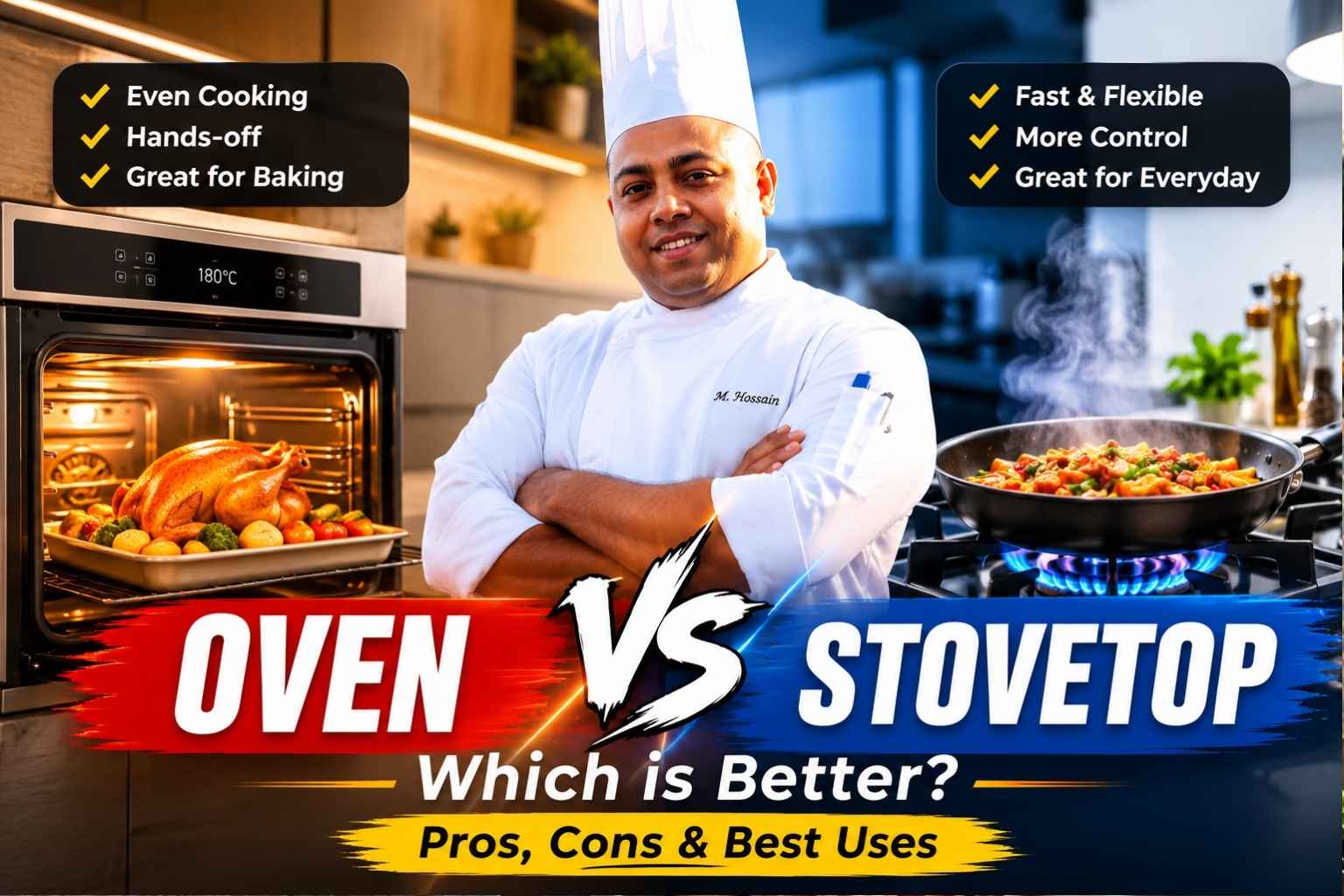
Have you ever stood in your kitchen and wondered about Oven vs Stovetop? I have done that more times than I can count, especially when I wanted the best flavor with the least stress. Each method has its own strengths, and the right choice depends on your food, time, and cooking goals. In this guide, I’ll help you compare both, share simple tips, and make it easy to choose the best way to cook every meal.
What’s Actually Different: Conduction, Convection, and Radiant Heat
A stovetop and an oven heat food in two different ways. That’s the real root of this whole debate.
A stovetop uses conduction. The burner heats the pan. The pan touches the food. Heat moves from the hot metal straight into your dinner. This happens fast, often in seconds.
An oven uses two things at once. Hot air moves around the food. This is convection. The oven’s walls also glow with heat and send out infrared waves. This is radiant heat.
I learned this the hard way in my first kitchen job. I tried to sear a steak under the broiler alone, with no pan contact. It took far too long, and the crust never formed the way it should. A hot pan on the stove did the same job in two minutes flat.
Direct contact wins for speed and a dark crust. Hot air wins for even cooking over time. That’s why a sauté pan sears in seconds, but a whole roast in the oven takes an hour or more.
Some restaurant kitchens use a combi oven, which adds steam to the hot air. This is still convection at its core, just with extra moisture control. Even high-end equipment runs on the same basic physics as a home oven.
Heat Control: Why a Stovetop Reacts in Seconds and an Oven Lags
Turn a gas burner down, and the flame drops right away. Turn an oven down, and the air inside stays hot for a while. That’s the short version.
A stovetop gives instant feedback. You watch a sauce start to boil. You turn the knob. The heat drops in seconds. This tight loop lets you fix mistakes before they happen.
An oven is slow to respond. The air and metal inside hold heat. Even after you lower the dial, the oven can stay too hot for ten minutes or more. This delay is called thermal lag.
I once dropped the oven temperature mid-bake to save a tray of cookies that were spreading too fast. Nothing changed for ten minutes. The damage was already done by the time the oven cooled.
This is also why bakers set a timer and walk away, while line cooks stand at the stove the whole time. One tool rewards patience. The other rewards fast hands.
Speed and Energy Efficiency: Which Costs Less to Run
For one task, a stovetop burner is usually faster and cheaper to run. For big batches, an oven can pull ahead. It depends on the dish.
A burner heats a small pan fast, with little wasted heat. You heat the pan, not the whole kitchen. Most stovetops reach full heat in under a minute.
An oven has to heat a large box of air and its own metal walls first. Preheating takes 10 to 20 minutes, depending on the model and the target temperature. That preheat time uses energy before any food goes in.
But ovens are efficient per item when they’re full. Roast six chicken thighs at once, and the energy cost per thigh drops. Pan-fry six thighs, and you may need two or three batches, which adds up in total stove time (ENERGY STAR, 2023).
The oven type also matters. A convection oven uses a fan to move hot air, so it heats up and cooks a bit faster than a conventional oven. The gap is usually 10 to 25 percent less time, not a full change in strategy.
Here’s a quick side-by-side to make the trade-offs clear.
Oven vs. Stovetop at a Glance
| Category | Stovetop | Oven |
|---|---|---|
| Speed | Heats up in under a minute | Needs 10-20 minutes to preheat |
| Heat control | Instant response to changes | Slow to respond, holds heat |
| Energy use (small meals) | Lower, heats only the pan | Higher, heats a large box of air |
| Energy use (large batches) | Higher, often needs multiple rounds | Lower per item when the oven is full |
| Best for | Searing, sauces, sautés, quick fixes | Roasting, baking, large trays |
| Cleanup | Pan and stove splatter | Racks and walls, but less daily mess |
| Learning curve | Steep at first, fast feedback | Gentle, but slower to learn from |
The table shows the general trend. The right pick still depends on the dish, the portion size, and how much time you have.
Best Stovetop Tasks: Searing, Sauces, and Quick Sautés
Use the stovetop for anything that needs fast changes or close attention. Searing, sauces, and sautés are the clearest examples.
Searing needs very high, direct heat. A cast iron or steel pan on high heat gives a dark crust in two to three minutes per side. This crust forms through a chemical change called the Maillard reaction, which needs high, dry heat (Serious Eats, 2024).
Sauces need small, constant fixes. A pan sauce can go from thin to thick in under a minute. You need to stir, taste, and adjust right away. The stovetop lets you do that without delay.
Eggs are another stovetop job. During brunch service, I cooked eggs to order, one pan at a time. A few extra seconds on the heat is the difference between a runny yolk and a dry one. You can’t get that kind of control from an oven.
Other stovetop wins: stir-fries, pan sauces, pasta, and anything that finishes in under 15 minutes.
Best Oven Tasks: Roasting, Baking, and Hands-Off Cooking
Use the oven for dishes that need slow, even heat over a longer time. Roasting, baking, and large trays of food all fall into this group.
Roasting works because hot air surrounds the whole piece of food. A whole chicken browns on all sides without you flipping it. The skin crisps while the inside slowly reaches a safe temperature.
Baking depends on steady, even heat held over time. Bread, cakes, and cookies all need a set temperature for a set time. Even a small swing in oven heat can change the final texture (King Arthur Baking, 2023).
Large batches are also an oven strength. A sheet pan can hold a full meal, like chicken, potatoes, and vegetables, all cooking at once with no extra attention.
I cook a turkey or a big roast in the oven every year for the same reason: it frees up my hands. While the oven does its job, I make sides, set the table, or just sit down for a while.
Low and slow roasting is another oven-only job. A pork shoulder at 300°F for several hours breaks down tough fibers into something soft and easy to pull apart. You can’t get that result with direct stovetop heat, since the bottom would burn long before the inside softened.
Gas vs. Electric Stovetops: How the Comparison Changes
Gas and electric stovetops change how fast and how precise the “stovetop side” of this whole comparison feels.
Gas burners give instant, visible heat. You see the flame size, and you can change it in less than a second. This makes gas feel closer to a chef’s tool, since most professional kitchens run on gas.
Electric coil burners are slower. The coil takes time to heat up and cool down, much like an oven does. This thermal lag makes electric coils far less responsive than gas.
My first apartment had an electric coil stove, and I burned more than one pan sauce before I learned to pull the pan off the heat early. The coil stayed hot long after I turned it down.
Induction is the outlier. It heats the pan directly through a magnetic field and skips the burner step entirely. Response time is close to gas, and many cooks find it easier to control and clean (Cook’s Illustrated, 2023).
If your stovetop is electric coil, treat it a bit like a small oven. Plan your heat changes a little earlier than you would on gas.
The “Sear Then Finish in the Oven” Method Pros Use
Most professional kitchens don’t pick one tool and stop. For thick cuts of meat, they use both, in order: sear on the stovetop first, then finish in the oven.
Here’s why. A hot pan gives a fast, dark crust on the outside in just a few minutes. But that same high heat would burn the outside long before the inside reaches a safe temperature.
The oven solves the second half. Once the crust is set, the dish moves to a preheated oven. Gentle, even heat finishes the inside without burning the crust you already built (America’s Test Kitchen, 2024).
I use this for steaks over an inch thick, pork chops, bone-in chicken thighs, and most roasts. Sear two to three minutes per side on the stove. Then move the pan to a 400°F oven for 8 to 15 minutes, depending on the thickness.
This combo gives you the best of both: a hard, dark crust on the outside and a juicy, evenly cooked center.
Texture Differences: Crust, Moisture, and Even Cooking
The tool you choose changes the texture of the final dish, not just the cook time.
Stovetop heat is intense and direct. This builds a strong crust fast. But that same intensity can dry out thin foods if you walk away, even for a minute.
Oven heat is gentler and more even. Moisture stays in the food longer, since the heat doesn’t hit one spot harder than another. This is part of why slow-roasted meats often stay juicier than pan-fried cuts of the same size.
Even cooking is an oven strength. A thick piece of fish in a hot pan can be raw in the center and overdone at the edges. The same fish in the oven cooks at a steadier rate from edge to center.
Crust, though, almost always needs the stovetop or a broiler. Bread bakers even add steam to ovens to help the crust form, since hot air alone rarely gives that deep brown, crisp edge (King Arthur Baking, 2023).
Thickness changes which tool wins. A thin cutlet cooks through in the time it takes to brown one side, so the stovetop alone can handle it. A thick roast needs more time than the outside can survive on direct heat alone, which is why it needs the oven, or both tools together.
Cooking Without an Oven: Stovetop-Only Strategies and Their Limits
You can cook full meals with just a stovetop. I did exactly that for two years in a small studio apartment with no working oven.
Braising works well on the stovetop. Brown the meat first, then add liquid, cover the pot, and cook on low heat for one to two hours. This mimics what a low oven does, just inside a covered pot instead of a box.
A toaster oven or air fryer can fill the gap for small baking and roasting jobs. Both use hot air, much like a full-size oven, just on a smaller scale.
A heavy pot with a lid can even bake bread on the stovetop, if you keep the heat low and steady and check it often. It’s not the same as a real oven, but it works in a pinch, even while camping.
The main limit is batch size. A stovetop pot can only hold so much. Cooking for a crowd without an oven means cooking in rounds, which adds up in total time.
Common Mistakes When Choosing Oven vs. Stovetop (and Fixes)
The biggest mistakes come from using the wrong tool for the job, or using the right tool the wrong way.
Mistake 1: Overcrowding a pan. Too much food in one pan drops the pan’s temperature and traps steam. The food steams instead of searing. Fix: cook in smaller batches with space between pieces, or move to a sheet pan in the oven.
Mistake 2: Skipping the oven preheat. Putting food in a cold oven means the early cook time doesn’t count the way most recipes assume. Fix: always let the oven fully preheat before the food goes in, especially for baking.
Mistake 3: Using high stovetop heat for everything. High heat is great for searing but ruins sauces and delicate proteins. Fix: match the heat level to the task. Searing needs high heat. Sauces and eggs need low to medium heat.
Mistake 4: Opening the oven door too often. Each open lets out heat and adds extra minutes to the cook time. Fix: use the oven light and window to check food instead of opening the door.
Mistake 5: Using the oven for a single small portion. Heating a full oven for one chicken breast wastes time and energy. Fix: for one or two portions, the stovetop or a toaster oven is usually faster and cheaper.
My Decision Routine: How I Pick Oven or Stovetop for Any Dish
Here’s the actual routine I use, every time, after 15 years of cooking in professional and home kitchens.
First, I ask: does this dish need constant attention, or can it sit on its own? If it needs stirring, flipping, or fast fixes, it goes on the stovetop. If it can sit and cook by itself, it goes in the oven.
Second, I ask: what’s the portion size? A single serving or two usually makes more sense on the stovetop. A full tray or a large roast usually makes more sense in the oven.
Third, I ask: do I need a crust? If yes, the stovetop comes first, even if the dish finishes in the oven afterward.
Fourth, I ask: how much time do I have to stand at the stove tonight? Some nights I want a 10-minute stovetop meal. Other nights I’d rather set an oven timer and step away.
Fifth, I ask: am I cooking for one or two people, or for a group? For one or two, the stovetop is often faster and uses less energy. For a group, the oven’s larger capacity usually wins.
This routine takes about two seconds in my head now, but it took years to build. Most “which is better” questions disappear once you ask what the dish actually needs.
Frequently Asked Questions About Oven vs. Stovetop Cooking
Is it cheaper to cook on the stove or in the oven?
For small, quick meals, the stovetop usually costs less to run. It heats only the pan, not a large box of air. For big batches, an oven can cost less per portion (ENERGY STAR, 2023).
Can I sear meat in the oven instead of on the stove?
You can use a broiler for some browning, but it’s slower and less even than a hot pan. For a real crust, sear on the stovetop first, then finish in the oven if needed.
Why does my oven take so long to preheat?
An oven has to heat a large box of air and its own metal walls before it reaches the set temperature. This usually takes 10 to 20 minutes, depending on the oven and the target temperature.
Is gas or electric better for stovetop cooking?
Gas gives instant, easy-to-see heat changes. Electric coil is slower to respond. Induction is fast like gas, but it heats the pan directly, which many cooks find easier to control (Cook’s Illustrated, 2023).
What foods cook better in the oven than on the stove?
Roasts, whole chickens, casseroles, bread, cakes, and cookies all do better in the oven. These need even heat from all sides over a longer time.
What foods cook better on the stove than in the oven?
Sauces, eggs, stir-fries, pan-seared meats, and anything that needs fast changes do better on the stove. These need quick, hands-on adjustments.
Why do recipes say to sear, then finish in the oven?
Searing builds a fast, dark crust with direct, high heat. The oven then finishes the inside with gentle, even heat, without burning the crust you just built (America’s Test Kitchen, 2024).
Can I bake without an oven?
A toaster oven or air fryer can bake small items, since both use hot air like a full oven, just on a smaller scale. Full loaves of bread or large cakes are hard to bake well without a full-size oven.
Key Takeaways
- A stovetop heats through direct contact (conduction). An oven heats through hot air and radiant walls (convection and radiant heat).
- The stovetop wins on speed, control, and crust. The oven wins on even heat, large batches, and hands-off cooking.
- Energy use depends on the job. Stovetops often cost less for small meals, while ovens can cost less per portion for big batches (ENERGY STAR, 2023).
- The “sear then finish in the oven” method gives you a strong crust and a juicy center, and it’s how most pros cook thick cuts (America’s Test Kitchen, 2024).
- Overcrowding a pan is one of the most common mistakes. Cook in smaller batches, or switch to a sheet pan in the oven.

I’m Mossaraof, a trained chef and the founder of OvenInsights.com. I spent years cooking at Larrupin’ Cafe and in kitchens across Chicago and Seattle. Now I test kitchen gear for a living. I moved to North Acton, London, and I test every tool I write about. I use real meals and real heat. No brand deals. No shortcuts. I cover 12 kitchen types and hundreds of recipes. I believe this: the right tools matter as much as the recipe.