
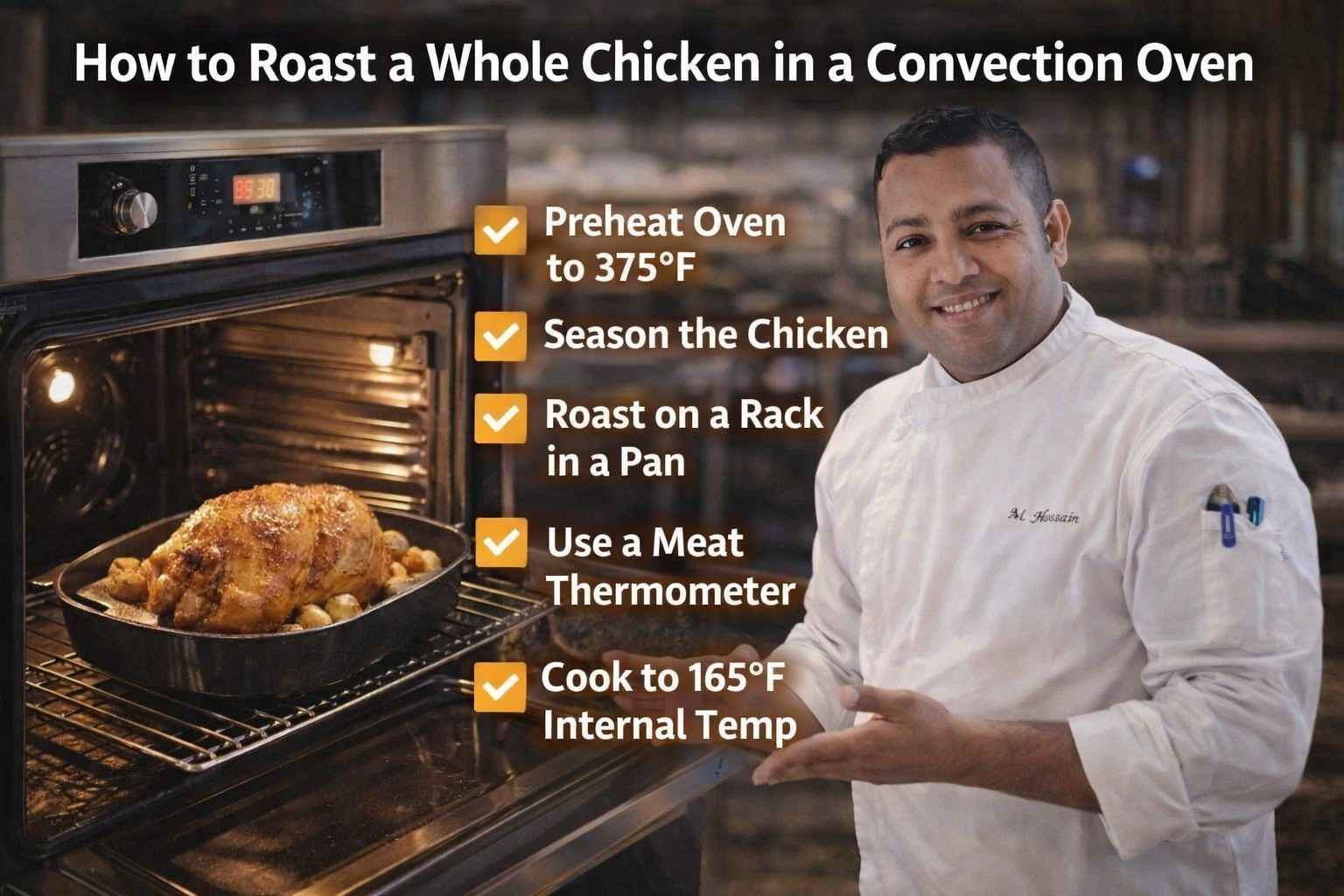
Hey, I’m Mossaraof — a professional cook and food blogger.
There is nothing quite like a bird with skin that shatters like glass and meat that stays incredibly tender. I will show you how to roast a whole chicken in a convection oven so you get a beautiful, even gold all the way around. My years in a busy Chicago kitchen taught me that a moving fan is the true secret to a faster, crispier roast than a standard bake. Use my Ultimate Guide to Master Your Oven to learn how to adjust your temperature and time for this high-performance setting. Let’s grab your roasting pan and start this perfect Sunday dinner together right now!
🟨 Why Convection Oven Roasting Changes the Whole Game
Before I switched to roasting whole chickens in a convection oven, I thought I had it all figured out. Then came the crispy skin test.
🟩 The Science of Roasting: Convection vs Conventional
Let me tell you — the first time I heard the oven fan kick on mid-roast, I was skeptical. I thought, “Great, now it sounds like a jet engine.” But what that fan does? Game-changer.
Convection ovens move hot air around using a built-in fan. That means:
- The heat wraps around the bird, not just hits it from top and bottom.
- It cooks faster — around 25% quicker than conventional.
- You get even browning and a crispier skin without babysitting.
When I used to roast in a regular oven, the breast would cook faster than the thighs. I’d cover it, uncover it, spin it around like a rotisserie mime. Now? The whole bird cooks evenly, and I’m not doing oven yoga.
Plus, in hot areas like Arizona (where I tested this again last summer), convection gives you less oven-on time. Less heat in the kitchen = less sweat dripping down your back while basting.
🟩 Who Benefits Most from Convection Roasting?
I think every home cook should try it at least once — especially if you:
- Work late and want dinner under 90 minutes
- Hate soggy chicken skin (who doesn’t?)
- Live in smaller homes or apartments where oven heat lingers
- Meal prep on Sundays and don’t want to spend all afternoon cooking
When I was living in Chicago in a one-bedroom, I avoided using the oven because it turned the whole place into a sauna. But with convection, I could roast a 4.5 lb chicken in about an hour and not break a sweat.
Also — if you’re cooking for Thanksgiving or a weekend gathering, and you need both racks? Convection is your best friend. It distributes heat so evenly that you can load up both trays and still get great results.
🟩 Is Convection Always Better? A Real Talk
Here’s where I’m honest with you: convection ovens are amazing, but not magic.
- If you forget to adjust the temp or don’t check early, your chicken can dry out.
- Stuffed birds may cook unevenly unless you really monitor the temp.
- Convection can over-brown thin parts like wing tips if you’re not careful.
I once left a 6 lb chicken in too long — forgot to reduce the convection temp — and let’s just say the skin was… “extra roasted.” Still edible, but definitely not Instagram material.
What I’ve learned is this: the more you roast with convection, the more you feel the timing. You start to trust the sizzle, the smell, the golden color through the oven door.
🟨 Choosing the Right Whole Chicken for the Oven
I don’t just grab the cheapest bird at the store. There’s more to picking the right chicken than meets the eye.
🟩 Fresh vs Frozen Whole Chicken — What I Prefer
Okay, I’ve roasted both — plenty of times. In fact, I once cooked a frozen whole chicken from Costco straight out of the deep freeze because I forgot to thaw it the night before. Big mistake. Took forever and cooked unevenly.
Now I always thaw fully — and yes, both frozen and fresh can work if handled right. But here’s what I’ve noticed:
- Fresh chicken usually has better texture and more natural flavor.
- Frozen chicken (if air-chilled) is still great if thawed in the fridge for 24–36 hours.
- Vacuum-sealed frozen birds from U.S. stores like Kroger or Safeway often retain moisture well.
When I go fresh, I try to cook it within 1–2 days. If I’m doing a weekend roast, I’ll grab the bird Friday and let it dry-brine overnight.
Smell and look matter too. A good chicken smells clean — no weird odors. Skin should look pale pink or ivory, not grayish.
I once grabbed a whole chicken in a hurry, didn’t check the pack date, and let’s just say… the fridge got a little funky.
🟩 Organic, Free-Range, or Air-Chilled?
Let’s break this down without the food snobbery.
- Organic: Yes, it’s usually more flavorful, but not always worth the price if you’re adding a strong rub or sauce.
- Free-range: Better texture in my experience — a bit more “chickeny.”
- Air-chilled: Hands-down my favorite. Less water = crispier skin in a convection oven.
Here in the U.S., brands like Smart Chicken and Bell & Evans offer good air-chilled options. You can usually tell because they aren’t swimming in liquid inside the package.
One thing I avoid? Pre-brined or “enhanced with up to 15% solution” birds. They always taste off to me — like they were soaked in chicken-flavored Gatorade.
🟩 Best Chicken Size for Roasting Evenly
Another thing I’ve learned: size matters, but bigger isn’t always better.
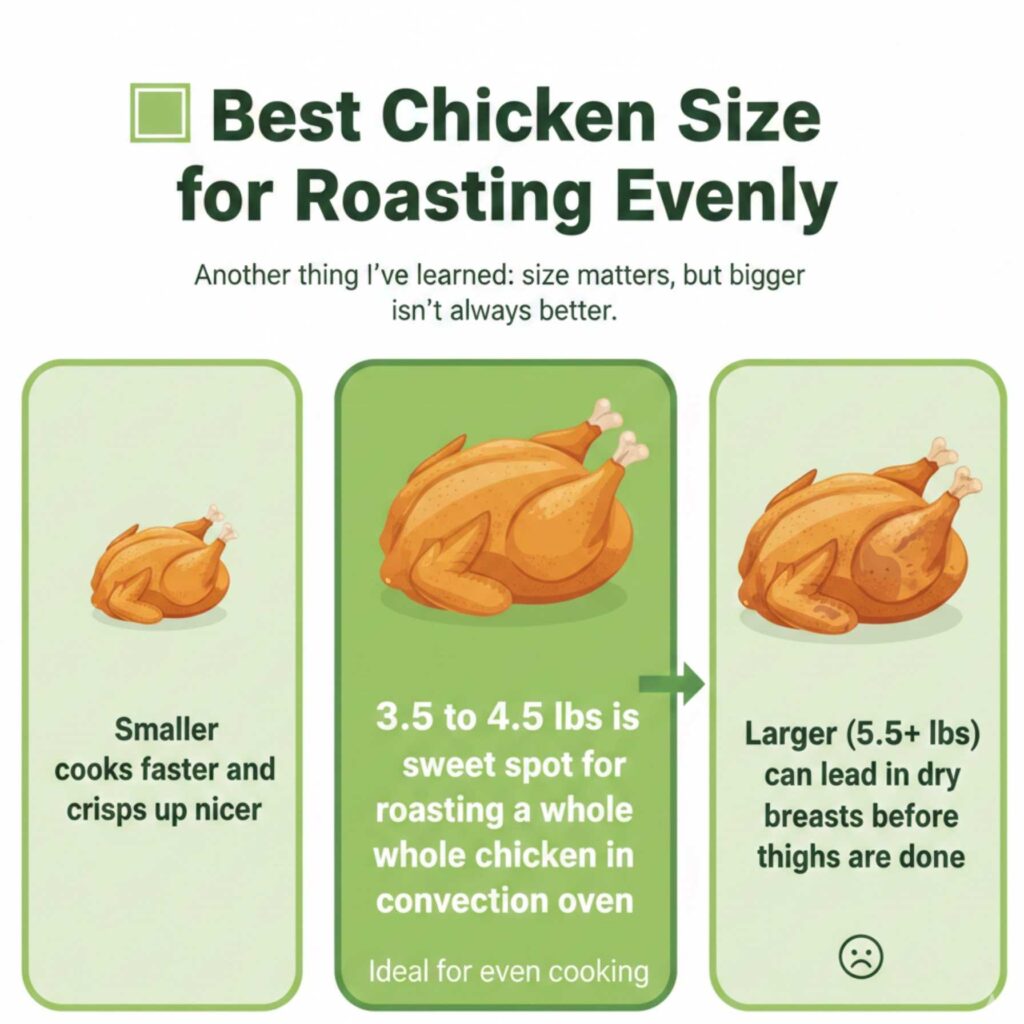
- 3.5 to 4.5 lbs is the sweet spot for roasting a whole chicken in a convection oven.
- Smaller cooks faster and crisps up nicer.
- Larger (5.5+ lbs) can lead to dry breasts before thighs are done.
If I’m feeding four people or meal-prepping for the week, a 4.2 lb bird is my go-to. It fits well in my Staub roasting pan, cooks in just over an hour, and gives me leftovers for tacos the next day.
Oh — and always check the cavity. I once roasted a chicken with the bag of giblets still inside. The kitchen smelled… interesting.
🟨 What Tools Make or Break Your Roasted Chicken
I’ve roasted chickens using everything from disposable foil pans to fancy Dutch ovens. Some tools help. Others? Just take up drawer space.
🟩 Best Pans for Roasting a Whole Chicken in a Convection Oven
Over the years, I’ve rotated through quite a few pans — glass, ceramic, metal, cast iron — and here’s what I’ve found:
- Sheet pans with a roasting rack work beautifully in convection ovens. Air circulates under the chicken, so the bottom crisps up, too.
- Dutch ovens (I use a Staub and sometimes a Lodge) make the juiciest chicken I’ve ever eaten — especially in colder climates like Minnesota, where I tested this in winter.
- Stainless steel roasters are reliable and durable, though the skin doesn’t crisp quite as evenly unless you elevate the bird.
- Avoid glass pans if you can. They heat unevenly in convection settings, and I’ve had one shatter after a quick broil. Scary stuff.
When I’m in a rush or cooking multiple birds, I still fall back on my aluminum half sheet pan with a metal rack. It’s affordable, lightweight, and fits in every oven I’ve used — even smaller GE convection ovens you see in apartment kitchens.
🟩 Thermometers, Baster, and Trussing Tools
Let’s talk tools that prevent dry chicken and kitchen meltdowns:
- Leave-in digital thermometers are a must. I use a ThermoPro with a probe — no guessing, no stabbing the bird a dozen times.
- Butcher’s twine helps keep the legs tucked in, which I do about 50% of the time. If I’m stuffing the cavity with lemon or garlic, I always truss.
- Baster? I honestly use a spoon or small ladle instead. It’s easier to clean, and I have better control.
There was a week I roasted three chickens back-to-back — testing different convection settings. The only consistent hero? My thermometer. Saved me from overcooking every single time.
🟩 Optional But Handy Extras
Not everything is essential, but some tools just make things smoother.
- Convection-safe roasting bags: I use these on dry winter days when I want ultra-juicy meat without much basting.
- Foil tent: Great for shielding wing tips or slowing down browning on top.
- Silicone oven mitts: If you’re working with cast iron or a Dutch oven, these save your hands — especially those Staub handles that feel like lava rocks.
I also keep a wire rack nearby post-roast. Letting the bird rest elevated (not sitting in juices) helps the skin stay crisp. I learned that one after serving a soggy-bottomed bird on Christmas Eve. Never again.
🟨 How to Prep a Whole Chicken for Convection Roasting
Roasting starts before it hits the oven. Trust me — how you prep matters as much as the roast.
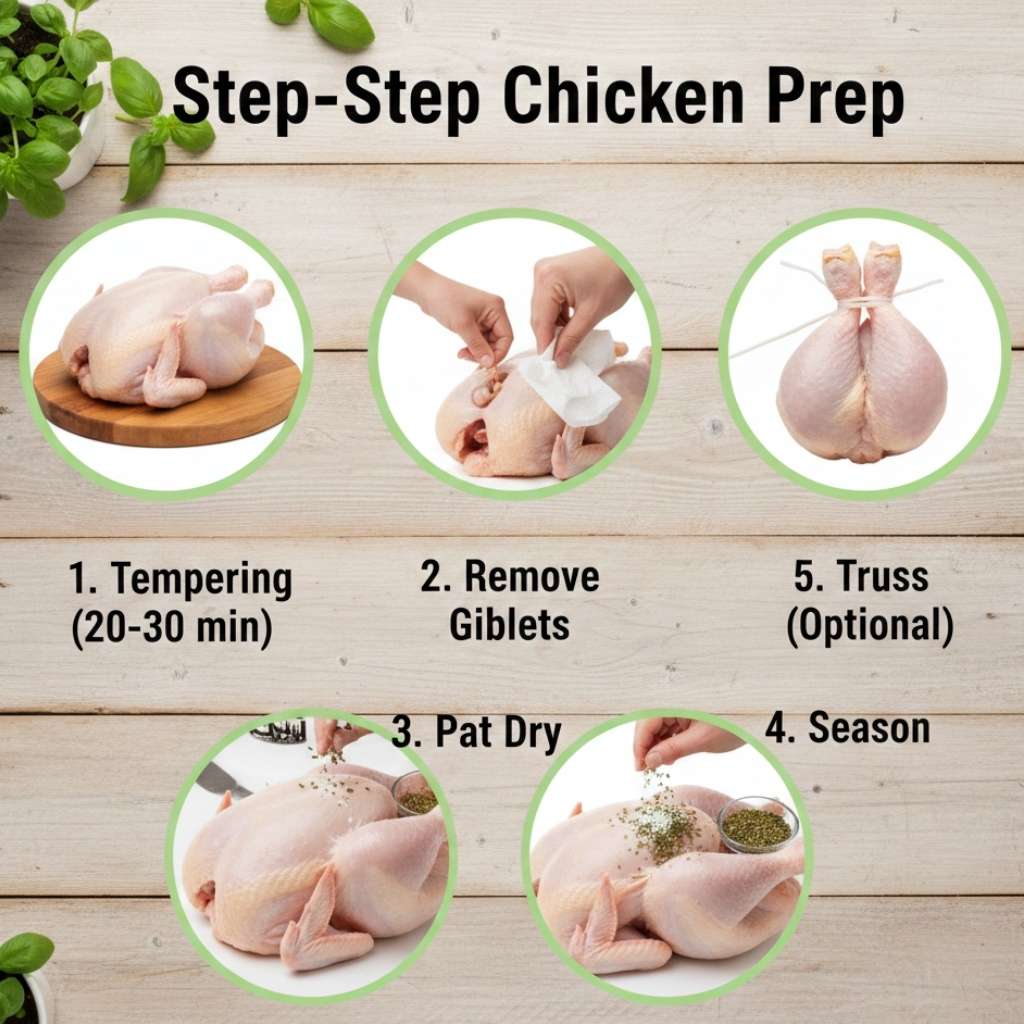
🟩 Step-by-Step Chicken Prep (My Real Routine)
Here’s exactly how I prep a whole chicken, whether it’s a Sunday meal or a midweek dinner.
- Take it out of the fridge and let it sit for 20–30 minutes. Cold meat cooks unevenly.
- Remove the giblets — yes, even from the back of the cavity. I’ve forgotten more than once.
- Pat it bone-dry with paper towels. This step makes or breaks the skin texture.
- Season it — either right before roasting or, ideally, dry-brine overnight.
- Truss the legs if I’m stuffing the cavity or want a neater roast. Otherwise, I leave them loose.
One time I was in a rush and skipped drying the skin. The chicken still tasted good, but the skin came out kind of rubbery. Lesson learned: moisture is the enemy of crisp.
If I have time, I leave the bird uncovered in the fridge overnight. That dry air pulls moisture from the skin and gives you that golden, crackly texture everyone loves.
🟩 Flavor Boosters — Rubs, Butters, Citrus & Herbs
Let’s be honest — a plain roasted chicken is fine, but when you layer in flavor? That’s where the magic happens.
Here’s what I reach for most:
- Garlic herb butter under the skin (my default):
I mash softened butter with salt, crushed garlic, rosemary, lemon zest, and thyme. Then I gently lift the skin and smear it in with my fingers. Messy, but worth it. - Dry rubs:
If I want something fast and low-mess, I mix smoked paprika, garlic powder, onion powder, kosher salt, and a touch of brown sugar. This works great when I’m roasting in convection at 400°F for extra crisp. - Cavity flavor bombs:
I toss in half a lemon, a few smashed garlic cloves, and fresh herbs. Not for eating — they just perfume the meat from the inside. - Oil vs Butter?
Butter browns beautifully but can burn if temps run high. If I’m going 400°F convection, I’ll swap to avocado oil.
I still remember the first time I pushed lemon-herb butter under the skin of a chicken. I expected flavor, but not the way it soaked into every bite. It was like roast chicken leveled up.
🟩 To Stuff or Not to Stuff?
For convection roasting, I almost always skip stuffing the chicken with anything dense like bread. It slows down cook time and can mess with food safety.
Instead, I:
- Add herbs, citrus, or garlic to the cavity for steam flavor
- Make stuffing separately in a small baking dish
- Keep the bird airy and loose so hot air flows through
One Thanksgiving, I tested a convection roast with breadcrumb stuffing in the bird. The outside cooked faster than the inside by about 20°F — not ideal. I ended up having to cut it open and finish it in pieces.
So now I keep it simple: flavor inside, stuffing outside.
🟨 Convection Oven Settings for Roasting Chicken
This is where I had to relearn everything — convection roasting messes with traditional temps and timing.
🟩 Whole Chicken Convection Oven Temperature
When I first started roasting chickens in a convection oven, I made the rookie mistake of using the same temperature I used for bake mode — 425°F. Let me tell you, that skin got dark fast, and the inside was still pink.
Now I’ve tested it enough times to know:
- 375°F convection is the sweet spot for even cooking and browning.
- 400°F convection works great if you’re watching it closely and want ultra-crisp skin.
- Start low, end high (reverse sear): I sometimes begin at 325°F for 30 minutes, then blast at 425°F for the last 10–15 mins.
I use this strategy when I’ve got company coming over and I want that glossy, photo-worthy chicken skin. And when I’m reheating leftovers? I never go above 325°F convection — more on that later.
🟩 Whole Chicken in Convection Oven — How Long to Cook?
If you’re asking how long to cook a whole chicken in a convection oven, here’s the basic rule I go by:
🕒 15 minutes per pound at 375°F convection
(But always confirm with a meat thermometer.)
Here’s a quick cheat sheet I use on the fridge:
- 3 lb chicken → ~45 minutes
- 4.5 lb chicken → ~1 hour 10 minutes
- 5.5 lb chicken → ~1 hour 20–25 minutes
- 6 lb chicken → ~1 hour 30–40 minutes
But of course, it depends on a few things:
- If the chicken is stuffed, add 15–20 minutes
- If you trussed it tightly, heat takes longer to reach the cavity
- Altitude matters — when I cooked in Denver, everything took slightly longer. Dry air, thinner atmosphere. Go figure.
Once, I roasted two 4-lb chickens side by side in my Whirlpool convection oven. Same size, same prep. One finished 10 minutes earlier than the other — just because it was closer to the fan. I now rotate the pan once during cooking to even things out.
🟩 Internal Temperature and Rest Time
Here’s where I’ve become a total stickler.
No matter what the clock says, I go by temperature:
- Breast meat: 165°F
- Thigh meat: 175°F to 180°F for juicy, tender legs
I use a leave-in probe thermometer that beeps when the breast hits 162°F. Then I pull it, let it rest under foil for 10–15 minutes, and it coasts up to 165°F safely.
That resting time is sacred in my kitchen. It gives the juices time to settle back into the meat. If you slice too soon, it all runs out onto the cutting board and you’re left with dry bites and sticky fingers.
Also — convection keeps cooking the bird even after you shut the oven off. It’s like passive heat revenge. So give it that pause. You’ll be glad you did.
🟨 My Go-To Method: How I Roast a Whole Chicken in a Convection Oven
This is how I do it at home — nothing fancy, just what works.
🟩 The Real Cooking Process, Step-by-Step
This is my go-to method when I want that classic golden roast chicken — juicy inside, crispy outside — without babysitting the oven.
Step 1: Preheat
I preheat the oven to 375°F on convection mode.
If your oven has convection roast and convection bake, I use convection roast — it activates both top and bottom heating elements plus the fan.
While it heats up, I grab my butter, herbs, and thermometer.
Step 2: Final Prep
- I pull the chicken from the fridge if it’s not already at room temp.
- If I didn’t dry-brine it overnight, I’ll salt it now — generously.
- Then I smear garlic-herb butter under the skin with my hands (yes, it’s messy).
- A few lemon halves and herbs go in the cavity.
- Truss the legs loosely, tuck the wings under.
Sometimes I skip trussing if I’m in a rush. The legs splay a little more, but it still cooks beautifully.
Step 3: Into the Pan
I place the chicken breast-side up on a rack inside my sheet pan or Dutch oven.
If I’m using a cast iron pan, I’ll sometimes toss some carrots and onions underneath to catch the juices (bonus side dish!).
Step 4: Roast Time
Into the oven it goes — middle rack, uncovered.
- I set a timer for 45 minutes.
- No opening the door unless something smells burnt.
- Around the 45–50 min mark, I check temp:
- Insert the probe into the thickest part of the breast (not touching bone).
- If it’s around 155°F–160°F, I know it needs 10–15 more minutes.
- At 162°F, I pull it and let carryover heat finish the job.
Sometimes I rotate the pan halfway through if the fan browns one side more than the other — especially in my older GE convection oven.
Step 5: Rest
Once out, I loosely tent with foil and let the chicken rest for 10–15 minutes.
During this time, the juices redistribute and the internal temp settles at a safe, juicy 165°F. The skin gets a little crinkly — that good kind of crackly look.
I’ve skipped resting before. The result? Cutting board soup. Never again.
Optional: Broil Blast
If the skin isn’t brown enough (rare, but it happens), I’ll pop it back in under convection broil for 2–3 minutes — eyes glued to the oven door. It goes from golden to scorched real fast.
🟨 What to Serve with Oven-Roasted Whole Chicken
Once it’s out of the oven and filling the whole kitchen with that herby scent, here’s what I usually plate with it.
🟩 Easy U.S.-Style Sides That Pair Perfectly
Depending on the day — and how many dishes I feel like cleaning — I rotate between quick sides and full-on comfort food.
Here are a few combos I’ve cooked over and over again:
- Roasted Baby Potatoes
Tossed with olive oil, rosemary, and sea salt. I throw them in a separate tray about 40 minutes before the chicken’s done. They crisp beautifully in convection. - Garlicky Green Beans
I sauté them in a pan with butter, garlic, and lemon zest. Sometimes I finish them in the oven during the chicken’s resting time — saves stovetop mess. - Southern Cornbread
Especially in colder months, this hits the spot. I bake it in a cast iron skillet for that crispy bottom. Adds a nice texture contrast. - Sourdough Rolls
I’m a sucker for crusty bread with roasted chicken. Especially when there’s lemon pan juice to mop up. I’ve used store-bought ones too when time’s tight (no shame!). - Sheet-Pan Veggies
If I’m doing a one-pan meal, I’ll surround the chicken with chunks of carrot, onion, and halved Brussels sprouts. Just toss them in oil and scatter around the bird.
When I cooked in Arizona during the summer, I avoided starchy sides and kept it light — think roasted zucchini or chilled cucumber salad. The convection oven helps keep the roast time short, so the kitchen doesn’t turn into a sauna.
🟩 Sauces and Gravies
Some days the chicken’s so juicy it doesn’t need a thing. Other times, I like to dress it up a bit.
- Lemon Herb Pan Sauce
After the roast, I deglaze the pan with a splash of white wine or chicken broth. Scrape up the brown bits, whisk in a little butter and lemon juice — boom, instant pan sauce. - Garlic Yogurt Dip
Especially for next-day leftovers, I mix Greek yogurt, garlic, dill, and a pinch of salt. It turns cold chicken into something snack-worthy. - Smoky BBQ Sauce
When I want a summer cookout vibe without firing up the grill, I’ll brush on a little BBQ sauce near the end or serve it on the side. Works well for guests who like stronger flavor.
I once brought a roasted chicken to a potluck and forgot the sauce. You’d be surprised how many people dipped it in ranch. Hey — whatever works.
🟨 Common Mistakes When Roasting Whole Chicken in a Convection Oven
I’ve made them all — so maybe you don’t have to.
🟩 Mistake #1: Not Drying the Skin Enough
If I could scream one tip from the rooftop, it’s this: dry that bird like your life depends on it.
The first time I roasted with convection, I skipped drying. I figured, “It’s hot air, it’ll crisp it up anyway.” Nope.
The skin steamed instead of crisped and came out rubbery, like microwaved turkey skin. Not great.
What I do now:
- Pat it dry with paper towels
- If time allows, leave it uncovered in the fridge overnight
- Make sure the cavity is dry too (I’ve pulled out water before — gross)
That one extra step makes a world of difference. You’ll hear the crackle when the chicken hits the hot oven air.
🟩 Mistake #2: Trusting Only the Clock
I used to set a timer, walk away, and trust the recipe. That worked… until it didn’t.
Once I had a 4.2 lb chicken roast 15 minutes longer than it should’ve — breast came out dry, even though the thighs were still perfect. That’s when I finally admitted it: the clock is just a guide.
What I do now:
- Use an internal thermometer, every time
- Check the breast AND the thigh — different zones cook at different speeds
- Adjust for cavity stuffing, pan material, even your oven brand
Different U.S. ovens have their own quirks. My Whirlpool convection oven runs hot; my mom’s older Frigidaire barely holds 375°F unless you give it a long preheat.
🟩 Mistake #3: Skipping the Resting Time
I’ve made this mistake more times than I care to admit. The chicken smells so good, it’s almost impossible to wait.
But if you slice into it right away? The juices pour out onto the board. That perfect roast turns into dry meat and wasted flavor.
What I do now:
- Pull the chicken at 162°F
- Tent loosely with foil
- Let it rest 10–15 minutes minimum before carving
I usually use that resting time to pour a drink, throw together a side, or just breathe. It gives the bird time to finish cooking gently — and it always tastes better.
🟩 Bonus Mistake: Overcrowding the Oven
This happened during a family gathering. I tried to roast two whole chickens plus a tray of veggies — all at once. The air couldn’t circulate, so the bottoms got soggy and the tops browned unevenly.
Lesson? Give the chicken space. Especially with convection, airflow is everything.
🟨 Reheating Leftovers Without Losing the Magic
Whole chicken means leftovers — and I’ve figured out how to reheat without rubbery skin.
🟩 How I Reheat in the Oven (Crispy Skin Hack)
I’ve tried reheating roast chicken every way imaginable — microwave (regret), skillet (not bad), air fryer (meh), and toaster oven (pretty decent). But the convection oven wins every time when you want that original texture back.
Here’s exactly how I do it:
- Preheat oven to 325°F (convection mode)
Lower heat helps reheat evenly without drying out the meat. - Place chicken in a small baking dish or on a sheet pan
I line it with foil for easier cleanup.
If it’s just breast meat, I add a small splash of chicken broth to the pan — about 2 tablespoons. This keeps it juicy. - Cover loosely with foil
This is the trick. It traps moisture in for the first few minutes. - Heat for 10–15 minutes covered
I usually pull a leg or breast out and press it gently — if it bounces back and feels warm all the way through, it’s ready for the final step. - Uncover and broil for 2–3 minutes
This crisps the skin back up. Watch it closely. Like… don’t leave the kitchen. The skin can go from beautiful to burnt real quick.
When I reheat a full leg quarter this way, it comes out almost like it was just roasted — crispy top, juicy inside, and none of that “leftover chicken funk.”
🟩 What NOT to Do
I’ve made plenty of leftover mistakes. Here’s what I avoid now:
- Microwaving
Unless it’s chopped up in soup or tacos, just don’t. It ruins the texture, and the skin turns soggy and sad. - Air fryer (sometimes)
It can work for wings or thin skin-on pieces, but it dries out breasts unless you add oil or cover it for part of the cook time. I use it in a pinch, but it’s not my go-to. - Skipping the foil
If you skip the foil cover in the oven, the meat dries out before the skin crisps. Learned that one the hard way during a lunch rush when I was impatient.
Oh, and don’t toss the bones. I save mine in a freezer bag for stock — especially in winter when I’m making soups on rotation.
🟨 Final Thoughts from a Roasting-Obsessed Chef
I’ve made this meal for everything from weeknight dinners to holiday feasts in Florida humidity and Midwest winters. Once you get the rhythm, roasting a whole chicken in a convection oven isn’t just easy — it’s joyful.
There’s something satisfying about it.
No fancy gadgets, no complicated marinades. Just a well-prepped bird, a hot oven, and a little know-how.
Some days, I cook it to feed myself for three days straight — drumsticks for dinner, breast meat for wraps, bones for broth.
Other times, it’s for friends. We crowd around the table, carving with buttered fingers and eating right off the cutting board.
I’ve burned the skin. Undercooked the thighs. Dropped the entire thing on the floor once.
But I’ve also nailed it — crisp, golden skin; meat so juicy it practically fell off the bone; kitchen filled with the scent of rosemary, lemon, and garlic.
And honestly? That’s what keeps me coming back.
If you’ve never roasted a whole chicken in a convection oven, give it a try this weekend.
You’ll feel like a chef — even if you’re just wearing sweatpants and roasting in a tiny apartment kitchen with a squeaky oven door.
And when that first slice reveals steamy, tender meat under golden crackly skin?
You’ll know it was worth it.
FAQs: How to Roast a Whole Chicken in a Convection Oven
How to Roast a Whole Chicken in a Convection Oven without drying it out?
To roast a whole chicken in a convection oven and keep it juicy, lower the temp by 25°F. Roast at 350°F and pull it at 165°F.
What temperature works best for How to Roast a Whole Chicken in a Convection Oven?
For how to roast a whole chicken in a convection oven, set it to 350°F. The fan cooks faster and helps brown the skin evenly.
How long does it take to roast a whole chicken in a convection oven?
When learning how to roast a whole chicken in a convection oven, plan about 15 minutes per pound at 350°F. Always check for 165°F inside.
Should I use a rack for How to Roast a Whole Chicken in a Convection Oven?
Yes, use a rack when you roast a whole chicken in a convection oven. Air flows under the bird, which helps crisp the skin all around.
Is convection better than a regular oven for roasting whole chicken?
Yes, convection moves hot air around the bird. It roasts a whole chicken faster, browns the skin well, and cooks the meat more evenly.

I’m Mossaraof, a trained chef and the founder of OvenInsights.com. I spent years cooking at Larrupin’ Cafe and in kitchens across Chicago and Seattle. Now I test kitchen gear for a living. I moved to North Acton, London, and I test every tool I write about. I use real meals and real heat. No brand deals. No shortcuts. I cover 12 kitchen types and hundreds of recipes. I believe this: the right tools matter as much as the recipe.