
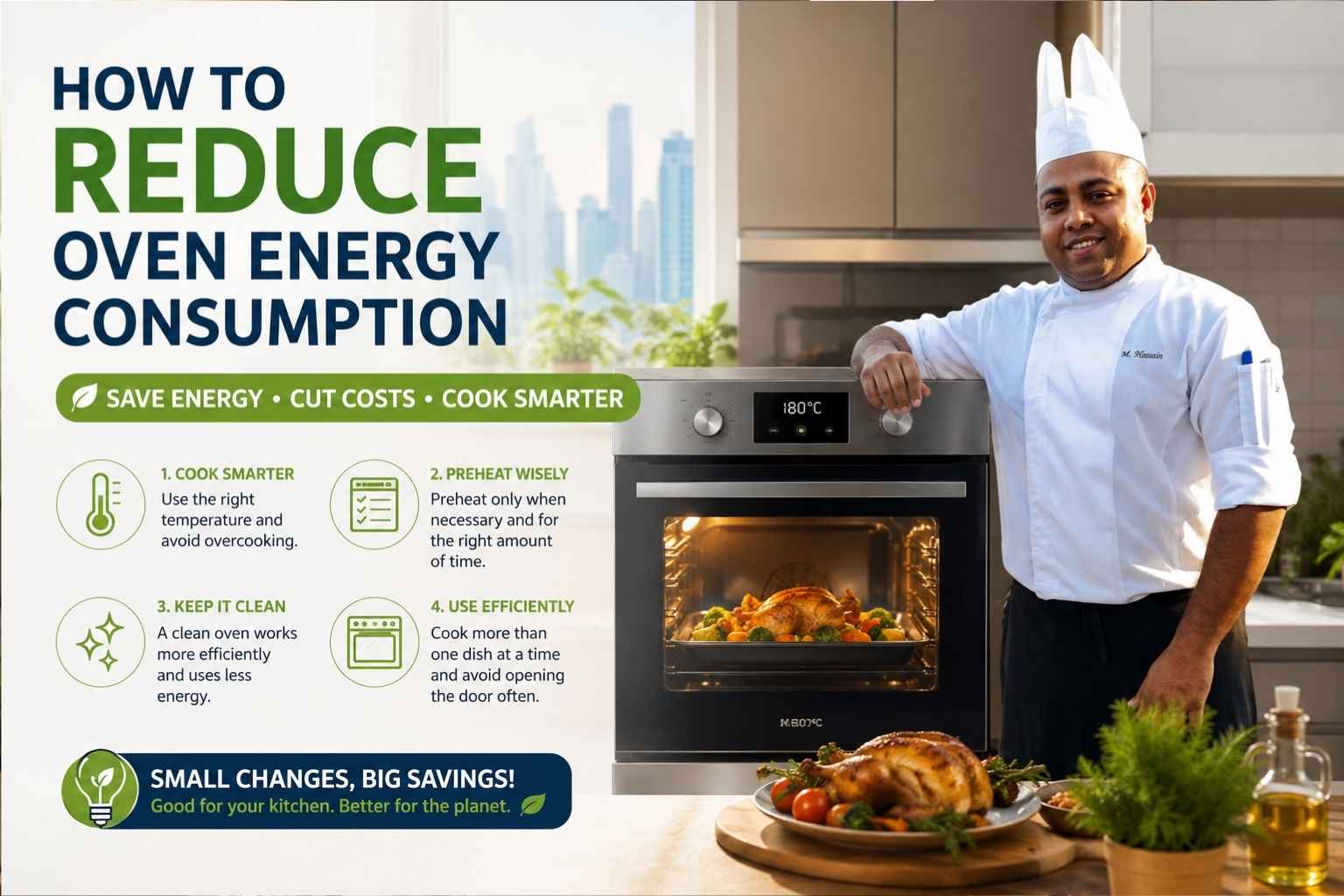
At A Glance
- A standard electric oven uses 2,000–5,000 watts per hour and costs the average U.S. household $80–$150 per year to run (U.S. Department of Energy, 2025).
- The three biggest energy wasters in any kitchen are preheating too early, opening the oven door mid-cook, and heating a near-empty oven.
- Convection mode cuts cook time by 25% and lets you drop the set temperature by 25°F — that alone can reduce per-meal energy use by 20% (ENERGY STAR, 2024).
- Residual heat cooking — turning the oven off 5–10 minutes before a dish is done — works reliably for roasts, casseroles, and baked goods, at zero extra cost.
- A toaster oven or air fryer uses 50–75% less energy than a full-size oven for meals under 4 servings (Consumer Reports, 2025).
Have you looked at your power bill and wondered why it keeps going up? How to Reduce Oven Energy Consumption is one of the easiest ways to save money without giving up the meals you love. I have tested many simple oven habits over the years, and I found that a few small changes can make a big difference.
In this guide, I will share easy tips that really work, explain why they help, and show you how to cook with less energy while getting great results every time. Let’s get started and help your oven work smarter, not harder.
Why Oven Energy Use Costs More Than You Think
A full-size electric oven draws between 2,000 and 5,000 watts depending on its age, size, and heating mode. If you cook dinner six nights a week at an average of one hour per session, you’re running your oven roughly 312 hours a year. At the U.S. average electricity rate of $0.17 per kWh (U.S. Energy Information Administration, 2025), that works out to $106–$265 annually — just for dinner.
That number surprises most people. And it doesn’t include preheating time, which can add 15–20 minutes per session on older ovens with poor calibration.
Gas ovens cost less to run per BTU in most markets, but they’re not as efficient as their price tag suggests. Around 40% of the heat a gas oven generates escapes through the door, walls, and venting (Lawrence Berkeley National Laboratory, 2024). Electric ovens lose less heat overall, but they take longer to reach temperature.
I’ve cooked in both professional gas kitchens and home electric setups for over 15 years. The type of oven matters less than how you use it.
The Three Energy Drains Most Cooks Never Address
Preheating Too Early — and for Too Long
Most home cooks preheat the oven when they start prepping ingredients. By the time the food goes in, the oven has been at full temperature for 20–30 minutes doing nothing.
A standard oven reaches 375°F in 10–15 minutes (America’s Test Kitchen, 2024). That’s the window you need, not 30. Set a timer when you turn it on. Put the food in as soon as it beeps.
For roasting vegetables or reheating dishes, you don’t need to preheat at all. Put them in a cold oven and let the heat rise with them. The texture difference is negligible for most savory dishes.
Opening the Door
Every time you open the oven door, you lose 25–50°F of heat (U.S. Department of Energy, 2025). The oven then pulls power to recover that temperature. If you’re checking on a roast every 10 minutes, you’re running the heating element almost continuously.
Use the oven light. Use a probe thermometer with an external display. Open the door once — to baste or rotate — then leave it alone.
Heating a Near-Empty Oven
Running a full-size oven to cook one chicken breast is like driving a semi-truck to pick up groceries. The energy cost is real, and the results aren’t better.
If you’re cooking for one or two people, a 1,200-watt air fryer or toaster oven gets the job done at a fraction of the energy cost. I’ll cover exactly when to make that switch later in this guide.
How Convection Mode Saves Energy — and Why More Cooks Should Use It
Convection mode uses a fan to circulate hot air inside the oven. That moving air transfers heat to food faster and more evenly than still air.
The practical result: you can cook at 25°F lower than the recipe says and finish 20–25% faster (ENERGY STAR, 2024). For a dish that normally takes 60 minutes at 375°F, convection gets it done in 45–48 minutes at 350°F.
That’s a 20–25% reduction in both time and energy with no change in food quality — often an improvement, since convection browning is more even.
When convection works best:
- Roasting vegetables, poultry, and meats
- Baking cookies and pastries (faster browning, crisper texture)
- Dehydrating or slow-roasting at low temperatures
When to skip convection:
- Delicate soufflés or custards — the fan can cause uneven rising
- Bread with a soft crust that benefits from steam retention
- Covered casseroles where the lid traps moisture anyway
If your oven has a convection setting and you’re not using it, you’re paying more than you need to for the same food.
Batch Cooking and Oven Stacking: Cook Once, Eat Three Times
The single most effective energy habit I’ve built over 15 years of cooking is batch cooking. Once the oven is hot, the marginal cost of adding a second or third dish is small — the oven is already at temperature.
On Sunday afternoons, I’ll often have three racks going at once: a tray of roasted vegetables on the top rack, a whole chicken on the middle, and a pan of grains or beans on the bottom. Total active oven time: 90 minutes. Total meals produced: 6–8 servings across 3–4 days.
How to Stack Dishes Without Ruining Them
The common fear is that stacking dishes blocks heat and leads to uneven cooking. That’s only true if you’re careless about it.
- Leave at least 2 inches of clearance between pans so air circulates.
- Put items that need more browning on the top rack — heat rises.
- Put covered dishes on the bottom — they don’t need direct radiant heat.
- Use convection mode when stacking. The fan compensates for blocked airflow.
- Rotate pans halfway through if cooking times differ by more than 15 minutes.
Professional kitchens run ovens at near-full capacity during service for exactly this reason. You don’t need a commercial setup to apply the same principle.
The Right Oven Temperature for the Right Job
Higher heat is not always faster. This is one of the most common misconceptions I see in home kitchens.
A chicken thigh roasted at 375°F for 35 minutes comes out juicier and more evenly cooked than one blasted at 450°F for 22 minutes. The high-heat version browns the outside faster, but the inside is still catching up — meaning the oven often ends up running longer to finish the center.
Temperature guide by cooking task:
| Task | Recommended Temp | Notes |
|---|---|---|
| Slow-roasting meats | 275°F–325°F | More even, less moisture loss |
| Roasting vegetables | 400°F–425°F | High heat for caramelization |
| Baking bread | 400°F–450°F | Steam in first 15 min for crust |
| Casseroles and braises | 325°F–350°F | Covered; low and slow works |
| Cookies and pastries | 325°F–375°F | Convection recommended |
| Reheating leftovers | 300°F–325°F | Low heat prevents drying out |
Matching temperature to the task means the oven runs for the right amount of time — not longer because you cranked it and then had to pull back.
Residual Heat Cooking: Turn the Oven Off Early
This is a professional kitchen technique that almost no home cook uses. It’s one of the easiest energy savings available.
The principle is simple: an oven that’s been at 375°F for 45 minutes has stored a significant amount of heat in its walls, floor, and the food itself. When you turn it off, the temperature inside drops slowly — typically 10–20°F over the first 10 minutes.
For most dishes, that’s enough to finish cooking.
How to apply it:
- For a roast or casserole: turn the oven off 8–10 minutes before the recipe’s end time. Leave the door closed.
- For baked goods like muffins or quick breads: turn off 5 minutes early. Let them sit for the final minutes undisturbed.
- For pizza: use residual heat for the last 3–5 minutes when the bottom is done but the top needs a little more set.
A probe thermometer is your best friend here. If the internal temperature of a roast is 5°F below target and there’s 10 minutes left, the oven can go off now. Carry-over heat will finish it.
I started doing this in a professional kitchen during a busy service when an oven was needed for the next tray. The food never suffered. The habit stuck.
Gas vs. Electric vs. Induction: Energy Efficiency by the Numbers
This is a question I get constantly, and the honest answer is more specific than most articles admit.
| Oven Type | Energy Efficiency | Average Annual Cost | Best For |
|---|---|---|---|
| Gas oven | ~40% efficient | $40–$80/year (varies by gas price) | High-heat searing, open-flame tasks |
| Electric conventional | ~55–60% efficient | $80–$150/year | All-purpose baking, roasting |
| Electric convection | ~65–75% efficient | $65–$120/year | Best overall for most cooking |
| Induction cooktop | ~85–90% efficient | N/A (stovetop only) | Fastest, most precise heat |
Sources: Lawrence Berkeley National Laboratory, 2024; U.S. Department of Energy, 2025.
Gas ovens are cheaper to run in markets where natural gas is inexpensive — but that gap is narrowing as gas prices rise and electric grids get cleaner. In states where electricity comes primarily from renewables, an electric oven has a significantly lower carbon footprint.
Induction is a cooktop technology, not an oven — but it’s worth mentioning here because many people use the stovetop to start dishes that finish in the oven. Switching stovetop cooking to induction while using the oven only for finishing work is one of the most effective ways to cut total kitchen energy use (Serious Eats, 2025).
How Oven Maintenance Affects Energy Use
A poorly maintained oven works harder to do the same job. I’ve seen this in both home and professional settings.
Door Seals
The rubber gasket around the oven door degrades over time. When it stops sealing properly, heat escapes and the thermostat triggers the heating element more often. A worn seal can increase energy use by 10–15% (Consumer Reports, 2024).
Test yours: close the door on a piece of paper. If you can pull it out easily, the seal needs replacing. Replacement seals for most oven models cost $15–$40 and take 20 minutes to swap.
Dirty Glass and Interior
A thick layer of grease on the oven floor acts as insulation — not in a helpful way. It absorbs heat that should be cooking your food and can cause hot spots. Clean the oven interior every 2–3 months, or after any major spill.
Avoid using self-clean mode more than twice a year. It runs the oven at 900°F+ for 2–4 hours and uses as much energy as a week of normal cooking (ENERGY STAR, 2024).
Calibration
Most ovens drift out of calibration by 25–50°F over time. An oven that reads 375°F might actually be at 340°F, which means you’re cooking longer — or compensating by cranking the heat.
Buy an oven thermometer ($8–$12 at any kitchen store). Put it in the center of the oven, set to 350°F, and check it after 20 minutes. If it’s off by more than 25°F, adjust your temperature settings to compensate, or call a technician to recalibrate.
When to Use a Toaster Oven, Air Fryer, or Microwave Instead
I’ll be direct: for meals under 4 servings, you often don’t need a full-size oven. Here’s how I actually use smaller appliances in my own kitchen.
| Appliance | Wattage | Best Use Case | Skip When |
|---|---|---|---|
| Toaster oven | 1,200–1,800W | Reheating, small roasts, toast, pizza | Cooking for 4+ people |
| Air fryer | 1,400–1,700W | Crispy foods, fries, chicken pieces, reheating | Baking delicate items |
| Microwave | 700–1,200W | Reheating, steaming vegetables, defrosting | Any browning or crisping needed |
| Full-size oven | 2,000–5,000W | Large roasts, batch baking, multiple dishes | Single servings |
Sources: Consumer Reports, 2025; ENERGY STAR, 2024.
A toaster oven uses 50–75% less energy than a full-size oven for the same task at smaller scale (Consumer Reports, 2025). For one portion of leftovers, the microwave uses 90% less energy.
I keep an air fryer on my counter and use it for anything under 3 servings that needs crispiness. Chicken thighs, vegetables, frozen appetizers — the results are equal to or better than the full oven, and it preheats in 3 minutes instead of 15.
The toaster oven handles bread, small sheet pan meals, and reheating pizza without the sogginess a microwave introduces. It’s the most versatile small appliance in my kitchen.
Common Energy-Wasting Mistakes and How to Fix Them
| Mistake | Why It Wastes Energy | Fix |
|---|---|---|
| Preheating 30+ minutes early | Oven at full temp with no food inside | Preheat for 10–15 min only; use a timer |
| Opening door frequently | Loses 25–50°F each time | Use probe thermometer with external display |
| Ignoring convection mode | Longer cook times at higher temps | Use convection; reduce temp by 25°F |
| Running oven for 1–2 servings | Full energy cost for small output | Use air fryer or toaster oven |
| Skipping batch cooking | One oven cycle, one meal | Plan 2–3 dishes per oven session |
| Turning off oven at recipe time | Wastes final 5–10 min of stored heat | Turn off 5–10 min early; use residual heat |
| Ignoring old door seals | Heat escapes; thermostat overcompensates | Test and replace seals annually |
| Using self-clean monthly | Uses more energy than 7 days of cooking | Use self-clean max twice per year |
| Wrong rack placement | Uneven heat; longer cook times | Top rack for browning, bottom for bases |
| Cooking at altitude without adjusting | Food takes longer; oven runs more | At 3,500+ ft, reduce temp 15–25°F or extend time slightly (King Arthur Baking, 2024) |
My Personal Energy-Saving Kitchen Routine
Here’s what I actually do, not what sounds good in theory.
Sunday batch cook (90 minutes of oven time, 6–8 servings produced):
- Preheat oven on convection at 375°F — set a 12-minute timer.
- Load three racks: vegetables on top, protein in the middle, grains or a covered dish on the bottom.
- Check oven temp with an in-oven thermometer, not the display.
- Use a probe thermometer in the protein so I don’t open the door.
- Turn the oven off 8 minutes before the protein hits target temp. Close the door and let it rest.
- Total cost for 6–8 servings: roughly $0.35–$0.50 in electricity.
Weeknight cooking (under 2 servings):
I use the air fryer for anything that needs heat and crispness. I use the microwave for steaming and reheating sauces. The full oven stays off unless I’m cooking for guests or doing a larger roast.
Monthly:
- Check door seal with the paper test.
- Verify oven calibration with my thermometer.
- Wipe down the interior to prevent grease buildup.
Every 6 months:
- Replace the oven thermometer if it’s reading inconsistently.
- Schedule a maintenance check if the oven is more than 10 years old — elements lose efficiency, and calibration drifts get worse.
Frequently Asked Questions About Reducing Oven Energy Consumption
How much energy does a typical electric oven use per hour?
A standard full-size electric oven uses 2,000–5,000 watts per hour, depending on its age and heating mode. Most modern ovens average around 2,400 watts during active heating. At the U.S. average rate of $0.17 per kWh (U.S. Energy Information Administration, 2025), that’s roughly $0.40 per hour of cooking.
Does preheating really make a significant difference in energy use?
Yes. Preheating for 30 minutes instead of 12–15 minutes can add $0.08–$0.12 per cooking session — that’s $25–$40 per year if you cook daily (U.S. Department of Energy, 2025). For most dishes, you don’t need more than 12–15 minutes to reach temperature.
Is convection mode actually worth using?
For most savory cooking, yes. Convection cuts cook time by 20–25% and lets you lower the set temperature by 25°F. The energy savings per meal are modest — maybe $0.05–$0.10 — but they add up over hundreds of meals per year. The food quality also improves for roasting and baking.
When should I use an air fryer instead of the oven?
Use an air fryer any time you’re cooking fewer than 4 servings of food that benefits from dry heat or crispness: chicken pieces, vegetables, fries, leftovers. It uses 50–75% less energy than a full-size oven for the same task at smaller scale (Consumer Reports, 2025) and preheats in 2–3 minutes.
How does opening the oven door affect energy use?
Each time you open the oven door, the interior temperature drops 25–50°F (U.S. Department of Energy, 2025). The heating element then runs at full power to recover that heat. If you open the door three times during a 45-minute cook, you’re adding 10–15 minutes of extra heating time. Use an oven light and probe thermometer to check on food without opening the door.
How do I know if my oven is wasting energy due to poor calibration?
Buy an oven thermometer and place it in the center of the oven. Set the oven to 350°F and check the thermometer after 20 minutes. If the reading is off by more than 25°F in either direction, your oven is miscalibrated. You can compensate by adjusting your set temperature, or have a technician recalibrate the thermostat.
Does oven age affect energy efficiency?
Older ovens — especially those made before 2005 — use significantly more energy than modern models. Insulation degrades, heating elements lose efficiency, and thermostats drift. If your oven is more than 15 years old, it may cost 20–30% more to run than a current ENERGY STAR-certified model (ENERGY STAR, 2024). Replacing it could pay off within 5–7 years in energy savings alone.
What is the most energy-efficient way to reheat food?
The microwave is the most energy-efficient option for reheating liquids and soft foods — it uses 90% less energy than a full-size oven for the same task (Consumer Reports, 2025). For food that needs a crisp texture, a toaster oven or air fryer is the next best option. A full-size oven is the least efficient choice for reheating single servings.
Key Takeaways
- A full-size electric oven costs $80–$265 per year to run depending on usage and local electricity rates (U.S. Energy Information Administration, 2025).
- The three biggest energy drains are early preheating, opening the door, and running a full oven for small meals.
- Convection mode saves 20–25% of cook time and energy with no change in food quality — use it for roasting and baking whenever possible.
- Batch cooking is the highest-impact habit: load the oven fully each session and cook 3–4 days of food in one 90-minute block.
- Turn the oven off 5–10 minutes before a dish is done and let residual heat finish the job.
- For meals under 4 servings, a toaster oven or air fryer uses 50–75% less energy than a full-size oven.
- Check your oven’s door seal and calibration annually — a 25°F calibration error or worn seal can add 10–15% to your energy bill.
- Self-clean mode uses as much energy as a full week of cooking — limit it to twice per year.

I’m Mossaraof, a trained chef and the founder of OvenInsights.com. I spent years cooking at Larrupin’ Cafe and in kitchens across Chicago and Seattle. Now I test kitchen gear for a living. I moved to North Acton, London, and I test every tool I write about. I use real meals and real heat. No brand deals. No shortcuts. I cover 12 kitchen types and hundreds of recipes. I believe this: the right tools matter as much as the recipe.