
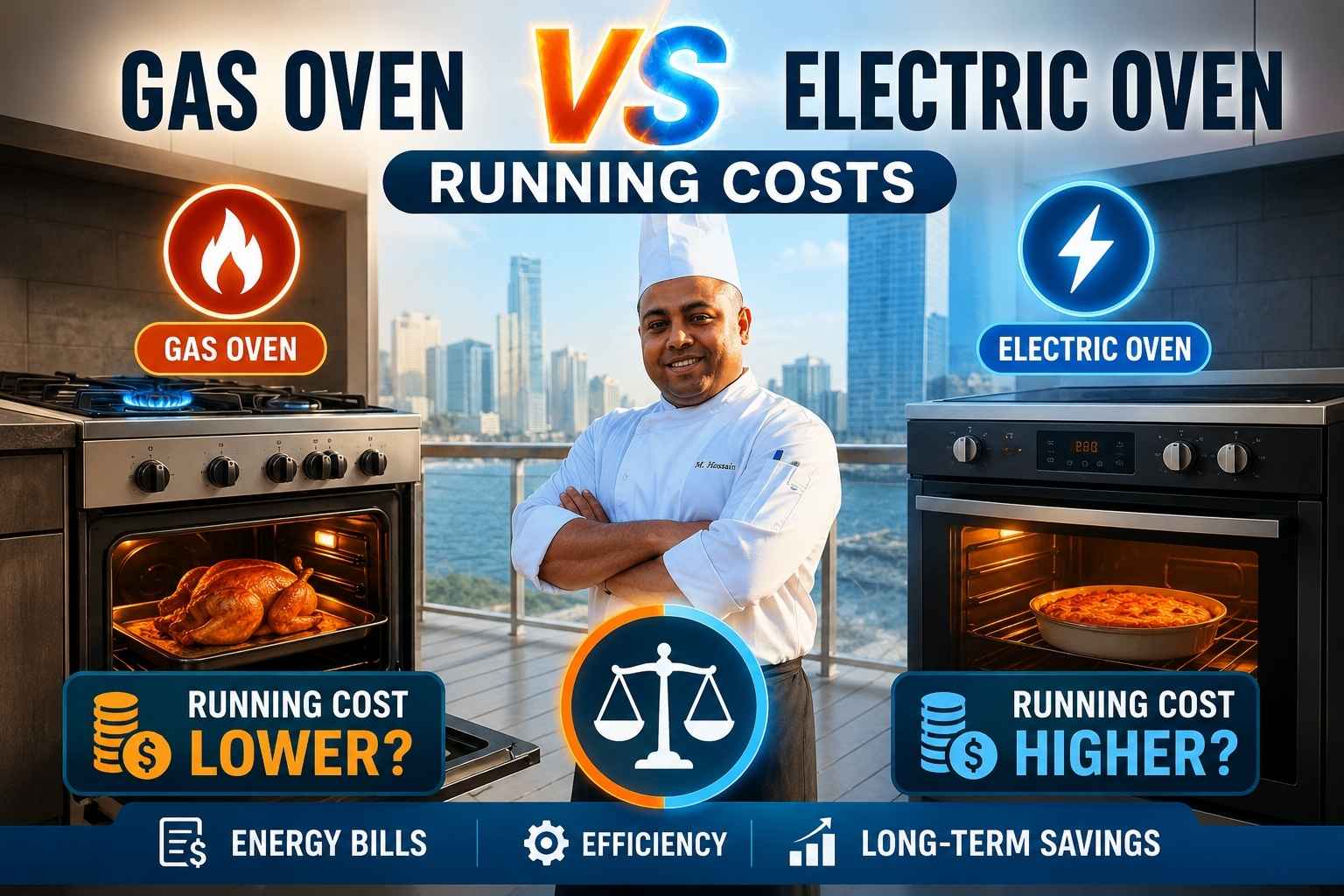
At A Glance
- Electric ovens cost more per hour to run than gas ovens in most US regions – roughly $0.17–$0.25/hour vs $0.07–$0.12/hour for gas – but the gap is narrowing as gas prices rise (U.S. Energy Information Administration, 2025).
- A heavy-use household (baking or roasting daily) can expect to spend $180–$320/year running an electric oven vs $80–$150/year for gas, based on current national average energy prices.
- Convection mode saves 15–25% on energy for both oven types by reducing cook time and temperature (U.S. Department of Energy, 2024).
- Electric ovens hold heat better after preheating, which partially offsets their higher hourly rate – especially for long, slow cooks.
- If your home already runs on solar or a renewable energy tariff, the electric oven becomes the cheaper AND lower-carbon option.
- For most households cooking 4–6 times per week, the annual running cost difference is under $100 – less than most people think.
My jaw dropped when I saw my last energy bill, so I knew I had to check out gas oven vs electric oven running costs to find some relief. It feels like our utility bills are burning a hole right through our pockets these days. As a home cook who has spent years testing both appliances, I have tracked every single cent to see where the cash goes. Let us dive into the real data together so you can choose the best way to cook your meals and save your money.
How Gas and Electric Ovens Use Energy Differently – BTUs vs Kilowatts
Gas and electric ovens don’t just use different fuels. They convert energy into heat in fundamentally different ways – and that changes how you pay for them.
A gas oven burns natural gas to produce heat, measured in BTUs (British Thermal Units). A standard home gas oven uses roughly 18,000–25,000 BTUs per hour at full power (U.S. Department of Energy, 2024). One therm of natural gas equals 100,000 BTUs, and the national average price for natural gas in early 2026 is around $1.35 per therm (U.S. Energy Information Administration, 2026). That works out to approximately $0.07–$0.12 per hour of oven use.
An electric oven uses a heating element – typically rated at 2,000–5,000 watts (2–5 kW). Most standard home electric ovens draw around 2.3–3.5 kW during active heating. At the US national average electricity price of $0.17 per kilowatt-hour (kWh) (U.S. Energy Information Administration, 2026), that’s roughly $0.17–$0.25 per hour at temperature.
The key phrase is “at temperature.” Both ovens cycle on and off to maintain the set temperature. They don’t run at full power continuously. But electric ovens are more efficient at holding that temperature once reached – more on that below.
What You Actually Pay Per Cook: US and UK Prices Calculated
The hourly rate only tells part of the story. What you care about is the cost per cook – from the moment you turn the oven on to the moment the food comes out.
US Running Cost Per Cook (2026 Prices)
Gas oven costs are based on $1.35/therm national average. Electric costs use $0.17/kWh national average (U.S. Energy Information Administration, 2026).
A typical 45-minute roast at 375°F, including a 10-minute preheat:
- Gas oven: ~22,000 BTU/hr x 0.92 hours = ~0.20 therms = $0.27 per cook
- Electric oven: ~2.5 kW x 0.75 hours (lower duty cycle once at temp) = ~1.9 kWh = $0.32 per cook
That’s a difference of about $0.05 per cook. Over 300 cooks a year, that’s $15 in savings for gas.
UK Running Cost Per Cook (2026 Prices)
UK prices are higher and the gap is wider. The average UK gas unit rate is 7.42p/kWh and electricity is 24.50p/kWh (Ofgem, 2026).
- Gas oven: ~0.9 kWh gas equivalent per cook = 6.7p per cook
- Electric oven: ~1.9 kWh per cook = 46.6p per cook
In the UK, gas is roughly 7x cheaper per unit than electricity. That makes the annual gap much larger for heavy users.
Running Cost Comparison by Usage Level: Light, Moderate, and Heavy
This table uses US national average prices. Gas at $1.35/therm, electricity at $0.17/kWh. Preheat time is included in each session estimate.
| Usage Level | Sessions/Week | Gas – Monthly Cost | Gas – Annual Cost | Electric – Monthly Cost | Electric – Annual Cost |
|---|---|---|---|---|---|
| Light (occasional roasting) | 1-2 | $4–$7 | $48–$84 | $6–$11 | $72–$132 |
| Moderate (regular family cooking) | 3-5 | $10–$18 | $120–$216 | $16–$28 | $192–$336 |
| Heavy (daily baking or meal prep) | 6-7+ | $18–$30 | $216–$360 | $28–$46 | $336–$552 |
Note: Actual costs vary by region, oven age, insulation quality, and whether convection mode is used. These figures reflect a mid-range oven in good working condition.
Hidden Costs: Preheat Time, Heat Retention, and Energy Waste
The hourly rate doesn’t capture everything. Preheat time and heat retention are two factors that shift the real-world numbers.
How Long Each Oven Takes to Preheat – And Why It Matters
A gas oven typically reaches 350°F in 10–15 minutes. An electric oven takes 12–20 minutes to reach the same temperature (Consumer Reports, 2025). That extra time on an electric oven isn’t free – you’re paying for 5–10 minutes of heating before a single thing goes in.
Over a year of daily use, that preheat gap adds up to roughly 18–36 kWh extra for an electric oven – about $3–$6 per year at average US rates. Not huge, but real.
Heat Retention After Preheat
Here’s where electric ovens claw back some ground. Electric ovens hold temperature more steadily than gas. Gas ovens cycle with a flame that goes fully on and off. Electric elements cycle more gradually. The result is that electric ovens maintain a more even temperature with less energy once they’re up to heat.
I’ve baked sourdough in both. My gas oven at the restaurant spikes and dips by 15–20°F during a cycle. My home electric oven stays within 5–8°F of the set point (measured with an oven thermometer). That stability means the electric element isn’t fighting temperature swings as hard – which partially explains why the duty cycle (the percentage of time the element is actually on) is lower than you’d expect from the wattage rating.
Leaving the Door Open
Both ovens lose significant heat when you open the door. A single door opening drops oven temperature by 25–50°F and triggers the heating system to compensate (U.S. Department of Energy, 2024). Gas recovers faster because the flame can ramp up quickly. Electric recovers more slowly. If you’re a “check on it every five minutes” baker, gas is genuinely cheaper for you.
How Oven Age, Insulation Quality, and Maintenance Affect Running Costs
An old oven costs more to run – no matter what fuel it uses. This is the factor most cost comparisons ignore completely.
Oven door seals degrade over time. A worn door gasket lets heat escape continuously during cooking. According to Which? (2025), a damaged door seal can increase oven energy use by up to 20%. That turns a $200 annual electric bill into $240 just from one worn rubber strip. Replacement gaskets cost $15–$40.
Oven insulation also matters. Older ovens – typically 10+ years old – have thinner or compressed insulation that holds heat less effectively. A well-insulated modern oven can be 15–30% more efficient than a 15-year-old model of the same type (ENERGY STAR, 2024).
For gas ovens specifically, a dirty or partially blocked burner runs less efficiently. If your gas flame is yellow or orange instead of blue, the burner needs cleaning. A clean blue flame burns more completely and wastes less gas. This is a five-minute job most people skip for years.
Calibration also affects both types. Most ovens drift from their set temperature over time. An oven that runs 25°F hot makes you cook longer to hit the right internal temperature – costing you more energy per cook. A $10 oven thermometer and a calibration adjustment (check your manual) can fix this.
Convection Mode: Does It Actually Save Money?
Yes – and the savings are real enough to change the math on either oven type.
Convection mode uses a fan to circulate hot air inside the oven cavity. This removes the cool air layer that forms around food and speeds up heat transfer. The practical result: you can typically lower the temperature by 25°F and reduce cook time by 20–25% compared to standard mode (U.S. Department of Energy, 2024).
For a gas oven running at 375°F for 45 minutes, switching to convection at 350°F for 35 minutes saves roughly 22% of the energy for that cook. For an electric oven doing the same swap, the savings are similar in percentage terms – but because electricity costs more per unit, the absolute dollar saving per cook is slightly higher.
Here’s a simple example at US average prices:
- Standard gas cook (45 min): $0.27
- Convection gas cook (35 min): $0.21 – saves $0.06
- Standard electric cook (45 min): $0.32
- Convection electric cook (35 min): $0.25 – saves $0.07
Over 300 cooks a year, that’s roughly $18–$21 in savings just from using convection consistently. That’s not nothing
Regional and Seasonal Price Variation: When Gas Wins and When Electric Wins
National averages hide a lot of variation. Where you live changes the calculation significantly.
US Regional Price Differences (2026)
- Hawaii and California have electricity prices above $0.30/kWh (U.S. Energy Information Administration, 2026). In these states, gas ovens are dramatically cheaper to run.
- Louisiana and Oklahoma have some of the cheapest electricity in the US at $0.10–$0.12/kWh – almost comparable to gas running costs.
- Northeast states have high gas AND electricity prices, so neither oven type is cheap. Gas still leads, but the margin is smaller.
Seasonal Price Swings
Gas prices spike in winter when heating demand peaks. The U.S. EIA reported a 30–45% increase in residential gas prices during the winters of 2022 and 2023 compared to summer months (U.S. Energy Information Administration, 2024). If you do heavy baking in November through February – Christmas cookies, holiday roasts – you’re hitting gas at its peak price. Electric rates are more stable year-round.
If you’re on a time-of-use electricity tariff (where rates drop at night or on weekends), electric oven cooking during off-peak hours can become cost-competitive with gas even in high-electricity states. Check your utility provider for time-of-use options.
Installation and Infrastructure: The Upfront Costs Most People Forget
The running cost comparison only matters if you actually have both options available. Many homes don’t.
Installing a Gas Line
If your home has no gas supply, adding it costs $500–$2,000 for an interior connection from an existing street line – sometimes more in dense urban areas (HomeAdvisor, 2025). If there’s no gas main on your street, you’re looking at propane (LP gas), which costs 2–3x more per BTU than natural gas and largely erases the running cost advantage.
Electrical Upgrades for Electric Ovens
A standard freestanding electric oven needs a 240V / 50-amp dedicated circuit. If your panel doesn’t have space or capacity, an electrical upgrade runs $200–$800 for the circuit alone (CNET, 2025). Older homes with 100-amp panels may need a full panel upgrade – averaging $1,500–$3,000 – before an electric oven is even viable.
The True Cost Picture Over 5 Years
For a moderate-use household (4 sessions/week), here’s a rough 5-year total cost of ownership assuming current energy prices hold:
| Scenario | Gas Oven (existing gas line) | Electric Oven (existing 240V circuit) | Gas (new line install) | Electric (panel upgrade needed) |
|---|---|---|---|---|
| 5-Year Running Cost | ~$720 | ~$1,150 | ~$720 | ~$1,150 |
| Installation Cost | $0 | $0 | $1,250 (avg) | $500 (avg) |
| 5-Year Total | ~$720 | ~$1,150 | ~$1,970 | ~$1,650 |
The cheapest option over five years is an electric oven in a home that already has the right circuit.
Carbon Footprint: Gas vs Electric in 2026
Gas burns cleaner at the point of use than coal-generated electricity – but the picture depends heavily on your local grid.
Burning natural gas in your oven produces approximately 117 lbs of CO2 per million BTU (U.S. Environmental Protection Agency, 2024). For a heavy-use household running a gas oven 7 sessions/week, that’s roughly 0.5–0.7 metric tons of CO2 per year from oven use alone.
An electric oven’s carbon footprint depends on how your electricity is generated. The average US grid in 2025 produces 0.386 lbs of CO2 per kWh (U.S. EPA, 2025). For a heavy-use electric oven, that’s approximately 0.3–0.5 metric tons of CO2 per year.
On an average US grid, electric is slightly lower-carbon than gas. On a grid with significant renewables – or if you have rooftop solar – the electric oven becomes almost zero-carbon at the point of use.
By 2026, sixteen US states generate more than 30% of their electricity from renewables (U.S. EIA, 2026). If you’re in California, Texas (yes, Texas), or the Pacific Northwest, your electric oven already has a significantly lower carbon footprint than a gas oven.
Gas also has a methane leakage problem. Natural gas is mostly methane, and methane has 80x the warming potential of CO2 over a 20-year period (Intergovernmental Panel on Climate Change, 2021). Small leaks throughout the gas supply chain mean the real-world carbon cost of gas is higher than combustion alone suggests.
My Honest Take After 15 Years in Professional and Home Kitchens
I’ve cooked on both. For 12 years in restaurant kitchens, I worked on commercial gas ranges and gas deck ovens. For the last three years at home, I’ve used an electric convection oven for day-to-day cooking and baking.
Here’s what I actually think.
Gas is better for a restaurant. The instant heat, the fast recovery, the ability to see the flame – all of it matters when you’re turning over 80 covers a night and someone needs a roast to go in right now. But that logic doesn’t transfer cleanly to home cooking.
I remember one winter – my first year cooking at home after leaving restaurant work – when my gas bill spiked in December. I was doing Christmas baking on top of heating the house. My oven was running two hours a day, six days a week. That month’s gas bill was noticeably higher than any electric bill I’d had at my previous flat with an electric oven. I did the math afterward and realized I’d been treating restaurant logic as universal truth. It isn’t.
For most home cooks, the annual running cost difference is under $80–$100 USD. That’s real money – I’m not dismissing it. But it’s not the deciding factor it’s often made out to be.
What I’d tell a friend shopping for an oven today:
- If you already have gas and a gas oven, keep it. The running costs are lower and the performance is good.
- If you’re starting fresh or renovating, electric is the smarter long-term bet. Electricity prices are more stable, the grid is getting cleaner, and a good electric convection oven performs brilliantly for home baking.
- If you’re in the UK, gas is still significantly cheaper to run – the electricity/gas price ratio in the UK makes gas the clear winner on running costs for now.
- If you have solar panels, get electric. You’re generating free electricity. Use it.
Frequently Asked Questions About Gas Oven vs Electric Oven Running Costs
Is a gas oven or electric oven cheaper to run?
In the US, gas ovens are cheaper to run for most households. The average gas oven costs $0.07–$0.12 per hour to run vs $0.17–$0.25 per hour for electric, based on 2026 national average energy prices (U.S. Energy Information Administration, 2026). In the UK, gas is dramatically cheaper – roughly 7x less per unit of energy (Ofgem, 2026).
How much does it cost to run an electric oven for 1 hour?
At the US national average electricity rate of $0.17/kWh, a standard 2.3–3.5 kW electric oven costs $0.17–$0.25 per hour at full power. In practice, the oven cycles on and off to maintain temperature, so the real cost for a one-hour cook is closer to $0.12–$0.18 once you account for the duty cycle.
How much does it cost to run a gas oven for 1 hour?
At the US national average gas price of $1.35/therm (U.S. Energy Information Administration, 2026), a standard gas oven using 18,000–25,000 BTU/hr costs approximately $0.07–$0.12 per hour to run.
Does leaving the oven door open waste a lot of energy?
Yes. A single door opening drops oven temperature by 25–50°F and forces the heating system to compensate (U.S. Department of Energy, 2024). Gas ovens recover faster because the flame ramps up immediately. Electric ovens recover more slowly, meaning each door opening costs slightly more on an electric oven.
Is a gas oven or electric oven better for baking?
Electric ovens produce more even heat and hold temperature more steadily, which is better for most baking. Gas ovens have more moisture in the heat (from combustion), which some bakers prefer for bread. A well-calibrated electric convection oven gives the most consistent baking results for home cooks (Good Housekeeping, 2025).
How much money does convection mode save?
Convection mode saves 15–25% per cook by reducing required temperature by 25°F and cutting cook time by 20–25% (U.S. Department of Energy, 2024). For a household using the oven 300 times a year, that’s roughly $18–$30 in annual savings depending on whether you use gas or electric.
Does oven age affect running costs?
Yes, significantly. A worn door seal alone can increase energy use by up to 20% (Which?, 2025). Older insulation, dirty gas burners, and uncalibrated thermostats all push running costs up. A 15-year-old oven in poor condition can cost 30–40% more per cook than a modern equivalent.
Which oven type is better for the environment?
In most US regions, electric ovens have a slightly lower carbon footprint on an average grid (U.S. EPA, 2025). If you have solar panels or live in a state with significant renewable energy (California, Oregon, Texas), electric is clearly the lower-carbon option. Gas has an additional methane leakage risk in the supply chain, which makes its real-world climate impact higher than combustion figures suggest (IPCC, 2021).
Key Takeaways
- Gas ovens cost $0.07–$0.12/hour to run in the US; electric ovens cost $0.17–$0.25/hour at current national average prices.
- The annual running cost gap for a moderate-use household is $70–$140 in the US – less than most people expect.
- UK users face a much larger gap due to high electricity prices; gas is roughly 7x cheaper per unit of energy in the UK (Ofgem, 2026).
- Convection mode saves 15–25% per cook on both oven types – use it consistently.
- Door seals and oven calibration have a bigger impact on running costs than most people realize; inspect and replace worn gaskets.
- Regional electricity prices matter more than the national average – California and Hawaii electric rates make gas clearly cheaper; Louisiana rates make electric almost competitive.
- For new installations, electric is the better long-term bet – especially for homes with solar, EV chargers, or a time-of-use electricity tariff.
- Gas wins on current running costs in the US and UK. Electric wins on stability, future-proofing, and carbon footprint in renewable-heavy grids.

I’m Mossaraof, a trained chef and the founder of OvenInsights.com. I spent years cooking at Larrupin’ Cafe and in kitchens across Chicago and Seattle. Now I test kitchen gear for a living. I moved to North Acton, London, and I test every tool I write about. I use real meals and real heat. No brand deals. No shortcuts. I cover 12 kitchen types and hundreds of recipes. I believe this: the right tools matter as much as the recipe.