
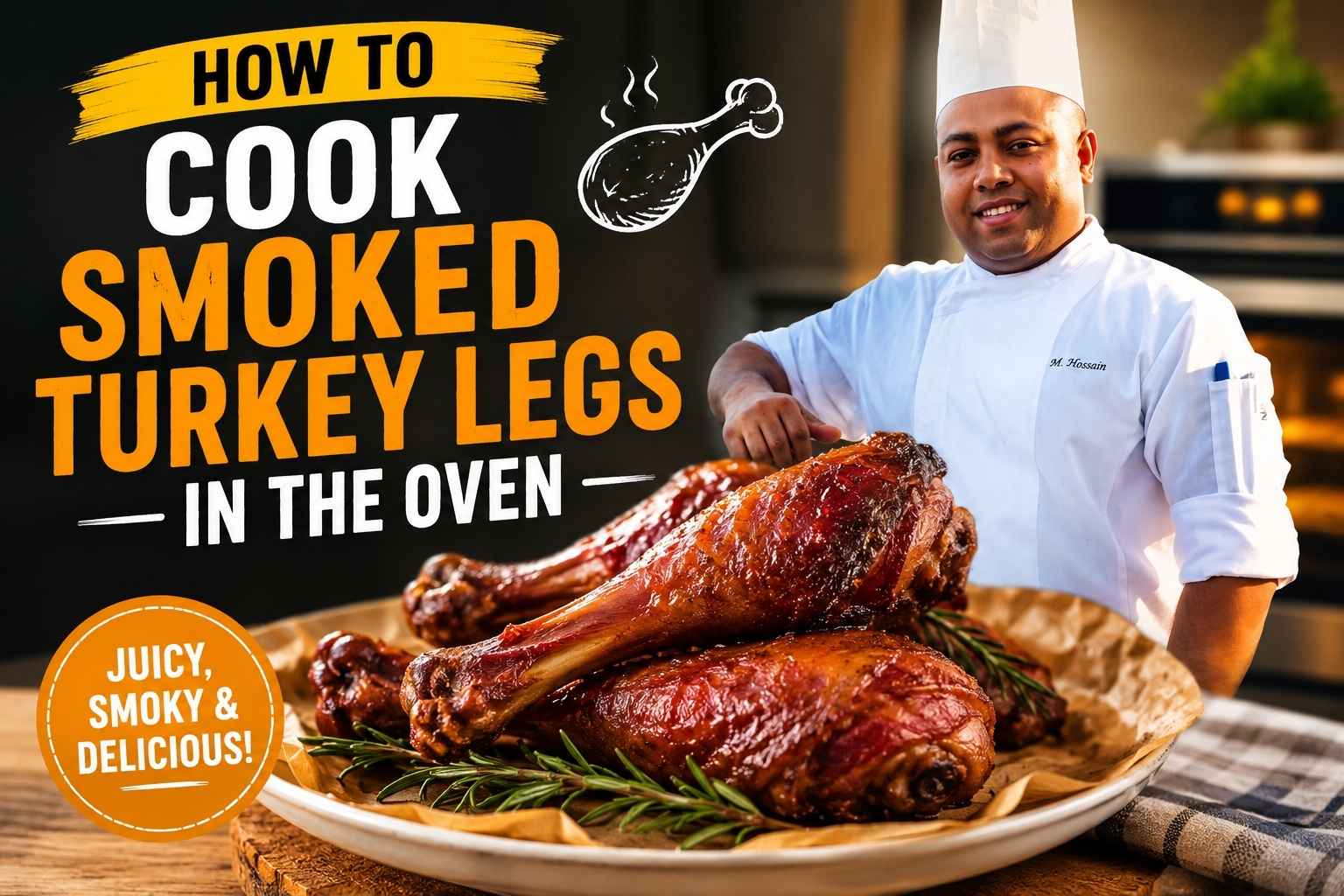
At A Glance
- Store-bought smoked turkey legs are already fully cooked. You are reheating them, not cooking them, so your goal is 165°F at the center without drying out the meat.
- Raw or “fresh” smoked turkey legs from a butcher or your own smoker still need to hit 165°F as a new cook, and they behave differently in the oven than the pre-cooked kind.
- 300°F to 325°F wrapped in foil with a splash of broth is my go-to range for both types. It is slow enough to keep the meat moist and fast enough that dinner doesn’t take all day.
- A meat thermometer is not optional. Insert it into the thickest part of the leg without touching the bone, or you’ll get a false reading and either raw meat or shoe leather.
- Unwrap and broil for the last 5 to 8 minutes if you want crackling, caramelized skin instead of soft, rubbery skin.
You know that deep, smoky smell that hits you the second you walk into a barbecue joint? You can get that same magic right in your own kitchen. I’m going to show you exactly how to cook smoked turkey legs in the oven, no smoker required, no fuss, no guesswork.
I’m Mossaraof, and I’ve spent over 15 years testing ovens, timing meat, and chasing that perfect crispy-skin, fall-off-the-bone bite. Turkey legs scared me at first too. They looked huge, tough, and easy to mess up.
Turns out, the oven makes this almost foolproof once you know the trick. Stick with me, and in the next few minutes, you’ll have a simple, step-by-step method that gets you juicy, smoky turkey legs every single time. Grab your baking tray, because we’re diving in right now.
What “Smoked” Actually Means Before It Hits Your Oven
Not all smoked turkey legs start in the same place, and that changes everything about how you cook them. There are three versions you’ll run into, and mixing them up is the number one reason people end up with dry or under-seasoned turkey legs.
Store-bought smoked turkey legs (the kind you find at a grocery store, a state fair stand, or Disney parks) are fully cooked and cured. They’re smoked low and slow, often for six to eight hours, then vacuum-sealed or frozen. When you buy these, your oven’s job is to reheat and re-crisp them, not cook raw meat.
Home-smoked turkey legs, the ones you or a friend ran through a backyard smoker, may or may not be fully cooked depending on how long they were in the smoker. If the person who smoked them pulled them at 165°F internal, they’re done and you’re reheating. If they were pulled early to finish indoors (a common move when weather turns or time runs short), you’re finishing a raw cook.
Raw turkey legs with a smoked flavor rub or smoked paprika seasoning are not smoked at all. They just taste like it. These need a full, safe cook from raw, the same as any raw poultry (USDA Food Safety and Inspection Service, 2024).
Why This Distinction Matters So Much
I learned this the hard way early in my career, working a holiday buffet line where a cook grabbed a batch of “smoked” legs from the walk-in and treated them like they needed a full two-hour cook. They came out of the oven dry enough to use as drumsticks in a percussion section. Turns out they were fully cooked, pre-smoked legs that only needed 45 minutes to reheat. Know your starting point before you touch the oven dial.
Reheating vs. Fully Cooking: How to Tell Which One You’re Doing
Check the packaging first, or ask your butcher directly. If the label says “fully cooked” or “ready to eat,” you’re reheating. Same thing if it lists a cook temperature you’ve already reached. If the label says “raw,” or gives cook instructions with a target temperature you haven’t hit yet, you’re cooking from scratch.
A quick visual test also helps. Fully cooked, pre-smoked turkey legs usually have a deep mahogany color all the way through, when you cut near the bone. The meat also pulls away from the bone easily. Raw or undercooked legs show pink or clear meat near the bone. They resist pulling away cleanly.
When in doubt, use your thermometer first before you decide on a cook time. A cold, fully cooked leg straight from the fridge might read 38°F. A cold, raw leg reads about the same. The starting temperature won’t tell you which one it is. The packaging and the visual test will.
Target Internal Temperature: Why 165°F Isn’t a Suggestion
The USDA sets 165°F as the safe minimum for all poultry, including turkey legs. You check this at the thickest part of the meat (USDA Food Safety and Inspection Service, 2024). This number holds true either way. It doesn’t matter if you’re cooking a raw leg for the first time or reheating one that was cooked, then chilled or frozen.
Here’s the part most home cooks miss: 165°F is the safety floor, not the flavor target. Dark meat like turkey legs tastes better and feels more tender at a higher temp. Aim for the 175°F to 180°F range. The extra time and heat break down more connective tissue (America’s Test Kitchen, 2023).
White meat gets tough and dry past 165°F. Dark meat, including thighs and legs, gets more tender the longer it cooks within reason. That’s the opposite of what most people assume, and it’s why so many turkey legs come out chewy. Cooks pull them the second they hit 165°F, treating dark meat like it’s breast meat.
My rule in the kitchen: pull turkey legs at 175°F for the best texture, then let them rest. If you’re short on time or serving a crowd fast, 165°F is safe and fine, just slightly firmer.
Oven Temperature Breakdown: Low and Slow vs. Moderate vs. Fast
Your oven temperature choice depends on how much time you have and how much you care about texture. I’ve cooked turkey legs at every setting from 275°F to 400°F over the years, and each has a real use case.
Low and Slow: 275°F to 300°F
This range gives you the most forgiving, most tender result. The lower heat breaks down the connective tissue in the leg slowly. It won’t push moisture out of the meat too fast.
Best for: raw or home-smoked legs that need a full cook. Also good if you want to walk away for a couple hours without checking on them.
Trade-off: takes the longest, usually 2 to 2.5 hours for raw legs and 1 to 1.5 hours for reheating pre-cooked ones.
Moderate: 325°F to 350°F
This is my default range for most weeknight cooking. It balances speed and moisture retention well, especially when the legs are wrapped in foil with a bit of liquid.
Best for: both reheating pre-smoked legs and finishing raw ones when you don’t have two hours to spare.
Trade-off: you need to watch the clock more closely than at lower temperatures. The gap between “done right” and “dried out” is smaller.
Fast: 375°F and Above
This range gets dinner on the table fast. It also gives you the best skin texture on its own, without a separate broiling step. But it’s less forgiving.
Best for: reheating fully cooked legs when you’re short on time, or finishing the last few minutes of a lower-temp cook to crisp the skin.
Trade-off: raw legs cooked this way can dry out on the outside. The inside may still be catching up. This is worse without foil.
Cook Time and Temperature Reference Table
| Turkey Leg Type | Oven Temp | Estimated Time | Target Internal Temp | Foil? |
|---|---|---|---|---|
| Pre-smoked (fully cooked), reheating | 275°F–300°F | 60–75 min | 165°F (safe) / 175°F (best texture) | Yes, first 45 min |
| Pre-smoked (fully cooked), reheating | 325°F–350°F | 35–45 min | 165°F (safe) / 175°F (best texture) | Yes, first 25 min |
| Pre-smoked (fully cooked), reheating | 375°F+ | 20–30 min | 165°F (safe) / 175°F (best texture) | Optional |
| Raw or home-smoked, finishing cook | 275°F–300°F | 2–2.5 hrs | 165°F minimum, 175°F ideal | Yes, first half |
| Raw or home-smoked, finishing cook | 325°F–350°F | 1.5–1.75 hrs | 165°F minimum, 175°F ideal | Yes, first hour |
| Raw or home-smoked, finishing cook | 375°F+ | 1–1.25 hrs | 165°F minimum, 175°F ideal | Yes, until last 10 min |
Times assume standard turkey legs weighing 1 to 1.5 pounds each. Larger legs need more time. Always confirm with a thermometer instead of relying on the clock alone (ThermoWorks, 2023).
Keeping Smoked Turkey Legs from Drying Out
Wrap them in foil for most of the cook. Foil traps steam and keeps the surface of the meat from losing moisture to the dry heat of the oven. I wrap tightly, leaving just a small vent, for anywhere from 70 to 90 percent of the total cook time.
Add liquid before you seal the foil. A quarter cup of chicken broth, turkey stock, or even apple juice per leg goes a long way. The liquid partially steams the meat and keeps the smoky flavor from turning bitter or dry.
Tent loosely instead of wrapping tight if the legs are already fully cooked. For reheating, a loose foil tent traps enough heat. It won’t oversteam meat that’s already tender.
Baste every 20 to 25 minutes if you’re not using foil at all. Spoon pan juices or melted butter over the legs each time you check the temperature. This matters more at higher oven temps, where moisture loss happens faster.
Don’t skip the resting period. Pull the legs from the oven. Let them sit for 10 minutes before serving. The internal heat keeps climbing a bit during this time. This is called carryover cooking. The juices spread back through the meat instead of spilling onto your cutting board the second you slice in (Serious Eats, 2022).
Using a Meat Thermometer Correctly
Insert the probe into the thickest part of the leg, usually just below where the drumstick meets the thigh. This is where the meat is densest and slowest to heat, so it gives you the most accurate read on doneness.
Avoid touching the bone. Bone heats up differently than muscle. A probe resting against it gives a reading several degrees too high. This is the most common thermometer mistake I see, even from cooks with years of experience.
Take two readings from two spots. Turkey legs are not an even shape. Checking two spots near the thickest part gives you a more reliable picture than trusting one number.
Use an instant-read thermometer for spot checks. Use a leave-in probe for longer cooks. An instant-read is fast for a quick check. A leave-in probe lets you track the rising temperature without opening the oven again and again. Opening the oven often drops the temperature and adds to your cook time (ThermoWorks, 2023).
Getting Crispy, Caramelized Skin Without Drying Out the Meat
This is the part most home cooks get backward. They crank the oven high the whole time to crisp the skin, and the meat dries out before the skin even browns properly.
My method: cook low and covered, then finish high and uncovered. Do most of the cooking at 300°F to 325°F wrapped in foil to protect the meat. In the last 5 to 8 minutes, remove the foil and either crank the oven to 425°F or switch to the broiler on high.
Watch the broiler closely. Turkey skin can go from deep brown to burnt in under a minute under a broiler. Stay at the oven the whole time. Rotate the pan halfway through if your broiler heats unevenly.
Glaze in the last 10 minutes for extra color and flavor. Try a simple glaze: honey, a splash of apple cider vinegar, and a pinch of smoked paprika. Brush it on twice near the end. This builds a sticky, deep-brown outside with no extra oven time.
Reheating Leftovers vs. Cooking Fresh Legs
Leftover, previously cooked turkey legs need less time and lower heat than a fresh cook. This is true even if they were smoked and fully cooked to start with. The meat already went through one full cooking cycle. A second long, hot cook will overcook it.
For leftovers, I use 300°F wrapped in foil with a splash of broth for 25 to 35 minutes, just until the center hits 165°F. I skip the high-heat finish on leftovers unless the skin has gone soft and needs a quick 3 to 4 minute broil to bring back some texture.
A fresh, raw-to-cooked turkey leg needs the full cook time listed in the table above. There’s no shortcut here. The internal temperature has to climb from raw all the way to safe, and rushing it with high heat alone risks a burnt exterior and an undercooked center.
Common Mistakes and How to Fix Them
Mistake: Cooking straight from the fridge without adjusting time. Cold turkey legs take longer to reach temperature. Going straight from fridge to oven, without planning for that, often leads to a bad guess on timing. Fix: let legs sit out at room temperature for 20 to 30 minutes before cooking. Or just add 10 to 15 minutes to your cook time if you skip this step.
Mistake: Skipping the foil and wondering why the meat is dry. Uncovered, high-heat cooking pulls moisture out fast. This is worse on legs that are already fully cooked. Fix: wrap in foil for most of the cook. Only remove it at the very end for browning.
Mistake: Placing the thermometer against the bone. This gives a falsely high reading. It leads to pulling the legs before the meat is actually done. Fix: angle the probe into the meat itself, away from the bone. Check two spots to confirm.
Mistake: Skipping the rest period. Cutting into the leg the moment it leaves the oven lets all the juice run out onto the cutting board instead of staying in the meat. Fix: tent loosely with foil and wait 10 minutes before slicing or serving.
Mistake: Treating all “smoked” turkey legs the same way. A fully cooked, pre-smoked leg is not the same as a raw one. Mixing them up leads to overcooking something already done, or serving raw poultry. Fix: check the label or ask the butcher before you pick a time and temperature.
My Personal Method: How I Cook Smoked Turkey Legs at Home
I’ve tested this for years on holiday buffets, catering trays, and plain Tuesday dinners. Here’s exactly what I do. This is for store-bought, fully cooked smoked turkey legs, which is what most home cooks buy.
- Preheat the oven to 300°F.
- Place the legs in a baking dish and pour a quarter cup of chicken broth around them, not directly over the skin.
- Cover the dish tightly with foil. Cook for 45 minutes.
- Check the internal temperature at the thickest part, away from the bone. You’re aiming for at least 165°F, ideally closer to 175°F.
- If not there yet, cook in 10 minute increments, checking each time, until you hit temperature.
- Remove the foil. Brush the legs with a light glaze if you’re using one.
- Broil on high for 5 to 8 minutes, watching closely, until the skin is deep brown and slightly crisp at the edges.
- Rest for 10 minutes before serving.
This method has never let me down, and it scales easily. Doubling the number of legs in one dish doesn’t change the time much, as long as they’re not stacked on top of each other and the dish isn’t overcrowded.
Frequently Asked Questions About Cooking Smoked Turkey Legs in the Oven
What temperature should smoked turkey legs be cooked to?
The safe minimum is 165°F at the thickest part of the meat, checked away from the bone. For the best texture, aim closer to 175°F. Dark meat like turkey legs gets more tender at a slightly higher temperature (USDA Food Safety and Inspection Service, 2024).
How long do you cook smoked turkey legs in the oven?
Fully cooked, pre-smoked legs need 35 to 75 minutes, depending on your oven temp, since you’re only reheating them. Raw or home-smoked legs that haven’t been fully cooked yet need 1 to 2.5 hours, again depending on temp.
Do I need to wrap smoked turkey legs in foil?
Wrapping in foil for most of the cook keeps the meat moist by trapping steam. I recommend foil for at least 70 percent of your total cook time, removing it only in the final stretch to crisp the skin.
Can I cook smoked turkey legs from frozen?
You can, but it takes much longer. The result is also less even. I recommend thawing in the fridge first, for 24 to 48 hours depending on size. This gives you the most even result.
Why are my smoked turkey legs tough even after cooking them long enough?
This usually means the meat never got hot enough inside. The most common cause is a thermometer reading against the bone instead of the meat. Recheck with the probe angled away from the bone. Check two different spots to be sure.
What’s the difference between smoked turkey legs and Cajun or Creole turkey legs?
Smoked turkey legs get their flavor and color from time in a smoker, real or from liquid smoke seasoning. Cajun or Creole turkey legs are usually raw legs coated in a spice blend, then cooked with no smoking. They need a full raw-to-safe cook, and they won’t have the same smoky taste.
Can I reheat smoked turkey legs in the microwave instead of the oven?
You can, but the skin turns rubbery and the meat can dry out or cook unevenly. The oven gives you far better control and texture, especially if you’re finishing with a broil at the end.
How do I know if my smoked turkey leg is already fully cooked?
Check the packaging first. Fully cooked legs are usually labeled as such. If you’re unsure, look for deep, even color near the bone and meat that pulls away easily. When in doubt, use a thermometer before deciding on cook time.
Key Takeaways
- Know whether your turkey legs are fully cooked (reheating) or raw (a full cook) before you pick a time and temperature.
- 165°F is the safe minimum, but 175°F gives you better texture in dark meat like turkey legs.
- 300°F to 325°F wrapped in foil, with a splash of broth, works well for most home cooks and most turkey leg types.
- Finish uncovered under high heat or a broiler for the last 5 to 8 minutes to get crisp, caramelized skin.
- Always check temperature with the probe away from the bone, in two spots, and always rest the legs for 10 minutes before serving.