
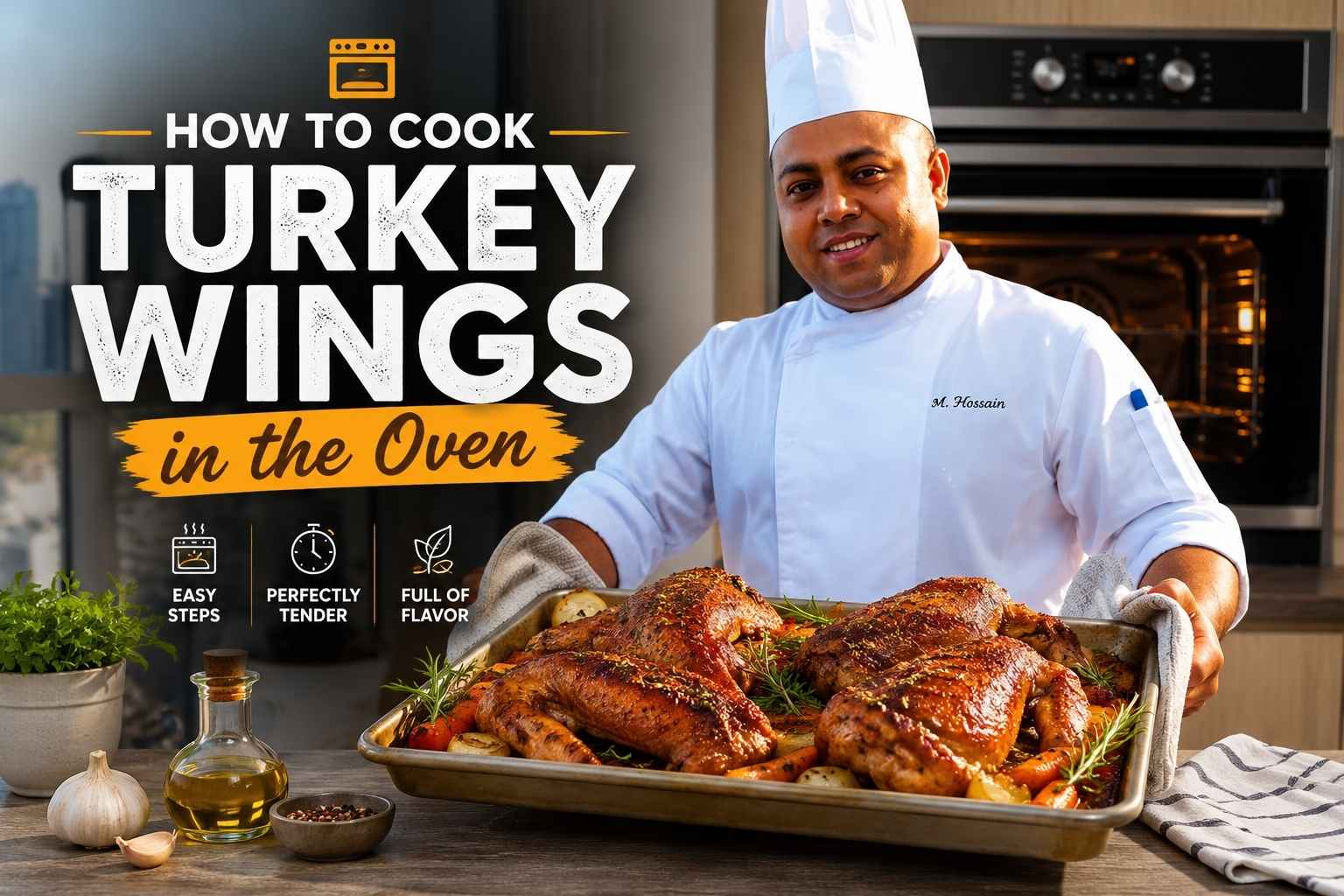
At A Glance
- Bake turkey wings at 325°F, covered, for about 1.5 to 2 hours, then uncover and bake 20 to 30 more minutes at 400°F for crisp skin.
- Pull the wings at 185°F to 190°F internal, not the USDA minimum of 165°F, for true fall-off-the-bone texture near the bone (USDA FSIS, 2024).
- Split the wings at the joints before cooking. Drumettes and flats cook more evenly than whole wings.
- Dry brine wins over wet brine for turkey wings. It builds better skin and needs zero extra equipment.
- A leave-in probe thermometer, placed in the thickest part of the drumette away from bone, is the single best tool for this recipe (ThermoWorks, 2025).
Turkey wings scared me at first. They looked big and tough. I feared dry meat and a sad meal. That fear made me test batch after batch. I found a way that works every time.
Learning how to cook turkey wings in the oven changed my weeknight meals. I have cooked in real kitchens for over 15 years. Today, I will show you my exact steps. You will get juicy, fall off the bone wings every time.
Why Turkey Wings Cook Differently Than Turkey Breast or Chicken Wings
Turkey wings are not big chicken wings. They carry far more connective tissue, thicker bones, and a much higher meat-to-skin ratio than a chicken wing does.
That connective tissue is collagen. Collagen needs time and heat to break down into gelatin. This is why turkey wings reward a slow braise-style bake instead of a quick roast.
Compare the numbers. A chicken wing might finish in 25 to 40 minutes. A single turkey wing section often weighs 8 to 12 ounces on its own, close to what an entire chicken weighs. It needs 1.5 to 2.5 hours to turn tender.
Turkey breast is the opposite problem. Breast meat is lean and dries out fast once it passes 165°F. Turkey wings have more fat and connective tissue, so they actually get better past that point, up to a point. I will walk you through where that point sits later in this guide.
Choosing and Prepping Turkey Wings
Good results start before the oven turns on. Here is what I check every time I buy wings.
Fresh vs. Frozen Turkey Wings
Fresh wings give you more control over brining and seasoning time, since you are not racing a thaw clock. I buy fresh when I can find it, usually at a butcher counter or a well-stocked grocery meat department.
Frozen wings work fine too. Turkey wings freeze well because of their higher fat content, which protects texture during freezing better than lean cuts do. Just plan ahead for a safe thaw.
How to Thaw Turkey Wings Safely
Thaw turkey wings in the refrigerator, not on the counter. Budget about 24 hours per 4 to 5 pounds of wings (USDA FSIS, 2024).
In a hurry? Submerge the sealed wings in cold water and change the water every 30 minutes. This method thaws wings in 2 to 3 hours depending on size.
Never thaw turkey wings on the counter at room temperature. Bacteria multiply fast once the surface climbs above 40°F, even while the center is still frozen.
Trimming and Patting Dry
Split whole turkey wings at the joints into drumette, flat, and tip. Save the tips for stock; they have little meat and mostly connective tissue.
Trim loose skin flaps and any visible feather stubs with kitchen shears. Then pat every piece bone-dry with paper towels.
Dry skin is the single biggest factor in good browning. Wet skin steams instead of crisping, no matter how hot your oven runs.
Brining vs. Dry-Rubbing Turkey Wings
Both methods add flavor and help the meat hold moisture. They work in different ways, and I land firmly on one side after years of cooking both.
Wet brining submerges the wings in a saltwater solution, often with sugar and aromatics, for 8 to 12 hours. It adds moisture through osmosis and seasons the meat deep into the muscle. The downside: wet skin. You need extra time to dry the surface again before baking, or you sacrifice crisp skin.
Dry brining is a simple salt rub applied 8 to 24 hours ahead, left uncovered in the fridge. The salt draws out surface moisture first, then that moisture reabsorbs back into the meat carrying dissolved salt with it. The skin dries out in the fridge instead of getting wetter.
Why I Reach for a Dry Brine First
I dry brine turkey wings almost every time now. It takes one bowl, some kosher salt, and fridge space. No brining bucket, no five-gallon bag, no worrying about food-safe containers.
The payoff is skin that crisps reliably at high heat. I learned this the hard way cooking Thanksgiving sides for a 200-cover restaurant service years ago. We wet-brined a full case of turkey parts and spent an extra hour under a fan trying to dry the skin before service. Dry brining removed that entire step.
Use 3/4 teaspoon of kosher salt per pound of turkey wings. Rub it directly onto the skin, place the wings on a wire rack over a sheet pan, and refrigerate uncovered for at least 8 hours.
Seasoning and Marinade Options
Salt is the foundation. These four flavor directions build on top of a dry brine or replace it if you are short on time.
Classic Southern-Style Rub
Mix smoked paprika, garlic powder, onion powder, dried thyme, black pepper, and a pinch of cayenne. Rub it on after patting the wings dry, right before they go in the oven or the night before for deeper flavor.
Herb Butter
Soften butter and mix in chopped rosemary, sage, thyme, and minced garlic. Gently loosen the skin with your fingers and push the butter underneath, directly against the meat. This bastes the wings from the inside as they cook.
Cajun
Combine paprika, cayenne, garlic powder, onion powder, dried oregano, and white pepper. This blend has real heat, so cut the cayenne in half if you are cooking for a crowd with mixed spice tolerance.
Garlic-Herb
Blend olive oil, minced garlic, chopped parsley, and lemon zest. Coat the wings just before roasting rather than the night before, since fresh garlic can turn bitter with long refrigerated contact on raw poultry skin.
Should You Sear Turkey Wings Before Roasting?
Searing turkey wings in a hot skillet before the oven builds a deeper brown crust through the Maillard reaction. It is an extra step, and I only recommend it in specific cases.
Skip the sear for a covered, low-and-slow bake. The covered stage already handles tenderizing, and you will uncover the wings for browning later in the oven anyway.
Sear when you are going straight into a braise-style dish, like smothered turkey wings in gravy. A hard sear on all sides, 2 to 3 minutes per side in a hot skillet with oil, adds flavor to both the meat and the pan drippings you will build a sauce from.
For the classic oven-baked, covered-then-uncovered method in this guide, save your energy. The oven does the browning job just fine at the end.
Covered vs. Uncovered Roasting: When to Use Foil
This is the single most important technique decision in the whole recipe. Get it right and you get tender meat with crisp skin. Get it wrong and you get one or the other, never both.
Cover the wings with foil for the first phase. This traps steam, which helps break down connective tissue and keeps the meat from drying out while it tenderizes. Use tight foil over the pan for roughly the first 60 to 75 percent of total cook time.
Uncover for the final phase. Removing the foil lets surface moisture evaporate and lets the skin brown and crisp. This is also when I raise the oven temperature if I started low.
A two-stage bake at 325°F covered, then 400°F uncovered for the last 20 to 30 minutes, gives you the best of both worlds: fall-apart meat and skin with real texture.
Turkey Wing Cook Time and Temperature Chart
Use this chart as a starting point. Actual time depends on wing size, oven accuracy, and whether wings are whole or split.
| Oven Temp | Cook Style | Estimated Time | Internal Temp Target | Notes |
|---|---|---|---|---|
| 300°F | Covered, low and slow | 2.5 to 3 hours | 185°F to 190°F | Best for large, whole wings; very tender, minimal browning without an uncovered finish |
| 325°F | Covered, then uncovered | 1.5 to 2 hrs covered + 20–30 min uncovered | 185°F to 190°F | My go-to; balances tenderness and hands-off time |
| 350°F | Covered or uncovered | 60 to 90 minutes | 165°F (safe) to 185°F (tender) | Butterball’s standard oven method for wings (Butterball, 2025) |
| 375°F | Mostly uncovered | 50 to 70 minutes | 165°F to 180°F | Good for split wings; watch skin closely after 45 minutes |
| 400°F | Uncovered, or final crisping stage | 45 to 60 minutes | 165°F to 180°F | Best used as a finishing temp after a covered low-heat stage |
| 425°F | Uncovered, split wings only | 35 to 50 minutes | 165°F to 175°F | Fastest option; higher risk of dry meat near the tips |
Split wings (drumette and flat separated) cook faster and more evenly than whole wings at every temperature on this chart. If you are short on time, split them.
Low and Slow vs. Moderate vs. High Heat: Texture and Time Tradeoffs
300–325°F: Low and Slow
This range gives connective tissue the most time to convert to gelatin without pushing the exterior past the point of no return. Expect the most tender result of any method here, with meat that pulls cleanly off the bone.
The tradeoff is time. You are looking at 2.5 to 3 hours total, and you will almost always need an uncovered high-heat finish to get real browning.
350°F: The Moderate Middle Ground
This is the temperature most packaged turkey wing instructions use, including Butterball’s own guidance for oven-cooked wings (Butterball, 2025). It balances speed and tenderness reasonably well in 60 to 90 minutes.
I use 350°F when I am short on time but still want a covered stage. It is a solid all-purpose choice if you only remember one number from this guide.
375–425°F: Higher Heat
Higher heat browns skin fast and shortens total cook time to under an hour for split wings. The risk is uneven cooking: the outside can brown before the connective tissue near the bone has broken down.
I only use this range for split wings, and I always cover the pan for the first 15 to 20 minutes to buy the interior some time before the skin sets.
What Internal Temperature Should Turkey Wings Reach?
The USDA sets 165°F as the minimum safe internal temperature for all turkey, checked at the thickest part with a food thermometer (USDA FSIS, 2024). That number keeps you safe from Salmonella and other foodborne pathogens.
But 165°F is a food safety floor, not a doneness target for tough cuts like wings. At 165°F, the collagen in a turkey wing has barely started to break down. The meat will be safe to eat and still somewhat chewy near the bone.
For true fall-off-the-bone texture, keep cooking past 165°F up to 185°F to 190°F internal. This extra range gives collagen time to fully convert to gelatin, the same principle that makes pulled pork and braised short ribs tender at similarly high internal temperatures.
Bottom line: 165°F is safe. 185°F to 190°F is tender. Cook turkey wings to the higher number for the best texture, and rest assured you are well past the safety threshold the whole time.
How to Use a Meat Thermometer Correctly
A thermometer removes the guesswork completely. Time estimates in any recipe, including this one, are only a starting point.
Where to Place the Probe
Insert the probe into the thickest part of the drumette or flat, avoiding bone entirely. Bone conducts heat differently than muscle and will give you a false, often lower, reading (ThermoWorks, 2025).
Angle the probe so the tip sits in the center of the thickest muscle mass, not near the surface. A probe placed too shallow reads hot before the interior actually is.
Common Placement Mistakes
Touching bone. This is the most common error home cooks make. Bone reads faster than meat, so you will pull the wings early and end up with undercooked meat near the joint.
Checking only one wing. Wings vary in size even within the same pan. Check your two or three largest pieces, not just the first one you grab.
Reading immediately after removing from the oven. Give the probe a few seconds to stabilize. Digital instant-read thermometers need 2 to 3 seconds to settle on an accurate number.
Basting and Moisture Retention: Does It Actually Matter?
Basting turkey wings with pan juices during the covered stage does very little for internal moisture. The foil is already trapping steam, so the meat is staying moist regardless.
Basting matters more during the uncovered, browning stage. A light brush of melted butter or pan drippings every 10 to 15 minutes during this phase helps the skin brown evenly and adds flavor on top of the meat.
Skip constant basting. Opening the oven door repeatedly drops the internal temperature and adds time to your total cook. Two or three bastes during the uncovered stage is plenty.
Common Mistakes to Avoid with Turkey Wings
Drying out the meat. This usually happens from cooking uncovered the entire time at high heat. Fix it by covering the wings for the first 60 to 75 percent of cook time, then uncovering only to finish the skin.
Undercooking near the bone. This happens when you trust time alone instead of a thermometer, or when your probe touches bone. Fix it by checking multiple pieces with a probe placed correctly in the thickest muscle.
Uneven browning. This comes from crowding the pan or leaving whole wings unsplit. Fix it by splitting wings at the joint and arranging pieces in a single layer with space between them.
Cooking straight from frozen. Frozen wings cook unevenly, with the outside overcooking long before the center reaches a safe temperature. Fix it by always thawing fully in the refrigerator first, even though it takes planning ahead.
My Go-To Turkey Wing Recipe and Routine
Here is the exact method I use at home, built from what worked and failed over 15 years of cooking turkey in both restaurant and home kitchens.
I first cooked turkey wings professionally at a Southern-style restaurant where we ran through cases of them for a weekly smothered wings special. We started uncovered at high heat to save time during a busy prep window. Half the batch came out dry near the tips before the thick end was even tender. That mistake taught me to always cover first, no exceptions, no matter how much of a rush I am in.
Step 1: Prep the wings. Split 4 pounds of turkey wings into drumettes and flats. Pat every piece completely dry with paper towels.
Step 2: Dry brine. Rub the wings with 1 tablespoon kosher salt total. Place on a wire rack over a sheet pan, uncovered, in the fridge for 12 to 24 hours.
Step 3: Season. Before baking, coat the wings with 2 tablespoons melted butter, 1 tablespoon smoked paprika, 1 teaspoon garlic powder, 1 teaspoon onion powder, and 1/2 teaspoon black pepper.
Step 4: Cover and bake. Arrange wings in a single layer in a roasting pan with 1/2 cup chicken broth in the bottom. Cover tightly with foil. Bake at 325°F for 1 hour 45 minutes.
Step 5: Uncover and crisp. Remove the foil. Raise the oven to 400°F. Bake 25 more minutes, basting once at the halfway point, until the skin is deep golden brown.
Step 6: Check temperature and rest. Confirm 185°F to 190°F internal in the thickest pieces, away from bone. Rest 10 minutes before serving so the juices settle back into the meat.
Frequently Asked Questions About Cooking Turkey Wings
How long does it take to cook turkey wings in the oven?
Most turkey wings take 1.5 to 2.5 hours total, depending on oven temperature and whether the wings are whole or split. A 325°F covered-then-uncovered method, my personal go-to, takes about 2 hours 10 minutes start to finish.
Can I cook turkey wings from frozen?
You can, but I do not recommend it. Frozen wings cook unevenly and typically need 50 percent more time. Always thaw in the refrigerator first for the most reliable, evenly cooked result.
What temperature should turkey wings be cooked to?
The USDA safe minimum is 165°F (USDA FSIS, 2024). For fall-off-the-bone texture instead of just safe-to-eat texture, cook to 185°F to 190°F internal.
How do I reheat leftover turkey wings without drying them out?
Reheat in a covered dish with a splash of broth at 325°F until the internal temperature hits 165°F, roughly 20 to 25 minutes. The added liquid and cover trap steam, which prevents the dry-out you get from microwaving.
Can I freeze cooked turkey wings?
Yes. Cool the wings completely, then freeze in an airtight container or freezer bag for up to 3 months. Thaw in the refrigerator overnight before reheating.
Should I use the convection setting on my oven?
Convection works well for the uncovered, browning stage of this recipe since moving air speeds up crisping. Drop the temperature by 25°F from what a recipe lists if you switch to convection, and check the wings a few minutes early.
What sides pair well with baked turkey wings?
Turkey wings pair well with mashed potatoes, collard greens, cornbread, or rice and gravy made from the pan drippings. The rich, dark meat holds up against bold, savory sides better than lighter vegetable dishes alone.
Why are my turkey wings tough even after 2 hours?
Tough wings after a long cook usually mean the oven ran cooler than the dial says, or the wings were unusually large. Check internal temperature with a thermometer rather than trusting time alone, and keep cooking covered until you hit 185°F.
Key Takeaways
- Turkey wings need 1.5 to 2.5 hours in the oven, far longer than chicken wings, because of their thick connective tissue.
- Cover the wings for most of the cook to trap steam and tenderize, then uncover to brown the skin at the end.
- Aim for 185°F to 190°F internal for fall-off-the-bone texture, well past the USDA’s 165°F safety minimum.
- Dry brining beats wet brining for turkey wings by building better skin with less equipment and effort.
- A meat thermometer placed correctly in the thickest meat, away from bone, is more reliable than any time estimate in this or any other recipe.
Sources: USDA Food Safety and Inspection Service, Turkey Basics: Safe Cooking (2024), fsis.usda.gov | ThermoWorks, Accurate Probe Placement in Turkeys (2025), blog.thermoworks.com | Butterball, Turkey Wings Cooking Instructions (2025), butterball.com | National Turkey Federation, Meat Thermometer Guidelines (2023), eatturkey.org