
At A Glance
- Pre-smoked, fully cooked wings just need to be warmed, not cooked. Bake covered at 300°F until they hit 165°F inside (USDA Food Safety and Inspection Service, 2024).
- Raw wings with smoke flavor need a low, slow bake at 275°F to 300°F for 2.5 to 3.5 hours, then a hot finish to crisp the skin.
- Use a meat thermometer in the thickest part of the wing. Keep it off the bone. Bone gives a false, high reading (ThermoWorks, 2026).
- Foil and a splash of broth are your best tools against dry wings. Uncover only at the end.
- Let the wings rest 10 minutes after the oven. This locks the juice back into the meat.
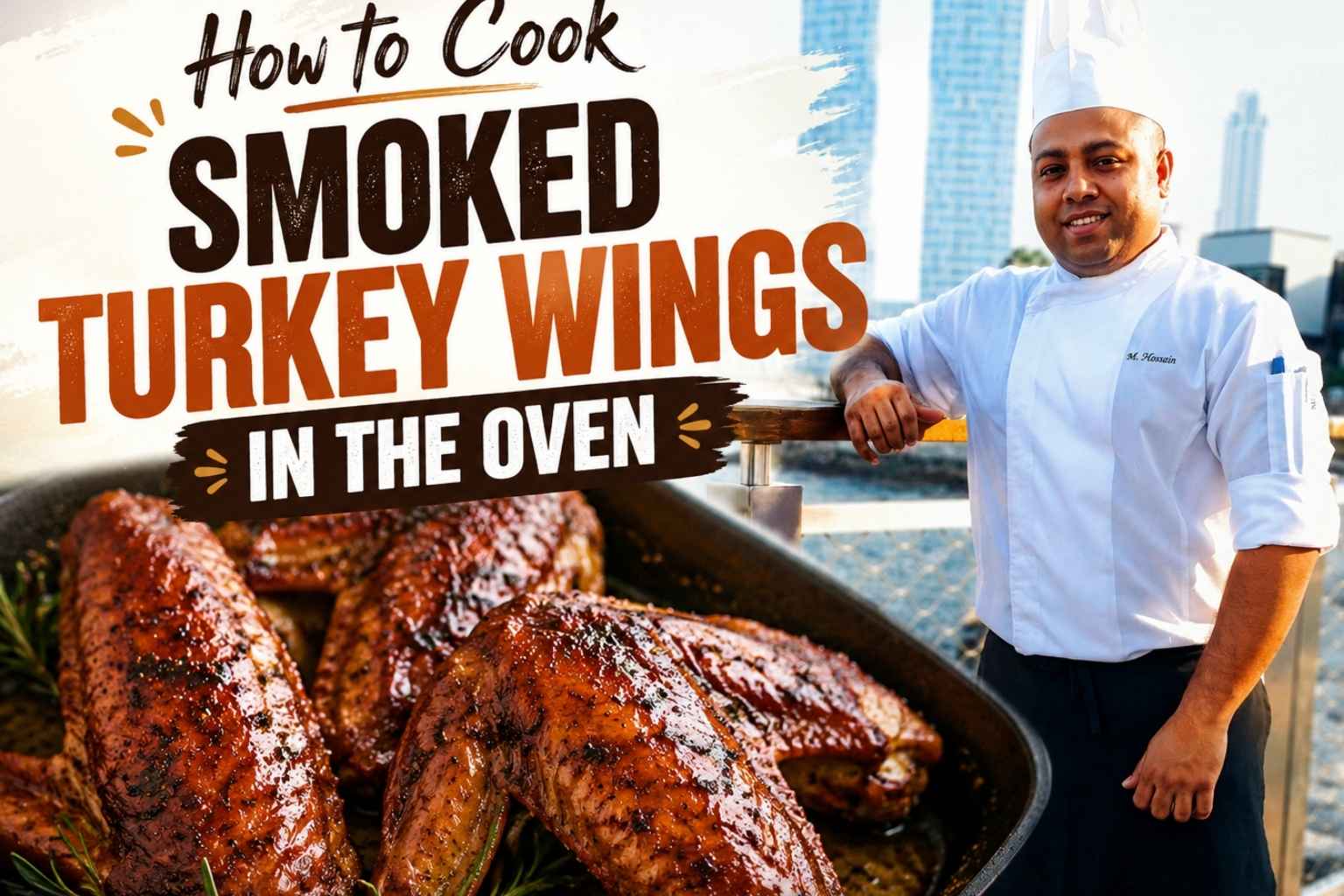
My kitchen smelled like a campfire. But I had not lit one. That is what happens when you cook smoked turkey wings in the oven. I have worked in real kitchens for years. This trick still gets me every time. Today, I will show you my easy steps. You will get juicy wings with a deep smoky taste. No smoker needed. Grab a pan, and let’s start.
What “Smoked Turkey Wings” Actually Means
Not all smoked turkey wings are the same product. This matters, because it changes your whole oven method.
Pre-smoked, fully cooked wings are what you find in the meat case at most grocery stores, often near the ham. A company smokes and fully cooks them at a plant. They are safe to eat cold, straight from the pack. Your oven’s job here is simple: warm them and make the skin taste good again. You are not cooking raw meat. You are reheating cooked meat (Butterball, 2025).
Raw turkey wings smoked at home start as raw poultry. You season them, then smoke them low and slow in a real smoker, or you fake the smoke flavor in your oven with liquid smoke, smoked paprika, and a long, slow bake. This path is not reheating. It is full cooking, from raw to safe. The oven has to take the wing all the way from raw meat to a safe internal temperature (USDA Food Safety and Inspection Service, 2024).
Mixing up these two paths is the single biggest reason home cooks end up with dry wings or, worse, wings that never really finished cooking. Check your package. If it says “fully cooked” or “ready to eat,” treat it as a reheat job. If it says “raw” or gives no cooking claim at all, treat it as a full cook.
Why the Oven Is the Right Tool for Smoked Turkey Wings
The oven wins because it gives you even, steady heat and a sealed space to trap moisture. A grill dries wings out fast. A stovetop pan cooks unevenly. The oven, especially with a foil tent, holds in steam and keeps the meat from turning tough.
For pre-smoked wings, the goal is moisture retention, not more cooking. High heat only pushes out the juice that is already locked in the meat. Low, covered heat brings the wing up to a safe, warm temperature while keeping that juice inside (America’s Test Kitchen, 2025).
For raw wings, the oven lets you cook low and slow, which breaks down the tough connective tissue in the wing joints. That is what gives you true fall-off-the-bone texture. Skip the low-and-slow step and rush the heat, and you get chewy, stringy meat instead.
Cook Time and Temperature Reference Table
Use this table as your starting point. Actual time depends on wing size and how many wings you have crowded onto the pan.
| Oven Temp | Pre-Smoked, Fully Cooked Wings | Raw Wings With Smoke Flavor | Internal Temp Target | Notes |
|---|---|---|---|---|
| 275°F | 1.5 – 2 hours, covered | 3 – 3.5 hours, covered | 165°F (raw path); 140°F warm-through (pre-smoked) | Best choice for max moisture. Add 1 cup broth to the pan. |
| 300°F | 1 – 1.5 hours, covered | 2.5 – 3 hours, covered | 165°F (raw path); 140°F warm-through (pre-smoked) | My default temp for both paths. Good balance of speed and moisture. |
| 325°F | 45 – 60 minutes, covered | 2 – 2.5 hours, covered | 165°F (raw path); 140°F warm-through (pre-smoked) | Fine if you’re short on time. Baste at the halfway point. |
| 350°F | 35 – 45 minutes, covered | 1.5 – 2 hours, covered | 165°F (raw path); 140°F warm-through (pre-smoked) | Risk of drying pre-smoked wings rises here. Watch closely. |
| 400°F (finishing blast only) | 8 – 12 minutes, uncovered | 10 – 15 minutes, uncovered | Skin golden and crisp | Use only in the last stretch, to crisp skin. Never the whole cook. |
Note on temperature targets: the USDA safe minimum for raw poultry is 165°F, checked in the thickest part of the meat away from bone (USDA Food Safety and Inspection Service, 2024). Pre-smoked, fully cooked wings are already safe at any temperature. Warming them to 140°F gives you a hot, juicy wing without drying it out.
Step-by-Step: Pre-Smoked, Fully Cooked Turkey Wings in the Oven
This is the easier path. You are warming, not cooking. Here is how I do it every time.
Step 1: Preheat and Prep the Pan
Preheat your oven to 300°F. Set the wings in a roasting pan or a deep baking dish, skin side up. Pour in about 1 cup of chicken or turkey broth. This creates steam, which keeps the meat moist as it warms (Serious Eats, 2025).
Step 2: Cover Tightly With Foil
Tent the pan with foil, sealed on all sides. This is not optional. An open pan at 300°F for over an hour will dry the wings out fast. The foil traps the broth’s steam right around the meat.
Step 3: Bake Until Warm
Bake for 1 to 1.5 hours at 300°F. Check the thickest part of the wing with a thermometer. You want 140°F. That is warm enough to taste hot without drying out meat that is already fully cooked.
Step 4: Baste Halfway Through
Open the foil once, at the halfway mark. Spoon some of the pan broth over the wings. Reseal and keep baking. This one step makes a real difference in juiciness.
Step 5: Uncover and Crisp
Once the wings hit 140°F, pull off the foil. Raise the oven to 400°F. Bake uncovered for 8 to 12 minutes, until the skin turns deep gold and a little crisp at the edges.
Step-by-Step: Raw Turkey Wings With Smoke Flavor in the Oven
This path takes longer, because you are cooking raw meat all the way through. The payoff is deeper flavor and full control over your rub.
Step 1: Dry Brine and Rub the Wings
Pat the wings dry with paper towels. Rub them all over with kosher salt, at least 4 hours before cooking, or the night before if you can plan ahead. Salt pulls moisture out at first, then pulls it back in with flavor. Right before cooking, coat the wings in your dry rub. My go-to mix: smoked paprika, brown sugar, garlic powder, onion powder, black pepper, and a touch of cayenne.
Step 2: Add Smoke Flavor
If you don’t own a smoker, smoked paprika alone gets you close. For a deeper smoke note, add a few drops of liquid smoke to the rub or brush it on before seasoning. Use it sparingly. A little goes a long way, and too much tastes bitter, not smoky.
Step 3: Low and Slow Bake
Set your oven to 275°F to 300°F. Place the wings on a wire rack set inside a baking sheet, so air moves under the meat. Pour a cup of broth into the pan below the rack, not directly on the wings. Cover the whole pan tightly with foil.
Step 4: Cook Until Tender
Bake for 2.5 to 3.5 hours at 275°F, or 2 to 2.5 hours at 300°F. Check the internal temperature at the 2-hour mark, then every 30 minutes after. You are aiming for 165°F minimum, but for true fall-off-the-bone texture, I like to push to 185°F to 190°F. At that point the collagen in the joints has broken down and the meat pulls apart easily.
Step 5: Uncover and Crisp
Remove the foil. Raise the oven to 400°F. Bake uncovered for 10 to 15 minutes, until the skin is deep brown and crisp. Watch it closely in the last few minutes. Sugar in the rub can burn fast at this heat.
Internal Temperature Safety: Where and How to Check
A thermometer is the only honest way to know a wing is done. Guessing by color or time alone gets people sick or gets you dry meat.
Where to place the probe: Push the thermometer into the thickest part of the wing, usually where the drumette meets the flat. Angle it away from the bone. Bone conducts heat differently than meat and will give you a reading that is off by several degrees (ThermoWorks, 2026).
What to look for: Raw wings must hit 165°F at minimum, checked in the thickest part of the meat (USDA Food Safety and Inspection Service, 2024). Pre-smoked, fully cooked wings are safe at any temperature, since they were already cooked at the plant. Warm them to 140°F for the best eating temperature.
One more tip: Take two readings in different spots on the same wing. Wings are small and uneven in shape, so one thin spot can read done while a thicker spot near the joint is still under temperature.
How to Keep Smoked Turkey Wings From Drying Out
Turkey wings dry out for one main reason: too much direct, dry heat for too long. Fix that, and you fix almost every dry-wing problem.
Use broth, not water. Broth in the bottom of the pan adds flavor along with steam. Water does the steam job but adds nothing to taste.
Tent with foil for most of the cook. Only remove it at the very end, for the crisping step. A wing left uncovered the whole time loses moisture the entire cook.
Baste on a schedule. Open the foil once or twice during a long bake and spoon pan juices over the wings. Do this quickly so you don’t lose too much heat from the oven.
Don’t walk away near the finish. The last 15 minutes, once the foil is off, is where wings go from perfectly crisp to overcooked in a hurry. Set a timer and stay close.
Getting Crispy Skin Without Drying Out the Meat
Crispy skin and juicy meat pull in opposite directions. The trick is to cook the meat low and covered first, then blast the skin with high heat only at the very end, for a short time.
Once your wings hit their target temperature under foil, remove the foil and crank the oven to 400°F. If your oven has a broiler, you can use that instead for the last 3 to 5 minutes, but watch it the entire time. A broiler can burn skin in under a minute if you look away.
Pat the skin dry with a paper towel right before this step, if it looks wet from basting. Wet skin steams instead of crisping. Dry skin browns.
Oven vs. Slow Cooker vs. Air Fryer for Smoked Turkey Wings
Each method has a real strength and a real weakness. Here is how I’d choose between them.
| Method | Best For | Skin Result | Time |
|---|---|---|---|
| Oven | Even cooking, easy basting, best overall balance | Crisp, with a finishing blast | 1 – 3.5 hours depending on path |
| Slow Cooker | Hands-off cooking, very tender meat | Soft, rubbery skin, needs a broiler finish | 4 – 6 hours on low |
| Air Fryer | Small batches, fast crisp skin | Crispiest skin of the three | 20 – 30 minutes for pre-smoked wings |
The oven is my pick for most people, because it handles both the moisture side and the crisping side in one appliance. The slow cooker gives you the most tender meat with the least effort, but you’ll need to finish the skin under a broiler or in a hot oven anyway. The air fryer is great for two or three wings on a weeknight, but it struggles with a full batch since the wings need space for air to move around them.
Common Mistakes and How to Fix Them
Mistake: Cooking pre-smoked wings like they’re raw. Fully cooked wings only need to reach 140°F. Cooking them to 165°F or higher, like raw poultry, dries them out for no safety reason. Fix: check your package label first, and pull pre-smoked wings at 140°F.
Mistake: Skipping the foil tent. An uncovered pan at 300°F for over an hour pulls moisture straight out of the meat. Fix: always cover for the main cook, and only uncover at the end.
Mistake: Wrong oven rack position. A rack too close to the top element burns the skin before the inside is warm. A rack too low cooks the bottom of the wings faster than the top. Fix: use the middle rack for the main bake, and move to the upper third only for the final crisping step.
Mistake: Skipping rest time. Cutting into a wing right out of the oven lets all the juice run onto the cutting board instead of staying in the meat. Fix: let wings rest 10 minutes, loosely tented, before serving.
Mistake: Ignoring carryover cooking. Meat keeps cooking for a few minutes after it leaves the oven, from residual heat. Pull wings at your target temperature, not 5 to 10 degrees past it, or they’ll overshoot while resting.
My Method: The Routine I Actually Use
Here’s exactly what I do at home, most weekends, with pre-smoked wings from my local grocery store.
I start with a dry brine the night before if I remember, or a straight rub 30 minutes before cooking if I don’t. My rub is simple: smoked paprika, brown sugar, garlic powder, and black pepper, nothing fancy. I set the oven to 300°F and use a deep glass baking dish, not a sheet pan, because it holds broth without spilling.
I pour in a full cup of low-sodium chicken broth, plus a splash of apple cider vinegar. That vinegar cuts through the richness of the skin and brightens the whole dish. I learned that trick from a line cook years ago who used it on braised short ribs, and it works just as well here.
Foil goes on tight. I bake for about 70 minutes, then check the temperature. Most of the time I’m at 130°F to 135°F by then, so I baste once and give it another 15 minutes. Once I hit 140°F, off comes the foil, oven up to 400°F, and I watch the wings like a hawk for 10 minutes until the skin bubbles and browns.
The part most people skip: I let the wings sit on the counter, loosely covered, for a full 10 minutes before anyone touches them. That rest is where the juice settles back into the meat instead of running out onto the plate.
Serving Suggestions and Pairing Ideas
Smoked turkey wings pair well with sides that can stand up to their rich, smoky flavor. Collard greens or braised cabbage cut through the richness. Cornbread soaks up the pan juices nicely. Mac and cheese is a classic match for a reason. For something lighter, a sharp vinegar-based slaw balances the smoke and fat.
If you saved the pan broth, don’t toss it. Strain it and use it as a base for gravy, or spoon a little over rice as a simple side dish.
Frequently Asked Questions About Cooking Smoked Turkey Wings in the Oven
How long do I cook smoked turkey wings in the oven?
Pre-smoked, fully cooked wings need about 1 to 1.5 hours at 300°F, covered, to warm through. Raw wings with smoke flavor need 2.5 to 3.5 hours at 275°F to 300°F to cook fully and turn tender.
What temperature should smoked turkey wings be cooked to?
Raw turkey wings must reach 165°F minimum in the thickest part of the meat, away from bone (USDA Food Safety and Inspection Service, 2024). Pre-smoked, fully cooked wings only need to be warmed to 140°F, since they were already cooked at the plant.
Do I need to cover turkey wings with foil in the oven?
Yes, for most of the cook. Foil traps steam from the pan broth and keeps the meat moist. Remove the foil only in the last 10 to 15 minutes, to let the skin crisp under higher heat.
Can I cook smoked turkey wings from frozen?
You can, but it takes longer and the results are less even. Thaw wings in the fridge for 24 to 48 hours first, if you have time. If cooking from frozen, add about 50 percent more time and check the internal temperature more often.
Why are my smoked turkey wings tough instead of falling off the bone?
Tough wings usually mean the cook was too fast or too hot. The connective tissue in the wing joints needs low, slow heat over time to break down. Raw wings pushed to 165°F and pulled right away will be safe but often still chewy. Push to 185°F to 190°F for true fall-off-the-bone texture.
Can I use liquid smoke on raw turkey wings instead of a real smoker?
Yes. A few drops mixed into your rub, or brushed on before seasoning, gives a real smoke flavor without a smoker. Use it sparingly, since too much turns bitter fast.
What’s the best oven rack position for turkey wings?
Use the middle rack for the main, covered bake, so heat circulates evenly around the pan. Move to the upper third of the oven only for the final uncovered crisping step, so the skin browns without burning.
How do I know when pre-smoked turkey wings are done without a thermometer?
Honestly, you can’t know for sure. A thermometer is the only reliable way to check. If you truly don’t have one, look for skin that’s deep golden and meat that pulls slightly from the bone at the joint, but this is a rough guess, not a safe substitute for checking temperature.
Key Takeaways
- Check your package first. Pre-smoked, fully cooked wings only need warming to 140°F. Raw wings need full cooking to at least 165°F.
- Cover with foil for most of the bake, using broth in the pan, and uncover only at the end to crisp the skin at 400°F.
- Place your thermometer in the thickest part of the wing, away from bone, for an accurate reading.
- For true fall-off-the-bone texture on raw wings, push past the 165°F safety minimum to 185°F to 190°F.
- Rest wings for 10 minutes after the oven. This one step keeps the juice in the meat instead of on the cutting board.