
At A Glance
- A roaster oven cooks faster and moister than a conventional oven because the heating coil wraps the whole insert, not just the top and bottom (Taylor Precision Products, 2025).
- Cook at 325°F and check with a thermometer. A whole turkey is safe at 165°F in the thigh, wing, and breast (USDA Food Safety and Inspection Service, 2024).
- A 12-lb turkey takes about 3 to 3.5 hours in a roaster oven. A 20-lb bird takes about 4.5 to 5 hours. Full chart below.
- Skip the lid-lifting. Every peek adds 15 to 20 minutes to your total cook time.
- Crispy skin is the weak spot of roaster ovens. Finish under a broiler or in a hot oven for the last 15 minutes for real color.
- I use my roaster oven every year to free up my main oven for pies, sides, and stuffing. It has saved more than one holiday.
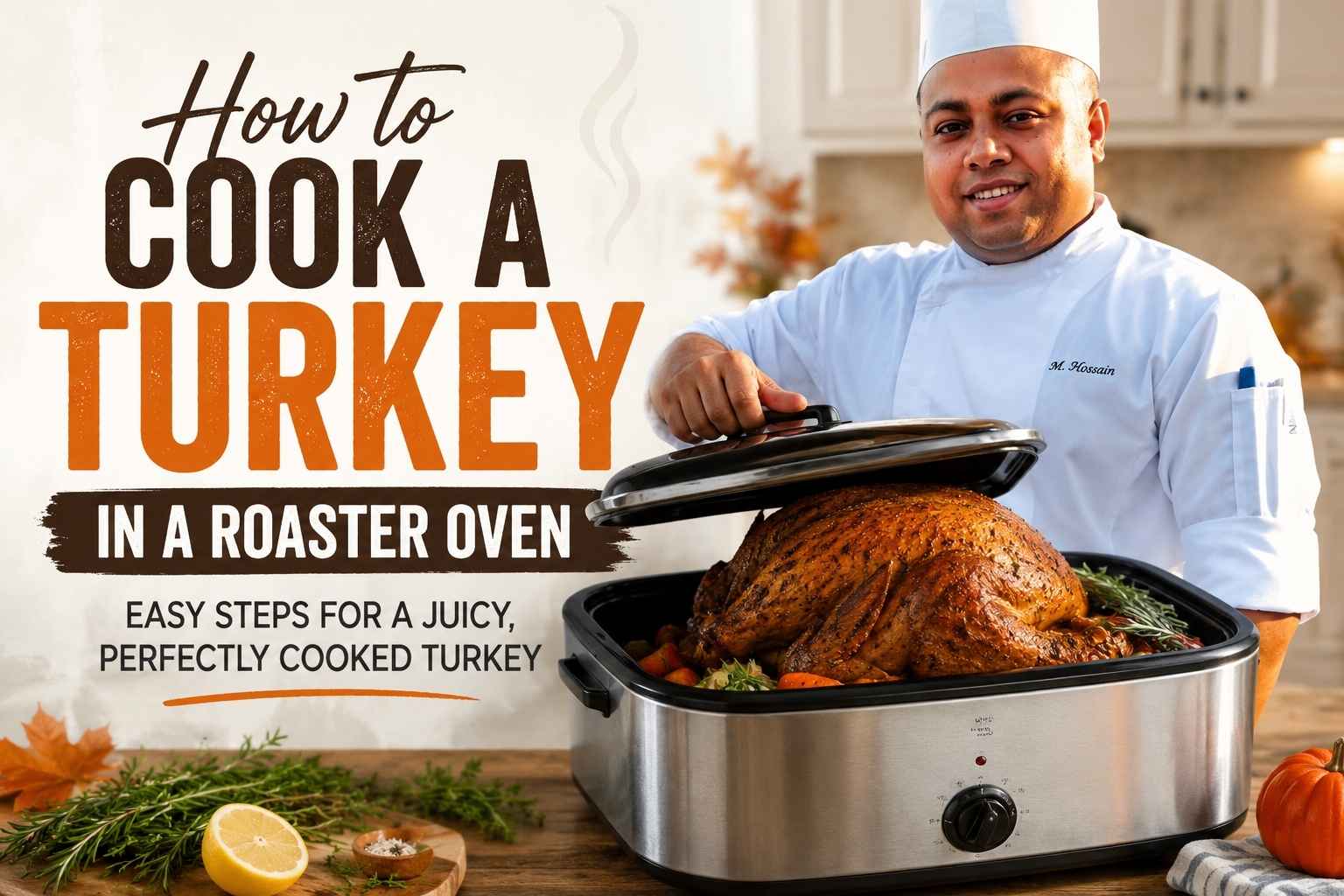
The first time I learned How to Cook a Turkey in a Roaster Oven, I was surprised by how easy it was. The turkey came out juicy, tender, and full of flavor without taking over my kitchen. After cooking many holiday meals, I have picked up simple tips that work every time. In this guide, I’ll show you how to roast a perfect turkey, avoid common mistakes, and get great results, so let’s get started.
Why a Roaster Oven Cooks Turkey Differently
A roaster oven is not a small version of your wall oven. The heating coil sits low, around the base of the insert, and wraps around the sides. Heat rises and surrounds the bird instead of blasting down from the top like a conventional oven does.
That changes three things. First, the turkey cooks faster per pound because the heat is closer and more even. Second, the tight-fitting lid traps steam, so the meat stays moister with less basting. Third, you lose the dry, blasting heat that browns skin fast in a conventional oven. That trade-off is the whole story of roaster oven turkey: juicier meat, but you have to work for the crackle.
I have cooked turkeys in six-burner combi ovens that cost more than a car, and I have cooked them in a $60 roaster oven from a hardware store. The roaster wins on juiciness almost every time. It loses on skin unless you plan for it.
Heating Element Placement Matters More Than People Think
In a conventional oven, hot air moves around a big, half-empty box. In a roaster oven, the bird sits close to the coil and the insert holds heat tightly. That is why roaster ovens run efficient and consistent, but also why a turkey can scorch on the bottom if you use the wrong rack height. More on that in the mistakes section below.
Choosing the Right Roaster Oven Size for Your Turkey
Match your roaster to your bird before you buy a turkey, not after. An 18-quart roaster oven fits a turkey up to about 22 lbs. A 22-quart model handles birds up to 26 lbs, giblets and all.
Leave at least one inch of clearance on every side of the turkey inside the insert. Crowding the bird against the walls blocks airflow and gives you an evenly undercooked turkey instead of an evenly cooked one. If your bird barely fits, size up your roaster or size down your turkey. Do not force the lid.
| Roaster Oven Size | Max Turkey Weight | Notes |
|---|---|---|
| 12-quart | Up to 12 lbs | Good for small households, breast cuts, or a backup unit |
| 18-quart | Up to 22 lbs | The standard size for most home kitchens |
| 22-quart | Up to 26 lbs | Best for large birds or double-duty as a side-dish warmer |
Prepping the Turkey Before It Goes In
Thawing Timeline
Thaw your turkey in the refrigerator, not on the counter. Plan on 24 hours of thaw time for every 4 to 5 lbs of turkey (USDA Food Safety and Inspection Service, 2024). A 16-lb turkey needs about 4 days in the fridge. A 20-lb bird needs closer to 5 days.
If you forgot to plan ahead, use the cold water method. Submerge the turkey in its original wrapper in cold water and change the water every 30 minutes. Budget 30 minutes per pound. A 16-lb turkey takes about 8 hours this way. Never thaw turkey on the counter at room temperature. Bacteria multiply fast in the 40°F to 140°F danger zone.
Brining vs. Dry-Brining
Both methods add flavor and help the meat hold onto moisture. A wet brine is a saltwater soak, usually 12 to 24 hours in a large cooler or stockpot. It works well but takes up fridge or cooler space you may not have during the holidays.
Dry-brining is my go-to for roaster oven turkeys. Rub the bird all over with kosher salt, about 1 tablespoon per 5 lbs, and let it sit uncovered in the fridge for 12 to 24 hours. The salt draws out moisture, then the meat reabsorbs it along with the salt. You get a well-seasoned bird without a giant tub of water to deal with, and the uncovered fridge time dries the skin, which helps with browning later.
Stuffed vs. Unstuffed
I roast turkeys unstuffed almost every time, and I recommend you do the same in a roaster oven. Stuffing inside the cavity slows the cook and creates an uneven safety risk. The center of the stuffing has to hit 165°F at the same time as the meat, and roaster ovens run hotter around the edges than the center of the cavity (USDA Food Safety and Inspection Service, 2024).
Cook your stuffing separately in a casserole dish. You get better texture on the stuffing anyway, with a crisp top instead of a soggy one, and you take the guesswork out of turkey safety.
Preheating the Roaster Oven
Preheat your roaster oven for 15 to 20 minutes before the turkey goes in. Set it to 325°F and let the insert come up to temperature with the lid on.
Skipping this step backfires. A cold roaster oven pulls the internal temperature of the meat down for the first 30 to 45 minutes of cooking, which throws off every time estimate you have. You end up either guessing at doneness or carving into a turkey that looks done on the outside and is still pink near the bone. Fifteen minutes of patience up front saves you from that gamble.
Cook Time and Temperature Chart
These times are for a fully thawed, unstuffed turkey at a roaster oven temperature of 325°F. Always confirm doneness with a meat thermometer, since oven calibration and bird shape vary (USDA Food Safety and Inspection Service, 2024).
| Turkey Weight | Estimated Cook Time | Roaster Temp | Notes |
|---|---|---|---|
| 10-12 lbs | 2.75 – 3.25 hours | 325°F | Check at 2.5 hours |
| 13-16 lbs | 3.25 – 4 hours | 325°F | Check at 3 hours |
| 17-20 lbs | 4 – 4.75 hours | 325°F | Check at 3.5 hours |
| 21-24 lbs | 4.75 – 5.5 hours | 325°F | Consider the 22-quart roaster; check at 4 hours |
Step-by-Step Roasting by Weight Range
10 to 12 Pounds
Pat the turkey dry and set it breast-up on the roaster’s rack insert. Rub the skin with softened butter or oil. Roast at 325°F for 2.75 to 3.25 hours. Start checking the internal temperature at the 2.5-hour mark. This size range is forgiving. It is the easiest weight to get right on a first attempt.
13 to 16 Pounds
Follow the same setup. Roast at 325°F for 3.25 to 4 hours. Begin temperature checks at 3 hours. If your roaster runs hot, which some older models do, check 15 minutes earlier than the chart suggests the first time you use it, then adjust for future cooks.
17 to 20 Pounds
At this size, confirm your roaster has enough clearance before you start. Roast at 325°F for 4 to 4.75 hours. Check at 3.5 hours. Birds this size benefit from a foil tent over the breast for the last hour if the skin is browning faster than the thigh is cooking.
21 to 24 Pounds
Use an 18-quart roaster only if the bird fits with an inch of clearance on every side. A 22-quart model is the safer choice. Roast at 325°F for 4.75 to 5.5 hours. Check at 4 hours, then every 20 minutes after that. Large birds cook unevenly near the joints, so plan extra time and do not rush the final checks.
Using a Meat Thermometer Correctly
A thermometer is not optional. Pop-up timers built into some turkeys are not reliable enough to trust on their own (Taylor Precision Products, 2025). Buy a separate instant-read or leave-in probe thermometer and use it.
Insert the probe into the thickest part of the thigh, without touching the bone. Check the breast separately by inserting the probe into the thickest part, again avoiding bone. The turkey is safe to eat once the thigh, wing, and breast all reach 165°F (USDA Food Safety and Inspection Service, 2024).
Here is where most home cooks misjudge doneness: they pull the turkey when the breast hits 165°F and assume the thigh is close behind. It usually is not. Thigh meat is denser and takes longer to come up to temperature than breast meat. Check both, every time, and do not rely on juice color or leg wiggle as your final call.
Basting, Browning, and Getting Crispy Skin
Basting matters less in a roaster oven than in a conventional oven, because the tight lid already traps moisture. If you baste, do it no more than twice during the whole cook, and do it fast to limit heat loss.
Crispy skin is the real weak point of roaster oven cooking. The moist, enclosed environment that keeps meat juicy also keeps skin from crisping the way it does in a dry, high-heat conventional oven. Here is what actually works:
Dry the skin before cooking. An uncovered dry-brine in the fridge for 12 to 24 hours pulls surface moisture out and sets you up for better color.
Rub with fat, not liquid. Butter or oil on the skin browns better than a wet baste.
Finish hot and open. For the last 15 to 20 minutes, transfer the turkey to a preheated 425°F conventional oven or under a broiler, uncovered, watching closely. This single step does more for crispy skin than anything you can do inside the roaster itself.
If you do not have a second oven free, remove the roaster’s lid for the final 15 minutes and let the exposed heat do what it can. It will not match a broiler finish, but it beats leaving the lid on the whole time.
Common Mistakes and How to Fix Them
Opening the lid too often. Every time you lift the lid, you lose heat and steam, and the roaster has to recover. Each peek adds roughly 15 to 20 minutes to total cook time. Trust your thermometer and the chart, and only open the lid to check temperature or baste.
Wrong rack position. Most roaster ovens come with a removable rack. Skipping it and setting the turkey directly on the base is a common error that leads to a scorched, soggy bottom because the meat sits in its own drippings against direct heat. Always use the rack.
Ignoring altitude and power fluctuations. At higher altitudes, water boils at a lower temperature, which can stretch your cook time by 10 to 15 percent. Older homes with older wiring can also see roaster ovens run below their set temperature during high-draw periods, like when the oven, stovetop, and roaster all run at once. If your holiday cook times keep running long, test your roaster’s actual temperature with an oven thermometer placed inside the insert, separate from the turkey.
Trusting the turkey’s pop-up timer alone. These are built for average conditions and average birds. Your bird is not average. Confirm with a real thermometer every time.
My Roaster Oven Routine
I run a roaster oven every Thanksgiving now, and I did not always. The first year I tried one, I rushed it. I did not preheat, I set the turkey directly on the base without the rack, and I checked the lid every 20 minutes because I did not trust the thing. The bottom of that turkey came out closer to braised than roasted, dark and a little tough, while the top stayed pale. It was edible. It was not good.
The fix was simple once I slowed down: preheat for a full 15 minutes, use the rack, dry-brine the night before, and leave the lid alone except for two temperature checks. The next attempt came out better than turkeys I have pulled from a $4,000 combi oven, because the roaster’s enclosed heat did the moisture work for me.
Here is the trick that actually changed my holiday: I roast the turkey in the roaster oven on the kitchen counter or in the garage on an extension cord, and that frees up my entire conventional oven for pies, stuffing, and gratins. On a day when oven space is the single biggest bottleneck in the kitchen, a $70 roaster oven buys you an entire second oven’s worth of capacity. I have talked more home cooks into buying a roaster oven for this reason alone than for any flavor argument.
Frequently Asked Questions
How long does it take to cook a turkey in a roaster oven?
A 12-lb turkey takes about 3 to 3.5 hours at 325°F. A 20-lb turkey takes closer to 4.5 to 5 hours. Always confirm with a meat thermometer instead of relying on time alone, since ovens and birds vary.
Do I need to preheat a roaster oven for turkey?
Yes. Preheat for 15 to 20 minutes at 325°F before adding the turkey. Skipping this step slows the early cooking phase and throws off your time estimates.
Can I stuff a turkey in a roaster oven?
You can, but I do not recommend it. Stuffing adds cook time and creates uneven heating between the cavity and the meat. Cook stuffing separately in a casserole dish for better texture and easier safety checks.
Why is my roaster oven turkey skin not crispy?
The enclosed, moist environment that keeps a roaster oven turkey juicy also keeps the skin from browning the way a dry conventional oven does. Dry-brine the skin ahead of time, rub with fat instead of liquid, and finish uncovered under a broiler or in a hot oven for the last 15 minutes.
What temperature should a roaster oven be set to for turkey?
Set the roaster oven to 325°F. This matches USDA guidance for whole turkeys and gives you even cooking without drying out the meat (USDA Food Safety and Inspection Service, 2024).
Is it safe to cook a turkey from frozen in a roaster oven?
It is safer to thaw first. A partially frozen turkey cooks unevenly, and the outside can overcook while the inside stays underdone. If you must cook from frozen, expect at least 50 percent longer cook time and check every section with a thermometer.
How do I know when the turkey is done without a thermometer?
You cannot know reliably without one. Juice color and leg wiggle are not accurate indicators of safety. A food thermometer reading 165°F in the thigh, wing, and breast is the only test that confirms doneness (USDA Food Safety and Inspection Service, 2024).
Can a roaster oven turkey replace my conventional oven turkey on Thanksgiving?
Yes, and for many kitchens it is the better choice. A roaster oven frees up your main oven for sides and desserts, and it produces a moister bird with less active attention. The one trade-off is skin crispness, which you can fix with a short high-heat finish.
Key Takeaways
- Roaster ovens cook faster and moister than conventional ovens because the heating coil wraps the insert instead of sitting only above and below the food.
- Match your roaster size to your turkey weight, with at least an inch of clearance on all sides.
- Dry-brine overnight for better flavor and better skin, and roast the turkey unstuffed.
- Preheat for 15 to 20 minutes before adding the turkey, and use the included rack every time.
- Check the thigh, wing, and breast with a real thermometer. The safe minimum is 165°F everywhere.
- Finish under a broiler or in a hot oven for 15 minutes if you want crispy skin.
- Use the roaster oven to free up your conventional oven on cooking-heavy days like Thanksgiving.
Sources referenced: USDA Food Safety and Inspection Service, Turkey Basics: Safe Cooking (2024); Butterball, How to Roast a Turkey (2025); Taylor Precision Products, Cooking Thermometers (2025); America’s Test Kitchen, americastestkitchen.com (2025).