At A Glance
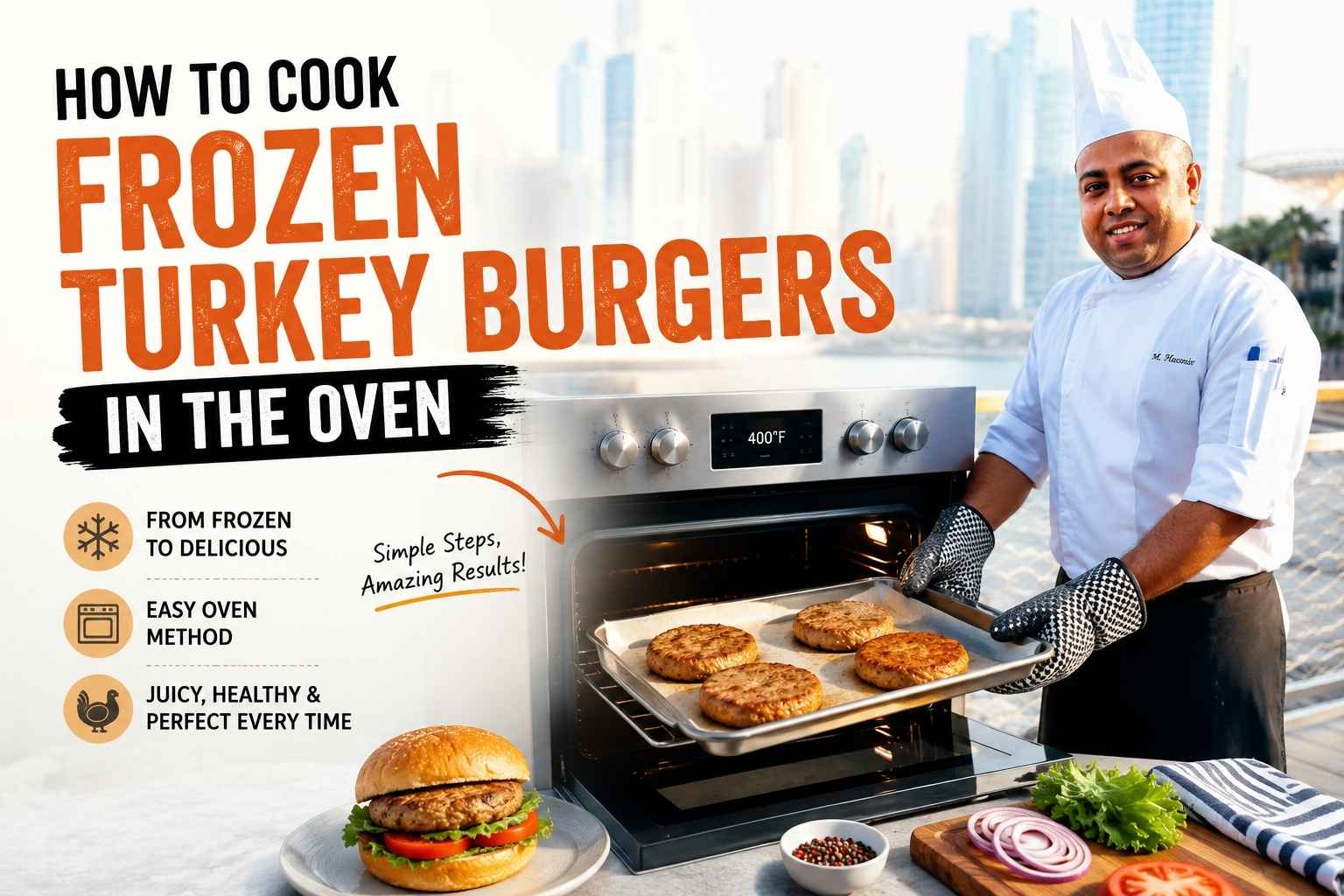
- Bake frozen turkey burgers at 400°F for 22–28 minutes. This gives you a browned outside and a juicy inside without drying out the patty.
- Skip the thaw. Turkey burgers cook more evenly from frozen because the outside and inside heat up at a closer rate.
- The only number that matters is 165°F at the center of the patty (USDA Food Safety and Inspection Service, 2024). Time is just a guess. A thermometer is the truth.
- Use a wire rack over a sheet pan. It lets fat drip away and air move under the patty, so both sides brown.
- Never guess on time when the patties are stuck together in a clump. Pry them apart first, or the center ones stay raw.
Have you ever stood in front of the freezer and wondered how to cook frozen turkey burgers in the oven without drying them out? I have been there too, especially on busy days when I wanted a fast meal that still tasted homemade. After cooking turkey burgers many times, I found a few simple tricks that keep them juicy, flavorful, and perfectly cooked every time. In this guide, I’ll show you the best oven temperature, cooking time, and easy tips so you can enjoy delicious frozen turkey burgers with confidence.
Why Turkey Burgers Aren’t Just Small Beef Burgers
A turkey burger is not a beef burger with feathers. It behaves like a different food in the oven, and treating it like ground beef is where most home cooks go wrong.
Fat content is the first big difference. Ground beef for burgers usually sits at 15–20% fat. Standard ground turkey burger blends run leaner, often 7–15% fat depending on the brand (Butterball, 2026). Fat is what keeps a patty moist as it cooks. Less fat means less room for error. Beef can survive a few extra minutes in the oven. Turkey can’t.
Density is the second difference. Turkey meat is finer-grained and packs tighter in the grinder. That tighter structure holds moisture differently than beef, and it also means heat moves through the patty at a different speed. A turkey patty firms up and can turn tough faster than a beef patty at the same temperature.
Food safety margin is the third, and most important, difference. Ground beef only needs to hit 160°F to be safe (USDA Food Safety and Inspection Service, 2024). Ground turkey has to reach 165°F. That five-degree gap sounds small, but it’s the difference between a patty that’s still a little pink and juicy and one that’s fully done. There’s no safe “medium” for turkey. You cook it through, every time.
I learned this the hard way in a hotel kitchen years ago, pulling turkey burgers at what looked like a perfect beef-burger doneness. They were still cool at the center. Turkey doesn’t give you visual cues the way beef does. You need a thermometer, not a guess.
Cooking From Frozen Is Not a Shortcut. It’s Often the Better Method.
Cooking a turkey burger straight from frozen isn’t a compromise you make when you forgot to thaw dinner. In a lot of cases, it’s the smarter move.
Here’s the science in plain terms. A thawed patty is soft all the way through. It heats fast on the outside and can overcook there before the center catches up. A frozen patty starts as a solid block. The outside browns while the inside thaws and cooks at a slower, steadier pace behind it. That gap in speed actually works in your favor. It buys you time to get color on the surface without drying out the middle.
Frozen also solves a shape problem. Thawed ground turkey is soft and can squish or spread on a hot pan. A frozen patty holds its shape until it’s most of the way cooked, so you get a rounder, thicker burger on the plate instead of a flat disc.
The tradeoff is time. A frozen patty takes roughly 8–12 minutes longer in the oven than a thawed one at the same temperature. That’s a fair trade for a burger that’s less likely to end up dry or misshapen.
The One Number That Actually Matters: 165°F
Every oven runs a little different. Every patty is a slightly different thickness. That means cook time is never exact. Internal temperature is.
The USDA Food Safety and Inspection Service sets 165°F as the safe minimum for all poultry, including ground turkey, because that’s the temperature needed to destroy harmful bacteria such as Salmonella (USDA Food Safety and Inspection Service, 2024). This rule applies whether the burger came from fresh or frozen meat, and whether you baked, grilled, or fried it.
Here’s the part that surprises people: FSIS has specifically warned that package cook-time instructions for frozen ground turkey patties can be misleading, because actual cook time varies with oven accuracy, patty thickness, and starting temperature (USDA Food Safety and Inspection Service, 2024). The agency’s guidance is blunt: don’t rely on minutes per side, rely on the thermometer.
Why guessing by time is risky:
- Ovens can run 15–25°F off their dial setting, even brand-new ones.
- Frozen patties vary in thickness by brand, sometimes by a full quarter-inch.
- A patty straight from a full freezer starts colder than one from a half-empty freezer.
None of those variables show up on the package instructions. A thermometer accounts for all of them at once.
Oven Temperature Breakdown for Frozen Turkey Burgers
There’s no single “correct” oven temperature. The right one depends on whether you’re racing a weeknight clock or chasing the juiciest possible burger. Here’s how I use each range in my own kitchen.
350°F: The Low-and-Slow Juicy Route
This is the temperature I reach for when I have 35 minutes and actually care about texture. The lower heat gives the inside time to catch up to the outside without scorching the surface. It’s my pick for thicker, restaurant-style patties (5–6 ounces or more).
375°F: The Balanced Everyday Choice
This is the middle ground, and honestly the one I recommend most for home cooks. You get decent browning, a manageable cook time, and enough of a safety cushion that a slightly thick patty won’t leave you with a raw center.
400°F: The Weeknight Speed Setting
This is my go-to on a Tuesday when dinner needs to happen fast. It browns the outside well and still gives the inside enough time to reach 165°F evenly, as long as you’re using a rack (more on that below) instead of a solid pan.
425°F: The High-Heat Finish, Used With Care
I only use this range for the last few minutes of a bake, to crisp the outside after the center is already close to done. Starting a frozen patty at 425°F from the beginning risks a dark, dry crust before the middle finishes. Save this heat for finishing, not starting.
Cook Time Reference Table
| Oven Temp | Estimated Cook Time (Frozen Patty) | Internal Temp Target | Notes |
|---|---|---|---|
| 350°F | 30–35 minutes | 165°F | Juiciest result. Best for thick, restaurant-style patties. Flip at the halfway point. |
| 375°F | 26–30 minutes | 165°F | Best all-around choice for most home cooks. Good browning, forgiving margin for error. |
| 400°F | 22–28 minutes | 165°F | Fastest reliable option. Use a wire rack so the bottom browns instead of steaming. |
| 425°F | 15–20 minutes (or 3–5 min finish only) | 165°F | Best used as a finishing blast after starting lower. Watch closely to avoid a dry crust. |
These ranges assume a standard ¼-pound patty, about ¾-inch thick. A thicker or thinner patty will shift these times. Always confirm with a thermometer instead of the clock.
Sheet Pan vs. Wire Rack vs. Broiler Pan: How Each One Changes the Burger
The pan you choose changes browning, moisture, and grease drainage more than most people expect.
A plain sheet pan is the setup most people default to, and it’s the weakest option for turkey burgers. Grease and juice pool underneath the patty as it cooks, and the bottom essentially steams instead of browning. You’ll get an evenly cooked burger, but a pale, soft bottom.
A wire rack set inside a sheet pan is my standard setup, and the one I’d tell any home cook to buy if they only get one tool from this article. Air moves underneath the patty, grease drips down into the pan below, and both sides brown instead of just the top. It’s the closest an oven gets to grill results.
A broiler pan is a built-in version of the rack-and-pan combo, with slots for grease to drain through. It works well, but the slots are often wider than a rack’s grid, so a thin or soft patty can sag into the gaps before it firms up. I’d choose a wire rack over a broiler pan for turkey specifically, since turkey patties are softer than beef straight out of the freezer.
Bottom line: if browning matters to you, get the patty up off the pan surface. A five-dollar wire rack does more for a turkey burger than any seasoning blend.
Preheating: A Bigger Mistake to Skip Here Than With Almost Anything Else
Skipping preheat is a bad habit with most oven cooking. With frozen turkey burgers, it’s a worse one.
Here’s why. A frozen patty is already starting from the coldest possible point, often near 0°F at the center. If you also start with a cold oven, you stack two slow-heating problems on top of each other. The oven spends its first several minutes just climbing to temperature, and the patty sits there absorbing weak, uneven heat the entire time. That’s exactly the environment where bacteria have the most opportunity, and exactly the environment that produces a gray, unappetizing crust instead of a browned one.
Give the oven the full preheat cycle, plus two extra minutes. Most ovens signal “ready” a bit before they’ve actually stabilized at the set temperature. That extra buffer matters more with a frozen patty than a room-temperature one, because you’re not giving the meat any head start of its own.
Using a Meat Thermometer Correctly on a Thin Patty
A meat thermometer is only useful if you use it right, and thin patties are the easiest food to misread.
Insert it from the side, not straight down through the top. A top-down insertion on a thin patty can push the probe tip straight through and out the bottom, or leave it reading the temperature of the pan instead of the meat. Tilt the patty slightly with a spatula, or insert the probe horizontally into the edge, and push it toward the center (ThermoWorks, 2026).
Aim for the thickest part, dead center. That’s the coldest point in the patty and the true test of whether it’s done.
Wait for the number to settle. Digital instant-read thermometers usually take five to ten seconds to give a stable reading (America’s Test Kitchen, 2026). Pulling the probe too fast gives you a number that’s still climbing, not the real internal temperature.
Check more than one patty if you’re cooking several at once. Ovens have hot spots, and patties near the back or edges of a pan often finish before ones in the middle.
If a patty reads anywhere under 165°F, it goes back in. There’s no acceptable “close enough” with ground turkey.
Flipping Technique: Why It Matters More for Frozen Turkey Burgers
Flipping does two jobs: it evens out browning, and it helps the patty cook through at a more consistent rate on both sides.
Flip once, at the halfway point of your estimated cook time. For a 26-minute bake at 375°F, that’s around the 13-minute mark. Flipping more than once doesn’t speed anything up. It just adds handling that can crack a still-firm frozen patty.
Use a thin, wide spatula, and go in fast and flat. Frozen turkey patties are more fragile than beef in the first half of cooking, before the proteins have set. A thin spatula gets under the whole patty at once instead of catching an edge and breaking it.
Wait until the bottom has actually browned before you try to flip. If the patty resists or feels like it’s sticking, it usually needs another minute or two. Forcing an early flip is how patties end up in pieces.
Flipping matters more here than with a beef burger because turkey’s leaner texture makes it more prone to sticking to a pan in that first stretch of cooking, before enough fat has rendered out to release it naturally.
Adding Cheese, Toppings, or Sauce Without Drying Out the Patty
Turkey burgers dry out fast once they’re overcooked, so how and when you add extras matters.
Cheese goes on in the last 3–4 minutes, not at the start. Adding it earlier means more total oven time exposed to heat, which is exactly what you’re trying to avoid. Lay the slice on once the patty is close to 160°F internally, and let the last few minutes finish both the melt and the cook.
Wet toppings go on after the oven, not before. Barbecue sauce, glazes, or marinades brushed on early can burn onto the pan or create a sticky layer that traps steam under the patty instead of letting it brown.
Skip pressing the patty down at any point. Pressing squeezes out moisture that a lean patty can’t afford to lose. That habit works against you with beef too, but it’s more costly with turkey.
A light oil brush before baking helps more than most seasoning does. A thin coat of oil on the surface promotes browning and adds a bit of moisture protection during the bake. It’s a small step that makes a noticeable difference.
When You Can Adjust Time or Temp, and When You Absolutely Cannot
There’s a real line here, and it’s a food safety line, not a preference line.
You can adjust:
- Oven temperature, based on how much time you have and how you want the crust to turn out
- Whether you flip once or leave it be until near the end (as long as you’re checking with a thermometer)
- When you add cheese or toppings
You cannot adjust:
- The 165°F internal temperature requirement. This is not negotiable, and it’s not a matter of taste (USDA Food Safety and Inspection Service, 2024).
- Cooking time as your only doneness check, without ever confirming with a thermometer
- Serving a patty that looks done but hasn’t been checked, especially with color as your only signal. Turkey can stay pink even after it’s fully cooked through, and it can also look white and dry while still being under temperature at the core (USDA Food Safety and Inspection Service, 2024).
If you’re short on time, lower the temperature or start the burgers earlier. Don’t shorten the cook and hope the thermometer agrees with you later.
Common Mistakes and How to Fix Them
Mistake: Cooking straight from a crowded freezer bag with patties frozen together. This is one of the most common problems I see, and it’s an easy one to prevent. Patties stuck in a clump cook unevenly. The ones touching stay colder longer, because they’re insulated from the oven’s heat by their neighbors. Fix: pry patties apart before they go in the oven, even if it takes running the bag under cool water for a few seconds to loosen the stack. Give each patty its own space on the rack, with at least an inch of gap around it.
Mistake: Skipping the thermometer and going by time alone. Time is a guideline, not a guarantee. Fix: check every patty at the thickest point before serving, no exceptions.
Mistake: Starting at too high a temperature. A 425°F start on a frozen patty often means a dark, dry crust before the center hits 165°F. Fix: start lower, and reserve high heat for a short finishing blast if you want extra color.
Mistake: Using a flat sheet pan with no rack. The bottom steams instead of browning, and grease pools around the patty. Fix: use a wire rack over a sheet pan, or a broiler pan if that’s what you have.
Mistake: Pressing the patty flat during cooking. This squeezes out moisture the lean meat can’t spare. Fix: leave the patty alone. Let the spatula do its job at flip time only.
Mistake: Adding cheese or sauce too early. This adds cook time and can burn onto the pan. Fix: add cheese in the final few minutes, and save sauces for after the burger comes out.
My Method: How I Cook Frozen Turkey Burgers in the Oven
After years of testing this in both restaurant and home settings, here’s exactly what I do.
- Preheat the oven to 400°F, and give it the full cycle plus two extra minutes.
- Separate the frozen patties completely. If they’re stuck together, I run the package under cool water for 10–15 seconds to loosen them, then peel apart with a butter knife if needed.
- Set a wire rack inside a sheet pan lined with foil for easy cleanup.
- Brush both sides of each patty lightly with oil, and season the top with a simple mix of salt, pepper, and garlic powder. Frozen patties don’t take seasoning well once they’re in the oven, so I do it before they go in.
- Space the patties at least an inch apart on the rack.
- Bake for 12 minutes, then flip.
- Bake another 10–12 minutes, checking the internal temperature at the thickest point starting around minute 20 total.
- If adding cheese, place it on in the final 3 minutes and let the residual heat finish the melt.
- Pull the patties once they read 165°F, and let them rest on the rack for 2 minutes before building the burger. That short rest lets juices settle back into the meat instead of running out the moment you cut in.
This gives me a browned, seasoned patty with a moist center, in about 24–26 minutes total, with zero guessing at the end.
Frequently Asked Questions
Do I need to thaw frozen turkey burgers before baking them?
No. Frozen turkey burgers cook more evenly in the oven than thawed ones, because the outside and inside heat up at a closer pace. Add roughly 8–12 minutes to your cook time compared to a thawed patty at the same oven temperature.
What temperature is safe for turkey burgers?
The internal temperature must reach 165°F at the thickest part of the patty, measured with a food thermometer (USDA Food Safety and Inspection Service, 2024). This applies no matter what oven temperature or cook time you use.
How long do frozen turkey burgers take at 400°F?
Frozen turkey burgers typically take 22–28 minutes at 400°F on a wire rack. Always confirm doneness with a thermometer instead of relying on the clock, since oven accuracy and patty thickness both affect actual cook time.
Can I cook frozen turkey burgers without a wire rack?
Yes, but the bottom of the patty will likely stay pale and slightly steamed instead of browned, since grease and juice pool underneath on a flat pan. A wire rack over a sheet pan gives a better result if browning matters to you.
Why is my turkey burger dry even though I followed the time on the package?
Package times are estimates, and actual results vary by oven accuracy and patty thickness. Overcooking past 165°F is the most common cause of a dry turkey burger. Pull the patty as soon as it hits 165°F, not several minutes later.
Is it safe to eat a turkey burger that’s still a little pink inside?
Color is not a reliable safety test for turkey. A patty can look fully white and still be under 165°F at the center, or stay slightly pink even after reaching a safe temperature (USDA Food Safety and Inspection Service, 2024). Always confirm with a thermometer.
Can I add cheese to a turkey burger without drying it out?
Yes, if you add it in the last 3–4 minutes of baking instead of at the start. Adding cheese early extends the total time the patty spends in the oven, which increases the risk of drying it out.
What’s the best pan setup for oven-baked turkey burgers?
A wire rack set inside a foil-lined sheet pan is the best setup for even browning and grease drainage. A broiler pan works as a substitute, though its wider slots can let softer, thinner patties sag before they firm up.
Key Takeaways
- Cook frozen turkey burgers at 400°F for 22–28 minutes for the best balance of speed and browning, or 350°F for 30–35 minutes for the juiciest result.
- 165°F at the center is the only doneness marker that counts. Time and color are both guesses.
- A wire rack over a sheet pan solves the biggest weakness of oven-baked turkey burgers: a pale, steamed bottom.
- Preheat fully before the patties go in. Frozen meat plus a cold oven means uneven, slow cooking.
- Separate stuck-together patties before baking, insert the thermometer from the side on thin patties, and add cheese only in the final few minutes.
Sources:
- USDA Food Safety and Inspection Service, “Turkey from Farm to Table” (2024)
- USDA Food Safety and Inspection Service, public health alert on frozen/fresh ground turkey products (2024)
- ThermoWorks, thermometer probe placement guidance
- America’s Test Kitchen, “How To Use A Digital Thermometer And Never Overcook Meat Again” (2026)
- Butterball, turkey burger product and cooking information (2026)