
At A Glance
- Convection turkey cooks about 25% faster than a conventional oven, and the skin gets crisper because the fan strips away the layer of moist air that normally sits against the bird (National Turkey Federation, 2026).
- Set your oven to 325°F on the convection setting. Do not drop the temperature to 300°F – a full 25°F cut is only needed on some older convection models with strong fans.
- Pull the turkey at 155-160°F in the breast. Carryover cooking will carry it to a safe 165°F while it rests (Serious Eats, 2025).
- Leave the bird untrussed and use a low, shallow rack. Tied legs and a tall pan block airflow and slow the cook.
- Rest for 20-30 minutes before carving. Skipping this step is the single most common reason home turkeys turn out dry.
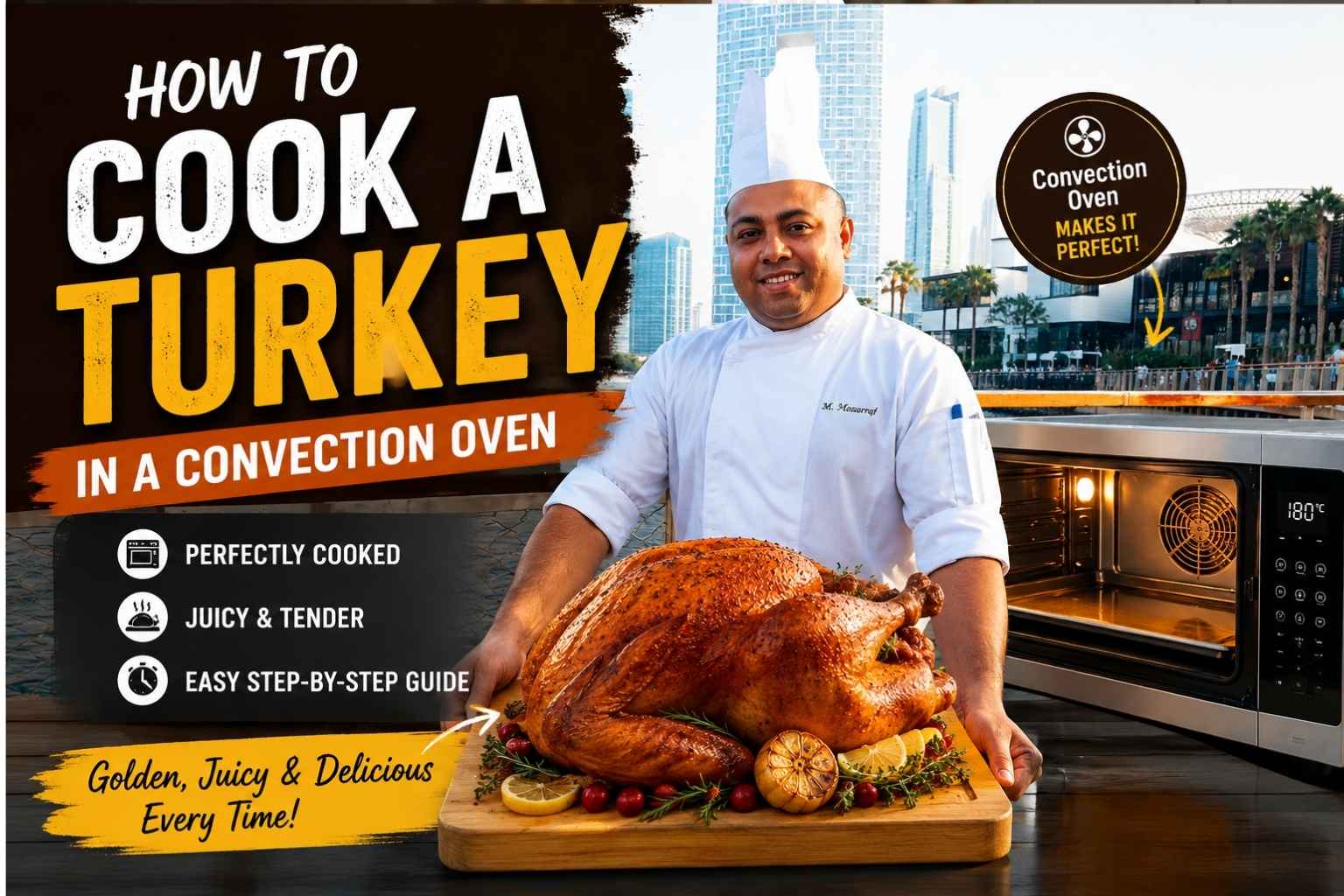
There is nothing quite like the smell of a turkey roasting in the oven. If you have been wondering How to Cook a Turkey in a Convection Oven, you are in the right place. I have cooked turkey this way for family dinners and holiday meals, and it has become my favorite method because it cooks faster and gives the bird crisp skin with juicy meat.
In this guide, I will show you every step, from choosing the right temperature and cooking time to checking for doneness without stress. You will also learn simple tips to avoid dry meat, get even browning, and serve a turkey that everyone will remember. Let’s get started and make your next turkey the best one yet.
Why Convection Changes Turkey Cooking
A convection oven uses a fan to push hot air around the bird instead of letting it sit still. That moving air strips away the thin layer of moisture that builds up next to the skin in a regular oven. Less moisture next to the skin means faster, more even browning.
I learned this the hard way in my first restaurant job. We ran six turkeys through a convection unit for a holiday buffet, and I set the temperature the same way I would for a home oven. Every bird came out with skin like leather on the drumsticks before the breast even hit temperature. My sous chef pulled me aside and explained the fan does the work that high heat usually does. You do not need to fight it with extra degrees.
Convection roasting cooks turkey roughly 25% faster than a standard oven at the same temperature, according to the National Turkey Federation (2026). The fan also evens out hot spots, so the wing tips and the thickest part of the breast finish closer together in time. That matters because a turkey is really several different cuts of meat cooking as one piece.
The Convection Temperature and Time Adjustment Rule
Here is the rule I actually use: keep the oven at 325°F on the convection setting and expect the bird to finish 25% to 35% faster than the same size turkey in a conventional oven. Some manufacturers suggest dropping the temperature by 25°F instead of shortening the time. Both approaches work. I prefer keeping the temperature steady and watching the clock, because a thermometer reading is easier to trust than guessing how much a lower temperature will slow things down.
Why not just crank the heat? A hotter oven browns the skin before the inside of the bird catches up. Convection already speeds up browning on its own. Add extra heat on top of that and you get a turkey that looks done at the 90-minute mark but reads 120°F in the thigh.
If your oven has a dedicated “convection roast” setting, use it. It usually combines the fan with a slightly different heat pattern built for large cuts of meat, and it will manage the adjustment for you.
Should You Truss the Bird?
No. Trussing pulls the legs in tight against the body, and that blocks the exact airflow that makes convection worth using. I stopped trussing turkeys years ago once I compared two birds side by side, cooked the same day, same oven. The untrussed bird had crisper skin on the inner thighs and finished about 15 minutes sooner.
If you like the classic look of a trussed bird for the table, tie it after cooking is done and you’re ready to carry it out. There is no food safety or texture reason to truss before roasting.
Tenting With Foil: Yes, But Only Near the End
Cover the breast loosely with foil once it hits about 155°F, or roughly two-thirds of the way through cooking. This slows down the breast, which cooks faster than the legs and thighs, and lets the dark meat catch up. Foil the whole bird from the start and you lose most of the benefit of convection, since you’re blocking the moving air from reaching the skin.
Leave It Uncovered for Most of the Cook
For the bulk of the roasting time, leave the turkey uncovered. The moving air needs direct contact with the skin to render fat and crisp it. A bird wrapped in foil for the full cook will steam instead of roast, and steamed turkey skin never crisps, no matter how long you leave it in afterward.
Rack Position and Pan Setup
Airflow only works if the air can actually reach the turkey from all sides. Here’s how I set up the pan every time:
- Use a low rack position. The middle or lower-middle rack keeps the bird centered in the oven’s airflow. Too high and the top browns while the fan can’t reach underneath as well.
- Use a shallow roasting pan, 2 to 2.5 inches deep. A deep pan with high walls blocks air from circulating around the lower half of the bird (Butterball, 2026).
- Set the turkey on a rack inside the pan, not directly on the pan floor. This lets air move underneath the bird, not just over the top.
- Skip the roasting bag. Bags trap steam and defeat the entire point of convection.
- Give the pan room on every side. A pan wedged against the oven wall blocks airflow on that side and creates uneven browning.
Internal Temperature Targets by Part
Different parts of the turkey need different final temperatures because they’re built from different tissue. Breast meat is lean and dries out past 165°F. Thigh and leg meat has more connective tissue and actually tastes better cooked further, since the collagen needs heat and time to break down into gelatin.
| Part | Target Pull Temperature | Where to Place the Probe |
|---|---|---|
| Breast | 155-160°F (rises to 165°F while resting) | Thickest part, parallel to the ribs, avoiding bone |
| Thigh | 170-175°F | Innermost part of the thigh, not touching bone |
| Wing | 165°F minimum | Thickest joint near the body |
| Stuffing (if stuffed) | 165°F | Dead center of the stuffing mass |
The USDA’s official minimum for all turkey and stuffing is 165°F, measured with a food thermometer in the thickest part of the breast and the innermost part of the thigh and wing (USDA FSIS, 2026). Pulling the breast a few degrees under that mark and relying on carryover heat to finish the job is a technique many working cooks use, but the USDA’s published guidance is 165°F throughout as the safe target. If you’re new to timing carryover cooking, cook straight to 165°F everywhere and skip the early pull.
Probe placement matters more than the number on the dial. A probe touching bone gives a false high reading, since bone conducts heat differently than muscle. I’ve seen home cooks pull a turkey they thought was done, only to find raw meat near the joint because the probe was resting against the femur the whole time.
Convection Turkey Cook-Time Reference Table (325°F)
These times are for an unstuffed turkey roasted breast-side up at 325°F on the convection setting. Always confirm with a thermometer – size, oven calibration, and whether the bird is fully thawed all shift the actual time (Butterball, 2026).
| Turkey Weight | Estimated Convection Cook Time | Notes |
|---|---|---|
| 8-10 lbs | 1 hr 45 min – 2 hr 15 min | Tent breast at the 1-hour mark |
| 10-12 lbs | 2 hr – 2 hr 30 min | Check thigh temp starting at 1 hr 45 min |
| 12-14 lbs | 2 hr 15 min – 2 hr 45 min | Standard size for a table of 8-10 |
| 14-16 lbs | 2 hr 30 min – 3 hr | Rotate pan once at the halfway point |
| 16-18 lbs | 2 hr 45 min – 3 hr 15 min | Tent breast around the 1 hr 45 min mark |
| 18-20 lbs | 3 hr – 3 hr 30 min | Start checking temp 45 min before target |
| 20-22 lbs | 3 hr 15 min – 3 hr 45 min | Larger birds need more resting time too |
| 22-24 lbs | 3 hr 30 min – 4 hr | Consider spatchcocking for faster, more even cooking |
Add 15 to 20 minutes to any of these times if the turkey is stuffed, and always confirm the stuffing itself reaches 165°F before pulling the bird (USDA FSIS, 2026).
Stuffed vs. Unstuffed: How Convection Timing Differs
I almost never stuff the bird itself, and convection is a big part of why. A stuffed turkey cooks slower because the cavity holds cold mass that has to come up to temperature before the meat around it is considered safe. That means the breast and thighs sit in the oven longer than they need to, well past their own ideal finish point, just so the stuffing in the middle can catch up.
If you do stuff the turkey, plan for 15 to 20 minutes of extra cook time compared to the same size unstuffed bird, and check the stuffing temperature separately from the meat. The center of the stuffing must reach 165°F, and it often lags behind the breast and thighs by a wide margin (USDA FSIS, 2026).
My routine: cook the stuffing in a separate dish alongside the turkey. It gets more consistent texture, a crisp top, and it doesn’t hold the whole bird hostage waiting for the center to catch up.
Resting Time After Convection Roasting
Rest the turkey for 20 to 30 minutes before carving, tented loosely with foil. This step matters just as much with convection as it does with a conventional oven, maybe more, since convection-roasted turkey often comes out of the oven with a higher surface temperature.
During the rest, the internal temperature keeps climbing for several minutes. This is carryover cooking. Heat that’s built up in the outer layers of meat continues moving toward the center even after the bird leaves the oven (Serious Eats, 2025). Skip the rest and cut into the bird right away, and you’ll watch a pool of juice spread across the cutting board instead of staying in the meat.
Resting also gives the muscle fibers time to relax. Meat cut straight out of a hot oven is tense and pushes liquid out with every slice. Give it half an hour and the same cut holds together and stays moist.
Common Convection Turkey Mistakes (and How to Fix Them)
Mistake 1: Overcrowding the Oven
Cramming the turkey pan next to casserole dishes and side pans blocks the airflow that makes convection work in the first place. The fan can only do its job if air has open space to move through.
Fix: Give the turkey pan clearance on all sides. If your oven is full, roast the turkey first and hold it, tented in foil, on the counter while the sides finish. A rested turkey holds its heat well for 30 to 45 minutes.
Mistake 2: Ignoring Carryover Cooking
Pulling the turkey exactly at 165°F everywhere, including the breast, almost guarantees dry white meat. The breast keeps climbing several more degrees after it leaves the oven, especially in convection ovens where the surface temperature runs hotter.
Fix: Pull the breast at 155-160°F and let the rest finish the job. Use a leave-in probe thermometer so you can watch the rise happen in real time instead of guessing.
Mistake 3: Skipping the Thaw Check
A turkey that’s still partly frozen in the cavity throws off every time estimate in this article. The outside can look and read done while ice sits near the bone.
Fix: A 12-16 lb turkey needs about 3 days in the refrigerator to fully thaw. Check the cavity with your hand before it goes in the oven.
Mistake 4: Using a Dark or Nonstick Roasting Pan
Dark pans absorb more heat and can scorch the bottom of the turkey before the top finishes, especially with a fan pushing extra heat around the pan walls.
Fix: Use a light-colored metal or glass roasting pan, and drop the temperature to 300°F if a dark pan is all you have.
Mistake 5: Never Rotating the Pan
Most home convection ovens have one fan on the back wall. Even with circulation, the side closest to the fan can brown faster.
Fix: Rotate the pan 180 degrees once, about halfway through cooking.
My Personal Convection Turkey Routine
Here’s exactly what I do, start to finish, for a 16-pound bird feeding 10 people.
I take the turkey out of the fridge about an hour before it goes in the oven so it isn’t ice cold going into a hot environment. I pat the skin bone dry with paper towels, since any surface moisture steams instead of crisping. I rub the whole bird with softened butter under and over the skin, season heavily with salt, and leave the cavity loose with a quartered onion, a halved lemon, and a handful of thyme and sage. No stuffing inside.
The oven goes to 325°F on convection roast. The turkey goes in breast-side up on a rack, in a pan with about an inch of chicken stock in the bottom, which I use later for gravy. No foil for the first hour and forty-five minutes.
I check the breast temperature around the two-hour mark. Once it hits 155°F, I tent the breast loosely with foil and let the legs and thighs keep going uncovered. I pull the whole bird once the thigh reads 170-172°F and the breast has climbed to about 160°F, which for a 16-pound bird usually lands somewhere around 2 hours 45 minutes.
The first year I tried this method at home instead of at work, I nearly talked myself out of pulling the breast early. Every instinct from years of “cook it until it’s done” told me to leave it in until every part hit 165°F on the nose. I pulled it anyway, tented it, and set a timer for 25 minutes. When I checked again, the breast had climbed to exactly 165°F on its own. That was the last year I second-guessed carryover cooking.
Twenty-five minutes of rest, then carve. The skin stays crisp because I never covered the whole bird in foil, only the breast, and only near the end.
Frequently Asked Questions
Can I cook a frozen turkey in a convection oven?
No. Start with a fully thawed turkey. A partially frozen bird cooks unevenly, and the times in this guide won’t apply. Thaw in the refrigerator, allowing about 24 hours for every 4 to 5 pounds of turkey.
Should I baste a turkey in a convection oven?
You don’t need to. Basting opens the oven door repeatedly, which drops the temperature and slows the fan’s job of crisping the skin. The butter or oil you apply before roasting does more for the skin than basting ever will.
Does dry brining work well with convection?
Yes, and I’d argue it works better than with a conventional oven. Dry brining, salting the bird 24-48 hours ahead and leaving it uncovered in the fridge, dries out the surface skin before it even hits the oven. That head start pairs well with convection’s own skin-crisping effect.
Is convection better than conventional for a first-time turkey cook?
I’d say yes, mainly because of the time savings and more even cooking. The one thing to watch is checking temperature earlier than you’d expect, since the bird finishes faster than most recipes written for conventional ovens assume.
Why is my convection turkey browning too fast on the outside?
The oven is likely running hotter than the fan alone accounts for, or the pan is too close to the fan wall. Tent the breast earlier, rotate the pan, and confirm your oven temperature with a separate oven thermometer.
Can I spatchcock a turkey for convection cooking?
Yes, and for birds over 18 pounds, I recommend it. Removing the backbone and flattening the turkey exposes more surface area to the moving air, which cuts cook time further and gives you even browning across the whole bird.
What size probe thermometer should I use?
A leave-in probe with an external readout lets you track temperature without opening the oven door. Opening the door repeatedly lets heat escape and slows the whole cook, which matters even more with convection since you’re relying on that steady airflow.
Do I need to adjust cook time if my turkey has a pop-up timer?
Trust a separate instant-read or probe thermometer over the built-in pop-up timer. Pop-up timers are calibrated for a single spot and can pop before the thickest part of the breast or thigh is actually at a safe temperature.
Key Takeaways
- Roast at 325°F on the convection setting and expect the bird to finish 25% to 35% faster than a conventional oven.
- Skip the trussing, use a shallow pan and low rack, and leave the bird uncovered until the last third of cooking.
- Pull the breast at 155-160°F and let carryover cooking carry it to 165°F during a 20-30 minute rest.
- Cook stuffing separately when possible; it saves time and gives the meat a more even cook.
- Overcrowding the oven and skipping the rest period are the two mistakes that ruin more convection turkeys than anything else.