At A Glance
- Spatchcocking means cutting out the backbone and pressing the turkey flat. It cuts oven time by 30-50% and cooks the breast and thighs at almost the same rate.
- A 12-14 lb spatchcocked turkey roasts in about 75-85 minutes at 425°F, or 65-75 minutes at 450°F (Butterball, 2026).
- Pull the breast at 160°F and the thigh at 170°F. Both climb a few more degrees during the rest (ThermoWorks, 2025).
- Dry brine beats wet brine for a flat bird. It crisps the skin instead of soaking it (America’s Test Kitchen, 2023).
- Rest the turkey for 20-25 minutes before you carve it. Skipping the rest is the fastest way to waste a good roast.
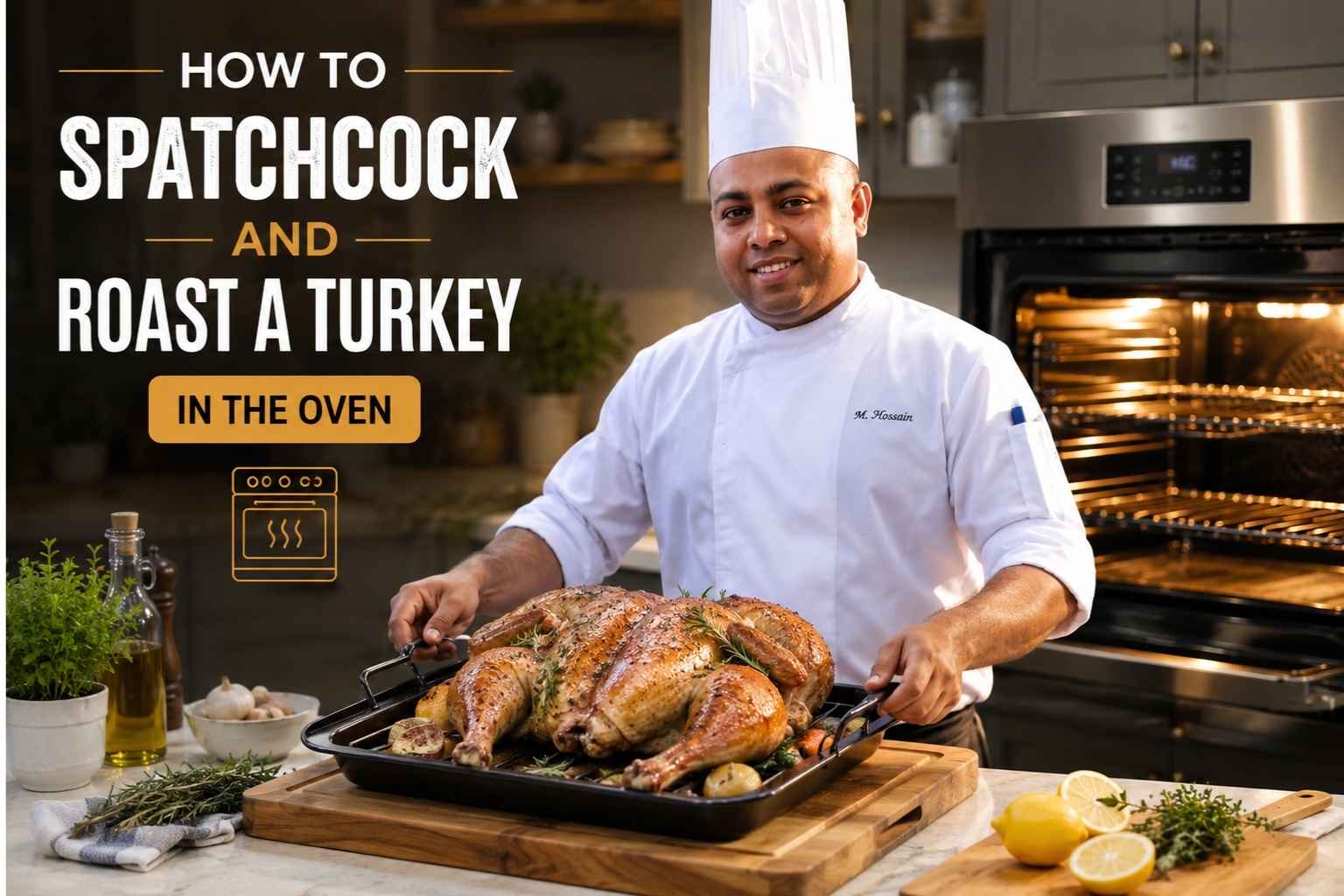
The first time I tried How to Spatchcock and Roast a Turkey in the Oven, I was surprised by how much easier it made the whole meal. The turkey cooked faster, the skin turned crisp and golden, and every bite stayed juicy. After testing this method for holiday dinners and family gatherings, I have learned the simple steps that give the best results every time. In this guide, I will show you how to spatchcock a turkey, roast it at the right temperature, and avoid common mistakes so you can serve a tender, flavorful bird with confidence.
What Spatchcocking Actually Means
Spatchcocking is a fancy word for a simple move: you cut out the backbone and press the turkey flat, breastbone down against the counter first, then flipped skin-up to roast. The bird ends up looking like a flattened map instead of a football.
I know the word sounds made up. It isn’t. Cooks have used it for centuries to describe butterflying a bird for faster, more even cooking. Once you do it one time, you’ll wonder why anyone still trusses a turkey and stands it up like a trophy.
The whole point is surface area. A whole trussed turkey is a thick, round shape. Heat has to fight its way to the center of the thigh while the breast sits closer to the hot air the entire time. Spread the bird flat, and every part of it sits about the same distance from the oven’s heat.
Why a Flat Turkey Cooks Faster and More Evenly
The Short Answer
A spatchcocked turkey cooks 30 to 50% faster than a trussed one because it has more skin exposed to hot air and no thick central mass to slow down heat transfer (America’s Test Kitchen, 2023).
The Longer Answer
Picture a whole turkey standing in a roasting pan. The dense breast meat is up top, and it dries out long before the dark meat in the legs reaches a safe temperature. That’s the core problem with a traditional roast turkey: white meat and dark meat finish at different times, but they’re stuck on the same bird in the same oven.
Flattening the turkey solves this. The legs and thighs swing out to the sides instead of tucking under the body. That puts the dark meat, which needs a higher final temperature, in direct contact with hot air on all sides. Meanwhile, the breast lies flatter and thinner than it does on a whole bird, so it heats through faster too.
I’ve cooked hundreds of turkeys both ways in restaurant kitchens. Trussed and upright, I was babysitting the oven with foil tents and temperature checks every 20 minutes. Spatchcocked, I set a timer, walked away, and came back to an evenly cooked bird almost every single time.
Tools and Materials Checklist
Before you touch the turkey, gather these:
- Poultry shears (heavy-duty kitchen shears built for cutting through bone)
- Sharp boning or chef’s knife
- Large cutting board (big enough to hold the whole bird)
- Sheet pan with raised edges, at least 18 by 13 inches
- Wire rack that fits inside the sheet pan
- Instant-read thermometer (a leave-in probe thermometer is even better)
- Paper towels, a full roll
- Small bowl for dry brine or rub
- Plastic wrap or a large container for the fridge rest
You don’t need a roasting pan for this method. A sheet pan and wire rack do the job better, since the flat shape needs a flat surface, not a deep pan.
How to Spatchcock a Turkey: Step-by-Step
Step 1: Set Up Your Station
Lay a few paper towels under your cutting board so it doesn’t slide. Set the turkey breast-side down on the board. Remove the neck and giblets from the cavity if they’re still in there.
Step 2: Cut Along the Backbone
Using poultry shears, cut down one side of the backbone, starting at the tail end and working toward the neck. Cut through the ribs, not through the spine itself, keeping your shears close to the bone.
Repeat on the other side of the backbone. You should end up with the backbone free and a long strip of bone in your hand. Save it. It makes excellent turkey stock.
Step 3: Flatten the Breastbone
Flip the turkey over so it’s breast-side up. Open it like a book, then press down hard with both palms on the breastbone, right in the center of the chest. You’ll hear a crack. That’s the keel bone breaking, and it’s exactly what you want.
A common mistake here is pushing too gently and only partially flattening the bird. Push with your full body weight, not just your arms. The turkey should lie flat on the board with no part of it standing up.
Step 4: Tuck the Wings
Fold the wing tips behind the shoulders so they don’t burn before the rest of the bird finishes. This is the same trick used for a whole roasted chicken, just scaled up.
Step 5: Pat It Completely Dry
Dry the entire surface, top and underside, with paper towels. Skipping this step is one of the biggest mistakes home cooks make. Wet skin steams instead of crisping, no matter how hot your oven runs.
Dry Brine vs. Wet Brine for a Spatchcocked Bird
I’ll say this plainly: for a spatchcocked turkey, dry brine wins. A wet brine adds water weight to the skin, and that water fights you the entire time you’re trying to crisp it. A dry brine pulls moisture out first, then draws it back into the meat over a day or two, leaving the skin dry and ready to crisp (America’s Test Kitchen, 2023).
How to Dry Brine
Mix 1 tablespoon of kosher salt per 5 pounds of turkey with black pepper and any dried herbs you like. Rub it under the skin and over the surface. Set the turkey uncovered on a wire rack in the fridge for 24 to 48 hours.
If You Still Want to Wet Brine
Wet brining works fine if you plan ahead and have the fridge space for a big container. Submerge the turkey in a saltwater brine, roughly ¾ cup of salt per gallon of water, for 12 to 24 hours. Rinse and dry it thoroughly afterward, since any leftover surface moisture will block browning.
Oven Setup for Spatchcocked Turkey
Rack Position
Put the oven rack in the lower-middle position, not the very bottom or very top. This gives the turkey room to sit close enough to the heat source for good browning, without the top of the skin scorching before the inside finishes.
Pan Choice
Use a sheet pan with a wire rack, not a deep roasting pan. A spatchcocked turkey is wide and flat, and a roasting pan’s tall sides block hot air from circulating around the legs and wings. The wire rack also lifts the skin off the pan so it doesn’t steam in its own drippings.
Convection vs. Conventional
If your oven has a convection setting, use it. Convection circulates hot air around the bird, which speeds up cooking and crisps skin more evenly. Drop the temperature by about 25°F from what a conventional recipe calls for, since convection ovens cook hotter for the same dial setting.
Roasting Time and Temperature by Turkey Weight
These times are for a spatchcocked, unstuffed turkey roasted breast-side up. Always confirm doneness with a thermometer instead of relying on the clock.
| Turkey Weight | 425°F Cook Time | 450°F Cook Time | Notes |
|---|---|---|---|
| 10-12 lbs | 65-75 min | 55-65 min | Start checking temperature at the low end of the range |
| 12-14 lbs | 75-85 min | 65-75 min | The sweet spot for most home ovens and most families |
| 14-16 lbs | 85-95 min | 75-85 min | Tent the breast with foil if it browns too fast |
| 16-18 lbs | 95-105 min | 85-95 min | May need a larger sheet pan or two pans side by side |
| 18-20 lbs | 105-120 min | 95-110 min | Consider a lower rack position for even browning |
These ranges line up closely with Butterball’s published roasting guidance, adjusted for the shorter cook time a flattened bird needs (Butterball, 2026). Oven accuracy varies, so an oven thermometer is worth the ten dollars it costs.
Target Internal Temperatures: Breast vs. Thigh
This is where most home cooks go wrong, and it’s not really their fault. A single “turkey is done” number ignores the fact that breast and thigh meat behave differently.
Pull the breast at 160°F. Carryover heat will carry it to a safe 165°F or higher while it rests (USDA, 2024).
Pull the thigh at 170-175°F. Dark meat has more connective tissue than breast meat, and it needs the extra heat to break down and become tender instead of chewy (ThermoWorks, 2025).
Where to Place the Thermometer
Insert the probe into the thickest part of the breast, away from the bone. For the thigh, angle the probe in from the side, between the leg and the body, again avoiding bone. Bone conducts heat differently than muscle and will give you a false reading.
Check both spots. A spatchcocked turkey cooks more evenly than a whole one, but “more evenly” doesn’t mean identically, and one probe reading is not enough proof the whole bird is done.
How to Get Crispy Skin Every Time
Dry the Skin Twice
Pat it dry after brining, then let it sit uncovered in the fridge for the last few hours before cooking. Open, dry air pulls surface moisture out, and dry skin is the entire secret to crisp skin.
Use Fat, Not Just Oil
Rub softened butter or oil over the entire surface, including under the skin over the breast. Butter browns better than oil because of its milk solids, though a neutral oil works if you’re avoiding dairy.
Finish Hot
If your turkey is close to done but the skin still looks pale, run the oven up to 475°F or switch on the broiler for the final five to eight minutes. Watch it closely. Skin can go from golden to burnt in under a minute under a broiler.
Resting Time: Why It Still Matters
A spatchcocked turkey cooks fast, and that speed tempts people to skip the rest and carve right away. Don’t. Resting redistributes juices that get pushed toward the center of the meat during cooking. Cut into it too soon, and those juices end up on your cutting board instead of in your slices.
Rest the turkey for 20 to 25 minutes, loosely tented with foil, before you carve. Because a flattened turkey has thinner meat than a whole roasted one, it doesn’t need the full 40-minute rest some traditional recipes call for. Twenty-five minutes is enough.
Common Mistakes and How to Fix Them
Cutting through the breastbone instead of flattening it. The breastbone should crack and lie flat, not get sliced through. Cutting it leaves the bird lopsided and creates an opening that dries out during roasting. Fix: press with your palms, not a knife, and center your weight over the keel bone.
Skipping the pat-dry step. Wet skin steams. Steamed skin never crisps, no matter how high you crank the oven. Fix: dry the bird thoroughly after brining and again right before it goes in the oven.
Using the wrong rack position. Too high, and the skin burns before the meat cooks through. Too low, and the underside never browns. Fix: lower-middle rack, checked partway through cooking.
Pulling the turkey too early. A fast cook time doesn’t mean you can eyeball doneness. Fix: check both the breast and the thigh with a thermometer every single time, no exceptions.
Forgetting the wings. Untucked wing tips burn to a crisp long before the rest of the bird is done. Fix: tuck them under the shoulders before the turkey goes in the oven.
My Personal Spatchcock Routine
Here’s exactly what I do, no fluff. Two days out, I spatchcock the turkey and dry brine it with kosher salt, black pepper, and dried thyme, then set it uncovered on a rack in the fridge. The night before, I flip it once so both sides dry evenly.
On cook day, I pull it out an hour before roasting so it’s not ice cold going into the oven. I rub softened butter under the skin and over the top, then set the oven to 450°F with convection on. For a 13-pound bird, I check the breast at the 55-minute mark and the thigh right alongside it. Most of the time, I’m pulling the bird between 65 and 70 minutes.
I rest it under loose foil for 20 minutes while I finish the gravy from the roasted backbone and pan drippings. That backbone isn’t a throwaway. It’s free flavor sitting right there on your cutting board.
The one thing I never skip: checking both the breast and the thigh with a thermometer, even after 15 years of doing this. Ovens lie. Thermometers don’t.
Frequently Asked Questions About Spatchcocked Turkey
Can I spatchcock a frozen turkey?
No. The turkey needs to be fully thawed before you cut it, since frozen bone and cartilage are too hard to cut safely and cleanly with poultry shears. Thaw it in the fridge first, which takes about 24 hours for every 4 to 5 pounds of turkey.
Does spatchcocking work if I want to stuff the turkey?
Not inside the bird. A flattened turkey has no cavity to hold stuffing. Some cooks roast the stuffing underneath the flattened bird on the same pan instead, which lets it soak up drippings as the turkey cooks (America’s Test Kitchen, 2023).
How much smaller does a turkey get after spatchcocking?
The turkey doesn’t lose weight or meat. It just takes up more space on the pan and less space in height. You’ll need a large sheet pan, or two turkeys side by side won’t fit for a big gathering.
Is spatchcocking safe, or does it increase food safety risk?
It’s just as safe as roasting a whole turkey, and arguably safer, since even cooking means less risk of undercooked pockets near the thigh joint. Always cook to a minimum internal temperature of 165°F throughout (USDA, 2024).
Can I spatchcock a turkey the day I plan to cook it?
Yes, but dry brining overnight gives noticeably better results. If you’re short on time, even a same-day dry brine of 4 to 6 hours improves the skin and seasoning compared to skipping it entirely.
What size turkey works best for spatchcocking?
Anything under 18 pounds fits comfortably on a standard sheet pan. Larger birds work too, but you’ll want a bigger pan or a half-sheet-and-full-sheet combination to keep the bird flat and supported.
Do I need special equipment to spatchcock a turkey?
Just sturdy poultry shears and a large cutting board. A sharp chef’s knife can substitute for the shears in a pinch, but shears make cleaner, faster cuts through bone.
Why does my turkey skin turn dark before the meat is fully cooked?
This usually means your oven runs hot, your rack is positioned too high, or the skin wasn’t dry enough going in and caramelized unevenly. Tent the darkest spots loosely with foil and lower the rack next time.
Key Takeaways
- Spatchcocking flattens the turkey by removing the backbone, cutting roast time by roughly a third to a half.
- A 12-14 lb bird takes about 65 to 85 minutes depending on oven temperature, not the 3-plus hours a whole turkey needs.
- Dry brine for 24 to 48 hours for the crispest skin and best-seasoned meat.
- Pull the breast at 160°F and the thigh at 170-175°F, then rest for 20 to 25 minutes before carving.
- Skip the pat-dry step or the thermometer check, and you’ll undo everything the spatchcock method is supposed to fix.
Sources: America’s Test Kitchen, “How to Spatchcock and Carve Your Turkey” (2023) — americastestkitchen.com; USDA Food Safety and Inspection Service, “Turkey Basics: Safe Cooking” (2024) — fsis.usda.gov; ThermoWorks, “How to Cook a Turkey: Temperature Tips” (2025) — blog.thermoworks.com; Butterball, “How to Roast a Turkey” (2026) — butterball.com