
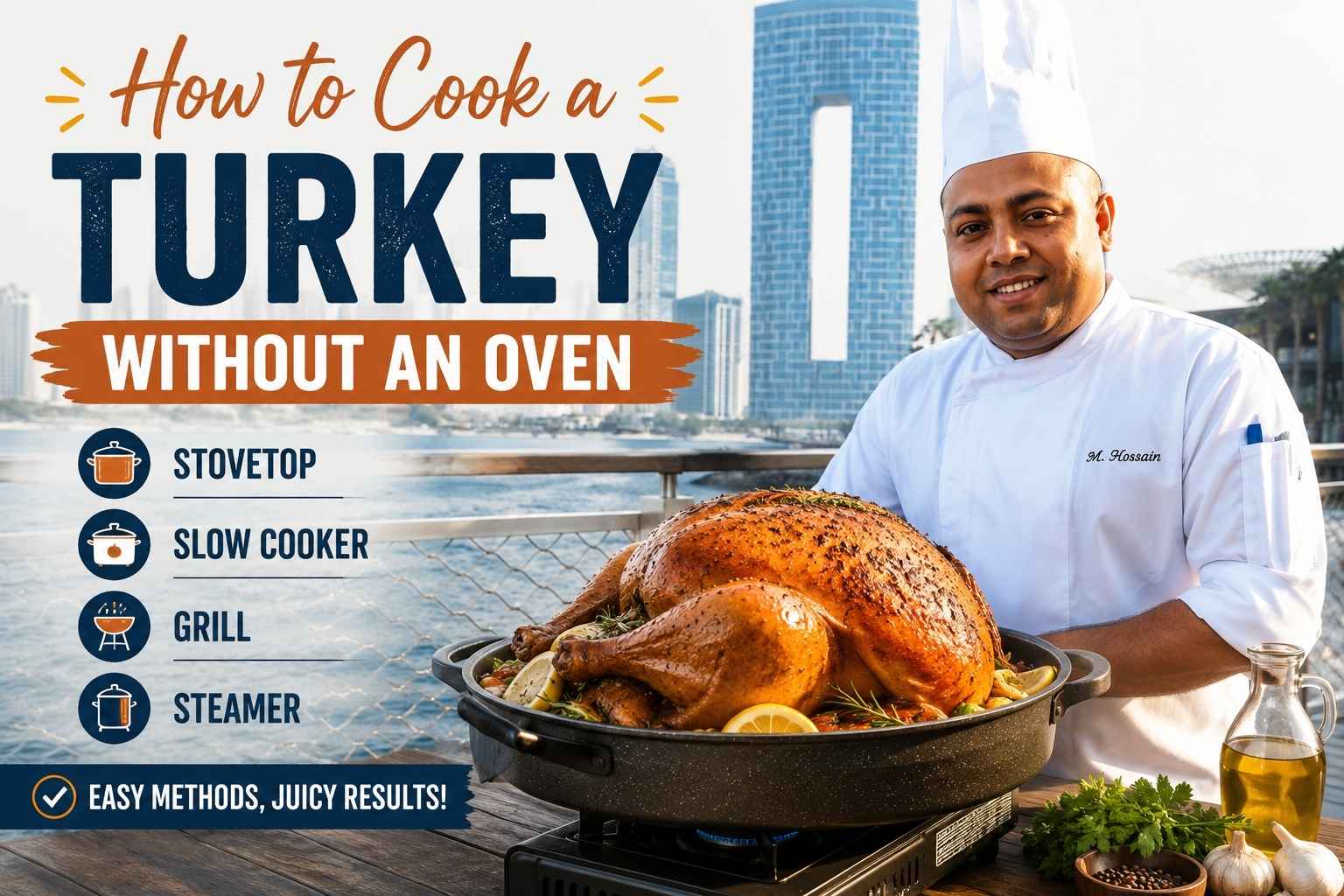
At A Glance
- Deep frying is the fastest whole-bird method at 3 to 4 minutes per pound, but the turkey must be fully thawed and dry, or hot oil can erupt (USDA FSIS, 2024).
- Grilling and smoking both use indirect heat. Grilling runs 11 to 13 minutes per pound. Smoking runs 30 to 40 minutes per pound at 225°F to 250°F.
- Instant Pot and slow cooker methods work best for turkey parts, not a whole 14-pound bird. A slow cooker breast takes 6 to 7 hours on low.
- Every method must hit 165°F in the thickest part of the breast and thigh. That number does not change no matter how you cook the bird (USDA FSIS, 2024).
- My personal pick after 15 years of holiday chaos is the propane fryer, and I explain exactly why below.
Have you ever planned a turkey dinner and then found out you had no oven? I have been there, and it felt like trying to sail without a boat. The good news is that how to cook a turkey without an oven is easier than most people think, and the results can be just as juicy and full of flavor.
Over the years, I have tested simple methods like a slow cooker, grill, smoker, and large pot to see what works best. In this guide, I will show you how to cook a turkey without an oven step by step, share easy tips to keep the meat moist, and help you choose the best cooking method for your home. Let’s get started and make a turkey everyone will enjoy.
Why You Might Not Have an Oven This Year
Your oven can fail you in more ways than you think. Here is when you need a backup plan.
The oven breaks. I have watched a walk-in oven die at 6 a.m. on Thanksgiving in a restaurant that sat 200 covers that day. It happens in home kitchens too, usually on the one day you need it most.
The oven is full. Turkey, stuffing, two pies, and a casserole do not fit in one box. Something has to cook somewhere else.
You do not have an oven at all. Cabins, RVs, dorm rooms, and rental units often skip the oven entirely.
You are camping or tailgating. No power, no gas line, no oven. Just a grill, a cooler, and a plan.
The power goes out. A storm knocks out electricity right as the bird was supposed to go in. This happened to my sister-in-law two years ago. She fried her turkey on the driveway by headlamp.
None of these situations mean a ruined dinner. They mean a different tool.
Method Comparison Table
Use this table to pick your method fast. Times are for a fully thawed turkey.
| Method | Cook Time (per lb) | Best Turkey Size | Skill Level | Equipment Needed |
|---|---|---|---|---|
| Deep Fryer | 3-4 minutes | 9-14 lbs | Intermediate | Propane burner, pot, thermometer |
| Grill (indirect) | 11-13 minutes | Up to 16 lbs | Beginner-Intermediate | Charcoal or gas grill, drip pan |
| Smoker | 30-40 minutes | Up to 15 lbs | Intermediate | Smoker, wood chips or chunks |
| Instant Pot | 6-8 minutes (parts) | Breast or legs only | Beginner | 6-8 quart pressure cooker |
| Slow Cooker | 4-5 hours total (parts) | Breast only, under 7 lbs | Beginner | 6-quart slow cooker |
| Camp Dutch Oven | 15-18 minutes | Up to 10 lbs | Advanced | Cast iron Dutch oven, charcoal briquettes |
| Electric Roaster | 13-15 minutes | Up to 18 lbs | Beginner | Countertop electric roaster oven |
Deep-Fried Turkey: The Fastest Whole Bird
Deep frying cooks a whole turkey in under an hour, and the skin comes out shatter-crisp. It is also the method most likely to send you to the emergency room if you skip a step.
Equipment You Need
You need a propane burner stand, a pot large enough to submerge the bird with room to spare, a turkey lifting hook, a candy or fry thermometer, and heavy oven mitts that go past your wrist. Do this outside, on a flat surface, far from your house, garage, or deck.
Oil Type and Amount
Use peanut oil, canola oil, or a blend rated for high heat. Peanut oil has a smoke point around 450°F, which gives you a safety cushion at your 350°F fry temperature.
To measure oil, lower the raw turkey into the empty pot first and add water until it covers the bird by about an inch. Pull the turkey out, mark the water line, dump the water, dry the pot completely, and fill to that line with oil (USDA FSIS, 2024). A 30-quart pot usually needs 3 to 5 gallons.
Timing Per Pound
Heat the oil to 350°F. Cook the turkey for 3 to 4 minutes per pound. A 12-pound turkey takes roughly 36 to 48 minutes. Pull the bird when the thickest part of the breast and the innermost thigh both read 165°F.
Safety Warnings
Never fry a frozen or partially frozen turkey. Ice turns to steam the instant it hits hot oil, and the oil erupts violently upward. This single mistake causes most turkey fryer fires (USDA FSIS, 2024). Thaw the bird completely in the refrigerator, then pat it bone-dry, inside and out, before it goes near the oil.
Never fry indoors, in a garage, or under a covered patio. Splashed oil ignites fast, and burner flames climb higher than most people expect.
Never fill the pot past your measured oil line. Overfilled oil spills over the sides when the turkey displaces it, and spilled oil on an open flame is how house fires start.
Lower the turkey slowly. Use the hook, and lower it inch by inch. Fast dunking causes splashing that can burn your hands and arms.
Grilled Turkey: Backyard Power, Even Heat
Grilling gives you a smoky crust without the multi-hour commitment of a smoker. The trick is heat placement, not heat intensity.
Indirect Heat Setup
Indirect heat means the turkey never sits directly above the flame. On a charcoal grill, bank the coals to both sides and place a drip pan in the empty middle. On a gas grill, light the outer burners and leave the center burner off, then set the turkey over the unlit zone.
Charcoal vs. Gas
Charcoal gives a deeper, smokier flavor and needs more attention to hold a steady temperature. Gas is more consistent and easier for a first attempt. Both work fine for a 12 to 16 pound bird. I default to charcoal at home and gas when I am cooking for a crowd and need predictable timing.
Timing
Hold your grill at 325°F to 350°F. Plan for 11 to 13 minutes per pound. A 14-pound turkey runs about 2.5 to 3 hours. Check the internal temperature at the 2-hour mark, then every 20 minutes after that.
Keeping It Moist
Brine the turkey the night before in a simple saltwater solution, about 1 cup of kosher salt per gallon of water, for 8 to 12 hours. Baste with melted butter every 45 minutes, and tent the breast with foil once it hits 155°F so the legs can catch up without the breast drying out.
Smoked Turkey: Low, Slow, and Full of Flavor
Smoking takes the longest of any oven-free method, but the payoff is a deep smoke ring and a bark you cannot get any other way.
Wood Choice
Apple, cherry, and pecan give a mild, slightly sweet smoke that pairs well with turkey’s mild flavor. Hickory and mesquite are stronger and can overpower the bird if you are not careful with quantity. Avoid softwoods like pine entirely, since they produce a bitter, resinous smoke.
Temperature Control
Run your smoker between 225°F and 250°F. Anything lower keeps the turkey in the food-safety danger zone (40°F to 140°F) too long, since it needs to pass through that range within 4 hours (America’s Test Kitchen, 2023). If your bird is over 15 pounds, spatchcock it, meaning cut out the backbone and flatten it, so it moves through that range faster and cooks more evenly.
Timing Per Pound
Plan for 30 to 40 minutes per pound at 225°F to 250°F. A 12-pound turkey takes roughly 6 to 7 hours. Use a leave-in probe thermometer rather than guessing, because smoker temperatures drift more than oven temperatures do.
Bark and Smoke Ring
The pink ring just under the skin is a chemical reaction with the smoke, not a doneness indicator. Smoked turkey stays pink even when fully cooked to 165°F (USDA FSIS, 2024). Judge doneness by temperature only, never by color.
Instant Pot or Pressure Cooker Turkey
Size Limitations
A pressure cooker is not built for a whole 14-pound turkey. Stick to a turkey breast, thighs, or drumsticks that fit with the lid sealed, usually under 5 pounds in a 6 to 8 quart pot.
Timing
Pressure cook a bone-in turkey breast for about 6 to 8 minutes per pound at high pressure, then let the pressure release naturally for 15 minutes before opening the lid. A 4-pound breast takes roughly 25 to 30 minutes of active cook time.
Best for Parts vs. Whole Bird
This method is best for parts, not the whole bird, and it is the fastest option on this list. If you need a whole-bird presentation, pair a pressure-cooked breast with grilled or smoked legs and thighs to keep the classic look on the platter.
Slow Cooker Turkey
Size Limitations
Slow cookers max out around a 5 to 6 pound turkey breast in a standard 6-quart model. A whole turkey will not fit, and even if it did, it would spend too long in the unsafe temperature zone before the slow cooker’s low heat caught up.
Timing
Cook a turkey breast on low for 6 to 7 hours, or on high for 4 to 5 hours, until it reaches 165°F. Add a cup of broth to the bottom of the pot so the meat does not dry out during the long cook.
Texture Tradeoffs
Slow cooker turkey comes out fall-apart tender, closer to pulled chicken than a sliceable roast. You also will not get crisp skin, since the moist, sealed environment steams the meat instead of browning it. If crisp skin matters for your table, run the finished breast under a broiler or torch it for 3 to 4 minutes before serving.
Camp Dutch Oven or Coals Method
This is the method for true off-grid cooking: camping trips, cabins with no power, or a backyard cookout with nothing but charcoal.
The Setup
Use a cast iron Dutch oven with a flanged lid designed to hold coals on top. Place a layer of hot coals underneath the oven and another layer on the lid. For most 8 to 10 pound turkeys, use roughly 8 to 10 coals underneath and 14 to 16 on top, adjusting as you check progress.
Timing
Plan for 15 to 18 minutes per pound. Rotate the oven a quarter turn every 20 to 25 minutes, and rotate the lid separately, to avoid hot spots from uneven coal placement. Check the internal temperature at the earliest expected finish time.
Weather Matters Here
Wind steals heat fast from an open coal setup. On a windy day, add 2 to 3 extra coals and check the bird more often, since your cook time can stretch by 30 minutes or more.
Electric Roaster Oven: The Countertop Alternative
An electric roaster looks and acts like a miniature oven, and it is the easiest substitute if your real oven is out of commission but you still want a classic roasted result.
How It Works
Set the roaster to 325°F, place the turkey on the included rack inside the removable pan, and close the lid. It functions almost exactly like your kitchen oven, just smaller and on your counter.
Timing
Plan for 13 to 15 minutes per pound at 325°F. A 16-pound turkey takes about 3.5 to 4 hours. Check temperature starting at the 3-hour mark.
Why I Recommend This for Beginners
If your oven died the morning of the holiday and you have never tried an alternative method before, this is the least intimidating option. It requires no open flame, no oil, and no outdoor setup. You baste it and check it exactly like you would a regular oven.
Food Safety Essentials
Safe Internal Temperature
Every method above shares one non-negotiable number: 165°F, measured in the thickest part of the breast and the innermost part of the thigh and wing (USDA FSIS, 2024). Color, juice clarity, and cook time are all backup indicators at best. A thermometer is the only reliable test.
Thawing Rules
Thaw a frozen turkey in the refrigerator, allowing 24 hours for every 4 to 5 pounds (USDA FSIS, 2024). A 12-pound bird needs about 3 days. If you are short on time, use the cold water method: submerge the wrapped bird and change the water every 30 minutes, allowing about 30 minutes per pound.
Never Fry a Frozen Turkey
This bears repeating on its own, because it is the single most dangerous mistake on this list. A frozen or even partially frozen turkey dropped into hot oil causes a violent, rapid boil-over that can ignite instantly (USDA FSIS, 2024). Confirm the turkey is fully thawed and dry before it goes anywhere near a fryer.
Common Mistakes and How to Fix Them
Wrong oil temperature. Oil that is too cool soaks into the turkey and leaves it greasy. Oil that is too hot burns the outside before the inside cooks. Fix: use a clip-on thermometer and hold steady at 350°F, adjusting the burner in small increments.
Oversized bird for the method. Cramming a 16-pound turkey into a slow cooker or a 20-pound bird into a fryer pot built for 14 pounds leads to uneven cooking and safety risk. Fix: match your bird size to the table above before you buy the turkey, not after.
Skipping the rest. Cutting into the turkey right off the heat lets all the juice run onto the cutting board. Fix: rest the bird for 20 to 30 minutes, tented loosely with foil, before carving.
Ignoring wind and weather outdoors. Wind drops grill and smoker temperatures fast and can blow flame toward you at a fryer setup. Fix: block wind with a barrier, check temperatures more often, and add extra time to your estimate on gusty days.
My Go-To Method, and Why
After 15 years of cooking under pressure, my go-to is the propane fryer, hands down.
I learned this the hard way at a restaurant where the walk-in oven’s igniter failed on Thanksgiving morning with 200 covers booked. We had eleven turkeys and no oven. We rigged two commercial propane burners in the parking lot, borrowed a second fryer pot from a line cook who lived nearby, and fried every single bird in shifts. Dinner service started twelve minutes late. Nobody in the dining room ever knew.
What sold me on frying, beyond that one chaotic morning, is the math. A 12-pound bird takes under an hour, start to finish, versus 3 to 4 hours in an oven or roaster. The skin comes out crisper than anything an oven produces, because the oil seals it fast instead of slowly drying it out. And once you have your oil temperature dialed in with a good thermometer, the process is more forgiving than people expect.
The tradeoff is real: you need outdoor space, a full afternoon of undivided attention, and zero tolerance for shortcuts around the frozen-turkey rule. If you have all three, I do not think any other method beats it.
Frequently Asked Questions
What is the fastest way to cook a turkey without an oven?
Deep frying is the fastest whole-bird method, at 3 to 4 minutes per pound. A 12-pound turkey is done in under an hour. Pressure cooking is faster still, but only works for turkey parts, not a whole bird.
Can I cook a whole turkey in a slow cooker?
No. A standard slow cooker only fits a turkey breast up to about 5 or 6 pounds. A whole turkey will not fit in most models, and it would spend too long in the unsafe temperature zone before fully cooking.
Is it safe to deep fry a frozen turkey?
No, never. A frozen or partially frozen turkey causes hot oil to boil over violently on contact, which is the leading cause of turkey fryer fires (USDA FSIS, 2024). Thaw the bird completely and pat it dry before frying.
How do I know when my turkey is done without an oven thermometer?
Use an instant-read or leave-in probe thermometer regardless of method. The turkey is done at 165°F in the thickest part of the breast and the innermost thigh and wing. Do not judge doneness by color, since smoked turkey stays pink even when fully cooked.
What is the best oven-free method for a beginner?
An electric roaster oven is the easiest starting point. It works almost exactly like a kitchen oven, just on your countertop, with no open flame or oil to manage.
Can I smoke a turkey that is over 15 pounds?
You can, but spatchcock it first by removing the backbone and flattening the bird. This helps it pass through the food-safety danger zone of 40°F to 140°F faster, since a large whole bird can take too long at low smoker temperatures.
How much oil do I need to deep fry a turkey?
Enough to cover the turkey by about 1 inch once submerged. Measure this before frying by lowering the raw turkey into the empty pot and filling with water to mark the line, then replacing that water with the same amount of oil (USDA FSIS, 2024).
Does grilling a turkey taste different from smoking one?
Yes. Grilling at 325°F to 350°F for 11 to 13 minutes per pound gives a light smoky note and a shorter cook time. Smoking at 225°F to 250°F for 30 to 40 minutes per pound produces a much deeper smoke flavor, a visible smoke ring, and a firmer bark on the skin.
Key Takeaways
- Match your turkey’s size to your method before you shop. Fryers and slow cookers both have hard size limits.
- 165°F in the breast and thigh is the only number that matters for doneness, no matter which method you choose.
- Never fry a frozen turkey. Full thaw and a dry surface are non-negotiable.
- Deep frying is fastest, smoking delivers the most flavor, and the electric roaster is the easiest for a first attempt.
- Rest every turkey for 20 to 30 minutes before carving, regardless of method.
Sources cited: USDA Food Safety and Inspection Service, Turkey Basics: Safe Cooking; USDA FSIS, Deep Fat Frying and Food Safety; USDA, Don’t Make Turkey Frying a Disastrous Situation This Thanksgiving; Butterball, How to Deep Fry a Turkey.