At A Glance
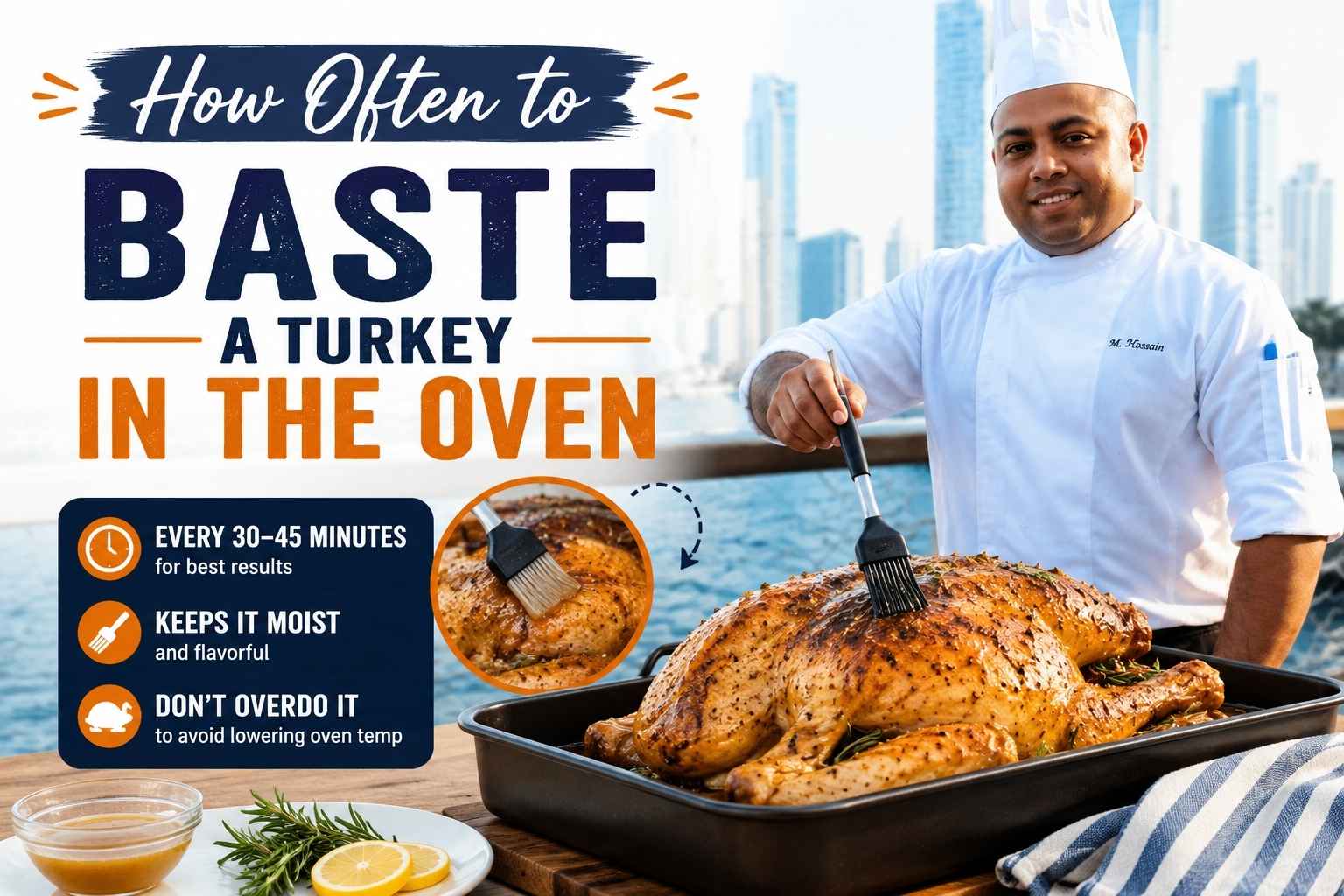
- Baste every 30-45 minutes if you baste at all – more than that just wastes heat and time.
- Basting barely touches the meat. It only soaks about a quarter-inch into the skin (Butterball Turkey Talk-Line, 2024).
- Every oven-door opening drops the temperature by up to 25 degrees in 30 seconds (AOL/Mythical Kitchen roundup, 2024). Do the math on ten openings and you’ve added real cook time.
- Dry-brined turkeys need little to no basting. Wet-brined turkeys need even less.
- My routine: one butter rub before roasting, one optional baste at the halfway mark, done. Crisp skin, juicy meat, one less trip to the oven.
I used to open that oven door every ten minutes, sure my turkey would dry out if I didn’t. Turns out, I was wrong and I was letting all the heat escape too! After years of testing birds in my own kitchen, I finally cracked the real answer to how often to baste a turkey in the oven. Stick with me, and I’ll walk you through the exact schedule that keeps your bird juicy without wrecking your cook time. Grab your baster, and let’s get this turkey right.
Why I Wrote This (And Why I Changed My Mind)
I’ve roasted more turkeys than I can count. Hotel banquets, small bistros, my own kitchen on a Thursday in November when 22 relatives show up expecting a show.
For the first ten years of my career, I basted like my job depended on it. Every 30 minutes, oven door open, baster in hand, drippings flying. I thought that was what a real cook did.
Then I ran my own side-by-side test one slow prep day: two birds, same size, same oven, same seasoning. One got basted every 30 minutes. One got left alone after a butter rub. The unbasted bird came out just as juicy. Its skin was actually more even. That test changed how I cook turkey for good.
This guide gives you the real answer on basting frequency, backed by kitchen testing and food science, not tradition for tradition’s sake.
What Basting Actually Does to a Turkey
Basting spoons hot fat and pan juices back over the turkey’s skin while it roasts. That’s it. That’s the whole action.
The Moisture Myth: “Locking In Juices”
You’ve heard it a hundred times: basting “locks in the juices.” It doesn’t. Meat doesn’t work like a sealed container.
Once the turkey’s surface hits oven heat, the proteins in the skin tighten up. That tightening blocks liquid from moving inward, not outward. The Butterball Turkey Talk-Line has said basting liquid penetrates only about a quarter inch under the skin (Butterball Turkey Talk-Line, 2024). It never reaches the breast meat or the thigh.
Cook’s Illustrated ran a controlled test with three turkey breasts: one basted every 20 minutes, one left alone, and one where the oven door was opened every 20 minutes without basting. The basted bird wasn’t any more moist than the untouched one (America’s Test Kitchen, 2024).
What Basting Actually Improves
Basting does one real thing well: it redeposits fat, browned bits, and drippings onto the skin’s surface. That can boost surface flavor and add some shine.
But it’s uneven. Because you’re pouring liquid by hand, some spots get more than others. That unevenness can cause blotchy, streaky browning instead of the deep, uniform gold you’re after (Serious Eats, 2025).
The Real Job of Turkey Skin
Turkey skin crisps through a dry, hot environment. Water is the enemy of crisp skin. Every time you baste with watery pan juices, you re-wet the surface and reset the browning clock. That’s the opposite of what you want if a shattering, golden skin is the goal.
Why Opening the Oven Door Too Often Costs You
This is the part most home cooks underestimate.
Every time you open the oven, heat rushes out. A 325°F oven can drop by roughly 25 degrees in the 30 seconds it takes to pull out the pan, baste, and slide it back (AOL/Mythical Kitchen roundup, 2024). The oven then has to work to recover that heat.
Do this every 30 minutes over a five-hour roast, and you’ve opened the door ten times. That adds up to real, measurable extra cook time, not just a few wasted minutes.
The Chain Reaction
Here’s what happens step by step:
- You open the door. Hot air escapes immediately.
- The oven’s thermostat detects the drop and cranks the heating element back on.
- The oven takes several minutes to climb back to the set temperature.
- Your total roast time stretches, sometimes by 30 minutes or more across a full basting session.
- Uneven heat recovery can also lead to uneven cooking between the breast and the legs.
A better Food Safety and Inspection Service note applies here too: extending cook time at inconsistent oven temperatures raises the risk of the turkey sitting too long in an unsafe temperature range before it’s fully done (USDA Food Safety and Inspection Service, 2024). Consistency matters more than most people think.
Basting Frequency Reference Table
Here’s my working chart for basting intervals by turkey weight, based on standard 325°F roasting times. Use this as a planning guide, not a rulebook, because oven behavior varies.
| Turkey Weight | Estimated Roast Time (Unstuffed, 325°F) | Basting Interval | Total Basting Count | Notes |
|---|---|---|---|---|
| 10-12 lbs | 2.75-3 hours | Every 45 min (optional) | 2-3 times | Small birds dry out fastest from door-opening heat loss. Skip basting or limit to one mid-roast baste. |
| 13-14 lbs | 2.75-3.25 hours | Every 45 min (optional) | 3 times | A single butter rub before roasting does more work than repeated basting here. |
| 15-16 lbs | 3.25-3.75 hours | Every 45-60 min | 3-4 times | Good middle ground for cooks who want the visual ritual without hurting the skin. |
| 17-19 lbs | 3.75-4.25 hours | Every 60 min | 3-4 times | Foil-tent the breast at hour two to slow browning instead of relying on basting. |
| 20-22 lbs | 4.25-4.75 hours | Every 60 min | 4 times | Large birds have more mass to hold heat, so oven recovery matters even more. |
| 23-24 lbs | 4.75-5.25 hours | Every 60-75 min | 4 times | Consider skipping basting entirely and using a high-heat finish instead (see below). |
Note: these times assume a fully thawed turkey and an oven that holds temperature accurately. Always confirm doneness with a meat thermometer reading 165°F in the thigh, wing, and thickest part of the breast (USDA Food Safety and Inspection Service, 2024), not by the clock.
Basting Frequency Broken Down by Method
Every 30 Minutes
This is the classic Thanksgiving ritual, and it’s the one I’d steer you away from. Ten or more oven openings over a five-hour roast adds real cook time and gives you blotchy skin for the effort. If you love the ritual for family tradition’s sake, fine, but know it’s doing more harm than good to the bird itself.
Every 45 Minutes
A reasonable middle ground if you want some hands-on involvement. Five to six basting sessions total for a mid-size bird. Still causes some heat loss, but far less than the 30-minute schedule.
Hourly
My preferred interval when I do baste at all. Four to five total basting sessions for a large bird. Enough to add a flavor boost and a bit of sheen without constantly resetting the oven’s temperature.
Not at All
The choice backed by the strongest testing. Skip basting entirely, rely on a pre-roast butter or oil rub, and let the oven do its job undisturbed. This is what I do for my own Thanksgiving bird now.
Basting Liquid Choices and How Each Affects the Bird
If you do baste, what you baste with matters.
Pan drippings. The traditional choice. Drippings carry fat and browned meat particles, which add surface flavor. The downside: they also carry watery juice, which works against crisp skin.
Melted butter. Butter’s higher fat content browns skin better than watery drippings. A butter baste (or better yet, a butter rub applied once before roasting) gives you flavor without soaking the skin.
Broth or stock. Mostly water with some flavor compounds. This is the weakest option for browning and the one most likely to soften the skin if used repeatedly.
Wine. Adds acidity and aromatic depth, but wine is mostly water too. Use it sparingly, and only mixed with fat, not on its own.
Bottom line: if you’re going to baste, use melted butter or a butter-and-drippings blend, not straight broth or wine. Fat crisps. Water doesn’t.
Wet-Brined vs. Dry-Brined vs. Unbrined: How Prep Changes Basting Needs
Dry-Brined Turkeys
A dry brine (salt, sometimes with a little baking powder, rubbed on the skin a day or two ahead) draws moisture to the surface, then reabsorbs it along with the salt. This process seasons the meat all the way through and sets up the skin for excellent browning on its own.
Dry-brined birds need the least basting of all three methods. In my kitchen, a dry-brined turkey gets zero basting. The salt and time have already done the work.
Wet-Brined Turkeys
A wet brine (turkey submerged in a salted liquid solution) adds moisture into the meat before cooking even starts. Because the meat is already carrying extra moisture, basting adds very little additional benefit.
One caution: wet-brined turkeys have wetter skin going into the oven, so they actually need a longer dry-out period (uncovered, in the fridge, skin exposed to air) before roasting to get any real crisping. Basting won’t fix skin that started out too wet.
Unbrined Turkeys
An unbrined bird is the one case where basting offers the most noticeable benefit, purely for surface flavor and shine, since there’s no salt-driven moisture already at work. Even here, though, a single fat rub before roasting outperforms repeated basting.
Basting Tools: Bulb Baster vs. Spoon vs. Brush
Bulb baster. Fast and efficient for pulling up pooled drippings from the bottom of the pan. Downside: the bulb is hard to clean thoroughly and can harbor bacteria if not sanitized between uses. Always wash it in hot, soapy water immediately after each use, and never let it touch raw juices then touch a serving surface.
Spoon. Simple, cheap, easy to clean completely. Less precise for reaching pooled liquid, but perfectly functional.
Brush (silicone or natural bristle). My pick when I do baste. A brush distributes fat evenly across the skin instead of pooling it in one spot, which helps avoid the blotchy look. Silicone brushes clean easily and don’t harbor bacteria the way natural bristle can.
Hygiene rule: whatever tool you use, treat it like raw poultry equipment. Wash it in hot soapy water between basting rounds if you set it down on any surface that later touches cooked food, and always wash your hands after handling it (USDA Food Safety and Inspection Service, 2024).
Covered vs. Uncovered Roasting and the Basting Equation
Roasting uncovered exposes the skin directly to dry oven heat, the setup that produces the best browning and crispest texture. Basting an uncovered bird has more visible impact on browning, for better or worse.
Foil-tenting the breast (loosely covering it partway through roasting) slows browning in that specific area so the legs and breast finish closer to the same time. If you tent, you don’t need to baste under the foil. The tent is already managing moisture and browning for that section. Save any basting for the exposed legs and thighs only.
Fully covering the turkey for the whole roast (common in some slow-roast methods) traps steam and keeps the skin from crisping no matter how much or how little you baste. If you want crisp skin, covered roasting and basting don’t mix well together.
When Basting Can Actually Hurt Your Turkey
Soggy, rubbery skin. Repeated basting with watery drippings keeps re-wetting the surface. Wet skin doesn’t crisp. Baste too often and you’ll pull out a turkey with skin closer to boiled than roasted.
Uneven, blotchy browning. Hand-basting never distributes liquid perfectly. Some patches get soaked, others stay dry, and the result is streaky color instead of a uniform golden bird.
Extended, inconsistent cook time. Every door opening drops the oven temperature and forces a slow recovery. Do this enough times and your “four-hour turkey” becomes a four-and-a-half or five-hour turkey, throwing off your entire dinner schedule.
Food safety risk from raw juice splash. Early in the roast, pan drippings can still carry bacteria from the raw turkey. If you baste in the first hour and a basting tool or your hand touches a clean surface afterward without washing, you risk cross-contamination. Wait until the bird has been in the oven long enough that drippings are fully cooked through, and always wash hands and tools after contact (USDA Food Safety and Inspection Service, 2024).
When It’s Okay to Skip Basting Entirely vs. When It Genuinely Helps
Skip it if:
- You dry-brined the turkey.
- You want the crispest possible skin.
- You’re short on time and want to minimize oven-door interruptions.
- You already applied a fat rub (butter, oil, or mayonnaise) before roasting.
It genuinely helps if:
- The turkey is unbrined and you want extra surface flavor.
- You’re going for a deep mahogany color on the skin and are willing to trade a little crispness for it.
- You enjoy the process and it’s part of your holiday tradition. There’s real value in that, even if the science says the bird won’t taste much different.
Common Basting Mistakes and How to Fix Them
Mistake: Basting too frequently. Every 20-30 minutes adds up to ten or more oven openings, tanking your oven temperature repeatedly. Fix: Baste hourly at most, or skip it and rely on a pre-roast fat rub instead.
Mistake: Leaving the oven door open too long while basting. Lingering to admire the bird or take a photo extends the heat loss well past the typical 30-second dip. Fix: Have your basting liquid and tool ready before you open the door. Baste in under 20 seconds, then close the door immediately.
Mistake: Using only broth or wine to baste. These are mostly water. They soften skin instead of crisping it. Fix: Baste with melted butter or a butter-drippings blend if you baste at all.
Mistake: Basting a foil-tented section. This traps extra moisture exactly where you’re already trying to slow browning. Fix: Lift the tent only to check color, and baste the exposed areas only, if at all.
Mistake: Skipping the pre-roast fat rub and basting instead. A rub applied once before roasting does more for browning than five basting sessions combined. Fix: Rub the skin with softened butter or oil before the turkey goes in. Let basting be optional after that, not the main strategy.
Mistake: Not accounting for oven temperature drop in your timeline. Cooks who baste every 30 minutes and still plan dinner around the “expected” roast time often end up serving late. Fix: If you’re basting on a schedule, add 20-30 minutes of buffer to your total roast time estimate.
My Personal Basting Routine for Thanksgiving
Here’s exactly what I do, no more, no less.
Two days ahead: Dry brine the turkey with kosher salt and a small amount of baking powder, uncovered, in the fridge.
Morning of: Pat the skin completely dry. Rub the whole bird with softened butter mixed with a little chopped sage and thyme. Season the cavity.
Into the oven: 325°F, uncovered, breast up. I do not open the door for the first two hours. Not once. Every peek costs heat and adds time.
Halfway through: I check the color. If the breast is browning faster than the legs, I tent the breast loosely with foil. This is the only time the oven door opens before the final stretch.
Optional single baste: If the bird looks like it needs a flavor boost around the halfway point, I’ll brush (not spoon) a little of the pan drippings and butter over the legs and thighs only, working fast, door open for under 20 seconds.
Final 30 minutes: Foil comes off if it was on, and I let the oven finish the browning job on its own.
Result: Crisp, evenly colored skin. Juicy meat. One roast time I can actually predict, because I’m not adding unplanned oven-door stops. My guests never once asked why I wasn’t basting. They just asked for seconds.
Frequently Asked Questions
How often should I baste a turkey?
If you baste at all, do it every 45-60 minutes, not every 30. Three to five total basting sessions is plenty for most turkey sizes. Skipping basting entirely, backed by a pre-roast butter rub, gives comparable or better results with less risk to your skin’s texture.
Does basting actually make a turkey juicier?
No. Basting liquid only penetrates about a quarter inch into the skin (Butterball Turkey Talk-Line, 2024) and doesn’t reach the meat underneath. Juiciness comes from brining, proper internal temperature, and resting the bird after roasting, not from spooning liquid over the outside.
What happens if I never baste my turkey at all?
Nothing bad. A turkey that’s dry-brined or rubbed with fat before roasting and never basted will still develop good color and stay juicy, since basting was never doing the moisture work in the first place. Many professional kitchens skip basting entirely.
Does opening the oven door to baste really matter that much?
Yes. A 325°F oven can lose up to 25 degrees in the 30 seconds it takes to baste (AOL/Mythical Kitchen roundup, 2024), and it takes time to recover. Multiply that by ten basting sessions and you’ve added real minutes, sometimes 30 or more, to your total roast time.
What’s the best liquid to baste a turkey with?
Melted butter or a butter-and-drippings blend browns skin better than broth, wine, or straight pan juices, because fat crisps and water doesn’t. If flavor is your goal, a herb butter rub applied before roasting beats any basting liquid.
Is it safe to baste with the same liquid the whole time?
Only after the turkey has cooked long enough that the drippings are no longer raw juice. In the early part of the roast, treat pan drippings like raw poultry liquid. Wash your basting tool and hands after each use, and avoid letting the baster touch any surface that later contacts cooked food (USDA Food Safety and Inspection Service, 2024).
Should I baste a turkey that’s been dry-brined?
You don’t need to. A dry brine already draws moisture to the surface and sets up the skin for good browning on its own. Basting a dry-brined bird mostly just re-wets skin that’s already primed to crisp.
Does basting help the skin get crispy?
Not really, and it can actively work against crisp skin if done too often. Repeated basting with watery drippings re-wets the surface and resets the browning process (Serious Eats, 2025). A single fat rub before roasting, followed by dry, undisturbed oven heat, produces crisper skin than frequent basting.
Can I baste a turkey that’s roasting inside an oven bag or fully covered?
There’s little point. Covered roasting traps steam, which keeps skin from crisping regardless of basting. If you want crisp skin, finish uncovered for the last 30-45 minutes instead of basting under cover.
Key Takeaways
- Basting mainly affects surface flavor and shine, not internal juiciness, since liquid only penetrates about a quarter inch into the skin.
- Every oven-door opening costs you real heat and adds real time to your roast, so fewer, well-timed basting sessions beat frequent ones.
- If you baste, do it every 45-60 minutes with melted butter or a butter-drippings blend, not broth or wine alone.
- Dry-brined and wet-brined turkeys need little to no basting, since the prep work has already handled moisture and seasoning.
- A single fat rub before roasting, combined with an undisturbed, dry oven environment, produces better skin than repeated basting ever will.