
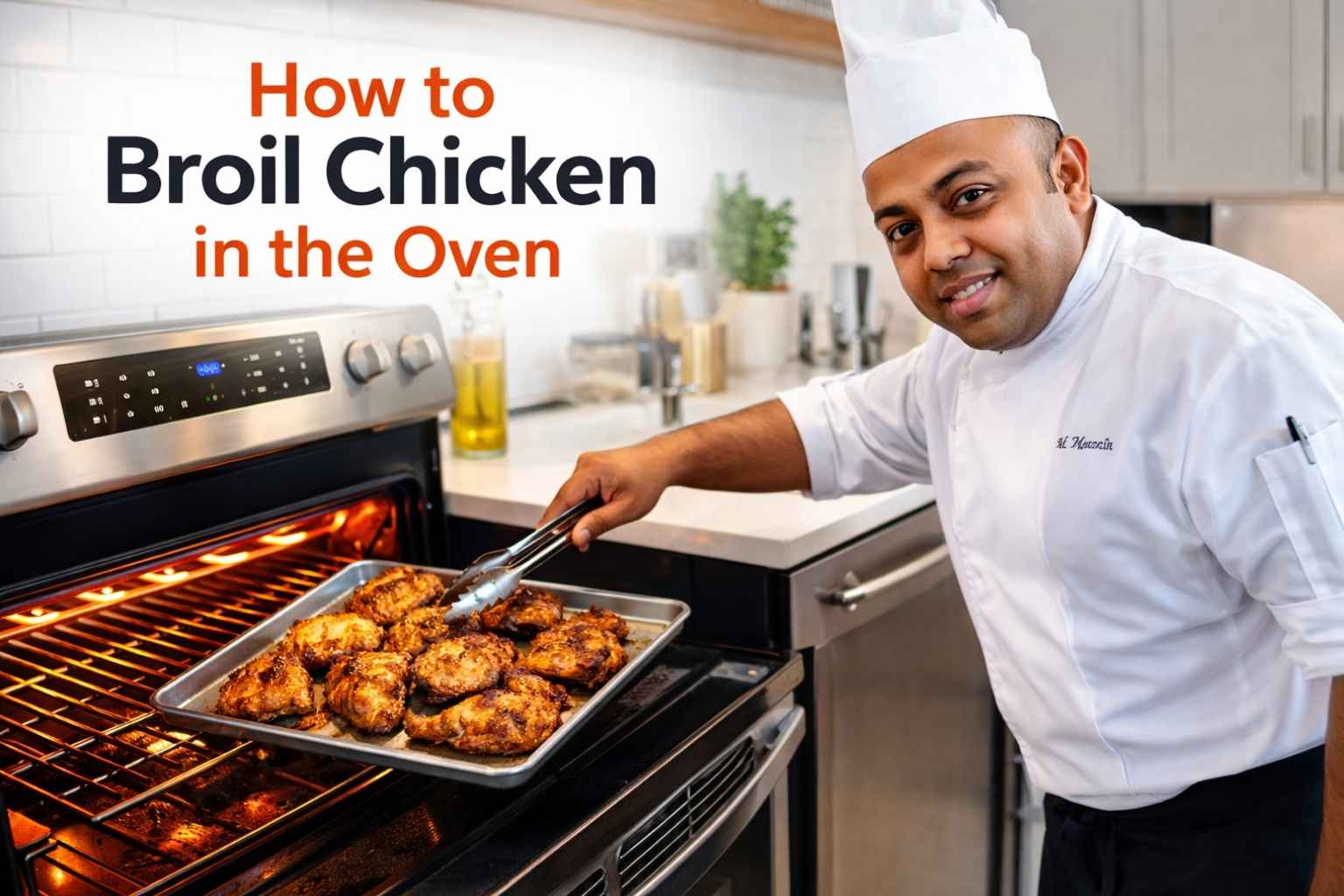
Hey, I’m Mossaraof — a professional cook and food blogger.
We all want those tender, savory bites with a deep, charred crust and a shattered-glass snap that only intense, direct heat can provide. I will show you how to broil chicken in the oven so you get a restaurant-quality, golden-brown sear in just a matter of minutes.
My years in a busy Chicago kitchen taught me that the distance between the meat and the heating element is the true secret to achieving a smoky, caramelized finish without drying out the succulent center. Use my Ultimate Guide to Master Your Oven to find the best rack position to prevent burning while ensuring a perfect, high-heat tan. Let’s grab your broiler pan and start this fast, flavorful meal together right now!
What Is Broiling — And Why It’s So Different from Baking or Roasting
This part took me a while to really understand. It was one hot, sticky afternoon in Florida. The AC was barely working, I was craving something crispy, and I didn’t feel like turning the whole kitchen into a sauna. That’s when I tried using the broil setting on my oven — out of pure desperation, honestly.
What I didn’t expect? The result was better than my baked chicken and faster. The skin bubbled. The edges charred just enough. It looked like I had grilled it — but I hadn’t even stepped outside.
Here’s what I learned by trial (and a couple near smoke-detector disasters):
🔥 The Science Behind Broiling (A.K.A. Oven Grilling)
- Broiling is all about intense top heat — think of it like an upside-down grill.
- Instead of surrounding the food with warm air like baking does, the broiler blasts heat directly from above.
- It’s fast, hot, and honestly a little unforgiving if you step away for even 60 seconds.
I’ve used it in a GE electric oven, an older Whirlpool gas oven, and even in a Breville Smart Oven Air when I was living in a small Chicago apartment.
In every case, broiling gave me:
- Golden crispy skin (especially on thighs and drumsticks)
- Deep flavor in less time
- A kitchen that didn’t get boiling hot — important if you’re anywhere humid or warm in the U.S.
🔁 Broiling vs Roasting: Not the Same Thing
At first, I thought they were interchangeable. Nope.
| Method | Heat Direction | Texture Result | Best For |
|---|---|---|---|
| Roasting | All-around, slower | Even cook, softer skin | Whole chicken, veggies |
| Broiling | Top-down, intense | Crisp top, juicy inside | Wings, thighs, thin breasts |
That top-down heat is what creates that blistered texture we all want — like grilled wings on game day but without dealing with propane tanks or charcoal bags.
🧑🍳 U.S. Oven Types That Can Broil (Yes, Even Toaster Ovens)
I’ve lived in a few different places across the U.S., and let me tell you, not all ovens broil the same. Here’s what I’ve worked with:
- Gas oven with a bottom drawer broiler — common in older apartments (hello, New York). Heat is uneven, but still does the job.
- Electric oven with upper broil element — more even and easier to control. That’s what I use now in Arizona.
- Toaster oven with broil function — lifesaver in small kitchens, especially if you’re just cooking for one or two.
If you’re in the U.S., odds are your oven has a broil setting. Look for “Broil” on the dial or control screen. If it says “High/Low” or “Max/400°F” — you’ve got options.
📏 Where You Place the Chicken Matters (A Lot)
My first broiling mistake? Putting the chicken on the bottom rack. The result? Pale, soggy meat. No thanks.
Here’s how I do it now:
- Top rack, about 4–6 inches below the broiler element.
- I use my top rack position, but adjust if I see it browning too fast.
- If the skin’s burning before the meat cooks through, I lower the tray a notch or loosely tent with foil.
Don’t be afraid to adjust based on your own oven. Some U.S. brands broil hotter than others — my old Frigidaire ran way hotter than my current Whirlpool.
🧠 Little Things I Learned the Hard Way
- Always preheat the broiler for at least 5 minutes. Cold broiler = sad chicken.
- Keep the oven door slightly ajar if your manual allows it. This vents steam and lets you see what’s happening.
- Use a broiler-safe pan — no parchment paper, and for the love of crispy skin, don’t use glass bakeware (it can shatter).
There was a time I tried broiling chicken thighs in a Pyrex dish. Not only did the bottom stay soggy, but the glass actually cracked. That was the day I bought a proper metal pan.
🧂 The Flavor Hits Different When Broiled
There’s something about that fast top heat. The chicken fat starts to render, the skin starts to sizzle, and your whole kitchen smells like you’re cooking at a backyard BBQ.
You’ll know it’s working when:
- The skin bubbles and pops
- Juices start dripping and caramelizing in the pan
- You’re hovering near the oven like it owes you rent
That’s when you know: broiling isn’t some forgotten cooking method. It’s a power tool — especially in U.S. kitchens where oven space matters, meal prep happens fast, and heat waves are real.
🍗 Best Chicken Cuts to Broil — What Works and What Fails
Not every cut of chicken is made for the broiler. I found that out on a random Wednesday night when I tossed boneless chicken breasts under high heat and walked away for five minutes. They came out drier than a hotel towel.
So, over time, I started experimenting with different cuts — thighs, wings, drumsticks — in different ovens across Florida, Chicago, and now Arizona. Here’s what actually works, and what doesn’t.
🦴 How to Broil Chicken Breasts in the Oven
Let’s start with the trickiest one: boneless skinless breasts.
I’ve broiled these dozens of times for meal prep — and while they cook fast, they dry out even faster if you don’t baby them.
What I Do:
- I pound them flat with a meat mallet so they cook evenly
- A quick 30-minute marinade or brine helps hold moisture
- I brush with oil before broiling to prevent a chalky texture
- Broil about 6–8 minutes total, flipping at the halfway mark
Real Tip:
If I see white bubbly juices on top, that’s usually my sign they’re done. If I wait until the top fully browns, it’s already overcooked inside.
Tools I use:
- Nordic Ware broiler pan
- Meat thermometer (target 165°F internal temp)
When I skip broiling breasts:
- If they’re super thick
- If I already have the oven on for baking
- If it’s for shredding — I prefer slow-bake for that
🍗 How to Broil Chicken Thighs in the Oven
Now we’re talking. Thighs are hands-down my favorite cut for broiling.
They’re juicy, forgiving, and the skin crisps up like something off the grill.
Here’s how I do it:
- Bone-in, skin-on thighs = flavor bomb
- Place skin-side up and don’t flip
- Broil about 10–12 minutes, until the skin blisters and the meat hits 175°F
My go-to seasonings:
- Salt, pepper, smoked paprika, garlic powder
- Sometimes Cajun seasoning if I’m feeling spicy
When I was in the Midwest during a brutal winter, this was my go-to comfort meal. Crispy thighs, a side of roasted potatoes, and some snow outside the window — no grill required.
Why it works:
- Thighs have more fat = less chance of drying out
- Skin protects the meat while it crisps
- Even cheap thighs from Aldi or Walmart cook beautifully under the broiler
🍖 How to Broil Chicken Drumsticks in the Oven
Drumsticks are a crowd-pleaser — especially if you’ve got kids or guests who eat with their hands.
I’ve made broiled drumsticks for Sunday football, potlucks, and late dinners when I’m too tired to deal with a full roast.
What works best:
- Season generously (drums are thick, so go bold)
- Use a rack over a tray so fat drips below
- Rotate every 4–5 minutes to prevent burning one side
Total broil time:
12–14 minutes depending on size, turning 2–3 times during cooking.
One time, I forgot to turn them and ended up with charcoal on one side and raw meat on the other. Lesson learned.
My favorite combo:
- Garlic powder + lemon pepper + a bit of chili
- Finish with hot honey drizzle after cooking (chef’s kiss)
🐔 How to Broil Chicken Wings in the Oven
Wings are broiler gold. Seriously — if you’re not broiling your wings, you’re missing out on crispiness without frying.
I do this almost every other weekend when I’m craving takeout-style wings without the mess.
Here’s my foolproof method:
- Pat wings super dry with paper towels
- Toss in oil + dry rub (paprika, garlic, cayenne)
- Space out on a wire rack for air flow
- Broil for 8–10 minutes, no flipping needed if evenly spaced
I learned the hard way — if the wings are crowded, you get steamed mush, not crisp skin.
Finish with:
- Buffalo sauce tossed after broiling
- Or BBQ glaze brushed on for the last 2 minutes under broiler
US insight:
Some U.S. toaster ovens handle wings really well — especially models like the Breville Smart Oven Pro or Cuisinart TOA-70. They fit a dozen wings max, but give awesome results for a small crowd or solo night in.
🦵 How to Broil Chicken Legs (Drum + Thigh) in the Oven
When I’ve got full chicken legs (aka quarters), I broil them just like I would thighs — but with a little more attention.
My steps:
- Score the skin with a knife (helps heat penetrate)
- Place on rack, skin side up
- Broil for 14–16 minutes, rotating once or twice
- Always check temp — thighs should hit 175°F
I made these for a cookout once when the weather turned, and we had to move everything inside. Nobody even noticed the grill never came on.
They taste incredible with:
- Garlic butter brushed on post-broil
- A sprinkle of rosemary + coarse salt
❌ Cuts I Don’t Recommend for Broiling
Not every chicken cut loves the broiler. A few I avoid:
- Whole chicken — uneven cook, outside burns
- Frozen pieces — they steam, don’t brown
- Stuffed breasts — fillings leak, insides undercook
Stick with thin or medium-thick cuts. Let the broiler do what it’s best at — quick, direct heat on exposed surfaces.
🧂 Seasoning & Marinades — What Holds Up Under a Broiler
Not everything survives the broiler. I’ve torched honey glazes, incinerated garlic, and once made a smoky mess that set off the fire alarm at 9 p.m. (Sorry again to my Arizona neighbors.)
The trick is knowing what can handle high heat — and what to save for later.
🌶️ Dry Rubs That Don’t Burn Under the Broiler
When I’m in a rush or just too tired to fuss with sauces, dry rubs are my best friend.
They stick well, they don’t drip, and they crisp up beautifully. I use these rubs most often when broiling thighs and wings.
My go-to dry rub blend:
- 1 tsp smoked paprika
- ½ tsp garlic powder
- ½ tsp onion powder
- ½ tsp kosher salt
- Pinch of cayenne for heat
- Black pepper to taste
This combo works with all cuts — drumsticks, wings, thighs, even breasts if you oil them first.
U.S. tip:
In most supermarkets (Publix, Kroger, even Walmart), you’ll find McCormick’s Grill Mates Montreal Chicken — it holds up surprisingly well under broil if you want a shortcut. I used that rub during a summer in Florida when I was cooking every day after work.
🧄 Marinades That Actually Stick — Without Burning
A good marinade can take broiled chicken from okay to wow — but some can cause flare-ups or scorching.
I learned that sweet marinades (like teriyaki or barbecue) can blacken way too fast if used too early under a broiler. So now, I use heat-smart marinades with oil, acid, and herbs — and I pat the chicken dry before broiling.
3 marinade combos I trust under the broiler:
1. Yogurt + Lemon + Garlic
- Great for thighs and legs
- Tenderizes the meat
- Doesn’t burn like sugary sauces
2. Olive Oil + Smoked Paprika + Cumin + Lime
- Earthy and bold
- Holds up for drumsticks and wings
3. Soy Sauce + Ginger + Rice Vinegar + Toasted Sesame Oil
- Umami-packed
- Works well with wings (just broil a few minutes less to prevent over-browning)
💡 Chef tip: I blot off excess marinade with paper towels before broiling. A wet surface = steam, not crisp.
🧈 Sauces to Add at the End — Not the Start
Here’s one of the biggest mistakes I used to make: brushing BBQ sauce on chicken before broiling. It looked great for 2 minutes… then turned into a sticky black crust.
If your sauce has sugar (BBQ, honey garlic, hoisin, buffalo), save it for the final minute or two — or toss it on after broiling.
Here’s how I handle it now:
- Broil chicken until fully cooked
- Pull from oven
- Brush with sauce
- Optional: return to broiler for 1–2 minutes max to set it (watch it closely!)
This works especially well for:
- Buffalo wings — toss in sauce after broiling
- BBQ drumsticks — glaze and flash-broil
- Honey soy thighs — sauce after cooking to avoid burning
And yes, I’ve had sauces bubble over and smoke like crazy. My smoke alarm still flinches every time I grab the BBQ bottle.
🧄 Fresh Garlic = Danger Zone
I love garlic. But under a broiler? It goes from fragrant to bitter in seconds.
Now I use garlic powder in rubs, and if I want that fresh garlicky punch, I mix minced garlic into butter or oil, then brush it on halfway through or after broiling.
Same goes for fresh herbs — they singe too fast. So I add chopped parsley, chives, or basil as a garnish at the end.
🧂 Salt First, Not Last
This may sound obvious, but it’s a mistake I made more than once.
I once forgot to salt my chicken until after broiling. The texture felt… off. It was juicy, but flat. Like biting into a good-looking wing with zero attitude.
Now I always:
- Salt the chicken before seasoning it
- Let it sit 15–30 minutes (or overnight if I’m meal prepping)
- Pat it dry again before it hits the broiler
This simple step changed my chicken game. Every bite tastes seasoned, not just the outside.
🔥 Things That Burn Easily Under the Broiler (I Avoid These Now)
Not all flavors belong near a flame. I’ve lost a few good thighs to these:
- Brown sugar rubs — burn too fast
- Honey glazes — only safe at the end
- Store-bought teriyaki sauces — usually loaded with sugar
- Butter alone — it melts and smokes before it flavors
You can still use these — just apply them later, or use tiny amounts mixed with oil.
⏱️ How Long to Broil Chicken in the Oven (Cut-by-Cut Guide)
I’ll be honest — this part took me a while to master. Timing under the broiler is weird. One minute it’s perfect… the next it’s a burned mess that sets off your smoke alarm (been there, more than once).
What helped me was building out a time chart based on trial and error — using both a full-size oven and a toaster oven. That way, I wasn’t just guessing anymore.
Let me break it down by cut.
📋 My Real-Life Broiler Time Chart (Standard Oven)
Here’s the chart I’ve built from using a GE electric oven in Florida and a Frigidaire gas oven during my time in Chicago. Adjust for your own oven strength — some run hotter than others.
| Chicken Cut | Broil Time (Total) | Rack Height | Flip? | Internal Temp |
|---|---|---|---|---|
| Boneless Breast | 6–8 minutes | 4–5 inches below | Yes (halfway) | 165°F |
| Bone-In Thigh | 10–12 minutes | 5–6 inches | No (skin up) | 175°F |
| Drumsticks | 12–14 minutes | 5 inches | Yes (2–3 times) | 175°F |
| Wings | 8–10 minutes | 4 inches | Optional | 170°F |
| Whole Legs (drum + thigh) | 14–16 minutes | 5–6 inches | Yes (once) | 175°F+ |
This assumes you’re using the high broil setting, with preheating for 5 minutes before adding the chicken.
🔄 When to Flip Chicken Under the Broiler
Flipping is a hot debate — I’ve messed up both ways.
Here’s what’s worked best for me:
I flip:
- Boneless breasts — halfway through
- Drumsticks — 2–3 times (every 4–5 mins) for even crisp
- Whole legs — once, around the halfway mark
I don’t flip:
- Bone-in thighs, skin-side up — they cook perfectly without flipping
- Wings — only if I see uneven browning
💡 Pro tip: If I hear popping sounds and the skin starts blistering, I peek fast. That’s the “crisp zone.” If I ignore it, I enter the “burn zone.”
🌡️ Target Internal Temperatures for Broiled Chicken
This part isn’t just technical — it’s how you avoid dry meat or undercooked insides. I use a digital meat thermometer every time.
Here’s what I aim for:
- Breasts: 165°F
- Thighs/Legs/Drumsticks: 175°F (they’re better a bit higher — more tender)
- Wings: 170°F is perfect for me
I always check the thickest part without touching the bone. Sometimes I’ll even broil thighs until 180°F — they’re still juicy because of the fat content.
📏 How Close to the Broiler Element?
This varies based on your oven, but here’s what I use:
- Wings/Breasts: 4–5 inches
- Thighs/Drums/Legs: 5–6 inches
- In my toaster oven, I go 2–3 inches max — it’s a smaller space, so it gets hotter faster
I learned to watch the color and bubbling. If the top isn’t sizzling after 3 minutes, I move the tray closer. If it’s browning too fast, I drop it down a level or tent loosely with foil.
⏲️ Broiling in Real Time: What I Watch For
Here’s what I personally look for during broiling — way more useful than just staring at a timer.
In the first 3–5 minutes:
- Edges start to crisp
- Fat begins rendering
- If nothing’s happening, the rack’s too low or the oven’s not hot enough
By 6–8 minutes:
- Bubbles form on the skin
- Juices start to caramelize in the pan
- The kitchen smells amazing (unless I forgot to clean the broiler tray — oops)
By 10–12 minutes:
- Thighs and drumsticks start to blister and darken
- Wings look golden brown and crispy
- I start testing temps with my thermometer
🪄 How to Adjust Time for Different Chicken Sizes
I learned this the hard way — chicken cuts aren’t always uniform. That jumbo pack from Costco? Every drumstick’s a different size.
Here’s how I adjust:
- Smaller pieces (like wingettes or thin-sliced breasts): shave off 2–3 minutes
- Larger pieces (jumbo drumsticks, thick thighs): add 2–4 minutes, or finish in a 350°F oven if broiling starts to overbrown
If in doubt:
I broil to brown → then finish baking at 350°F for 5–10 mins. It’s not cheating — it’s just finishing smart.
🔁 Do I Ever Par-Cook Before Broiling?
Yes — sometimes.
If I’m working with thick drumsticks or whole legs, I’ll:
- Bake them at 350°F for 15–20 minutes
- Then finish under the broiler for 5–6 minutes to crisp the skin
This method saved me when I had to feed six people in under an hour using just a small oven and a single sheet tray.
🔌 Broiling Chicken in a Toaster Oven (Small Kitchen, Big Flavor)
I’ve lived in all kinds of kitchens — some barely had room for a full-size baking sheet. That’s when my toaster oven became my best friend.
I started broiling chicken in it out of pure necessity when I was staying in a tiny Chicago apartment — no real oven, no grill, and one window that barely opened. And to my surprise? That little thing delivered crispy skin and juicy meat without taking over the whole space.
🧍♂️ Adjusting for Size and Power
Toaster ovens aren’t all built the same. The one I used in Florida barely hit 400°F. But my Breville Smart Oven Air hits 450°F+ and even has a convection broil mode, which is a game changer.
Here’s what I do no matter the brand:
- Cook small batches only — 2–4 pieces max
- Use broiler-safe trays or pans — most come with one
- Keep the rack 2–3 inches from the top heating element
- Preheat for 5+ minutes — don’t skip this!
💡 Toaster oven insight for U.S. users: Brands like Breville, Cuisinart, and Hamilton Beach are popular in U.S. households. If yours doesn’t say “broil,” look for a setting labeled “top heat” or “grill.”
🌬️ Watch the Heat Zones (Hot Spots Are Real)
Unlike a full oven, a toaster oven can have serious hot spots — areas that brown or burn faster.
Here’s what I’ve learned the hard way (especially with wings):
- Always rotate the tray 180° halfway through
- Don’t overcrowd — chicken pieces should have breathing room
- If one piece starts browning too fast, move it to the back or center
I once tried broiling a full tray of wings for game night. Half were undercooked, and the others looked like burnt marshmallows. Since then, I batch-cook in smaller rounds — much safer and tastier.
🧱 Use a Rack if You Can
Even in a toaster oven, airflow matters. When I use a rack, the heat reaches both sides, and fat drips off instead of pooling.
If your toaster oven doesn’t come with one, you can use:
- A cooling rack (only if it’s oven-safe)
- A small roasting rack that fits the tray
- Or even two layers of rolled foil with slits poked through
It makes a huge difference, especially for skin-on cuts.
🛠️ What I Broil in the Toaster Oven (and What I Don’t)
✅ Best cuts for toaster oven broiling:
- Wings — my #1 toaster oven MVP
- Small drumsticks — under 6 oz
- Boneless chicken thighs — quick and juicy
- Thin-sliced breasts — with a watchful eye
❌ What I avoid:
- Thick bone-in breasts — uneven results
- Stuffed chicken — too risky under direct heat
- Frozen pieces — toaster ovens don’t handle ice crystals well; I always thaw first
⏱️ My Toaster Oven Broiling Time Guide
| Chicken Cut | Time (Total) | Flip? | Notes |
|---|---|---|---|
| Wings | 8–10 min | Optional | Best on a rack |
| Drumsticks | 10–12 min | Yes | Rotate once or twice |
| Boneless Thighs | 7–9 min | Yes | Watch for shrinkage |
| Thin Breasts | 6–8 min | Yes | Flip carefully |
My toaster oven gets crazy hot, so I check often. A good rule: If the skin starts to blister and you can smell roasted fat — it’s go time.
🧽 Clean-Up Tips (Because Broiling in a Small Oven Gets Messy)
Broiling in a toaster oven can leave splatter and burnt bits everywhere. Here’s what I do to save my sanity:
- Line the bottom tray with foil — never the top!
- Soak the pan in warm soapy water right after cooking
- Use a silicone spatula to scrape off crispy drippings (they taste amazing over rice, by the way)
And yeah, I’ve had my fair share of smoky clean-ups. One time I used a sugary sauce in a toaster oven, walked away, and came back to the smell of burnt caramel and regret. Since then, sauces go on after.
🔁 Broiling Chicken in a Convection Oven (Extra Crispy, Extra Fast)
If you’ve got a convection oven, you already know it changes the game — especially when you’re in a hurry. I didn’t start using convection broil until I moved to Arizona and got a newer Whirlpool range with all the bells and whistles.
At first, I overcooked everything. Chicken breasts dried out faster than I could blink. But once I figured out how to use the convection broil mode, it became one of my favorite ways to cook crispy thighs and wings without waiting forever.
🌀 What Makes Convection Broil Different?
Let’s keep it simple.
A standard broiler uses top-down heat. A convection broiler does that plus circulates hot air with a fan.
That hot air:
- Helps brown more evenly
- Speeds up cooking time
- Can make skin extra crispy (especially on wings and thighs)
But that same fan also dries food out super fast if you’re not careful.
✅ When to Use Convection Broil — And When to Skip It
I don’t use convection broil for every chicken cut. It depends on the thickness and fat content.
I use convection broil for:
- Wings — best results I’ve ever had
- Bone-in thighs — crispy skin, juicy center
- Drumsticks — browns evenly when rotated once
- Thin boneless thighs — if I babysit them
I avoid convection broil for:
- Boneless chicken breasts — they dry out unless heavily marinated
- Stuffed chicken — too easy to burn the outside while leaving the inside raw
- Cuts brushed with sweet sauces — the fan heat burns sugar too fast
I ruined a batch of barbecue drumsticks once by putting them too close to the convection fan. The sauce turned to black tar while the inside was still pink. Never again.
⏲️ Adjusting Cook Times for Convection
Here’s what I figured out after lots of trial and (very smoky) error:
- Reduce total time by 2–3 minutes compared to standard broil
- Check internal temp earlier than you think — usually by minute 6 or 7
- Lower the rack one level if the top is browning too fast
Here’s how I generally time things:
| Chicken Cut | Convection Broil Time | Flip? | Notes |
|---|---|---|---|
| Wings | 7–9 minutes | No | Turn tray if uneven |
| Bone-In Thighs | 9–10 minutes | No | Skin side up |
| Drumsticks | 10–12 minutes | Yes | Flip once |
| Boneless Thighs | 6–8 minutes | Yes | Watch edges |
I treat the convection broiler like a hot-headed cousin — powerful, helpful, but needs supervision.
🔥 Rack Placement Tips for Convection Broil
This part is trickier than regular broiling because the fan affects air movement.
Here’s what works in my Whirlpool convection oven:
- Top rack for wings and thinner pieces
- Middle rack for thicker cuts like thighs and drumsticks
- If it browns too fast on top, I lower the tray a notch or tent with foil
If your oven lets you choose fan speed (mine doesn’t), use low convection fan when broiling chicken. High speed can dry things out fast.
🔄 Rotating the Tray for Even Browning
No matter how “smart” your oven is, it still has hot spots.
When I broil in convection mode, I:
- Rotate the tray 180° halfway through
- Occasionally flip the chicken if it’s a drumstick or boneless cut
- Pull out one piece early if it looks done (they don’t all cook evenly)
I usually hover near the oven with my tongs, peeking every few minutes. The broiler’s not the time to multitask.
⚠️ Common Mistakes I Made with Convection Broil
Let me save you from these (learned from a smoky Arizona night and one ruined apron):
- Forgetting to reduce the cook time — even 1–2 extra minutes can dry out meat
- Leaving sugary glazes on too long — always brush on after or in the final minute
- Crowding the tray — convection needs room for airflow, especially with skin-on cuts
- Using parchment paper — it can scorch or even catch fire under a strong broiler (ask me how I know)
Stick with foil-lined trays, stainless racks, and minimal sauces during the cook. You can always dress it up after.
🧂 Flavor Notes — What Tastes Better in Convection Broil
Some combos just work better when convection is involved. These are my go-tos:
- Lemon zest + cracked black pepper + rosemary — crisp and bold on thighs
- Cajun dry rub with oil — browns beautifully on drumsticks
- Sesame oil + soy + garlic powder — great for wings if added post-broil
Since the fan speeds up crisping, I sometimes add a light oil spray right before broiling for extra crackle. Avocado oil spray is my go-to — high smoke point and easy to find in most U.S. stores.
🛠️ Tools That Make Broiling Easier (and Safer)
Broiling sounds simple: crank the heat, toss in some chicken, and wait for magic. But once you’ve had hot fat splatter on your arm or tried flipping slippery drumsticks with bare tongs — yeah, you learn fast.
Here’s what I actually use in my own U.S. kitchen. Not fancy, but they work.
🥇 My Must-Have Broiler Gear
I’ve tested a lot over the years — from dollar-store racks to pricier pans. Some lasted, some warped and rusted after a few months. These are the tools I still rely on when I want crispy, juicy broiled chicken without the mess.
🔲 1. Broiler Pan with Drip Tray
You know that two-piece pan your oven probably came with? Don’t toss it.
I use a broiler pan with slits up top and a drip tray underneath to:
- Let fat drip down (so the chicken crisps instead of steams)
- Reduce smoke from dripping juices hitting the oven base
- Prevent flare-ups — especially with skin-on pieces
Brand I use: Nordic Ware. Simple. Durable. Easy to clean.
U.S. tip: If your oven didn’t come with a broiler pan, you can find them at Target, Walmart, or even Home Depot. Get one that fits your oven width — I made that mistake once and had to wedge the thing in sideways.
🌡️ 2. Meat Thermometer
This is non-negotiable for me. Broiling is too fast to eyeball doneness — and I’ve had enough pink chicken scares to know better.
I use a digital instant-read thermometer to:
- Check the thickest part of the meat
- Avoid overcooking lean cuts
- Nail the temp without slicing into the chicken mid-cook
Ideal temps:
- 165°F for breasts
- 175°F for thighs, drumsticks, wings
What I use now: ThermoPro TP03. Affordable and accurate.
🧤 3. Silicone Oven Mitts
I burned through (literally) two pairs of cotton mitts before I switched.
With broiling, the heat is fierce — and metal pans get scorching fast. I use silicone mitts because:
- They handle high heat without melting
- Easy to rinse off grease
- Great grip for turning trays mid-broil
Mine are from OXO — thick and still flexible.
🍴 4. Tongs with Non-Slip Grip
Every time I’ve tried to flip chicken with a fork, I regret it.
I keep a pair of 12-inch stainless steel tongs on standby whenever I broil:
- Long enough to avoid getting burned
- Strong enough to grab full drumsticks
- Easy to control during flips and tray rotations
I’ve used both OXO and Cuisinart — both hold up.
🧺 5. Cooling Rack (for Better Air Flow)
Sometimes I broil chicken on a cooling rack placed over a foil-lined sheet tray. Why?
- Air circulates underneath for better crisp
- Less sticking
- More even browning
Important: Make sure your rack is oven-safe. Not all cooling racks are built for broiler heat. (I learned this the hard way when one warped like a Pringle.)
🧽 Clean-Up Tools That Save My Sanity
Broiling isn’t gentle — grease pops, drippings burn, and pans get gnarly fast. These tools help me clean up without spending all night at the sink.
✨ My go-to tricks:
- Line the tray base with foil (not the slotted broiler top)
- Soak the pan in hot soapy water right after dinner
- Use a silicone spatula to scrape off stuck bits — safer than metal
- For deep-clean days: sprinkle on baking soda + vinegar soak
One night I left a broiler pan soaking overnight… and the next morning it smelled like wet campfire. Lesson learned — clean it while it’s still warm.
💡 Optional (But Helpful) Add-Ons
If you really get into broiling like I did, these are nice to have:
Splatter screen — if you broil fatty pieces and want to cut down on smoke
Oven liner mat for easy bottom clean-up (make sure it’s broiler-safe)
Oven light bulb that actually works — so you don’t have to open the door 10 times
🧯 Broiling Safety Tips (Learned from Burned Hands & Smoky Kitchens)
Broiling sounds simple. Crank the heat, walk away, come back to magic. Right? Yeah… no.
I’ve nearly set off apartment sprinklers from a rogue BBQ-sauce wing session. I’ve singed my arm hairs pulling a pan out too fast. I’ve melted more than one silicone spatula.
Broiling is fast and powerful — but it’s also dangerous if you treat it like baking. Here’s what I do now to stay safe (and sane) every time I broil chicken.
🚨 1. Stay Nearby — Always
I cannot stress this enough: broiling is not a “set it and forget it” method.
Why I hover like a helicopter chef:
- Chicken goes from golden to black in under a minute
- If fat drips too close to the element, it can flare
- Sugary sauces? Instant smoke if you blink too long
I usually set a timer for halfway through, then check every 2–3 minutes with the oven light on. No phone calls. No “just one quick email.” Not during broiling.
If I have to step away? I pause the broil. That’s not overkill — that’s experience talking.
🔥 2. Don’t Use Glass or Parchment Paper Under a Broiler
I learned this one in the most dramatic way possible: in an apartment kitchen, with a Pyrex dish, and a scared cat bolting under the couch.
Why it’s a hard no:
- Glass (even Pyrex) can shatter under direct broiler heat
- Parchment paper will ignite — it literally curls up and burns
- Even nonstick-coated bakeware can get damaged or release fumes at high temps
What I use instead:
- Heavy-duty metal sheet pans
- Cast iron (like my trusty Lodge pan)
- Broiler-safe stainless steel racks
And I line the bottom tray with foil for easier cleanup — never the top.
💨 3. Ventilation Matters (Especially in Small U.S. Kitchens)
Broiling = smoke. Even when nothing’s burning, fat drips and sizzles. In older apartments or humid U.S. cities (like my place in Florida), it gets smoky fast.
My safety steps:
- Turn on the oven fan or hood vent
- Crack a window if I can (yes, even mid-winter)
- Keep a clean broiler pan — leftover grease is what smokes first
- Use minimal oil — especially if I’m broiling skin-on cuts
Pro tip: Don’t broil in a brand-new shirt. I’ve come out of a few sessions smelling like a BBQ truck.
❗ 4. Watch for Grease Build-Up & Flare-Ups
Broiling fatty cuts like thighs and drumsticks can cause drippings to hit the hot element and ignite small flames.
It’s rare, but it’s scary when it happens.
How I handle it:
- I use a drip tray or lined sheet pan to catch fat
- Avoid letting chicken sit directly in a pool of grease
- Never leave chicken skin-side down right under the broiler — it pops and flares
- If something catches or smokes too much, I turn off the broiler and let things cool down
Never throw water on oven flames — just turn off the heat and close the door. And if it’s really out of control, yeah… call for help.
🧯 5. Keep These Items Nearby (Just In Case)
I’m not trying to scare you — but if you broil regularly, it helps to be ready.
I keep these nearby:
- Oven mitts that go past my wrists
- Tongs that grip securely
- A box of baking soda (not flour — flour ignites)
- A clean, dry dish towel — for smoke fanning if needed
And I always know where the fire extinguisher is. Not because I expect to use it… but because the one time I forgot, I needed it.
💡 6. Clean the Broiler Pan After Every Use
This one’s less about flames and more about not triggering your smoke alarm every time you cook.
Old grease = instant smoke.
After I broil:
- I let the pan cool slightly (but not fully cold — makes cleanup harder)
- Soak it in hot soapy water
- Use a non-scratch scrubber or silicone spatula to clean stuck-on bits
- Dry it thoroughly to avoid rust
And if I’m using a wire rack, I clean that too. Otherwise, I’ve found myself broiling next week’s wings on a tray that still smells like last week’s garlic thighs.
🍽️ Serving & Pairing Ideas — How I Build Broiled Chicken Meals at Home
Broiled chicken is fast, crispy, and juicy — but what makes it a full meal is what you put with it. Some days, I keep it super simple. Other times, I lean into bold flavors or comfort sides that soak up the drippings.
And because I’ve broiled chicken in everything from a Chicago studio kitchen to an Arizona house with desert heat creeping through the window, I’ve figured out which meals work across seasons, energy levels, and budget.
🕘 Weeknight Broiled Chicken Plates (15–30 Minutes, Tops)
These are my go-to combos after long days — especially when I’m tired, hungry, and tempted to order takeout.
🍗 Broiled Thighs + Roasted Sweet Potatoes + Cabbage Slaw
- The thighs crisp while sweet potatoes bake in a second tray
- I toss thin-sliced cabbage with vinegar, olive oil, and salt — done in 2 minutes
- The mix of crispy skin, soft potato, and crunchy slaw just hits
🍗 Drumsticks + Microwave Jasmine Rice + Quick Pickles
- While the drumsticks broil, I zap a rice pouch
- Quick pickles = cucumber + vinegar + sugar + red chili flakes (chill 10 mins)
- It’s fast, fresh, and works for both summer and winter dinners
🍗 Boneless Breasts + Garlic Bread + Steamed Broccoli
- I use thinner breasts here — they broil fast
- Garlic bread toasts under the broiler right after the chicken
- Broccoli steams in the microwave — no shame in shortcuts
🏈 Game Day or Party-Style Plates (Especially Wings)
I’ve fed plenty of people with broiled chicken — no grill needed. These combos are perfect for when you want a finger-food vibe or something with bold flavor and crunch.
🍗 Buffalo Wings + Celery + Ranch
- Toss wings in Frank’s RedHot and butter after broiling
- Chill ranch dip on the side
- I keep celery sticks on standby in the fridge
🍗 BBQ Drumsticks + Mac & Cheese + Baked Beans
- Glaze drumsticks in BBQ sauce for the last 2 mins under broiler
- Mac is usually leftover or boxed (I won’t lie)
- Canned baked beans with a spoon of brown sugar = upgraded
🍗 Lemon-Pepper Thighs + Potato Wedges + Garlic Aioli
- Sprinkle lemon zest + cracked pepper before broiling
- Bake wedges alongside or air-fry ’em
- Garlic mayo on the side turns this into a flavor bomb
🧊 Meal Prep with Broiled Chicken (How I Do It for the Week)
There’s a stretch in Arizona where I meal-prep every Sunday because it’s too hot to cook daily.
I broil a batch of chicken, then build out lunches or dinners that last 3–4 days.
My method:
- Broil 6–8 thighs or breasts at once
- Let cool fully, then refrigerate in shallow containers
- Slice before storing so I don’t have to reheat whole cuts
Easy pairings for prepped broiled chicken:
- Toss into grain bowls with quinoa, spinach, roasted veggies
- Chop for wraps or burritos with salsa, cheese, and beans
- Serve cold over salads with olive oil and lemon
And if I need variety, I switch up the sauces:
- Day 1: Buffalo
- Day 2: Teriyaki drizzle
- Day 3: Pesto or chimichurri
You get crispy protein in minutes, but no flavor fatigue.
🌦️ Seasonal Serving Ideas (Based on My U.S. Kitchen Life)
I live in the U.S., and climate definitely changes how and what I serve with broiled chicken.
❄️ Winter (Midwest-style comfort):
- Broiled drumsticks + mashed potatoes + roasted carrots
- Bone-in thighs + buttery rice + green beans with bacon
- Hot, heavy, satisfying — warms the kitchen and the soul
🌞 Summer (Arizona no-oven-too-long vibes):
- Broiled wings + corn on the cob + tomato salad
- Boneless breasts + cucumber-yogurt sauce + pita
- I keep broiling short and serve with chilled or grilled sides
🌧️ Rainy Days (Hello, Florida!)
- Broiled thighs over rice and beans
- Drumsticks with cheesy grits or polenta
- Wings with crusty bread to soak up sauce
There’s something about hearing rain while smelling chicken crisping under the broiler — makes staying in feel right.
🧨 Common Broiling Mistakes I Made (And How I Fixed Them)
If you broil chicken long enough, you’ll mess something up. It’s just part of the game. I’ve had burnt skin, raw centers, a mini grease fire, and even a time the chicken welded itself to the pan.
But every mess taught me something. Here are the biggest mistakes I made — and how I now broil with way more confidence (and way less smoke).
❌ Mistake #1: Not Preheating the Broiler
I used to slide chicken into the oven as soon as I turned the broil setting on. Big mistake.
Without a preheated broiler:
- The chicken steams instead of crisps
- The skin stays soft
- Timing gets way off
✅ Fix: I always preheat the broiler for at least 5 minutes before the chicken goes in. It needs to be ripping hot before anything hits the rack.
❌ Mistake #2: Using the Wrong Pan
I once broiled thighs on a Pyrex baking dish. Another time, I used parchment paper. Both ended with panic.
- Glass can shatter under direct broiler heat
- Parchment can curl or ignite
- Nonstick pans? The coating can degrade at broil temps
✅ Fix: I use metal sheet pans, cast iron skillets, or proper broiler pans. And I line only the bottom with foil for easier cleanup — never the top.
❌ Mistake #3: Too Much Sauce, Too Early
It’s so tempting to slather on BBQ or honey garlic sauce before broiling. I did this for years — and always ended up with burnt sugar sludge on the pan.
✅ Fix:
- I add sauce at the end — last 1–2 minutes max under the broiler
- Or toss chicken in sauce after cooking
- For sweet glazes, I keep a close eye and never walk away
This gives me flavor and caramelization — not carbon.
❌ Mistake #4: Walking Away From the Oven
I’ve burned more wings because I “just checked my phone real quick” than I care to admit.
Broiling moves fast — especially if your chicken is close to the heating element.
✅ Fix:
- I never leave the kitchen while broiling
- I use the oven light and a 2–3 minute timer
- I rotate trays and check for blistering, not just browning
Broiling rewards attention. And punishes multitasking.
❌ Mistake #5: Crowding the Pan
I used to pile on 10 drumsticks in one tray, thinking they’d all broil evenly. What actually happened:
- They steamed
- They stuck together
- Some cooked, others were still raw near the bone
✅ Fix:
- I space out pieces, even in a small oven
- Use a rack for airflow when possible
- If I’m feeding a crowd, I cook in two batches
The skin comes out way crispier when the chicken has room to breathe.
❌ Mistake #6: Forgetting to Check Internal Temperature
I used to rely on color and timing. One day, I served pink chicken at a dinner party. That was enough to make me a thermometer loyalist for life.
✅ Fix:
- I use a digital meat thermometer every single time
- I check at the thickest part, without hitting bone
- My targets:
- 165°F for breasts
- 175°F for thighs/drumsticks
- 170°F for wings
This gives me juicy meat without guessing.
❌ Mistake #7: Trying to Broil Frozen Chicken
Out of desperation one night, I threw frozen thighs under the broiler. The outside looked cooked. The inside was still icy.
✅ Fix:
- Always thaw chicken fully in the fridge overnight
- If I’m in a rush, I use the cold water method (submerged, sealed bag)
- Broiling frozen chicken doesn’t work — unless you like charred outside + raw middle
❌ Mistake #8: Forgetting to Clean the Broiler Pan
I once used the same tray two days in a row without cleaning it. On Day 2, the leftover grease smoked like crazy, and I had to open every window in my apartment.
✅ Fix:
- I soak pans while they’re still warm (easier to clean)
- I scrape with a silicone spatula
- I wash racks, trays, and drip pans after every session
No more flavor carryover, no more smoke, no more embarrassment.
Final Thoughts — My Broiler Isn’t Fancy. It’s Just Used Right.
I’ve broiled chicken in:
- An old gas oven in a tiny Brooklyn rental
- A toaster oven in a Chicago apartment
- A new convection oven in dry Arizona heat
- A squeaky Whirlpool electric range in humid Florida
And in every kitchen, with the right prep, timing, and attention — the results have been the same: juicy, crispy, satisfying chicken, cooked fast, without the grill.
If you’re in the U.S. with any kind of oven, chances are you can broil too. Just don’t forget the mitts. Or the smoke detector batteries.
FAQs: How to Broil Chicken in the Oven
How to broil chicken in the oven without drying it out?
To broil chicken in the oven, use high heat and place it near the top rack. Brush with oil and watch closely. Flip once to keep it juicy and avoid overcooking.
What temperature is best to broil chicken in the oven?
Set your oven to the broil setting, usually 500°F or high heat. This strong heat cooks chicken fast and gives a crisp top while keeping the inside moist.
How long does it take to broil chicken in the oven?
Broiling chicken takes about 10–15 minutes total. Thin cuts cook faster. Always flip halfway and check that the inside is fully cooked before serving.
Do you need to flip chicken when broiling in the oven?
Yes, flip chicken once when broiling in the oven. This helps both sides cook evenly and prevents burning. It also gives a nice golden color on each side.
Can you marinate chicken before broiling in the oven?
Yes, you can marinate chicken before broiling in the oven. A simple marinade adds flavor and keeps it soft. Pat off extra liquid so it broils well.

I’m Mossaraof, a trained chef and the founder of OvenInsights.com. I spent years cooking at Larrupin’ Cafe and in kitchens across Chicago and Seattle. Now I test kitchen gear for a living. I moved to North Acton, London, and I test every tool I write about. I use real meals and real heat. No brand deals. No shortcuts. I cover 12 kitchen types and hundreds of recipes. I believe this: the right tools matter as much as the recipe.