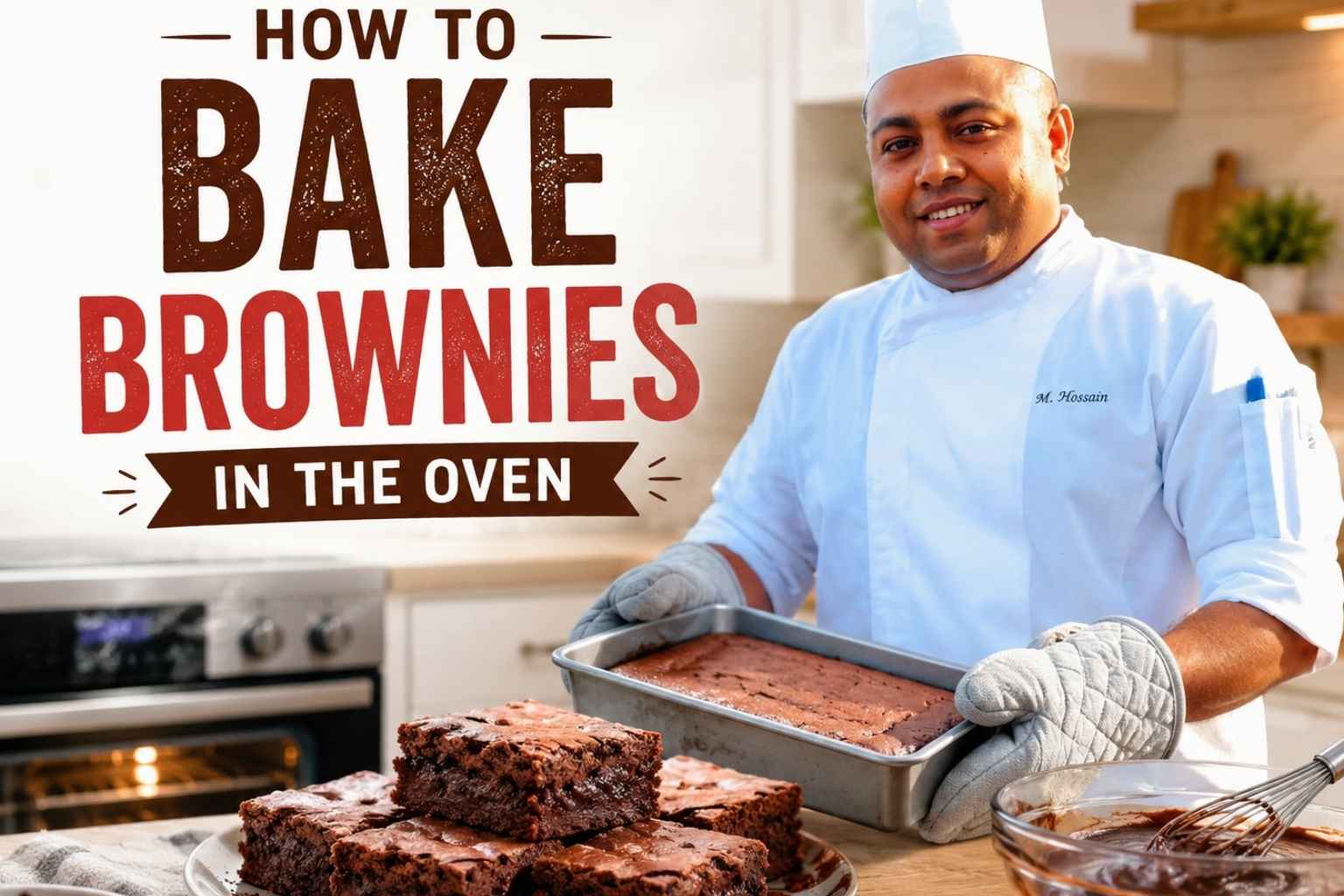
Brownies are pure comfort food — simple, rich, and hard to resist. I have baked them more times than I can count, and trust me, the oven is where the magic happens. Knowing how to bake brownies in the oven the right way makes all the difference between gooey perfection and a dry, crumbly mess. I am sharing my best tips so you skip the mistakes I made early on. Read on and get ready to bake your best batch yet!
At A Glance
- Set your oven to 325°F for fudgy brownies and 350°F for a chewier, more set texture. The 25-degree difference matters more than most bakers realize.
- Pull brownies out when a toothpick shows moist crumbs, not a clean stick. A clean toothpick means overbaked.
- Metal pans bake faster and give you better edges. Glass pans retain heat and can overcook the bottom. Ceramic sits in the middle.
- Convection ovens need a 25°F temperature drop and a 5-to-8 minute reduction in bake time for brownies to come out right.
- The most common brownie mistake is overbaking by 3 to 5 minutes. Learn to read the jiggle test and you will stop doing it.
The Brownie Baking Reference Table
Use this table before you preheat. The pan size and target temperature determine everything that follows.
| Pan Size | Temp (°F) | Bake Time | Texture Outcome |
|---|---|---|---|
| 8×8 inch | 325 | 30-35 min | Very fudgy, dense center |
| 8×8 inch | 350 | 28-32 min | Chewy center, set edges |
| 9×9 inch | 325 | 28-33 min | Fudgy, slightly more even |
| 9×9 inch | 350 | 25-30 min | Chewy, lifted texture |
| 9×13 inch | 325 | 22-27 min | Thinner layer, fudgy |
| 9×13 inch | 350 | 20-25 min | Chewy to cakey depending on formula |
| 9×13 inch | 375 | 18-22 min | More cakey, faster set |
| Muffin tin (12 cups) | 350 | 18-22 min | Crispy edges, soft center |
Times assume a standard home oven with a middle rack. Add 3-5 minutes for glass pans. Reduce by 5-8 minutes for convection mode.
Why Oven Temperature Changes the Whole Brownie
Temperature controls how the batter sets, and with brownies, the margin between fudgy and overdone is narrow.
At 325°F, the batter heats slowly. The edges cook first, but the center stays liquid longer. More moisture stays trapped in the batter before the top crust forms. The result is a dense, almost ganache-like center with a thin, papery crust on top. That crust is what most people are chasing.
At 350°F, the center sets faster. The batter firms up more evenly from edge to middle. You get a chewier texture with a bit more lift, and the top crust is less pronounced.
At 375°F, brownies behave more like cake. The eggs set quickly, gas from leavening escapes before the batter traps it, and you end up with an open crumb structure. That is fine if you want cakey brownies. If you want fudgy, stay off 375°F.
How the Batter Changes During Baking
Here is what is actually happening in your pan:
The butter and chocolate start melting in the first 5 minutes. The sugar dissolves and the eggs begin to coagulate around 160°F. The starch in the flour absorbs moisture and swells between 170°F and 200°F. The top surface dries out and forms a crust while the center is still below 200°F.
The fudgy center you want is batter that never fully gelatinized. The edges hit 210°F. The center might only hit 185-190°F at pull time. That is the target. (America’s Test Kitchen, 2022)
Rack Position and Its Effect on Browning
Middle rack is the default for a reason. It puts equal distance between your pan and both the top and bottom heating elements.
Drop to the lower third rack and you get more bottom heat. The base of the brownie will set faster, which can cause a dry or even slightly burnt bottom with a still-liquid center. This is a bad combination.
Move to the upper third and you risk the top crust burning before the interior sets. I tried this once during a hotel kitchen rush in 2014 and handed out pans of raw-bottomed brownies with a burnt top to 80 people at a staff dinner. I do not do that anymore.
Middle rack. Every time.
The Toothpick Test Myth: Why “Clean” Is Wrong
The toothpick test is in every recipe. The instructions are almost always wrong.
“Insert a toothpick in the center and bake until it comes out clean.” That instruction will overbake your brownies by 3 to 5 minutes every single time.
A clean toothpick means the center has fully set. That sounds right, but it is not what you want. A fully set center is a dry, cakey center. The residual heat in the pan will continue cooking the brownies for another 5 to 10 minutes after you pull them from the oven. (Serious Eats, 2021)
What to look for instead:
Pull at moist crumbs. Stick the toothpick in the center and pull it out. You want to see small, fudgy clumps clinging to the toothpick, not wet batter and not a clean stick. That middle state is the target.
The Jiggle Test Is More Reliable
I stopped relying on the toothpick years ago. The jiggle test is faster and more accurate.
Open the oven door and gently shake the pan. The edges should be completely set and not move at all. The center 2 inches of the pan should have a slight wobble, like a just-set gelatin. If the entire pan sloshes, close the door and give it another 3 minutes. If nothing moves at all, you are 2 minutes past done.
This sounds harder than it is. After two or three batches, you will read it in under a second.
Glass vs. Metal vs. Ceramic: Pan Material and What It Does
The material of your pan changes your bake time and your texture. This is one of the areas where home bakers lose the most consistency.
Metal Pans: The Professional Default
Metal pans – specifically light-colored aluminum – heat fast and cool fast. They conduct heat evenly across the bottom and sides. The edges of your brownies will be properly set and slightly pulled away from the sides by the time the center is done.
Dark metal pans absorb more heat and can overcook the bottom. If your pan is dark, reduce temperature by 10-15°F or check 3-4 minutes early.
I use an 8×8 light aluminum pan for 90% of my brownie baking. King Arthur Baking recommends the same for consistent results across most brownie formulas. (King Arthur Baking, 2023)
Glass Pans: Slower to Heat, Slower to Cool
Glass takes longer to heat up than metal. It also retains heat much longer after the pan comes out of the oven.
This creates a double problem: you need more time in the oven to get the center set, and then the pan keeps cooking the brownies after you pull them. The bottom and edges continue to bake on the counter for 10-15 minutes while you think they are cooling.
If you use a glass pan, add 5 minutes to your bake time and pull when you see the first sign of a set edge. Let them cool completely in the pan before cutting.
Ceramic Pans: Beautiful, But Unreliable
Ceramic heats slower than metal but more evenly than glass. The main problem is that most ceramic pans are thick and have sloped sides, which changes your effective batter depth. A ceramic dish that says 8×8 might give you a thicker batter layer than a metal 8×8.
Ceramic is fine for brownies. I just find it less predictable. Add 3-5 minutes to your metal-pan time and watch the edges.
Convection vs. Conventional Ovens: The Adjustments You Need
Convection ovens have a fan that circulates hot air. That fan strips moisture from the surface of your batter faster and cooks more evenly, but it also speeds up the bake.
The Standard Convection Adjustment
Drop the temperature by 25°F and reduce bake time by about 20%. For a standard 350°F, 30-minute brownie recipe, that means 325°F convection for 22-24 minutes.
Watch the top crust. In convection mode, the crust forms faster because the moving air dries the surface. This can make brownies look done before the center has set. Check the center with the jiggle test at the early end of your estimated time window.
Pan Rotation in Convection Mode
Most convection ovens still have some hot spots despite the fan. Rotate the pan 180 degrees halfway through the bake. For a 22-minute bake, that is the 11-minute mark. (Sally’s Baking Addiction, 2022)
How to Test Your Oven’s Accuracy
Your oven’s thermostat is probably wrong. Most home ovens run 15-50°F off from what the dial says, and many have hot spots where one side of the rack is hotter than the other. (America’s Test Kitchen, 2021)
This matters for brownies because the bake window is only about 5 minutes wide. A 50°F hot oven is the difference between perfect and overbaked.
The Oven Thermometer Test
Buy a standalone oven thermometer. They cost $8-15 and are the best investment in your baking kit. Hang it on the middle rack and preheat for 20 minutes. Read the thermometer and compare to your dial.
If your oven reads 325°F and the thermometer reads 350°F, you have been overbaking brownies for years without knowing why.
Finding Hot Spots with Bread Toast
Place a single layer of sandwich bread slices on the middle rack. Toast at 350°F for 5 minutes. Pull the rack out without moving the bread. The darker slices show the hot spots on your rack. Note where they are and adjust your pan placement or rotation schedule.
My current kitchen oven runs 20°F hot on the left rear corner. I always rotate at the halfway point.
Parchment Slings vs. Greasing Directly
The lining method changes how easy it is to remove the brownies and how the edges bake.
When to Use a Parchment Sling
A parchment sling is a piece of parchment cut to overhang two sides of the pan by 2 inches. After baking and cooling, you lift the whole slab out by those handles and cut on a flat surface.
Use a parchment sling when you want clean cuts and neat edges, when you are baking in a metal pan with straight sides, and when your recipe has a high sugar content that might stick.
To make one: cut parchment to fit the pan with 2-inch overhangs on two sides. Grease the pan lightly, press in the parchment, and grease the parchment. The light grease holds the parchment flat against the corners.
When Greasing Directly Is Fine
If you are cutting brownies in the pan or if you plan to serve them informally, greasing directly with butter or nonstick spray is fine. Just grease the bottom and lower inch of the sides. Full-side greasing can cause the edges to pull away from the pan too early.
I grease directly for casual weeknight batches. I use a parchment sling when I am cutting them for an event or a photo.
Common Brownie-Baking Mistakes and How to Fix Them
Overmixing the Batter After Adding Flour
The problem: Stirring too much after the flour goes in develops gluten. The brownies come out tough and bread-like with a drier texture.
The fix: Fold the flour in with a spatula using as few strokes as possible. Stop when you can no longer see dry flour. Lumps are fine. Streaks of flour are fine. Stop stirring.
Overbaking by 3-5 Minutes
The problem: Following the recipe timer without checking the actual pan. Every oven, pan, and batter formula bakes differently.
The fix: Start checking 5 minutes before the recipe says. Use the jiggle test. Pull at moist crumbs, not a clean toothpick.
Using the Wrong Pan Size
The problem: A 9×13 pan recipe poured into an 8×8 doubles the batter depth and adds 15+ minutes to the bake time. The outside oversets before the center is done.
The fix: Match your pan to the recipe. If you have to substitute, use the reference table at the top of this article to adjust time and temperature.
Cutting Too Early
The problem: Brownies look set on top but are still liquid in the center. Cutting warm brownies tears the top crust and smears the center.
The fix: Cool in the pan on a wire rack for at least 1 hour. For the cleanest cuts, refrigerate for 30 minutes after cooling to room temperature. Use a sharp knife and wipe the blade between cuts.
Altitude Adjustments
At altitudes above 3,500 feet, water boils at a lower temperature and leavening gases expand faster. Brownies can rise and fall, leaving a sunken center.
The fix: Reduce baking powder by 1/4 teaspoon per teaspoon called for. Add 1-2 tablespoons of extra flour to compensate for faster moisture evaporation. Increase oven temp by 15-25°F and reduce bake time slightly. (King Arthur Baking, 2022)
My Personal Brownie Routine
After 15 years of baking in professional and home kitchens, this is how I do it. I am not saying it is the only way. I am saying it works every single time.
Pan: 8×8 light aluminum with a parchment sling, greased lightly.
Temperature: 325°F conventional oven, middle rack. I preheat for 25 minutes and verify with a standalone thermometer before I put anything in.
Batter mixing: I melt butter and chocolate together, let it cool for 5 minutes, then whisk in eggs and sugar. I fold in flour last with a silicone spatula. Maximum 30 strokes after the flour goes in.
Bake time: I set a timer for 28 minutes and start checking at 25. I look for the edge to be set, the center to have a 1-to-2-inch wobble, and the toothpick to show moist crumbs.
Cooling: Pan on a wire rack for 1 hour. Then refrigerator for 30 minutes. Then I lift the slab out and cut with a large chef’s knife wiped clean between each cut.
The only time I skip the fridge step is when someone is standing in my kitchen waiting for brownies. In that case I cut them warm and accept the messy edges. No regrets.
Frequently Asked Questions About Baking Brownies in the Oven
What temperature should I bake brownies at for fudgy results?
Bake at 325°F for the fudgiest texture. At that temperature, the center of the brownie stays below full gelatinization point when you pull the pan, and residual heat finishes the job on the counter. (America’s Test Kitchen, 2022)
How do I know when brownies are done baking?
Use the jiggle test. Shake the pan gently. The edges should be fully set with no movement. The center 2 inches should have a slight wobble like loose gelatin. On a toothpick, look for moist crumbs, not wet batter and not a clean stick.
Can I bake brownies in a glass pan?
Yes, but add 5 minutes to your bake time and pull the pan when the edges are just set. Glass retains heat longer than metal, so the brownies keep cooking after you remove them from the oven. Cool fully before cutting.
Why did my brownies come out cakey instead of fudgy?
Three common causes: oven was too hot, you baked too long, or the recipe has too much flour relative to fat. For fudgier results, drop the temperature to 325°F, use the jiggle test, and look for a recipe with a higher butter-to-flour ratio.
Do I need to adjust baking time for a convection oven?
Yes. Reduce the temperature by 25°F and the bake time by about 20%. For a 350°F, 30-minute recipe, that is 325°F convection for 22-24 minutes. Rotate the pan at the halfway point.
Why do my brownies sink in the middle after baking?
The most common cause is underbaking. The center was not set when you pulled the pan, and without support it collapses as it cools. A secondary cause is opening the oven door before the 20-minute mark, which drops the temperature and causes the batter to fall. At high altitude, excess leavening gas expansion is the likely cause.
How long should brownies cool before cutting?
At least 1 hour at room temperature. For the cleanest cuts, follow that with 30 minutes in the refrigerator. Cutting warm brownies tears the crust and smears the center, even if they look set on top.
Can I use a 9×9 pan instead of 8×8?
Yes. A 9×9 pan gives you a thinner batter layer and a slightly more even bake. Reduce your bake time by 3-5 minutes and start checking early. The texture will be slightly less fudgy because the thinner layer has less of the liquid center.
Key Takeaways
- 325°F is the fudgy temperature. 350°F gives chew. 375°F gives cake. Pick based on what you want, not just what the recipe says.
- The toothpick test misleads most bakers. Pull at moist crumbs, not a clean stick.
- Metal pans are faster and more consistent than glass. If you switch materials, adjust your time.
- Convection needs two adjustments: 25°F lower temperature and 20% less time.
- Your oven is probably wrong. A $10 thermometer fixes this permanently.
- Cutting warm brownies is the single most common reason for messy results. Wait 1 hour minimum.
- Altitude above 3,500 feet requires adjustments to flour, leavening, temperature, and time.

I’m Mossaraof, a trained chef and the founder of OvenInsights.com. I spent years cooking at Larrupin’ Cafe and in kitchens across Chicago and Seattle. Now I test kitchen gear for a living. I moved to North Acton, London, and I test every tool I write about. I use real meals and real heat. No brand deals. No shortcuts. I cover 12 kitchen types and hundreds of recipes. I believe this: the right tools matter as much as the recipe.