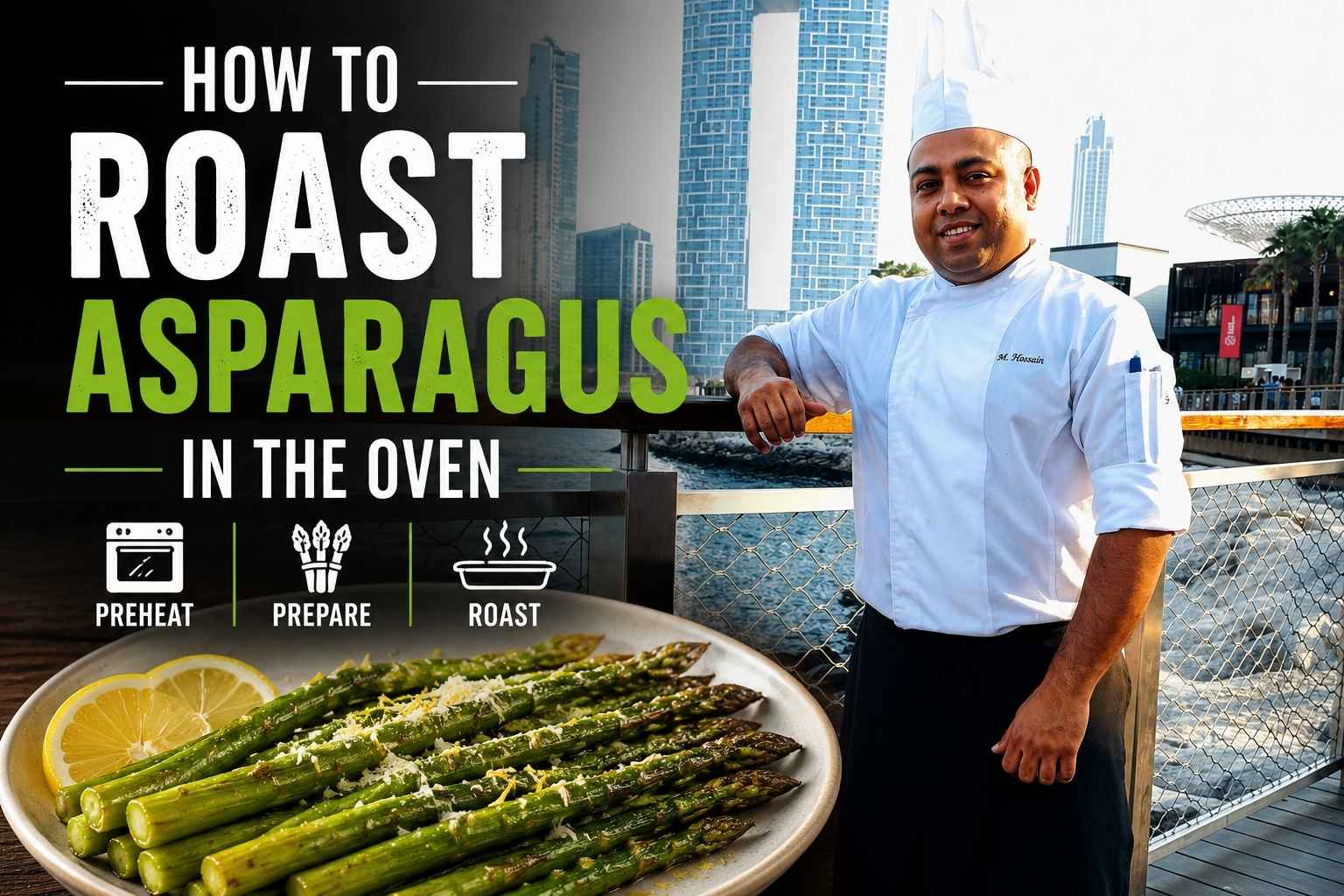
I used to burn asparagus every single time. Like, every time.
I’d toss it in the oven, get busy, and come back to sad, mushy spears. So I started testing batches until I found a method that just works.
Now I’ll show you how to roast asparagus in the oven so it comes out crisp, snappy, and full of flavor. No fancy skills needed. Just a pan, some heat, and a few simple tricks I learned the hard way.
At A Glance
- Roast asparagus at 425°F for the best balance of caramelization and bite — it’s my default temperature after 15 years of cooking.
- Use a rimmed sheet pan with spears in a single layer; a crowded pan steams the asparagus and kills browning.
- Pat the spears completely dry before oiling — surface moisture is the number one reason roasted asparagus comes out soft instead of crisp.
- Thin spears need only 8-10 minutes; thick ones can take up to 20. Check at the lower end every time.
- The ideal doneness cue: tips are lightly charred, the thickest part bends slightly but doesn’t snap.
Why Oven-Roasting Beats Every Other Cooking Method
Roasting asparagus is the right call — and not for vague reasons. Two specific chemical reactions make oven-roasted spears taste fundamentally better than steamed or sautéed ones.
The first is caramelization, which starts at around 320°F. The natural sugars in asparagus break down and produce new flavor compounds — nutty, slightly sweet, mildly bitter in the best way (University of California Division of Agriculture, 2021). You don’t get that in a steamer basket.
The second is the Maillard reaction, which requires surface temperatures above 280°F and, critically, low surface moisture. This is why a dry, hot oven is so effective: it creates a slightly crisp exterior with deep savory flavor while keeping the interior tender (America’s Test Kitchen, 2023). A sauté pan can approximate this, but only if you’re working in a single layer with plenty of clearance — at home, most pans are too small, and you end up steaming half the batch anyway.
Steaming preserves color and gives you a clean, mild flavor. That’s the right choice if you’re serving asparagus as a neutral component in a composed dish. But if asparagus is the thing — the side dish you want people to notice — roasting wins every time.
How to Pick Fresh Asparagus at the Market
The quality of what goes into the oven determines the quality of what comes out. Here’s what I check before I buy.
Thickness: This matters more than most people realize, and it’s not just about cooking time. Thin spears (pencil-width, roughly under 1/2 inch in diameter) are delicate and sweet — excellent for quick high-heat roasting. Medium spears (1/2 to 3/4 inch) are the most versatile. Thick spears (over 3/4 inch) have more starch and a heartier texture that holds up well to longer roasting and bold sauces.
The idea that thin asparagus is “better” is a myth. Both Serious Eats (2022) and Cook’s Illustrated (2021) have confirmed that thickness is a preference and context issue, not a quality signal. I reach for thin spears when I want a delicate spring side dish. I reach for thick spears when I’m pairing with steak or making asparagus the anchor of a plate.
Color and tips: Look for deep green color from tip to cut end. The tips should be tightly closed and dry — not slimy, not feathery. Any open, flowering tips mean the asparagus is past its prime.
The snap test: The old snap-the-end-off-by-feel method is real. Fresh asparagus snaps cleanly at the woody-to-tender transition point. If a spear bends instead of snapping, it’s been stored too long.
The cut end: Check for moisture at the cut end. Dry, whitened ends mean the asparagus was harvested days ago. A slightly moist, bright-green cut end means it’s fresh.
Prepping Asparagus: Trimming, Washing, and Peeling
How to Trim Asparagus Without Wasting Half the Spear
The snap-and-waste method is common but wasteful. When you snap each spear individually, you lose different amounts from each one depending on how you hold it. That wastes good asparagus.
My preferred method: line up all the spears with the tips together, then find the point on one spear where the color shifts from bright green to pale or white. Cut the whole bunch at that point with a chef’s knife. You’ll lose a tiny bit more from the occasional unusually tough spear, but you’ll waste far less overall.
Pencil-thin asparagus rarely needs any trim at all beyond 1/2 inch. Thick spears can have woody ends that extend further up — trim more aggressively and check by bending one: the trimmed end should have some give.
Do You Need to Peel Asparagus?
For thin and medium spears: no. The skin is thin enough to eat without any bitterness.
For thick spears over 3/4 inch: sometimes. The outer layer of very thick asparagus can be fibrous even after cooking. Use a vegetable peeler to peel from just below the tip down to the cut end. It’s a two-minute job and it makes a genuine difference in texture.
Washing and Drying
Rinse asparagus in cold water and shake off the excess. Then — and this step matters more than most recipes acknowledge — dry the spears thoroughly with a kitchen towel or paper towels.
Surface moisture is the enemy of browning. A wet spear hits the hot pan and steams instead of roasting. The difference is not subtle: wet asparagus comes out soft and dull; dry asparagus comes out with texture and color (Serious Eats, 2022).
The Right Pan, Rack Position, and Airflow Setup
Pan Choice
Use a heavy rimmed sheet pan — a half sheet pan (18×13 inches) is ideal. Thin pans warp at high heat and create hot spots. Rims matter because you’ll be tossing the spears with tongs at least once.
Avoid nonstick for this task. Nonstick coatings start to degrade above 400°F, and we’re roasting at 400-450°F (Cook’s Illustrated, 2023). A bare aluminum or stainless half sheet pan gets hot faster and gives you better browning.
I don’t line my pan with foil when roasting asparagus. Foil reflects heat and slows the browning of the underside. The cleanup takes an extra 30 seconds with a pan scraper — worth it.
Rack Position
Use the upper-middle rack. At that position the spears get direct top heat from the broil element (even during regular bake mode, the top element cycles on) and good bottom heat from the oven floor. The bottom rack runs hotter on the underside but not enough to do anything useful for asparagus — all it does is burn the tips that touch the pan.
Single Layer Is Non-Negotiable
If the spears overlap, you’re steaming, not roasting. The moisture released by asparagus as it cooks needs somewhere to go — it needs to evaporate off the pan. A crowded pan traps that steam and prevents any browning.
If you have more asparagus than fits in a single layer on one pan, use two pans and rotate them halfway through cooking.
Oil, Seasoning, and Flavor Variations
How Much Oil
Use enough oil to coat each spear lightly — not drench it. For a pound of asparagus (about 20-24 medium spears), one tablespoon of olive oil is the right amount. More than that and the spears fry in pooling oil rather than roast; less than that and the exposed skin scorches before the interior cooks through.
Toss the spears with oil in a bowl or directly on the sheet pan before spreading them out. Every surface should have a thin, even coat.
Salt Timing
Season with kosher salt right before the pan goes into the oven. Salting too early draws out moisture (Bon Appétit, 2022). I use about 1/2 teaspoon of kosher salt per pound of asparagus, applied after oiling.
Black pepper is optional but good — crack it on after cooking so the volatile oils haven’t cooked off.
Flavor Variations That Actually Work
These are the combinations I come back to:
- Garlic: Slice 2-3 garlic cloves thin and toss with the asparagus before roasting. The garlic caramelizes alongside the spears. Don’t use pre-minced jarred garlic — it burns before the asparagus finishes.
- Lemon: Squeeze fresh lemon juice over the asparagus after roasting, not before. Lemon juice added before cooking turns bitter under high heat.
- Parmesan: Grate finely and scatter over the spears in the last 3-4 minutes of cooking. It forms a light crust. Don’t add it at the start or it’ll burn.
- Chili flakes: Add 1/4 teaspoon with the oil before roasting. The heat blooms in the fat and penetrates the spears.
- Balsamic glaze: Drizzle after roasting. A thick reduction works well; thin balsamic vinegar added before roasting turns the spears a muddy color and doesn’t taste good.
Roasting Times by Spear Thickness and Temperature
This is the reference table I wish I’d had early in my career. Times are from when the pan goes into a fully preheated oven.
| Spear Thickness | 400°F | 425°F | 450°F | Notes |
|---|---|---|---|---|
| Thin (under 1/2 inch) | 10-12 min | 8-10 min | 6-8 min | Watch closely at 450°F — tips char fast |
| Medium (1/2 to 3/4 inch) | 14-16 min | 12-14 min | 10-12 min | Best overall results at 425°F |
| Thick (over 3/4 inch) | 18-22 min | 16-20 min | 14-18 min | Peeling the lower third helps at all temps |
When to use each temperature:
- 400°F is the right call when you want more control and you’re cooking for a crowd — you have a wider window before things go wrong. Also the right choice if your oven runs hot.
- 425°F is my default. It gets good caramelization without the rushed window you get at 450°F.
- 450°F is for thin spears when you want significant tip char and a slightly more intense flavor. You need to watch the oven and not leave the kitchen.
How to Tell When Asparagus Is Done
Timing is a starting point, not the answer. Here are the cues I actually use.
The tip char: The feathery tips should have some browning — golden to light brown. If they’re fully green, the asparagus needs more time. If they’re dark brown or black, you’ve gone a minute too far.
The bend test: Pick up a spear with tongs from the thickest part. It should have some flex — bend slightly under its own weight but not go fully limp. A spear that holds perfectly rigid needs more time. A spear that goes fully floppy is overcooked.
Fork tenderness: Pierce the thickest point with a fork. It should slide in with slight resistance — not crunch, not slide through like butter.
The difference between perfectly done and overcooked is about 90 seconds at 425°F. This is not a dish you can set and walk away from.
Convection vs. Conventional Oven
If your oven has a convection or “fan-assisted” setting, use it for roasting asparagus. Convection circulates hot air around the pan, which removes surface moisture faster and speeds browning. In my tests, convection shaves 2-3 minutes off the cooking time and produces more even browning across the full length of each spear.
When using convection, reduce the temperature by 25°F. So if the table above says 425°F, set your oven to 400°F on convection. Cooking time will be similar or slightly shorter.
If your oven doesn’t have convection, no problem — the standard times in the table above are calibrated for conventional ovens.
Common Mistakes and How to Fix Them
| Mistake | Why It Happens | Fix |
|---|---|---|
| Soft, pale asparagus with no browning | Pan crowded, spears overlapping | Use two pans; single layer only |
| Wet, steamed texture | Spears not dried before oiling | Pat dry with a towel before oiling |
| Tips burned before stalks cook through | Oven not preheated fully | Preheat for 15-20 minutes minimum before the pan goes in |
| Thin spears mushy | Left in at timing for medium spears | Check thin spears starting at 7 minutes |
| Underseasoned | Salt added after plating | Salt before roasting for penetration |
| Garlic burned and bitter | Garlic added at start with thick spears | Add garlic in the last 5 minutes for thick spears, or at the start for thin ones |
Make-Ahead, Storage, and Reheating
Roasted asparagus is best eaten within 10 minutes of coming out of the oven. The texture degrades noticeably after that.
If you need to prep ahead, roast the asparagus until it’s about 80% done — still slightly underdone in the center — then cool and refrigerate. Finish in a 425°F oven for 4-5 minutes before serving.
Storage: Roasted asparagus keeps in an airtight container in the refrigerator for up to 3 days. It softens further as it sits — that’s unavoidable.
Reheating: Skip the microwave. It steams the spears and turns them completely soft. Instead, spread them on a sheet pan and reheat at 400°F for 5-6 minutes. You won’t recover the exact original texture but you’ll get close.
Serving Ideas and Pairings
Roasted asparagus works with nearly any protein. Here are the combinations worth knowing.
With proteins:
- Alongside pan-seared salmon: the slight bitterness of asparagus cuts through the richness of the fish.
- With grilled chicken: straightforward and works every time. Add lemon.
- With a seared steak: use thick spears and finish with flaky salt and a drop of good olive oil.
- As a standalone salad base: cool the spears to room temperature and dress with a sharp vinaigrette, shaved Parmesan, and a soft-boiled egg on top.
Sauces that work:
- Hollandaise is the classic pairing — rich, egg-yolk-based, slightly tart.
- A simple aioli works for casual serving.
- Brown butter with capers and a squeeze of lemon takes about 3 minutes to make and transforms the dish.
- A tahini drizzle with a squeeze of lemon works well for a vegetarian plate.
Garnishes worth using: Flaky sea salt, toasted breadcrumbs (pangrattato), shaved Parmesan, chopped toasted almonds, or a soft-boiled egg halved over the top.
My Go-To Roasted Asparagus Routine
After 15 years of cooking — including time at a restaurant where we’d roast 30 pounds of asparagus per service — this is the routine I’ve settled on for home cooking.
I buy medium spears when I can, thick ones when I want something more substantial. I trim them in a single cut, not by snapping. I rinse them, then spend a full minute patting them dry. I toss them in a bowl with one tablespoon of olive oil per pound, season with 1/2 teaspoon of kosher salt, and spread them in a single layer on a bare sheet pan.
The oven is preheated to 425°F for at least 20 minutes before the pan goes in. I put the pan on the upper-middle rack and set a timer for 10 minutes. At 10 minutes I check — looking at the tips, doing the bend test — and decide whether they need 2 more minutes or 4.
When they come out, I finish with freshly cracked black pepper and a squeeze of half a lemon. That’s it. On a good day I add a shave of Parmesan with a vegetable peeler and a pinch of chili flakes.
It takes 25 minutes total, including prep and cook time. It works every time.
Frequently Asked Questions About Roasting Asparagus
What temperature is best for roasting asparagus in the oven?
425°F is the best all-purpose temperature for roasting asparagus. It produces good caramelization without the narrow time window you get at 450°F. Use 400°F if you’re cooking a large batch and want more control, or 450°F for thin spears when you want significant tip char.
How long does it take to roast asparagus at 400°F?
At 400°F, thin asparagus (under 1/2 inch diameter) takes 10-12 minutes, medium asparagus takes 14-16 minutes, and thick spears take 18-22 minutes. These times assume a preheated oven and spears in a single layer on the pan. Start checking a minute or two before the lower end of the range.
Should I use olive oil or another oil for roasting asparagus?
Olive oil is fine for roasting asparagus at 400-425°F. At 450°F, use a neutral oil with a higher smoke point — avocado oil, sunflower oil, or refined coconut oil — to avoid any bitter taste from olive oil breaking down. The difference is subtle at 425°F but noticeable at 450°F.
Why is my roasted asparagus soggy instead of slightly crisp?
The most common causes are: spears not dried before oiling, spears overlapping on the pan (trapped steam), or oven not fully preheated. Fix all three: dry the spears thoroughly, use a single layer with space between spears, and preheat for at least 15-20 minutes before adding the pan.
Should I cover asparagus with foil when roasting?
No. Covering asparagus with foil traps steam and turns the cooking method from roasting into steaming. You won’t get any browning or caramelization. Leave the pan uncovered throughout.
Can I roast asparagus from frozen?
You can, but the result won’t match fresh. Frozen asparagus releases a significant amount of water as it thaws in the oven. Spread it on a pan lined with paper towels, let it thaw and drain for 20-30 minutes, pat dry, then roast at 450°F. It’ll be softer than fresh but better than microwaving it.
Can I roast asparagus ahead of time for a dinner party?
Yes, with a modification. Roast the spears until they’re about 80% done — just barely underdone — then spread on a sheet pan to cool and refrigerate uncovered for up to 6 hours. Finish in a 425°F oven for 4-5 minutes just before serving. The texture won’t be identical to cooking them straight through, but it’s the best option for timing a dinner service.
What do I do if my asparagus spears are very different thicknesses?
Sort them before roasting. Put the thick spears on the pan first and give them a 3-4 minute head start, then add the thinner spears to the same pan. Both will finish close to the same time. Alternatively, roast them on separate pans with separate timers.
Key Takeaways
- 425°F is the best default roasting temperature for asparagus — it gives good caramelization without a tight time window.
- Dry the spears completely before oiling; surface moisture prevents browning and is the most common reason roasted asparagus turns out soft.
- Single layer on the pan is the most important structural rule — overlapping spears steam rather than roast.
- Check for doneness by the bend test and tip color, not just the clock — thin and thick spears at the same temperature can differ by 10+ minutes.
- Season with salt before roasting for penetration, and finish with acid (lemon) after roasting for brightness.
- Preheat the oven for at least 15-20 minutes before the pan goes in.

I’m Mossaraof, a trained chef and the founder of OvenInsights.com. I spent years cooking at Larrupin’ Cafe and in kitchens across Chicago and Seattle. Now I test kitchen gear for a living. I moved to North Acton, London, and I test every tool I write about. I use real meals and real heat. No brand deals. No shortcuts. I cover 12 kitchen types and hundreds of recipes. I believe this: the right tools matter as much as the recipe.