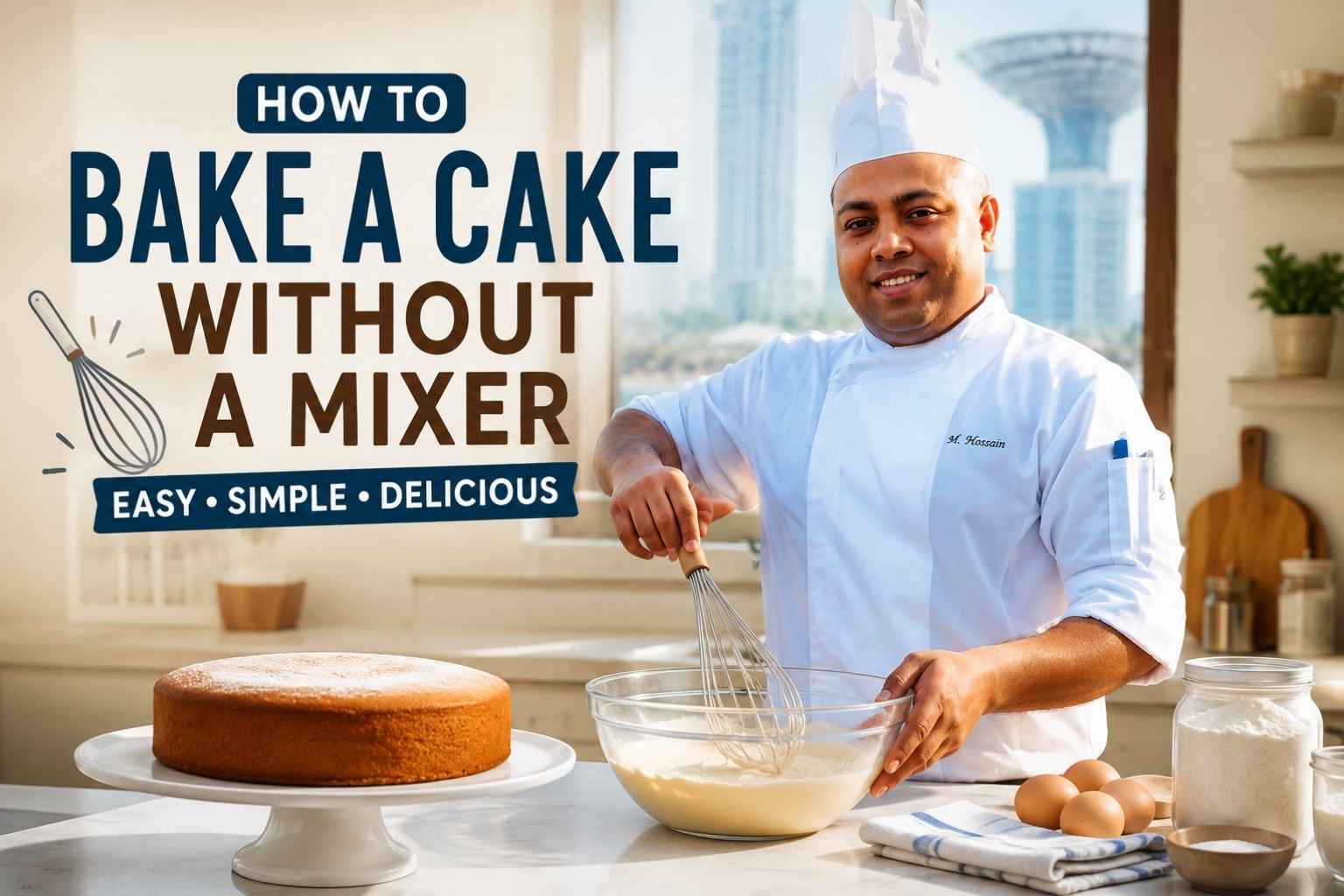
You don’t need a mixer to bake a great cake. I learned how to bake a cake without a mixer years ago, and honestly, it changed everything for me. A simple bowl and a whisk can do the job just fine. Some of my best cakes came from mixing by hand.
Most people think you need fancy tools to bake well. But that’s just not true. Hand mixing gives you full control over your batter. You can feel when it’s just right, and that’s a skill no machine can teach you.
I’ve baked dozens of cakes this way in my own kitchen. The results are always soft, moist, and full of flavor. You don’t need to spend money on equipment to bake like a pro. All you need is the right method and a little confidence.
In this guide, I’ll walk you through every step. You’ll learn the best hand mixing tips, the right tools to use, and how to get a fluffy cake every time. It’s easier than you think. Let’s get started and bake something amazing together.
At A Glance
- You can hand-mix most cakes – butter cakes, oil-based dump cakes, and even sponge cakes – with solid results if you follow the right technique for each type.
- The biggest hand-mixing mistake is under-creaming butter and sugar; it takes 5-7 minutes of hard work by hand, and the butter must be at 65-68°F (King Arthur Baking, 2024).
- A balloon whisk beats a fork or wooden spoon for almost every job – it moves more air per stroke and covers more volume in the bowl.
- Angel food and stiff meringue cakes are the two places where hand-mixing genuinely falls short; budget 20+ minutes of nonstop whisking or skip those recipes.
- Oil-based one-bowl cakes are the best starting point for no-mixer baking – they are designed to be stirred, not whipped.
Why Hand-Mixing Is Not “Settling” – What Actually Changes
Hand-mixing produces good cakes when you match the method to the recipe. That is the honest answer.
I have worked in professional kitchens for 15 years. I have mixed cakes by hand when the stand mixer motor burned out mid-service, when I was catering off-grid at a farm dinner with no outlets, and when I was testing recipes in a rented apartment with no equipment. The results were not compromises. Some were better than the mixer version.
Here is what actually changes without a machine:
Texture in butter cakes: A stand mixer can cream butter and sugar for 4-5 minutes at medium-high speed. By hand, you work harder for longer to get the same result – but the result is the same. The goal is pale, fluffy, aerated butter. Technique determines the outcome, not the tool.
Gluten development in flour-heavy batters: This is where hand-mixing has a real edge. Overmixing is the enemy of tender cake. By hand, you fatigue before the gluten does. A stand mixer will keep going and toughen a batter. Your arm quits at the right time. (America’s Test Kitchen, 2023)
Whipped eggs: This is the hardest job for human arms. Whisking eggs and sugar to ribbon stage for a genoise takes 8-10 minutes of nonstop motion by hand versus 5 minutes in a stand mixer. It is doable. Just slow.
When it genuinely does not matter: Oil-based cakes – carrot cake, chocolate mayonnaise cake, banana bread-style loaf cakes – do not need aeration from creaming. You stir wet into dry. A fork works. These cakes were designed before electric mixers were in every home, and they are still excellent.
The Science of Creaming Butter and Sugar by Hand
Creaming is the process of beating fat and sugar together until the mixture is pale, light, and roughly doubled in volume. You are forcing air into the fat. That air expands in the oven and gives the cake lift.
Temperature is the single most important variable. Butter at 65-68°F (18-20°C) is pliable enough to trap air but firm enough to hold it. Butter at 75°F or above is too soft – it will grease the sugar instead of aerating it. Cold butter, straight from the fridge, will not cream at all; it just chunks. (King Arthur Baking, 2024)
To hit the target temperature without a thermometer: pull butter from the fridge 30-45 minutes before you start. Press a finger into the block – it should leave a clean indent but not sink in fully. That is ready butter.
The hand technique: Use a wide, heavy bowl and a sturdy wooden spoon or silicone spatula. Press the butter against the side of the bowl in long, smearing strokes. Then fold it back to the center. Repeat. After 2 minutes, the butter will look greasy. Keep going. At 4 minutes, it lightens. At 6-7 minutes, it should be pale yellow, almost white, and fluffy when you lift the spoon.
How to tell when it is done: The mixture will be noticeably lighter in color – from yellow to nearly ivory. It will hold soft peaks if you drag the spoon through it. It will look almost like whipped cream cheese. If it still looks glossy and dense, keep going.
One trick I use: scrape the bowl every 2 minutes. The mixture at the bowl wall will be warmer and softer than what is in the center. Keeping it mixed evenly prevents greasy streaks in the final batter.
Whisking vs. Folding vs. Beating – When to Use Each Method
These three motions are not interchangeable. Using the wrong one at the wrong time wrecks the batter.
Whisking adds air. Use it for eggs, egg whites, cream, and any wet mixture you need to lighten. A balloon whisk is the right tool – the wire loops trap air with each pass. Hold the bowl at a 45-degree angle, tilted toward you, and move the whisk in rapid circles. The more surface area the whisk covers per stroke, the faster you build volume.
Beating is forceful whisking with a goal of full emulsification or aeration of dense ingredients. Use it for creaming butter, mixing cream cheese, or combining eggs into a batter. A wooden spoon or silicone spatula beats better than a whisk for dense mixtures because it gives more leverage.
Folding removes air rather than adding it – or rather, it incorporates a lighter mixture into a heavier one without deflating the lighter one. Use it when adding whipped egg whites or whipped cream to a batter, and when combining dry ingredients into a wet batter after the creaming stage. The motion is a J: cut down through the center of the bowl with the spatula, scoop under the mixture, and turn it over. Rotate the bowl a quarter turn and repeat. Stop the moment you see no streaks of flour.
The most common mistake I see in home bakers: they fold when they should beat (resulting in lumpy, under-combined batter) or beat when they should fold (deflating whipped whites). Read the recipe carefully. “Fold in flour” and “stir in flour” are different instructions with different outcomes.
Tools You Actually Need for Hand-Mixing
You do not need much. Here is what earns its place on the counter.
| Tool | What It Does | When to Use It |
|---|---|---|
| Balloon whisk | Adds air efficiently; best volume per stroke | Egg whites, whole eggs, thin batters, cream |
| Silicone spatula | Scrapes bowl clean; good for folding | Folding, combining, scraping every last gram |
| Wooden spoon | Leverage for heavy creaming | Butter-sugar creaming, thick batters |
| Fork | Quick incorporation of light ingredients | Oil-based batters, mashing bananas, quick stirs |
| Large glass jar (with lid) | Shake-to-combine method for thin batters | Pancake-style cakes, quick pour batters |
| Wide, heavy bowl | Stability; room to work | Everything – a bowl that slides around on the counter kills your technique |
| Hand grater or Microplane | Zesting citrus for flavoring | Adding zest, grating chocolate |
The balloon whisk is the most underrated tool on this list. Most home bakers use a flat or French whisk – they have fewer wires and move less air. A balloon whisk with 10 or more wires makes a measurable difference in how fast you build foam. (Serious Eats, 2022)
The jar-shaking method is legitimately useful for thin batters. Add all liquid ingredients to a large mason jar, seal the lid, and shake for 30-45 seconds. Pour into your dry ingredients, stir briefly to combine. No whisk needed, minimal cleanup, no arm strain.
Step-by-Step Technique by Cake Type
Butter Cakes: The Creaming Method by Hand
Butter cakes – yellow cake, pound cake, most layer cakes – need the creaming method. This is the most demanding hand-mixing job.
- Start with butter at 65-68°F. Cut it into 1-tablespoon pieces.
- Beat butter alone for 2 minutes in a wide bowl with a wooden spoon or spatula. It should start to look slightly fluffy.
- Add sugar in two additions, beating for 3 minutes after each. Total creaming time: 7-8 minutes minimum.
- Add eggs one at a time, beating 30 seconds after each addition.
- Switch to a folding motion when adding flour. Alternate dry ingredients and liquid (typically: one-third flour, half liquid, one-third flour, half liquid, one-third flour).
- Stop stirring the moment you see no dry streaks.
The finished batter should look smooth and slightly thick. It should ribbon off the spatula, not plop. If it looks curdled after adding eggs, the eggs were too cold – set the bowl over warm water for 30 seconds and beat again.
Sponge and Genoise Cakes: Whisking Eggs to Ribbon Stage
A classic sponge has no butter and no chemical leavening. All the rise comes from air beaten into eggs. This is a real workout.
- Warm whole eggs and sugar in a bowl set over simmering water (double boiler style). Stir until the sugar dissolves and the mixture reaches 110°F – about 3 minutes. This is the Warner-Bratzler method and it dramatically shortens the whisking time. (Serious Eats, 2023)
- Remove from heat. Whisk continuously – 8-10 minutes by hand – until the mixture is pale, thick, and falls from the whisk in a thick ribbon that holds its shape on the surface for 3-4 seconds before dissolving.
- Sift flour over the mixture in two additions. Fold in with a large spatula using the J motion. Do not overfold – 40-50 strokes total is enough.
- If adding melted butter (as in a French genoise), drizzle it around the edge of the bowl and fold in last.
Arm fatigue is real here. If you need to rest, rest – but come back fast. The foam deflates slowly if you leave it too long.
One-Bowl and Dump Cakes: Oil-Based, Easy to Mix
These are the best cakes for no-mixer baking. They use oil instead of butter, so there is no creaming step. Everything goes into one bowl.
- Combine all wet ingredients – oil, eggs, buttermilk, vanilla – in the bowl and whisk for 30 seconds.
- Add sugar and whisk another 30 seconds.
- Add dry ingredients all at once and stir with a spatula or fork until just combined. Ten to twelve strokes is usually enough.
- Pour into pan immediately – these batters move fast.
Classic examples: carrot cake, chocolate mayonnaise cake, wacky cake (vegan), and most quick-bread style cakes. All forgiving. All delicious. (Sally’s Baking Addiction, 2024)
Chiffon and Angel Food Cakes: Whipping Egg Whites by Hand – Realistic Expectations
I will be honest with you: whipping egg whites by hand for chiffon or angel food cake is possible but genuinely hard. A full angel food cake calls for 12 egg whites whipped to stiff peaks. By hand, that is 15-20 minutes of nonstop whisking.
If you are committed:
- Make sure your bowl and whisk are completely clean and dry. Even a trace of fat deflates egg whites.
- Use a large, deep bowl – copper if you have it. Copper ions stabilize egg white foam better than stainless steel. (Harold McGee, On Food and Cooking, 2004)
- Start whisking slowly to build small, stable bubbles. Speed up as the foam thickens.
- For soft peaks: the foam holds a shape but the tip flops over when you lift the whisk.
- For stiff peaks: the tip stands straight. This is the target for chiffon and angel food.
For chiffon cake (4-6 whites), this is manageable in about 10 minutes. For a full angel food, think carefully about whether the time investment makes sense.
How to Whip Cream and Egg Whites by Hand Without Ruining Them
Both cream and egg whites are easy to overwhip. Once you go past stiff peaks, you cannot go back.
Bowl angle and shape: Use a round-bottomed, deep bowl. Tilt it at 45 degrees while you whisk – this lets the mixture fall back into the path of the whisk with each stroke, maximizing contact. A flat-bottomed bowl forces you to chase the foam around the edges.
Rhythm: Whisk in a circular motion, not a back-and-forth. Keep your wrist loose, not rigid. A loose wrist means more rotations per second without muscle strain.
Cold helps: Chill the bowl and the cream in the freezer for 10 minutes before whipping. Cold cream whips faster and holds peaks longer. Cold egg whites do not whip faster, but the extra stability from starting cold helps on hot days. (King Arthur Baking, 2023)
Signs you are close to done:
- Cream: when the whisk leaves clear tracks in the foam that fill in slowly, stop or slow down. You are 30 seconds from overwhipping.
- Egg whites: when they look glossy and the peaks hold but still have a gentle curl, you are at soft peaks. When the peaks stand straight and the foam looks slightly matte, that is stiff.
If you overwhip cream: Stir in 1-2 tablespoons of unwhipped cream with a spatula. It usually rescues the texture.
If you overwhip egg whites: They will look dry, clumpy, and slightly grainy. There is no fix. Start over.
Common Hand-Mixing Mistakes and How to Fix Them
Mistake 1: Under-creaming butter and sugar. The batter looks combined after 2-3 minutes, so you move on. The result is a dense, slightly greasy cake. The fix is simple – cream longer. Set a timer for 7 minutes and do not stop until it goes off.
Mistake 2: Adding cold eggs to creamed butter. The mixture curdles and looks broken. It does not always fix itself in the oven – you can end up with a slightly dense, uneven crumb. Fix: use room-temperature eggs. If you forget, drop them (uncracked) in warm water for 5 minutes.
Mistake 3: Deflating whipped egg whites when folding. You fold five strokes and think it is enough, then switch to stirring to combine the last bits of flour. Stirring tears the foam. Fix: fold slowly, go all the way to the bottom of the bowl each time, and stop as soon as the flour disappears.
Mistake 4: Uneven sugar dissolving in the creaming stage. You feel gritty pockets in the batter. This comes from adding sugar all at once instead of in stages. Fix: add sugar in two or three additions, and beat fully between each.
Mistake 5: Overmixing flour. You keep stirring because the batter looks lumpy. A few lumps in a hand-mixed batter are fine – they will bake out. Every extra stir builds more gluten and makes the cake chewier than it should be. Fix: stop stirring. Seriously, put the spoon down.
When a Mixer Genuinely Matters
Hand-mixing works for most cakes. These are the cases where it does not.
Stiff meringues for Swiss or Italian buttercream. These require 15+ minutes of high-speed whipping to reach the right temperature and stability. A stand mixer is worth it here.
Large batches. Creaming 4 sticks of butter by hand for a 3-layer wedding cake tier is theoretically possible and practically miserable. If you are making more than a 2-layer 9-inch cake, a hand electric mixer at minimum will save your wrist.
Bread doughs with eggs (brioche, challah). These are technically cake-adjacent and require sustained, high-force mixing that tears most home bakers’ arms apart. A mixer is the right tool.
Angel food cake for a crowd. A single angel food is manageable. If you are feeding 20 people, you need 2-3 cakes and 30+ egg whites. Do not do this by hand unless you are a masochist.
My Personal No-Mixer Routine: What Actually Works in a Real Kitchen
My go-to for a last-minute no-mixer cake is a one-bowl brown butter chocolate cake I have been making for about eight years. It uses oil and brown butter together, Dutch-process cocoa, and buttermilk. No creaming. No whipping. Done in 12 minutes of prep time.
When I have to do a proper creamed butter cake by hand, here is my exact routine:
I take the butter out the night before if I am working in a cold kitchen, or 30 minutes before if it is warm. I use a wide, low-sided mixing bowl – the kind most home cooks use for salad. The low sides give me more stroke length per beat. I cream the butter alone first, for a full 2 minutes, before I add any sugar. That pre-softening step cuts total creaming time by about 90 seconds.
For flour incorporation, I sift everything – always. Lumps in unsifted cake flour do not mix in easily by hand the way they might under a mixer’s paddle. I alternate dry ingredients and liquid in three additions of flour and two of liquid, folding each time with 15-18 strokes.
The biggest arm-saver: switch hands. Alternate every 60-90 seconds when creaming. It sounds obvious, but most people do not do it. Your dominant hand will cramp at the 5-minute mark. Your non-dominant hand can carry the last 2 minutes without issue.
Frequently Asked Questions About Baking a Cake Without a Mixer
Can you bake a cake without any electric appliances at all?
Yes. Most cakes – butter cakes, oil-based cakes, sponge cakes, and chiffon cakes for small batches – can be made entirely by hand with a bowl, a whisk, and a spatula. The technique matters more than the tools. The one type that is genuinely difficult without electricity is a full angel food cake, which requires 12 whipped egg whites.
How do you cream butter and sugar without a mixer?
Start with butter at 65-68°F. Use a wooden spoon or silicone spatula and beat the butter against the side of a wide bowl in long, smearing strokes. Add sugar in two additions. Total creaming time by hand is 7-8 minutes. The mixture is done when it is pale ivory, fluffy, and holds a soft peak when you drag the spoon through it.
What is the best tool for hand-mixing a cake?
A balloon whisk is the most useful single tool for most jobs – it adds air faster than any other hand tool. For creaming butter, a wooden spoon or stiff spatula gives better leverage. For folding, a large silicone spatula is the right choice. You do not need all three for every recipe, but between these tools, you can handle any cake.
How do you whip egg whites by hand?
Use a clean, completely grease-free bowl. A round-bottomed bowl held at 45 degrees works best. Whisk in large circular motions, starting slowly to build small stable bubbles, then increasing speed as the foam grows. For soft peaks – about 5-7 minutes for 3-4 whites. For stiff peaks – 8-12 minutes. Stop when the peaks stand straight without curling.
Will a hand-mixed cake taste different from a mixer-made cake?
For most recipes, no – not noticeably. The main differences are in texture, not flavor. A hand-creamed butter cake may have a slightly denser crumb than a mixer version because getting full aeration is harder by hand. Oil-based cakes show no difference at all.
What cakes are easiest to make without a mixer?
Oil-based, one-bowl cakes are the easiest. Carrot cake, banana cake, chocolate “wacky” cake, and most coffee cakes use oil instead of butter, require no creaming, and call for stirring rather than whipping. They are nearly impossible to ruin by hand.
How do you avoid overmixing cake batter by hand?
Stop stirring the moment you see no dry streaks of flour. A few lumps are fine – they will absorb into the batter as it bakes. Count your strokes when adding flour: 15-20 folds is usually enough for a standard batter. Set the spoon down and walk away. Overmixed batter feels slightly elastic when you drag a spoon through it; properly mixed batter falls off the spoon in smooth ribbons.
Can I use a fork instead of a whisk?
A fork works for oil-based batters that just need the ingredients combined. It cannot whip air into egg whites, cream, or a creamed butter mixture efficiently – the tines do not trap enough air per stroke. Use a fork for quick-stir batters and for the jar-shaking method, but invest in a balloon whisk for anything that needs volume.
Key Takeaways
- Butter temperature is the most important variable in hand-mixed butter cakes: 65-68°F is the target.
- Creaming by hand takes 7-8 full minutes, not 2-3 – most bakers stop too early.
- Oil-based one-bowl cakes are the easiest starting point for no-mixer baking and produce excellent results.
- A balloon whisk moves more air per stroke than any other hand tool – it is worth buying one.
- Fold flour in with a J-motion spatula stroke; stop the moment you see no dry flour; overmixed batter is the most common hand-mixing failure.
- Angel food cake and large-batch stiff meringue are the two recipes where a mixer genuinely cannot be replaced by hand technique.
- Alternating hands every 60-90 seconds during creaming prevents cramps and makes the full 7-minute effort manageable.

I’m Mossaraof, a trained chef and the founder of OvenInsights.com. I spent years cooking at Larrupin’ Cafe and in kitchens across Chicago and Seattle. Now I test kitchen gear for a living. I moved to North Acton, London, and I test every tool I write about. I use real meals and real heat. No brand deals. No shortcuts. I cover 12 kitchen types and hundreds of recipes. I believe this: the right tools matter as much as the recipe.