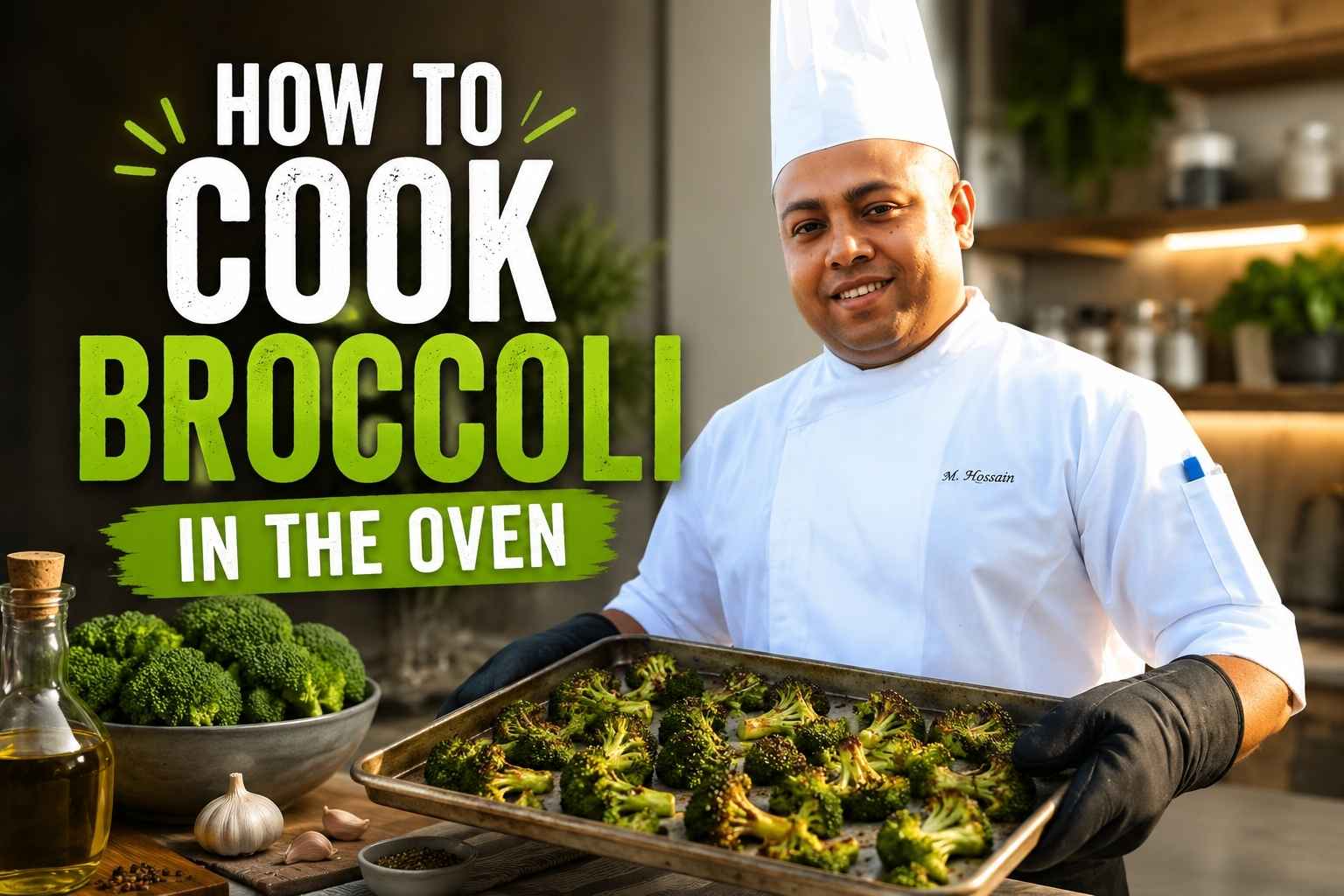
I used to burn broccoli more than I want to admit. It came out limp, sad, and a little bitter every single time. Then I learned how to cook broccoli in the oven, and my whole world changed. Now it comes out crispy, golden, and full of flavor every time. Stick with me, and I’ll show you the easy steps that work like magic.
At A Glance
- Roast broccoli at 425°F on a bare sheet pan (no parchment) in a single layer – this is the sweet spot for crispy edges and tender stems.
- Dry your florets completely before adding oil. Wet broccoli steams instead of roasts.
- Use 2 tablespoons of oil per large head of broccoli and toss by hand – not with a spoon.
- Add salt before roasting, not after – it draws out moisture and seasons all the way through.
- Broil for the final 2-3 minutes to get those charred, paper-thin crispy tips.
Why Roasting Makes Broccoli Actually Good
Roasted broccoli is one of the best things you can make in a home kitchen. Raw broccoli is fine. Steamed broccoli is acceptable. But roasted broccoli? That’s the version people eat standing over the sheet pan before it even reaches the table.
Here’s what the oven does that no other method can: it runs two separate chemical reactions at the same time.
The Maillard reaction kicks in above 300°F. It browns the proteins and sugars on the surface of the floret tips – those flat, tiny buds that make up the crown of each piece. That browning creates hundreds of new flavor compounds that don’t exist in raw broccoli. It’s why roasted broccoli tastes almost nutty. (America’s Test Kitchen, 2022)
Caramelization happens to the natural sugars in the stems and florets above 320°F. Broccoli has more sugar than most people think. When it caramelizes, the sharp, slightly bitter taste softens into something almost sweet.
Both reactions need heat – real heat – and they need the surface of the broccoli to be dry. That’s the single most important thing I’ll say in this guide.
I’ve cooked broccoli in professional kitchens for 15 years. I’ve watched line cooks overcrowd pans at 2 a.m. and wonder why the broccoli comes out gray and limp. The science isn’t complicated. The execution just needs attention.
One thing that surprised me early on: broccoli is roughly 89% water by weight (USDA, 2023). That water has to go somewhere during cooking. When you roast at high heat, it evaporates off the surface fast, leaving behind concentrated flavor and the dry surface the Maillard reaction needs. When you steam or overcrowd the pan, that water goes back into the food as it condenses. Same vegetable, completely different dish.
How to Choose and Prep Broccoli for the Oven
Fresh broccoli always beats frozen for roasting. Frozen broccoli has already been blanched and holds too much water. When you roast it, that water steams the florets from the inside before the surface can brown. You get soggy, pale, soft broccoli. Save frozen for soups.
For fresh broccoli, look for tight, dark green crowns with no yellowing. Yellowing means the sugars have already started converting – the broccoli is past peak and will taste bitter.
How to Cut Broccoli for Roasting
The cut matters more than most people realize. Each piece needs at least one flat side to press against the hot pan surface. That flat contact point is where your best browning happens – broccoli that’s all rounded edges bounces on the pan and browns unevenly.
Cut the crown into florets that are roughly equal in size – about 1.5 to 2 inches across. Don’t cut them too small or they’ll burn before the stems cook through. Don’t leave them too large or the stems stay raw while the tips char.
Here’s the part most home cooks skip: use the stems. Peel the outer tough skin with a vegetable peeler, then slice the stems into 1/2-inch planks. They roast beautifully – tender in the middle, crispy on the flat cut edges. Throwing the stems away is leaving the best part in the bin.
Dry Your Broccoli Before It Hits the Oil
Wash the florets, then dry them. Really dry them. I use a salad spinner first, then I spread them on a clean kitchen towel and let them sit for at least 10 minutes.
If you skip this step, the water on the surface turns to steam in the oven. Steam prevents browning. You’ll roast broccoli for 25 minutes and pull out something that looks like it was boiled.
The Oil and Seasoning Question
Use 2 tablespoons of a neutral oil for one large head of broccoli (roughly 4 cups of florets). Extra-virgin olive oil works great. Avocado oil is slightly better at high heat. Regular vegetable oil is fine. (Serious Eats, 2023)
The goal is an even, thin coat – not soaked, not dry. Too much oil and the broccoli fries in a pool of fat. Too little and it dries out before it browns.
Toss with your hands, not a spoon. Get your hands in the bowl and turn every piece until it’s lightly shiny. Make sure the flat cut sides are coated – that’s where they’ll sit on the pan.
Salt Timing and Seasoning Combos That Work
Add salt before roasting. I use about 3/4 teaspoon of kosher salt per large head. Salt draws a small amount of moisture to the surface in the first few minutes, which then evaporates quickly in the hot oven. The result is broccoli that’s seasoned through, not just on the outside.
Black pepper goes in before roasting. Garlic – either thin-sliced fresh garlic or 1/2 teaspoon of garlic powder – goes in before too. Fresh garlic will char slightly, which I love. If you want it milder, use garlic powder.
Here are the seasoning combos I reach for most:
- The classic: olive oil, kosher salt, black pepper, 3 cloves of sliced garlic
- The nutty finish: neutral oil + 1 tsp sesame oil, salt, finish with sesame seeds and a drizzle of soy sauce
- The spicy version: olive oil, salt, 1/2 tsp red pepper flakes, 1/4 tsp smoked paprika
- The cheesy close: olive oil, salt, pepper, finish with grated parmesan straight from the oven
Finish with lemon juice or a splash of red wine vinegar right after it comes out of the oven. Acid brightens everything. Don’t add it before roasting – acid slows browning.
Best Oven Temperature for Roasted Broccoli: 375°F vs 400°F vs 425°F vs 450°F
The temperature you choose changes the outcome completely. Here’s exactly what happens at each setting.
| Temp | Time (florets) | Texture | Notes |
|---|---|---|---|
| 375°F | 30-35 min | Soft, barely golden | Too slow – broccoli dries out before browning |
| 400°F | 25-28 min | Lightly caramelized, tender | Good for large batches; less char |
| 425°F | 20-22 min | Crispy edges, charred tips, tender stems | Best for most home cooks |
| 450°F | 15-18 min | Aggressive char, some burning risk | Great results but needs attention |
375°F is too low. By the time you get any color, the broccoli is completely soft and starting to dry out. I only use this temperature if I’m roasting something else in the oven and can’t run two temps at once.
400°F is solid if you’re roasting a large amount and can’t fit everything in a single layer comfortably. Lower heat forgives crowding a little more.
425°F is my go-to. It’s hot enough to brown fast, forgiving enough that 2 extra minutes won’t destroy a batch. The tips get properly charred and the stems stay tender. This is what I use 90% of the time.
450°F gives excellent results but you need to watch it. At this temperature, the difference between perfectly charred and burnt is about 3 minutes. I use 450°F when I want maximum char and I’m standing in the kitchen.
Sheet Pan Setup: The Details That Make the Difference
Use a bare metal sheet pan. A heavy-gauge aluminum half sheet pan is the best tool for this. No parchment, no foil.
Parchment paper insulates the bottom of the broccoli from the direct heat of the pan. You lose that bottom crust. Foil does the same thing and also reflects heat in a way that slows browning.
A bare metal pan gets hot and transfers that heat directly to the flat side of each floret. That’s where you get the second browning point – the underside of the broccoli, which looks like pure darkness when it’s done right.
Single Layer vs. Crowding the Pan
Single layer only. This is not negotiable.
When broccoli is stacked or touching, the steam coming off the pieces has nowhere to go. It circulates between the pieces and cooks them in humid air instead of dry heat. You end up steaming your broccoli inside your own oven.
Give each piece a small amount of breathing room – about 1/2 inch between pieces. If your broccoli doesn’t fit in one layer, use two pans side by side or roast in batches. (Cook’s Illustrated, 2021)
For a standard half sheet pan (18×13 inches), one large head of broccoli fits perfectly. Two heads is a crowd.
Convection vs. Conventional Oven
In a convection oven, a fan circulates the hot air continuously. This does two things for broccoli: it pulls moisture away from the surface faster, and it heats more evenly.
If you’re using convection, reduce the temperature by 25°F – so use 400°F instead of 425°F. The fan makes up the difference. Cook time also drops by about 20%, so start checking at 16 minutes instead of 20. (Bon Appétit, 2023)
In a conventional oven with no fan, stick with 425°F and rotate the pan once at the halfway point. Hot spots are common in home ovens. Rotating ensures both sides of the pan get equal heat.
One more thing: preheat the pan. Put your empty sheet pan in the oven while it preheats. When you add the broccoli, it hits a hot surface immediately and starts browning from the bottom right away. This alone adds significant crispiness to the underside of the florets.
The difference is easy to test: roast one batch on a cold pan and one on a preheated pan at the same temperature for the same time. The preheated batch will have a deeply browned, slightly crunchy underside. The cold-pan batch will be pale and soft on the bottom. Same oven. Same broccoli. Same everything else.
How to Get Crispy, Charred Edges Without Burning
Crispy edges come from three things: dry broccoli, high heat, and correct pan spacing. Charred tips on top come from the broiler.
Here’s the sequence I use:
- Roast at 425°F for 18 minutes.
- Pull the pan and flip each piece with tongs so the top faces down.
- Return to the oven for 4-5 more minutes.
- Switch to broil on high.
- Broil for 2-3 minutes, watching constantly.
Step 4 is the move most people skip. Broiling for the last 2 minutes pushes those tiny floret tips past caramelization into real charring. They turn paper-thin, almost lacey, and slightly bitter in the best possible way. That texture and flavor is what separates restaurant-style roasted broccoli from home cooking.
Watch the broiler the entire time. Walk away for 4 minutes and you’ll come back to a smoking pan.
Common Mistakes and How to Fix Them
Overcrowding the pan. The florets steam instead of roast. Fix: use two pans, or roast in batches. It takes longer but the result is a completely different dish.
Wet broccoli. You get gray, limp, sad broccoli. Fix: spin it dry, then towel-dry. If you’re in a hurry, put the washed florets in a 200°F oven for 5 minutes before roasting – that drives off surface moisture fast.
Under-seasoning. Broccoli needs more salt than you think. It has a lot of surface area and absorbs salt quickly. Fix: season generously before roasting and taste before serving. If it tastes flat, finish with flaky salt right at the table.
Skipping the oven preheat. Cold pan = no bottom crust. Fix: always preheat the pan with the oven. It’s the same principle as searing meat in a hot pan – the surface temp at contact matters.
Using parchment or foil. Both insulate the bottom. Fix: bare metal pan, every time.
Cutting florets unevenly. Tiny pieces burn while large pieces stay raw. Fix: take 2 extra minutes during prep to cut everything to roughly the same size.
My Go-To Roasted Broccoli Routine
Here’s exactly what I do, every time.
Temperature: 425°F conventional, 400°F convection. Preheat the oven AND the pan for at least 20 minutes.
Prep: One large head of broccoli, cut into 1.5-inch florets. Stems peeled and sliced into 1/2-inch planks. Washed, spun dry, towel-dried for 10 minutes.
Seasoning: 2 tablespoons extra-virgin olive oil, 3/4 teaspoon kosher salt, 1/4 teaspoon black pepper, 3 cloves of thinly sliced garlic. Tossed by hand.
Roasting: Spread in a single layer on the hot, bare sheet pan. Don’t wash the bowl yet – you’ll use it for the finished broccoli. Roast for 18 minutes. Flip. Roast 4 more minutes. Broil 2-3 minutes.
Finishing: Back into the bowl while still hot. Squeeze half a lemon over the top. Toss once. Taste. Adjust salt.
If I’m serving it as a side at a dinner party, I add 2 tablespoons of freshly grated parmesan while it’s still hot from the pan. The heat melts it into the florets.
Total time: 30 minutes from fridge to table, including prep.
I’ve made this version hundreds of times. I’ve served it in professional settings and at weeknight dinners at home. It doesn’t need improvement – just good broccoli and a hot oven.
Frequently Asked Questions About Roasting Broccoli
What is the best temperature to roast broccoli in the oven?
425°F is the best temperature for most home cooks. It produces crispy, charred edges and tender stems without burning. At 425°F, florets take 20-22 minutes total. Use 400°F if you’re roasting a large batch or using convection, and reduce to that setting by 25°F.
How long does broccoli take to roast in the oven?
At 425°F, broccoli florets take 20-22 minutes total. This includes flipping once at the 18-minute mark and an optional 2-3 minutes under the broiler for extra charring. Larger pieces take longer; smaller pieces need less time – check at 16 minutes if your florets are under 1 inch.
Should you use parchment paper when roasting broccoli?
No. Parchment insulates the bottom of the florets from direct contact with the hot pan surface. This prevents the bottom from browning and crisping. Use a bare metal sheet pan for the best results.
Why is my roasted broccoli soggy instead of crispy?
Soggy broccoli almost always means wet broccoli or an overcrowded pan. Wash and dry the florets thoroughly before oiling. Use a salad spinner and a kitchen towel. Spread pieces in a single layer with space between each one. If they’re touching, they’ll steam.
Can you roast frozen broccoli?
You can, but the results are noticeably different. Frozen broccoli releases a lot of water as it thaws in the oven, which makes browning hard to achieve without extending the cook time significantly. If you use frozen, spread on the pan straight from frozen (don’t thaw first), roast at 450°F, and expect a softer texture.
What goes well with roasted broccoli?
Roasted broccoli works with almost anything. For finishing touches: lemon juice, parmesan, red pepper flakes, tahini, soy sauce and sesame oil, or a balsamic reduction. It pairs well as a side for chicken, fish, pasta, grain bowls, or steak. Leftover roasted broccoli is excellent cold in a salad.
How do you keep roasted broccoli crispy after cooking?
Serve it immediately. Broccoli loses its crispiness within 10-15 minutes as steam from the hot pieces softens the tips. If you need to hold it, keep it on the sheet pan in a 200°F oven with the door cracked slightly. Don’t cover it – covering traps steam and kills the texture.
Is it better to roast broccoli whole or in florets?
Florets are better for most applications – they have more surface area for browning and cook evenly. Whole broccoli (halved through the stem) works for larger presentations and gives you a dramatic centerpiece, but the cooking time is longer and the results are less even. For a reference point: halved heads at 425°F take 30-35 minutes. (America’s Test Kitchen, 2022)
Key Takeaways
- 425°F is the best temperature for roasted broccoli in a conventional oven. It balances speed, browning, and control.
- Dry broccoli is the single most important prep step. No drying = no browning.
- A bare sheet pan, preheated, is your best tool. Parchment and foil hurt the result.
- Single layer always. Crowding creates steam and kills the crust.
- Broil for 2-3 minutes at the end to get charred, crispy tips.
- Finish with acid – lemon juice or red wine vinegar – right after the pan comes out.
- The stems are just as good as the florets when peeled and sliced. Don’t waste them.

I’m Mossaraof, a trained chef and the founder of OvenInsights.com. I spent years cooking at Larrupin’ Cafe and in kitchens across Chicago and Seattle. Now I test kitchen gear for a living. I moved to North Acton, London, and I test every tool I write about. I use real meals and real heat. No brand deals. No shortcuts. I cover 12 kitchen types and hundreds of recipes. I believe this: the right tools matter as much as the recipe.