
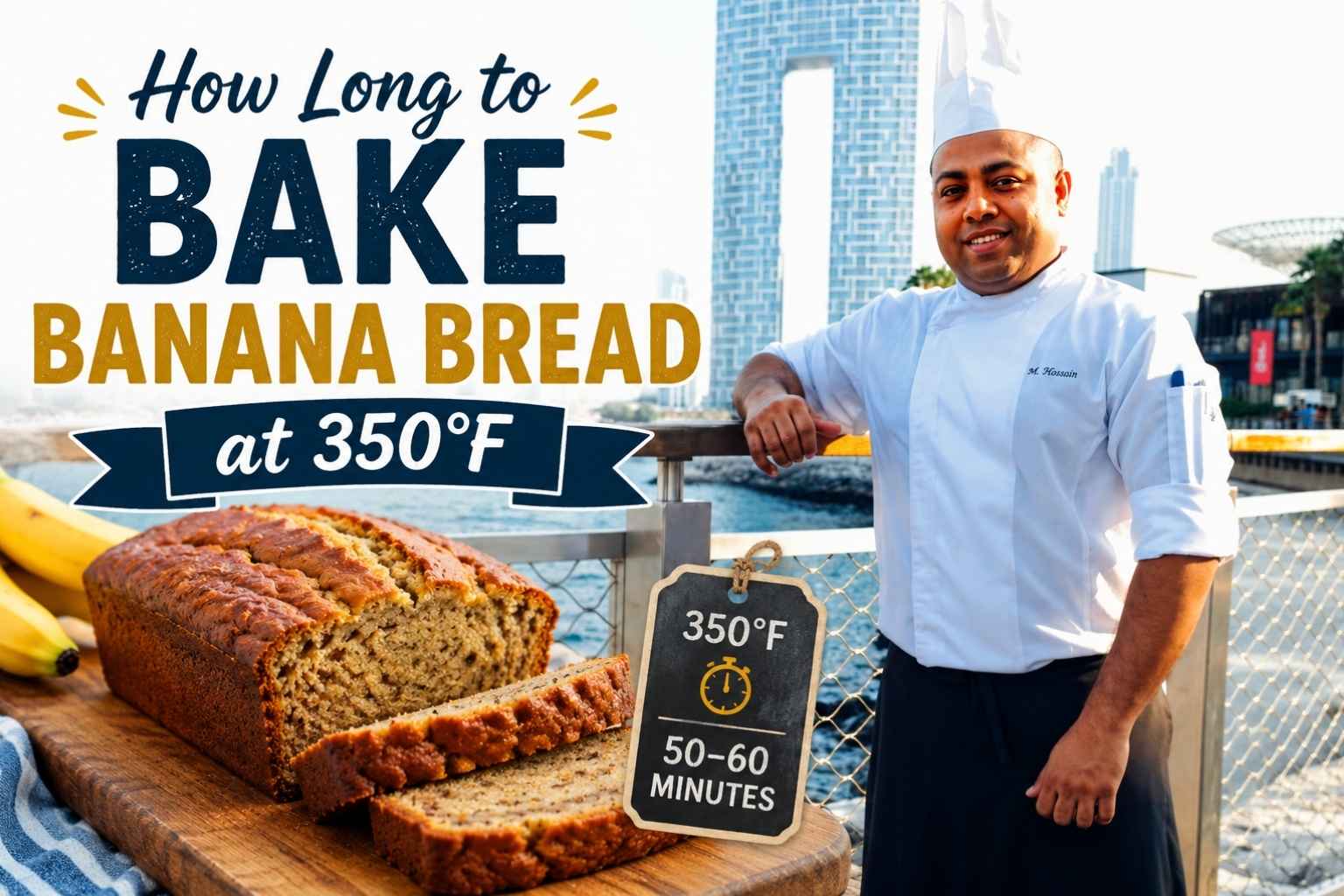
You pull the pan out of the oven, and your heart sinks. The top looks perfect, but the middle is raw. We’ve all been there. Knowing how long to bake banana bread at 350°F saves you from that exact moment.
Most recipes say 60 minutes, but that’s not the full story. Your pan size, oven, and batter all change the time. I’ve baked dozens of loaves, and small details make a big difference. The right time gives you a moist, golden loaf every single time.
I’ll walk you through exact bake times, easy doneness tests, and simple tips. No guesswork. No soggy middles. Just a perfect loaf you’ll want to make again and again.
At A Glance
- A standard 9×5 inch banana bread loaf bakes at 350°F for 55 to 70 minutes — the exact time depends on pan material, banana moisture, and your oven’s true temperature.
- The toothpick test is unreliable on its own. Use an instant-read thermometer: pull the loaf when the internal temp hits 200 to 205°F (King Arthur Baking, 2023).
- Glass pans run hotter than metal and need 5 to 8 fewer minutes, or a 325°F oven instead.
- Convection ovens cut bake time by about 20% — drop to 325°F or reduce time to 45 to 55 minutes.
- Very ripe, wet bananas add 5 to 10 minutes to bake time. Drier bananas bake faster.
Why 350°F Is the Right Temperature for Banana Bread
350°F works because it gives the loaf time to cook from the outside in without burning the crust before the center sets.
At this temperature, three things happen inside the batter at different stages. First, around 140°F internal temp, the leavening agents (baking soda and any baking powder) finish releasing gas. The loaf rises. Then, from 160°F to 180°F, the starches in the flour and bananas gelatinize — they absorb water and turn from liquid to solid. This is what sets the crumb. Finally, from 180°F to 205°F, the remaining moisture evaporates, the crust browns via the Maillard reaction, and the interior firms up to a sliceable texture.
If you bake hotter — say 375°F or 400°F — the outside browns and firms up before the center reaches 180°F. You get a raw, gummy middle under a fully cooked crust. I’ve seen this mistake more than once during my first two years baking in a professional kitchen, usually when someone used a convection setting without adjusting the temp. If you go lower — say 325°F — the loaf takes 90+ minutes, dries out, and the crust turns pale and tough before the center gets a chance to develop any flavor.
350°F is the number because it matches the time required for heat to travel to the center of a 4-inch-thick batter slab and complete every one of those reactions.
Banana Bread Bake Times by Pan Size at 350°F
The table below covers the most common pan formats. All times assume a conventional (non-convection) oven calibrated to a true 350°F, measured with a separate oven thermometer.
| Pan Type | Pan Size | Bake Time at 350°F | Internal Temp Target | Notes |
|---|---|---|---|---|
| Standard loaf pan | 9×5 inch | 55-70 min | 200-205°F | Most common. Start checking at 55 min. |
| Smaller loaf pan | 8×4 inch | 50-62 min | 200-205°F | Slightly shorter bake; narrower but taller. |
| Mini loaf pans | 5.75×3 inch | 28-35 min | 200-205°F | Start checking at 25 min. |
| Jumbo loaf pan | 10×5 inch | 65-80 min | 200-205°F | Extra moisture needs more time. |
| Standard muffin tin | 12-cup | 18-24 min | 200-205°F | Rotate pan at 12 min. |
| Jumbo muffin tin | 6-cup | 25-32 min | 200-205°F | Works well for grab-and-go. |
| Bundt pan | 10-12 cup | 45-55 min | 200-205°F | Check at 40 min; thinner walls bake faster. |
These ranges account for variation in batter hydration. Use the internal temp as your final call every time.
Why the Toothpick Test Lies (and What to Do Instead)
The toothpick test is not wrong — it’s just incomplete. A toothpick comes out clean when there’s no wet batter clinging to it. But banana bread can have a gummy, underbaked center that feels set to a toothpick because the banana chunks themselves are soft, not wet. You pull the pick, see no batter, and call it done. Then you slice it 20 minutes later and find a wet, dense ribbon running through the middle.
I switched to temperature-based doneness testing in my second year of serious baking, after a catering event where I delivered 12 loaves and two of them were underbaked. That was enough.
The three reliable doneness tests are:
- Internal temperature. Insert an instant-read thermometer (ThermoWorks Thermapen is the standard) into the thickest center point of the loaf. 200 to 205°F means done. Below 195°F means more time. This is the most accurate method available (ThermoWorks, 2022).
- The jiggle test. Pull the pan out and give it a gentle side-to-side shake. If the center jiggles like loose liquid, it’s not done. A fully baked loaf will have a very slight spring — it moves as a solid, not as a fluid.
- The hollow sound test. Tip the loaf out of the pan and knock the bottom with your knuckle. A done loaf sounds hollow, like tapping a wooden board. A wet loaf sounds dense and dull. This one takes practice to learn by ear, but once you hear the difference, you won’t forget it.
Use all three together. Temperature tells you where you are, jiggle confirms the center set, and the knock test is the final sign-off.
How Banana Ripeness and Moisture Affect Bake Time
Riper bananas have more sugar and more free moisture. That extra moisture takes time to cook out.
I split bananas into three stages when I’m deciding how to handle a recipe:
- Yellow with some brown spots. These are ripe but not very sweet. They have lower moisture. Bake time lands at the short end of the range: 55 to 60 minutes for a standard 9×5.
- Mostly brown, heavily spotted. This is the ideal stage for banana bread. Good sweetness, moderate moisture. Standard bake time: 60 to 65 minutes.
- Black-skinned, very soft, almost liquid inside. Maximum sugar, maximum moisture. These loaves need the full 65 to 70 minutes and sometimes more. I always mash these bananas on a plate and let any pooled liquid drain off before adding them to the batter.
The difference between a yellow banana batter and a black banana batter is real — I’ve measured it. Black banana batter runs about 8 to 12% higher moisture by weight (America’s Test Kitchen, 2021). That shifts the bake time by a full 8 to 10 minutes.
If your bananas are very wet, you can drain some liquid, or spread the mashed banana on a sheet pan and let it sit for 5 minutes before mixing. Both methods reduce excess moisture without losing flavor.
Glass vs. Metal vs. Ceramic Pans: How Each Changes Your Bake
The pan material changes how heat moves into your batter, which changes your bake time, your crust color, and your crumb texture.
Metal Pans (Aluminum and Dark Metal)
Light aluminum is the most consistent material. It heats evenly, reflects heat rather than absorbing it, and produces a golden crust without burning the bottom. The industry standard for professional baking. Bake at 350°F for the full stated times.
Dark metal pans (non-stick coatings, dark anodized aluminum) absorb more heat. The bottom and sides brown faster. Drop your oven temperature to 325°F or reduce bake time by 5 to 8 minutes, and watch the bottom — it will brown before the center is set if you’re not careful.
Glass Pans
Glass holds heat longer than metal and distributes it differently. It heats up slowly, then retains that heat after you pull the loaf. The bottom of a glass pan loaf often darkens or goes crunchy before the center reaches temp.
Drop your oven to 325°F when using glass, or reduce time by 5 to 8 minutes at 350°F and watch the color carefully. I stopped using glass loaf pans about seven years ago. The results are inconsistent, and light aluminum just works better. But if glass is what you have, adjust the temp and use your thermometer.
Ceramic Pans
Ceramic heats up slowly like glass but holds heat even longer. The bake starts slow, then finishes hot. This can actually produce a nice, even crumb if you manage it correctly. Add 5 to 10 minutes to your bake time at 350°F to account for the slow heat-up, and pull the loaf based on internal temp, not a timer.
Convection vs. Conventional Ovens: Adjusting Time and Temperature
A convection oven uses a fan to move hot air around the baking chamber. That fan strips the cool air layer from the surface of your batter and delivers fresh hot air continuously. The result: everything bakes faster and browns faster.
For banana bread in a convection oven, you have two options:
- Lower the temperature by 25°F. Bake at 325°F instead of 350°F, same time range. This is the safer option for banana bread because the inside still needs time to set even as the outside browns.
- Keep 350°F but reduce time by 20%. A 60-minute standard loaf becomes roughly 48 minutes. Start checking at 40 minutes.
I prefer the first option — temperature reduction over time reduction. Banana bread has a high sugar content and browns fast. At 350°F convection, I’ve seen the top go from golden to dark in under five minutes. The lower temp gives you more margin.
If your oven has a “convection bake” and a “convection roast” setting, use convection bake for banana bread. Convection roast runs a hotter fan speed and is too aggressive for delicate quick breads (Sally’s Baking Addiction, 2022).
How to Find Hot Spots in Your Oven (and Why They Ruin Banana Bread)
A sunken middle, burnt edges, and raw center are not recipe problems. They’re oven problems.
Most residential ovens have temperature variation of 25 to 50°F across the baking chamber. Some run as much as 75°F hot or cold in specific spots (ThermoWorks, 2023). If you always get a burnt right edge or a sunken middle, your oven is the cause.
How to map your oven:
- Place an oven thermometer (not the built-in one — get a separate dial or probe thermometer) on the center rack. Let the oven preheat for 20 full minutes after it signals ready.
- Check the thermometer reading. If it says 325°F when your dial is at 350°F, your oven runs 25°F cold. Adjust your dial accordingly.
- To find hot spots: place slices of white sandwich bread across the whole rack in a 3×3 grid. Bake at 350°F for 5 to 7 minutes. The bread that toasts darkest shows you where the heat concentrates.
Once you know your oven’s hot spots, you can rotate your loaf pan 180 degrees at the halfway point to even out the bake. I do this on every loaf — not because I have a bad oven, but because it’s a 10-second habit that produces more consistent results.
When to Tent with Foil and When to Move the Rack
Tenting with Foil
Tent your banana bread with aluminum foil if the top is browning too fast before the center reaches temp. This happens most often with dark pans, glass pans, or ovens that run hot on the top element.
Check your loaf at the 40-minute mark. If the top is already deep golden-brown and the internal temp is below 190°F, tent loosely. Don’t seal the foil tightly — you want steam to escape, not accumulate. Steam trapped inside the tent makes the crust soft and can extend bake time significantly.
Remove the foil for the last 10 to 15 minutes to let the crust firm back up.
Lowering the Rack
If your banana bread consistently burns on the bottom — especially with dark metal or glass — move the rack one position lower. This puts more distance between the loaf and the top broiler element, and less direct exposure to the bottom heating element. I bake banana bread on the second rack from the bottom in my home oven. This produces even bottom browning without any scorching.
If your loaf sinks in the middle and the edges are done, your oven is bottom-heavy in heat. Move the rack up one position and see if the center bakes through more evenly.
Common Banana Bread Baking Mistakes and How to Fix Them
Mistake 1: Not preheating long enough. Most ovens reach their set temperature and signal ready before the oven walls and rack have absorbed enough heat. The air might be 350°F, but the rack is still 300°F. Preheat for at least 20 full minutes after the oven signals ready. This one change makes a measurable difference in how evenly the loaf bakes from the first minute.
Mistake 2: Overmixing the batter. Overmixing develops gluten in the flour and makes banana bread dense and tough. Mix until just combined after adding dry ingredients — 10 to 12 folds with a spatula. Some streaks of flour are fine. They’ll incorporate during baking. The batter should look rough and uneven, not smooth.
Mistake 3: Opening the oven door in the first 30 minutes. The sudden drop in oven temperature deflates the leavening before the starch structure has set. The result is a sunken center. Set a timer for 40 minutes and don’t open the door before it goes off.
Mistake 4: Using too much banana. Most recipes call for 3 medium bananas (about 1 to 1.25 cups mashed). Using 4 or 5 adds so much moisture that the center never fully bakes through, no matter how long you go. Stick to the recipe amount, and drain any excess liquid from very ripe bananas.
Mistake 5: Altitude baking without adjustments. At elevations above 3,500 feet, leavening agents work faster and steam escapes quicker, causing quick breads to rise too fast and collapse. If you’re baking above 3,500 feet, reduce your baking soda by 20 to 25% (for most recipes, go from 1 teaspoon to 3/4 teaspoon), increase oven temperature by 15 to 25°F, and add 2 to 3 tablespoons of extra flour to stabilize the crumb (Colorado State University Extension, 2022). These adjustments keep the structure intact as the loaf rises.
Mistake 6: Skipping the pan prep. Grease AND flour your pan, or use parchment paper. A release spray alone often leaves the bottom sticking in the corners where the loaf cools and contracts. I line my pans with a parchment sling — two overlapping strips forming a cross — and lightly grease the exposed corners. The loaf comes out clean every time, no exceptions.
My Personal Banana Bread Routine (After 15+ Years of Baking)
I keep this simple because simple produces consistent results.
Pan choice: Light aluminum 9×5 loaf pan. I own four of them. I use the USA Pan brand — the corrugated bottom aids air circulation and produces an even bottom crust (USA Pan, 2023). I do not use glass or ceramic.
Banana ripeness test: I squeeze the banana through the peel. If it gives easily and the skin is at least 70% brown, it’s ready. If the skin is still mostly yellow, I freeze and thaw the bananas overnight. Freezing breaks down the cell walls and speeds up the same sugar conversion that happens during natural ripening. The texture turns mushy, but the flavor is identical to a fully black-ripe banana.
Mixing order: Wet ingredients into a bowl, dry ingredients measured separately. I fold the dry into the wet in three additions. I stop the moment I can’t see large streaks of dry flour. This takes less than 60 seconds of actual mixing.
Temperature and timing: 350°F conventional. Rack in the second-from-bottom position. I set a 55-minute timer and don’t open the oven before it fires. At 55 minutes, I check internal temp. My target is 203°F. Most of my loaves hit it between 60 and 65 minutes. If the top is browning too fast, I tent at the 45-minute mark.
Cooling: The loaf stays in the pan for exactly 10 minutes after coming out of the oven. Then I lift it out with the parchment sling and transfer it to a wire rack for a minimum of 45 minutes before slicing. Slicing a hot quick bread compresses the crumb and makes it gummy. Wait.
Frequently Asked Questions About Baking Banana Bread at 350°F
How long do you bake banana bread at 350°F in a standard 9×5 pan?
A standard 9×5 banana bread loaf bakes at 350°F for 55 to 70 minutes. The range exists because batter moisture, banana ripeness, and pan material all change the exact time. Start checking at the 55-minute mark using an instant-read thermometer. Pull the loaf at 200 to 205°F internal temperature.
Can you bake banana bread at 350°F in a glass pan?
Yes, but reduce your oven temperature to 325°F or watch the bottom carefully. Glass holds heat longer than metal and can burn the bottom before the center finishes baking. Drop the temp, add 5 minutes to your expected time, and use your thermometer as the final call.
How do you know when banana bread is fully baked?
The most reliable sign is an internal temperature of 200 to 205°F at the center of the loaf. Supporting signs include a hollow sound when you tap the bottom of the loaf, a top that springs back when lightly pressed, and clean sidewalls that have pulled slightly away from the pan.
Why is my banana bread raw in the middle but done on the outside?
The most common cause is oven temperature. Your oven is likely running hot. Buy a separate oven thermometer and check the actual temperature — most home ovens run 25 to 50°F off from the dial setting. The second cause is batter that’s too wet from very ripe bananas. Drain excess liquid from your mashed bananas before mixing.
Should I cover banana bread with foil while baking?
Only if the top browns faster than the center is baking. Check at 40 minutes: if the top is dark but your thermometer reads below 190°F, tent loosely with foil and remove it for the final 10 to 15 minutes to restore crust texture.
Does banana bread keep baking after you take it out of the oven?
Yes. Carryover cooking raises the internal temperature by 3 to 5°F after you pull the loaf. You can pull it at 198°F and let it coast to 202 to 203°F in the pan. Leave it in the pan for 10 minutes before transferring to a cooling rack.
Can you bake banana bread at 350°F and then increase the temperature to finish it?
You can, but it rarely helps. If your loaf has been in for 70 minutes and the center is still below 195°F, the problem is usually moisture or pan type — not temperature. Increasing the heat at that stage will burn the outside before fixing the inside. Instead, tent the top with foil and add 10 more minutes at 350°F.
How does baking banana bread in a convection oven differ from a conventional oven?
Convection fans cut bake time by about 20% and speed up browning. For a standard loaf, drop your oven to 325°F and check the internal temperature starting at 45 minutes. If you keep 350°F, start checking at 40 minutes and tent if the top browns faster than the center bakes.
Key Takeaways
- Bake banana bread at 350°F for 55 to 70 minutes in a standard 9×5 inch metal loaf pan — always verify doneness with an internal thermometer reading of 200 to 205°F.
- Use the thermometer as your primary test. Back it up with the jiggle test and hollow-knock test. The toothpick alone will mislead you.
- Pan material matters: dark metal and glass run hotter; drop to 325°F or reduce time by 5 to 8 minutes.
- Very ripe, black-skinned bananas add 5 to 10 minutes to bake time. Drain excess liquid before mixing.
- Convection ovens need a 25°F temperature drop or a 20% time reduction.
- Map your oven with an oven thermometer. Rotate your pan at the halfway point. These two habits fix most uneven-bake problems.
- Cool in the pan 10 minutes, then on a wire rack for at least 45 minutes before slicing.

I’m Mossaraof, a trained chef and the founder of OvenInsights.com. I spent years cooking at Larrupin’ Cafe and in kitchens across Chicago and Seattle. Now I test kitchen gear for a living. I moved to North Acton, London, and I test every tool I write about. I use real meals and real heat. No brand deals. No shortcuts. I cover 12 kitchen types and hundreds of recipes. I believe this: the right tools matter as much as the recipe.