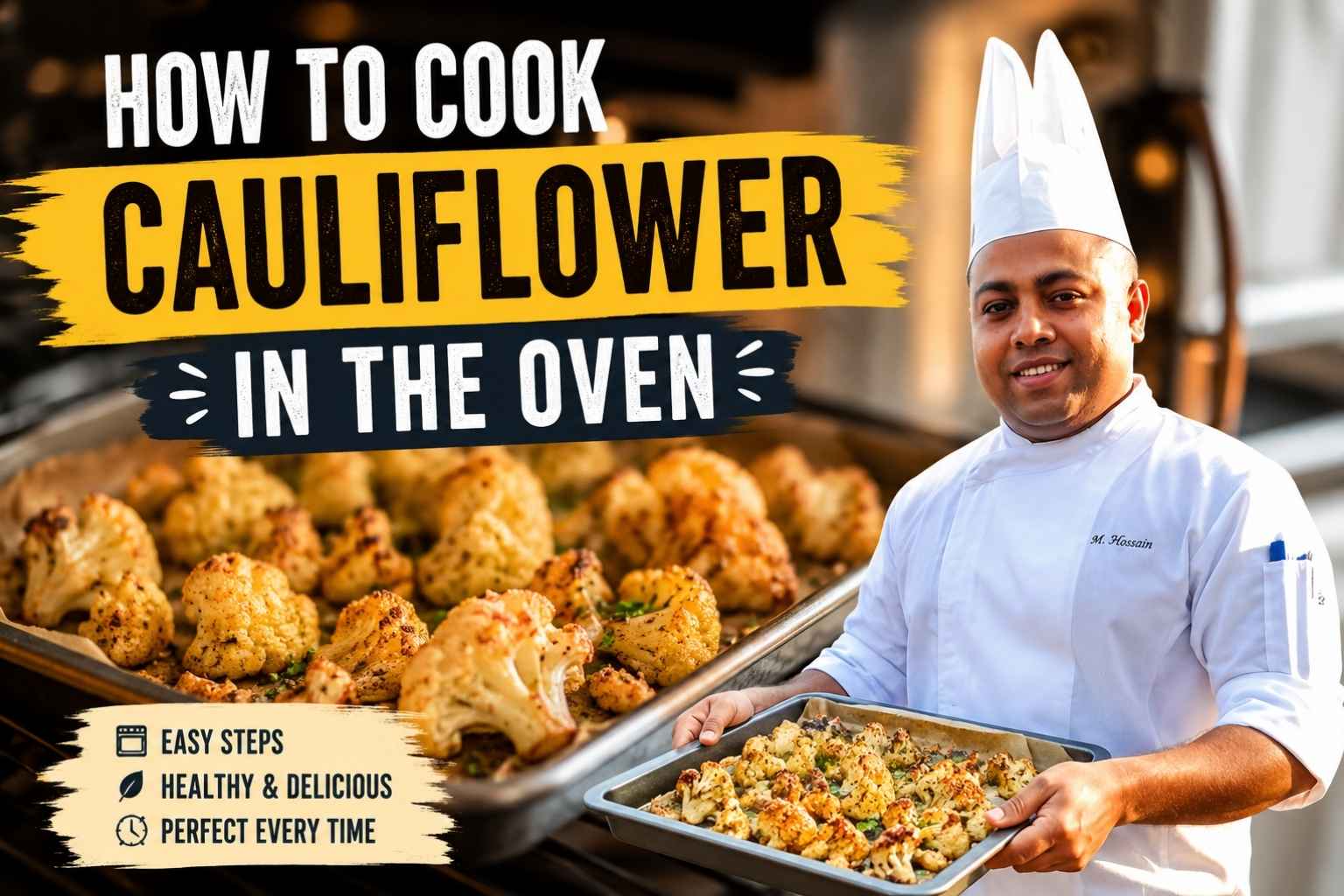
My first try at oven cauliflower was a flop. It came out soft and sad. I almost gave up on it. Then I found a few easy steps that fix this. I have worked in busy kitchens for years now. Today I will show you how to cook cauliflower in the oven, step by step. Grab a pan. Let’s get a nice gold crisp.
At A Glance
- Roast cauliflower florets at 400°F–425°F on a dry, uncrowded sheet pan for the best browning and caramelized edges.
- Dry your cauliflower completely before it goes in the oven – surface moisture is the number one reason roasted cauliflower turns out soft and pale instead of browned.
- Cut size matters: florets take 20–25 minutes at 425°F, steaks take 25–30 minutes, and a whole head takes 50–70 minutes at 375°F–400°F.
- Use a fat with a high smoke point – avocado oil (smoke point: 520°F) or regular olive oil (smoke point: 375–405°F) both work well, but skip extra-virgin olive oil at 450°F.
- Flip florets once, halfway through – steaks benefit from one flip too, but whole heads need no flipping at all.
Why Temperature and Prep Make or Break Roasted Cauliflower
The single biggest mistake people make with oven-roasted cauliflower is treating it like a vegetable that just needs heat applied. It needs the right heat, in the right conditions. Get those two things wrong and you get steamed, pale, waterlogged cauliflower instead of the golden, slightly charred result you’re after.
Cauliflower is about 92% water (USDA FoodData Central, 2024). That water has to escape the floret and evaporate off the sheet pan before browning – called the Maillard reaction – can happen. The Maillard reaction is the chemical process where amino acids and sugars react under dry heat to create browning and flavor. It kicks in above around 280°F (138°C) on the surface of the vegetable.
If your pan is crowded, the water has nowhere to go. It pools and steams the cauliflower from below. You end up with soft, wet florets that never brown. I’ve seen this happen in professional kitchens and home kitchens alike. The fix is simple: space on the pan, high heat, and a dry surface.
The Roasting Time and Temperature Reference Table
Use this table as your go-to guide. All temperatures are for a conventional oven. For convection, drop the temperature by 25°F or cut the time by about 20% (America’s Test Kitchen, 2023).
| Cut | Temperature | Time | Fat & Seasoning | Texture Result |
|---|---|---|---|---|
| Florets (1.5–2 inch) | 375°F | 30–35 min | 2 tbsp olive oil, salt | Tender, light golden, mild browning |
| Florets (1.5–2 inch) | 400°F | 22–28 min | 2 tbsp olive oil or avocado oil, salt | Tender with golden edges |
| Florets (1.5–2 inch) | 425°F | 20–25 min | 2 tbsp avocado or olive oil, salt | Caramelized edges, firm bite |
| Florets (1.5–2 inch) | 450°F | 15–20 min | 2 tbsp avocado oil, salt | Charred tips, fast result |
| Steaks (3/4 inch thick) | 400°F | 28–32 min, flip at 15 min | 3 tbsp olive oil, salt, pepper | Tender center, golden flat face |
| Steaks (3/4 inch thick) | 425°F | 25–30 min, flip at 12 min | 3 tbsp avocado oil, salt | Caramelized face, firm center |
| Whole head | 375°F | 60–75 min | 3 tbsp olive oil rubbed all over | Tender all the way through, lightly golden |
| Whole head | 400°F | 50–65 min | 3 tbsp olive oil rubbed all over | Deeper color, more browning on outer florets |
Note: Times assume a single layer on a half-sheet pan (18×13 inches). Thicker florets or a cold oven will add time. Always test for doneness with a fork – don’t just trust the clock.
How to Cut Cauliflower for Even Cooking in the Oven
How you cut the cauliflower determines how it cooks. Different cuts have different surface areas, different thicknesses, and different ideal oven temperatures.
Florets: The Most Common Cut
Pull the cauliflower apart into florets roughly 1.5 to 2 inches across. This size gives you enough mass to stay firm inside while the outside caramelizes. Smaller than 1 inch and they burn before cooking through. Larger than 2.5 inches and the outside browns long before the center softens.
Cut the flat base of each floret flat, not curved. A flat base makes full contact with the hot pan. That contact is where you get browning. A rounded floret wobbles on the pan and browns unevenly.
Steaks: The Dramatic Option
Slice the whole head from top to stem into 3/4-inch slabs. The outer slices will fall apart into florets – that’s fine, roast them separately. The center slices hold together because the core runs through them.
Steaks are good for plating as a main protein substitute or as a side that looks like you tried harder than you did. They need more oil on both sides because the flat faces are large. Press them gently onto the hot pan to maximize contact.
Whole Head: Low and Slow with a Payoff
Roasting a whole head takes patience – 50 to 75 minutes depending on size and temperature. But you get a dramatic table presentation and a completely different texture: tender and almost creamy through the center.
Score the base with a paring knife in a shallow cross pattern. This helps heat get into the dense core. Rub oil and seasoning over every visible surface. I put it straight into a cast iron skillet with a lid for the first 30 minutes, then remove the lid to brown the outside for the rest of the time.
What Fat to Use and Why It Matters at High Heat
Use a fat that can handle the temperature you’re roasting at. This sounds obvious, but it’s where a lot of home cooks go wrong.
Extra-virgin olive oil has a smoke point of around 350–375°F (Serious Eats, 2022). At 400°F and above, it starts to smoke and can leave a bitter flavor on the cauliflower. It’s fine at 375°F. Above that, switch to regular (light) olive oil, which handles up to around 405–420°F.
Avocado oil has a smoke point of around 520°F (Cook’s Illustrated, 2021). It’s the best choice for 425°F or 450°F roasting. It’s neutral in flavor, so it won’t compete with your seasonings.
Use about 2 tablespoons of oil per medium head of cauliflower cut into florets. Enough to coat each piece lightly – not drench it. Drenched florets don’t caramelize; they fry unevenly and go soggy.
Toss the florets in a large bowl with the oil before they go on the pan. Every surface should have a light sheen.
Sheet Pan Setup: Why Crowding Ruins Everything
Cauliflower roasted on the right pan in the right way comes out golden and slightly firm. Cauliflower roasted on a crowded pan comes out pale and soft. The pan setup is not optional – it’s the whole game.
Pan Size and Spacing
Use a half-sheet pan (18×13 inches) for one medium head of cauliflower. This is the standard commercial sheet pan size. If you’re roasting two heads, use two pans side by side – don’t stack one pan on top of the other in the oven.
Leave at least 1 inch of space between each floret. The gap allows steam to escape and hot air to circulate around each piece.
Parchment vs. No Parchment
No parchment gives better browning. The bare metal pan conducts heat directly into the flat base of the floret, which is where you want caramelization.
Parchment is fine if you’re worried about sticking or want easy cleanup, but expect about 10–15% less browning on the bottom of the florets (Bon Appétit, 2022). If you use parchment, crank the oven 25°F hotter to compensate.
A silicone mat (Silpat) is even worse than parchment for browning. It insulates the bottom of the floret from the pan. Skip it entirely for roasting.
Convection vs. Conventional Oven: What to Adjust
Convection ovens – also called fan-assisted ovens – circulate hot air around the food with a fan. This speeds up cooking and improves browning because it constantly moves fresh hot air across the surface of the food instead of letting a static pocket of air cool down around it.
If you’re using convection, do one of two things:
- Drop the temperature by 25°F and keep the same time, or
- Keep the temperature the same and check 15–20% earlier than the conventional time.
I prefer keeping the temperature and checking earlier. Convection at 425°F gives noticeably better caramelization on florets than conventional at 425°F in my experience. The fan dries the surface faster, which lets the Maillard reaction kick in sooner.
One watch-out: convection ovens can dry thin edges of florets too fast at 450°F. At that temperature in convection mode, check at the 12-minute mark.
How to Know When Roasted Cauliflower Is Done
The timer is a guide, not the answer. Oven calibration varies, floret size varies, and how full the oven is affects cooking time. Use these three checks instead.
Fork test: Push a fork into the thickest part of the largest floret. It should slide in with mild resistance – like pushing into a firm potato. If it goes in with no resistance at all, the cauliflower is overdone. If it takes real force, give it 5 more minutes.
Color check: The flat bottom of each floret should be deep golden to light brown, not pale yellow. The tips of the florets should show some browning too. Pale all over means it needs more time.
Sound check: When you open the oven, you should hear a faint sizzle from the pan, not bubbling or steaming. Bubbling means there’s still too much moisture and the cauliflower is steaming, not roasting.
When to Flip and When to Leave It Alone
Florets: flip once at the halfway point. If you’re roasting at 425°F for 22 minutes, flip at the 11-minute mark. Use a thin metal spatula to flip each floret so the browned bottom faces up. The bottom gets the most heat from the pan; flipping gives the top side some direct contact too.
Steaks: flip once, at the halfway point. Steaks are thick enough that they need browning on both flat faces to cook evenly all the way through.
Whole head: do not flip. Just leave it. Flipping a whole head halfway through cooking is how you break it apart and burn the florets that end up facing down on a too-hot pan.
One thing I’ve learned over 15 years: more flipping is not better. Every time you open the oven, temperature drops. Every time you move florets, you interrupt the caramelization process forming on the contact surface. Flip once, close the oven, walk away.
My Go-To Cauliflower Roasting Method
I’ve cooked cauliflower hundreds of times – for restaurant prep, for family dinners, and for testing recipes. Here’s the exact method I use at home.
Temperature: 425°F conventional, or 400°F convection.
Prep: I break the head into 1.5-inch florets, then spin them dry in a salad spinner for 60 seconds. This is the step most people skip. A salad spinner removes surface water faster and more completely than patting with paper towels. Then I let them sit on the pan uncovered for 10 minutes while the oven preheats. That final air-drying step makes a real difference.
Seasoning mix I always come back to: 2 tablespoons olive oil, 1 teaspoon kosher salt, 1/2 teaspoon black pepper, 1 teaspoon smoked paprika, 1/2 teaspoon garlic powder. Toss in a large bowl until every floret is coated.
Pan setup: Bare half-sheet pan, no parchment. Single layer, florets not touching.
Rack position: Middle rack for florets, top third for steaks (to get more top heat for browning).
Time: 22–24 minutes at 425°F, flip at 11 minutes.
Finish: I pull the pan when the florets are deep gold and the tips show a little char. Then I hit them with a squeeze of lemon juice and a tablespoon of tahini thinned with warm water. That combination – charred cauliflower, acid, and sesame – is one of the best things you can put on a table.
If I want something heartier, I serve them over a bowl of warm hummus with chopped parsley and a drizzle of chili oil. This pairing works because the richness of the hummus balances the dry char on the cauliflower.
Common Cauliflower Roasting Mistakes and How to Fix Them
Mistake 1: Wet cauliflower going into the oven. You wash the cauliflower (good) and then put it straight on the pan (bad). Surface water creates steam in the oven, and steam is the enemy of browning. Fix: spin dry in a salad spinner or pat very well with paper towels, then let the florets air-dry on the pan for 10 minutes while the oven preheats.
Mistake 2: Crowding the pan. Too many florets on one pan means steam can’t escape. The oven temperature drops when the door opens and the pan is full, and the florets cook in their own moisture. Fix: use two pans if you have more than one medium head of cauliflower.
Mistake 3: Under-seasoning. Cauliflower is mild by nature. It needs a full teaspoon of kosher salt per medium head, minimum. Under-salted cauliflower tastes flat even when perfectly roasted. Fix: season more than you think you need to.
Mistake 4: Wrong rack position. Cauliflower florets on the bottom rack get scorched bottoms before the tops cook. Florets on the top rack get browned tops but pale, undercooked centers. Fix: middle rack for florets, top third for steaks where you want aggressive surface browning.
Mistake 5: Pulling it too soon because of the timer. The timer is an estimate. Ovens run hot and cold. Florets that are pale and just slightly firm are undercooked and will taste flat. Fix: check with a fork and use color as your guide, not the clock.
Frequently Asked Questions About Cooking Cauliflower in the Oven
What is the best temperature to roast cauliflower in the oven?
The best all-purpose temperature for roasting cauliflower florets is 425°F. At this temperature, florets brown well within 20–25 minutes and develop caramelized edges without burning. Use 400°F if you want a slightly softer texture, or 450°F if you want fast, charred tips and don’t mind watching the oven closely.
Can you roast frozen cauliflower in the oven?
Yes, but the result is different from fresh. Frozen cauliflower has already been blanched, so the cell structure is softer. It holds a lot of ice crystals, which release water when they melt in the oven. To roast frozen cauliflower: do not thaw it first, spread it straight from the bag onto a dry sheet pan with space between pieces, and roast at 450°F for 25–30 minutes. The high heat and starting from frozen helps drive off moisture before the vegetable steams. Expect a softer texture than fresh-roasted, but still good browning if you use the 450°F method.
How do you reheat roasted cauliflower so it stays crispy?
The oven is the only method that preserves texture. Put leftover roasted cauliflower on a bare sheet pan at 400°F for 8–10 minutes. A microwave makes it soft and wet. An air fryer works too – 375°F for 5–6 minutes. Skip the microwave entirely if texture matters to you.
Is roasted cauliflower good for low-carb or keto diets?
Yes. Cauliflower has about 5 grams of carbohydrates per cup of raw florets, with 2 grams coming from fiber, leaving 3 grams of net carbs per cup (USDA FoodData Central, 2024). Roasting adds fat from oil but no carbohydrates. It’s one of the most used vegetables in low-carb cooking because it takes on other flavors well and has a satisfying texture when roasted.
What dishes pair well with oven-roasted cauliflower?
Roasted cauliflower works as a side dish with roasted chicken, lamb, or fish. It also works as a main when served over hummus, lentils, or grain bowls. The best flavor pairings are: tahini and lemon, harissa, miso-butter, or grated Parmesan added in the last 5 minutes of roasting. Strong, salty, or acidic flavors balance the mild sweetness of well-roasted cauliflower.
How do you know when whole roasted cauliflower is fully cooked?
Test doneness by inserting a long skewer or thin knife into the very center of the head. It should slide in with minimal resistance – no hard center. The outer florets should be golden brown and the base should look dry, not wet or pale. A medium head (about 2 pounds) takes 60–70 minutes at 375°F. A large head (3 pounds) can take up to 80 minutes.
Can you roast cauliflower without oil?
Technically yes, but the result is dry and leathery rather than tender and caramelized. Oil is what allows the Maillard reaction to happen evenly across the surface – it conducts heat and keeps the exterior from drying out before it browns. If you need to avoid oil, use a light spray of cooking spray (which is mostly oil) or toss the florets with a tablespoon of aquafaba (the liquid from a can of chickpeas) and a pinch of salt. The browning will be less even, but the result is edible.
Why does my roasted cauliflower smell strong while cooking?
Cauliflower contains glucosinolates – sulfur compounds that break down under heat and produce a sulfurous smell (similar to cabbage). The smell is strongest when cauliflower is overcooked or steamed. At high-heat roasting temperatures, the cooking time is short enough that the smell stays mild. If your kitchen smells strong while roasting cauliflower, it usually means the oven temperature is too low and the cauliflower is steaming instead of roasting.
Key Takeaways
- Roast cauliflower florets at 400–425°F for the best balance of browning and texture. Use 375°F for whole heads and 450°F when you want fast, charred results.
- Dry the cauliflower completely before it goes into the oven. Surface moisture causes steaming, not browning.
- Cut florets to 1.5–2 inches and give each piece at least 1 inch of space on the pan. Crowding is the most common cause of pale, soft roasted cauliflower.
- Use a fat suited to the temperature – regular olive oil for up to 420°F, avocado oil for 425°F and above.
- Roast on a bare metal half-sheet pan on the middle rack. No parchment gives better contact browning.
- Flip florets once at the halfway point. Don’t flip steaks more than once. Don’t flip whole heads at all.
- Test doneness with a fork – not just a timer. Look for deep gold color on the flat base and firm-but-yielding texture in the center.
- Finish with something acidic – lemon juice, vinegar, or a bright sauce. It lifts the flavor of caramelized cauliflower better than almost anything else.

I’m Mossaraof, a trained chef and the founder of OvenInsights.com. I spent years cooking at Larrupin’ Cafe and in kitchens across Chicago and Seattle. Now I test kitchen gear for a living. I moved to North Acton, London, and I test every tool I write about. I use real meals and real heat. No brand deals. No shortcuts. I cover 12 kitchen types and hundreds of recipes. I believe this: the right tools matter as much as the recipe.