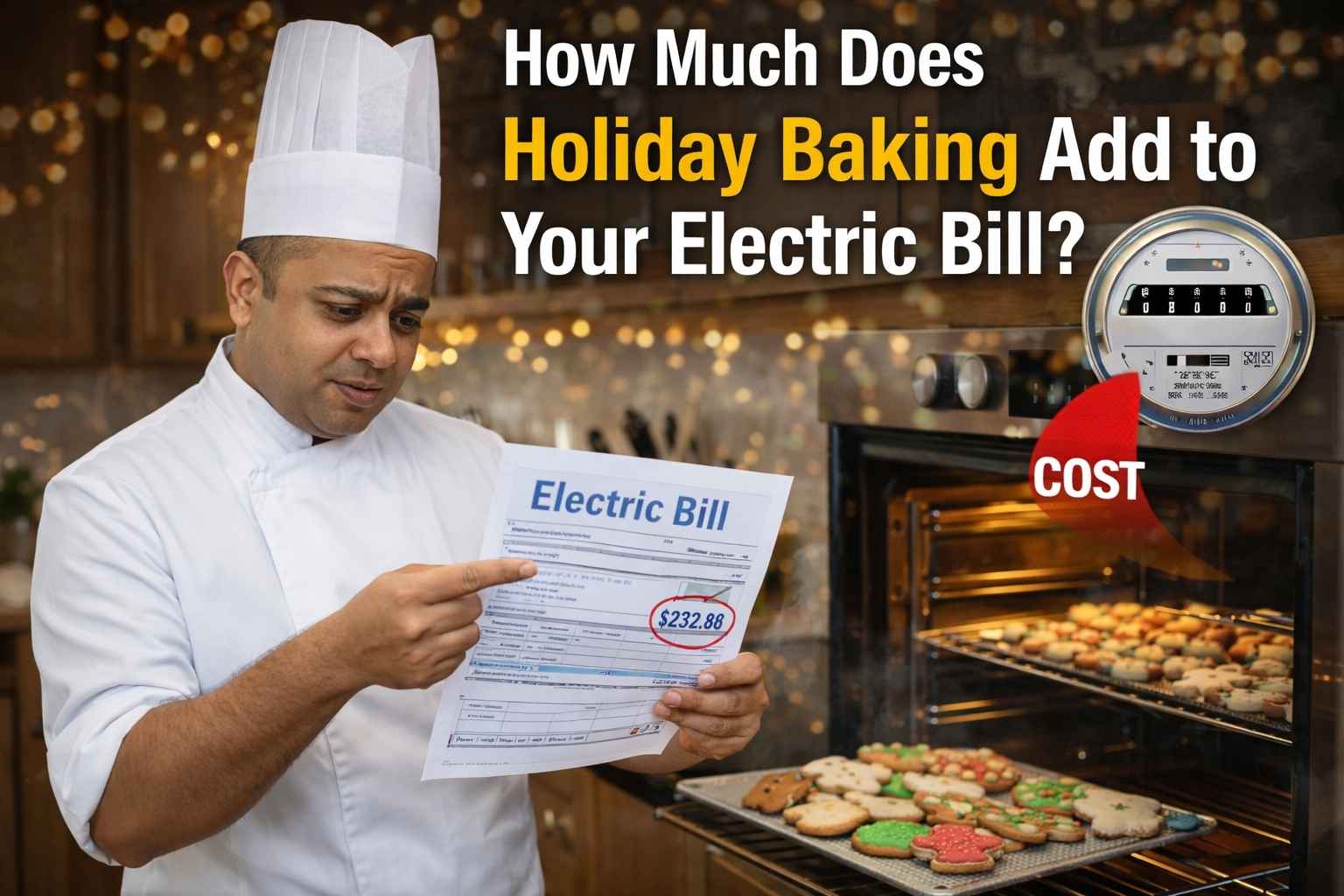
Do you love the smell of cookies but fear the arrival of your January power bill? As a cook, I know that joy and stress often mix during the festive season, so I looked into how much does holiday baking add to your electric bill? My years in the kitchen have taught me how to keep the oven hot and the costs low. Today, I will show you how to bake all your favorites without any money worries. Check out our Ultimate Guide: Energy Use & Costs to master your kitchen budget today!
The Hidden Costs of Your Holiday Oven Use
Baking for a crowd is a marathon for your appliances. Your electric meter tracks every single minute those coils stay red and hot.
I remember my first big catering gig. I had the oven running for twelve hours straight. My kitchen felt like a sauna. I was happy with the food, but the bill was a shock. Most U.S. ovens pull a lot of power.
- Average Usage: A standard oven uses 2,000 to 5,000 watts.
- The Cost: In the U.S., you pay about 16 cents per kilowatt-hour.
- The Math: If you bake for 5 hours, you might spend $2 to $4 just on heat.
Understanding Kilowatt-Hours (kWh) in the Kitchen
To save money, you must know how power works. A kilowatt-hour is how much energy a 1,000-watt tool uses in one hour.
Most American ovens are energy hogs. They are big. They have lots of empty space to heat up. If you use a GE or Whirlpool electric range, it stays on to keep the temp steady.
Does Oven Type Change the Price?
Not all ovens are the same. My old gas range was cheap to run. My new electric convection oven is faster.
- Convection Ovens: These use a fan to move air. They cook 25% faster. This saves you money.
- Electric Coils: These take a long time to get hot. They waste power during the warm-up.
- Wall Ovens: These are often smaller. They can be more efficient than a full range.
The Impact of Regional Electricity Rates
Where you live in the U.S. matters a lot. If you are in California, your bill will be high. If you are in Idaho, it might be half that price.
I always check my bill in November. Some power companies raise rates during the “peak” winter months. It’s a sneaky move. Always read the fine print on your monthly statement.
Why Preheating is Your Biggest Energy Hog
The hardest part for any oven is the climb from cold to hot. It’s like a car trying to drive up a steep hill.
I used to turn my oven on an hour early. I thought it made the heat “deeper.” I was wrong. I was just burning money. Now, I set a timer on my phone.
- The Surge: Your oven pulls the most “juice” during the first 10 minutes.
- The Door Gap: Opening the door to check the heat is a mistake. You lose 25 degrees in one second.
- The Sensor: Trust your oven light. When it goes off, put the food in.
The Thermodynamics of a Cold Start
Your oven walls need to get hot. It isn’t just about the air inside. The metal racks must be hot too.
In my professional kitchen, we never let the ovens turn off. At home, that’s too expensive. I try to bake in “blocks.” I do the bread, then the cookies, then the roast. I never let the oven get cold between jobs.
Myth Busting: Do You Really Need 20 Minutes?
Some recipes say to preheat for a long time. For a thick turkey, yes. For a tray of thin sugar cookies? No way.
- Fast Heat: Ten minutes is usually enough for light baking.
- Modern Tech: New Samsung ovens heat up very fast. Don’t waste the heat.
- The Bottom Rack: Put your stone or steel in early. It holds the heat for you.
Small Appliances vs. Big Ovens: The Math
Sometimes the smartest move is to let the big oven rest. I often use smaller tools to save money and time during the holidays.
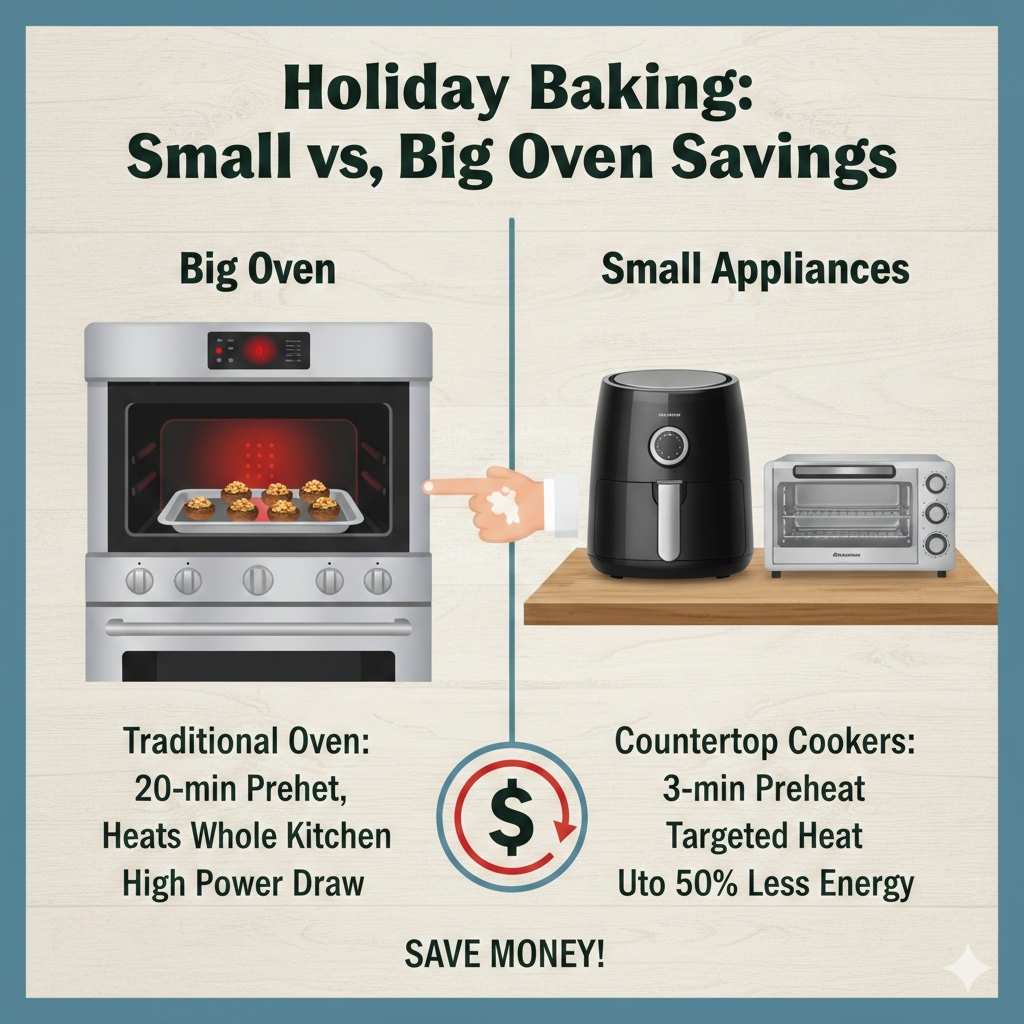
Last Christmas, my kitchen was a mess. I had flour on my face and a sink full of dishes. I realized I was heating a massive 30-inch oven for just six stuffed mushrooms. That felt silly. I switched to my countertop oven and felt much better. It didn’t heat up the whole house, and it used way less power.
- Space Efficiency: Small ovens heat up in three minutes, not twenty.
- Direct Heat: Air fryers use intense fans to cook food in half the time.
- Less Waste: You aren’t warming up cubic feet of empty air.
When to Use a Toaster Oven or Air Fryer
I love my Breville Smart Oven for side dishes. It is perfect for roasting a small tray of sprouts or warming rolls.
If you are cooking for two, skip the big range. A large oven is a “luxury” for small jobs. In the U.S., many of us have these powerful air fryers like Ninja or Cosori. They are great for the holiday crunch. They use about 1,400 watts, which is much lower than a full-sized wall unit.
The Power Consumption of Countertop Tools
Do not fear your stand mixer. A KitchenAid mixer is a beast, but it doesn’t eat much electricity.
- Mixers: These use about 300 to 500 watts. That is pennies per hour.
- Slow Cookers: These are very “green.” They sip power slowly all day long.
- Electric Kettles: These are faster than the stove for boiling water.
Comparing Efficiency Ratings
When I buy new gear, I look for the Energy Star logo. It tells me the tool won’t waste my money.
Modern gadgets are much better than the ones my grandma used. They have better seals and thicker glass. If your toaster oven feels hot on the outside, it is losing heat. That means it is losing money too. I prefer brands that stay cool to the touch.
Professional Chef Tips to Slash Your Baking Bill
I have worked in kitchens where every penny counts. I use those same “pro” habits at home to keep my costs down.
I once worked for a chef who yelled if we opened the oven door too much. He called it “letting the profit out.” He was right. Every time that door swings open, your bill goes up. Now, I use the oven light and the glass window. I only open the door when I am ready to pull the tray out.
- Batch Cooking: I plan my day so the oven never cools down.
- The “Off” Switch: I turn the heat off 10 minutes early. The trapped air finishes the job.
- Flat Pans: I use thin, dark pans. They transfer heat to the dough faster.
The Power of Residual Heat
Your oven is basically a big insulated box. Even after you turn it off, it stays hot for a long time.
I use this “free” heat to toast pecans or dry out bread for stuffing. I even use it to proof my yeast doughs once the temp drops a bit. It is a smart way to get two jobs done for the price of one. It makes me feel like a genius every time I do it.
Calibration and Oven Maintenance
A dirty oven is a slow oven. If your heating elements are covered in burnt cheese, they have to work harder.
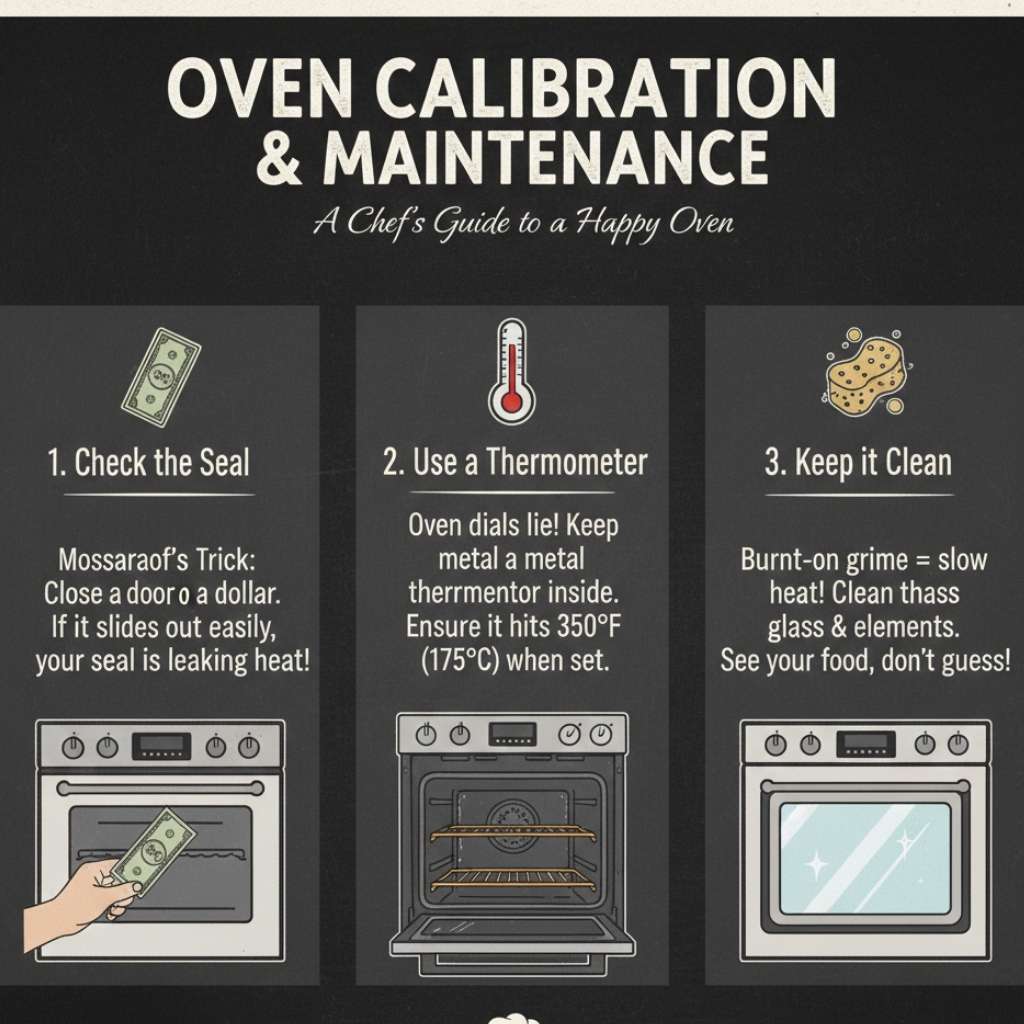
- Check the Seal: I take a dollar bill and close the oven door on it. If it pulls out easily, my seal is bad.
- Thermometers: I keep a small metal thermometer inside at all times.
- Clean the Glass: If you can’t see inside, you will open the door. Keep it sparkling.
Smart Scheduling for Off-Peak Hours
In many parts of the U.S., power is cheaper at night or on weekends. I call this “The Baker’s Shift.”
If I have a huge project, I start late at night. The house is quiet, and the rates are low. Some cities in Texas or Illinois have “Free Power” hours. If you have that, do all your heavy roasting then. Your January bank account will thank you.
Real-World Calculations: The 48-Hour Bake-a-Thon
Let’s look at what a weekend of flour and sugar actually costs. It is easy to lose track when you are having fun.
Last Saturday, I started baking at 8 AM. I didn’t stop until Sunday night. My counters were covered in flour. I felt like a cookie factory. I decided to track every minute the oven was on. It was an eye-opener. How Much Does Holiday Baking Add to Your Electric Bill? It adds up faster than a tray of disappearing fudge.
- The Big Roast: 4 hours for a turkey or ham.
- The Side Dishes: 2 hours for casseroles and yams.
- The Cookie Marathon: 6 hours of rotating trays.
- The Total: 12 hours of high-heat cooking.
Breaking Down the Batch Costs
You might think a few cents here and there don’t matter. But they do.
I used my Whirlpool oven for 12 hours total. At 3,000 watts, that is 36 kilowatt-hours. In my town, that costs about $6.00. That is just the oven! It doesn’t count the dishwasher or the fridge. If you do this every weekend in December, you are looking at an extra $25 or $30 on your bill.
The “Hidden” Costs: Ventilation and Cooling
Your oven doesn’t just heat your food. It heats your entire home.
In the U.S., our kitchens are often the heart of the house. If I bake in Florida, my Air Conditioning has to work twice as hard to fight the oven. That is a double charge! In a cold place like Maine, the oven helps the heater.
- Range Hoods: Running that loud fan pulls power too.
- The Fridge: Every time you put a warm bowl in the fridge, it works harder.
- Hot Water: Washing all those sticky pans takes a lot of heated water.
Better Gear for Lower Bills
The tools you choose can change how much power you waste. I have learned that cheap pans are often the most expensive to own.
I used to buy the cheapest baking sheets I could find. They were thin and wobbly. They warped in the heat. My cookies came out burnt on one side and raw on the other. I had to bake them longer just to get them “okay.” That was a waste of time and electricity. Now, I invest in quality.
- Heavy Duty: Thick pans hold heat better and bake more evenly.
- Material Matters: Aluminum is great for fast, even heat.
- Color Counts: Dark pans cook faster than shiny light ones.
Dark vs. Light Baking Sheets
This is a chef secret that most home cooks miss. The color of your pan changes the “physics” of your oven.
I love my Nordic Ware natural aluminum sheets. They are light and bright. They are perfect for delicate cookies. But if I want a crispy crust on my roasted potatoes, I use a dark Calphalon pan.
- Dark Pans: These absorb “radiant” heat. You can often lower your oven by 25 degrees.
- Shiny Pans: These reflect heat. They take longer but prevent burning.
- The Swap: Use dark pans for hearty foods to save on bake time.
Glass vs. Ceramic vs. Metal
Choosing the right dish is like choosing the right gear for a hike.
I use glass for my fruit pies. It takes a while to get hot, but once it is hot, it stays hot. Ceramic is the same. It is great for “low and slow” cooking. Metal is the king of speed. If you are in a rush to save power, go with metal. It conducts heat the fastest.
The Role of Insulation in Modern Ranges
American kitchens often have huge, beautiful ranges. But if yours is old, it might be “leaking” heat.
I recently tested a high-end Wolf range. The door was so thick I couldn’t feel any heat on the outside. My old apartment oven was different. I could practically toast bread just by standing near it. If your kitchen gets too hot while baking, your insulation is probably thin. That is money floating away into the air.
Safety and Efficiency Go Hand in Hand
A kitchen that runs safely is a kitchen that runs for less. When your appliances are in top shape, they don’t have to fight to keep up with your holiday demands.
I once worked in a small bakery where the oven door didn’t quite latch right. We used a heavy chair to propped it shut. It was a disaster! Not only was it dangerous, but we were wasting a fortune in heat. In the U.S., our home appliances are built to last, but they still need a little love to stay efficient.
- Steady Voltage: Good wiring ensures your oven reaches the right temp fast.
- Clear Vents: Blocked airflow makes the motor work harder and use more juice.
- Prompt Repairs: A clicking igniter or a frayed cord can spike your usage.
Checking for Electrical Wear and Tear
Your oven is likely the most power-hungry thing in your house. If it’s not getting “clean” power, it’s costing you.
I always tell my friends to watch their kitchen lights. If the lights dim when you turn the oven on, you might have an overloaded circuit. This “voltage drop” means your heating elements take longer to glow. In my old house, I had an electrician come in to give my kitchen a “check-up” before the December rush. It saved me a lot of stress.
The Danger of Self-Cleaning Cycles
This is a big one for the holidays. Most people want a sparkling oven before the family arrives.
I learned the hard way that the “Self-Clean” button is a risk. It heats your oven to over 800°F. This is an enormous drain on your electric bill—it’s like running your oven for four days straight in just a few hours.
- Component Stress: The extreme heat can blow a thermal fuse or melt a control board.
- The Timing: Never run it the day before a big dinner. If it breaks, you have no oven for the turkey!
- The Alternative: I use a paste of baking soda and water. It’s cheap, safe, and doesn’t cost a cent in electricity.
Final Thoughts from the Chef’s Counter
At the end of the day, holiday baking is about the memories, not just the meter. But being smart about it lets you spend more on gifts and less on the power company.
I love the holidays. I love the way my kitchen feels when three racks of gingerbread are cooling on the counter. By using these pro tips—like batch baking and choosing the right pans—I’ve managed to keep my December bill from spiraling out of control.
So, How Much Does Holiday Baking Add to Your Electric Bill? It doesn’t have to be a nightmare. A little planning goes a long way. Use your small appliances, keep the door shut, and enjoy the process. Your cookies will taste just as sweet, and your wallet will feel a lot heavier come January.
Frequently Asked Questions
How Much Does Holiday Baking Add to Your Electric Bill on average?
Baking can add $5 to $30 to your monthly bill. This depends on how often you use your oven. Big roasts and many cookie batches use more power.
Is a gas oven cheaper than an electric oven for baking?
Yes, gas is usually cheaper in the U.S. than electricity. Electric ovens like Whirlpool use a lot of energy to stay hot. Gas heat costs less per hour of use.
Does using a convection setting save money on my bill?
Yes! Convection fans move hot air around. This cooks your food 25% faster. Shorter cook times mean your Samsung oven pulls less power from the grid.
Can a toaster oven help lower my holiday energy costs?
Small ovens are great for tiny jobs. A Breville toaster oven heats up fast. It uses half the juice of a big range. Use it for side dishes and small treats.
Should I run the self-cleaning cycle after I finish baking?
Wait until the holidays are over. The self-clean mode uses high heat for hours. It is very expensive. It can also break your oven right when you need it most.

I’m Mossaraof, a trained chef and the founder of OvenInsights.com. I spent years cooking at Larrupin’ Cafe and in kitchens across Chicago and Seattle. Now I test kitchen gear for a living. I moved to North Acton, London, and I test every tool I write about. I use real meals and real heat. No brand deals. No shortcuts. I cover 12 kitchen types and hundreds of recipes. I believe this: the right tools matter as much as the recipe.