At A Glance
- A Dutch oven is a thick-walled, lidded pot — cast iron or enameled cast iron — that moves from stovetop to oven without complaint and holds heat longer than any other pot in your kitchen.
- A 5–6 qt Dutch oven covers 95% of home cooking tasks and fits most households of 2–6 people.
- Enameled cast iron (Le Creuset, Staub) needs no seasoning and handles acidic foods; bare cast iron (Lodge) costs less but needs more upkeep.
- Dutch ovens trap steam during bread baking and create the thick, crackly crust you cannot get from a baking stone alone (America’s Test Kitchen, 2023).
- Never put a cold Dutch oven into a screaming-hot oven — thermal shock can crack the enamel and ruin a $300 pot.
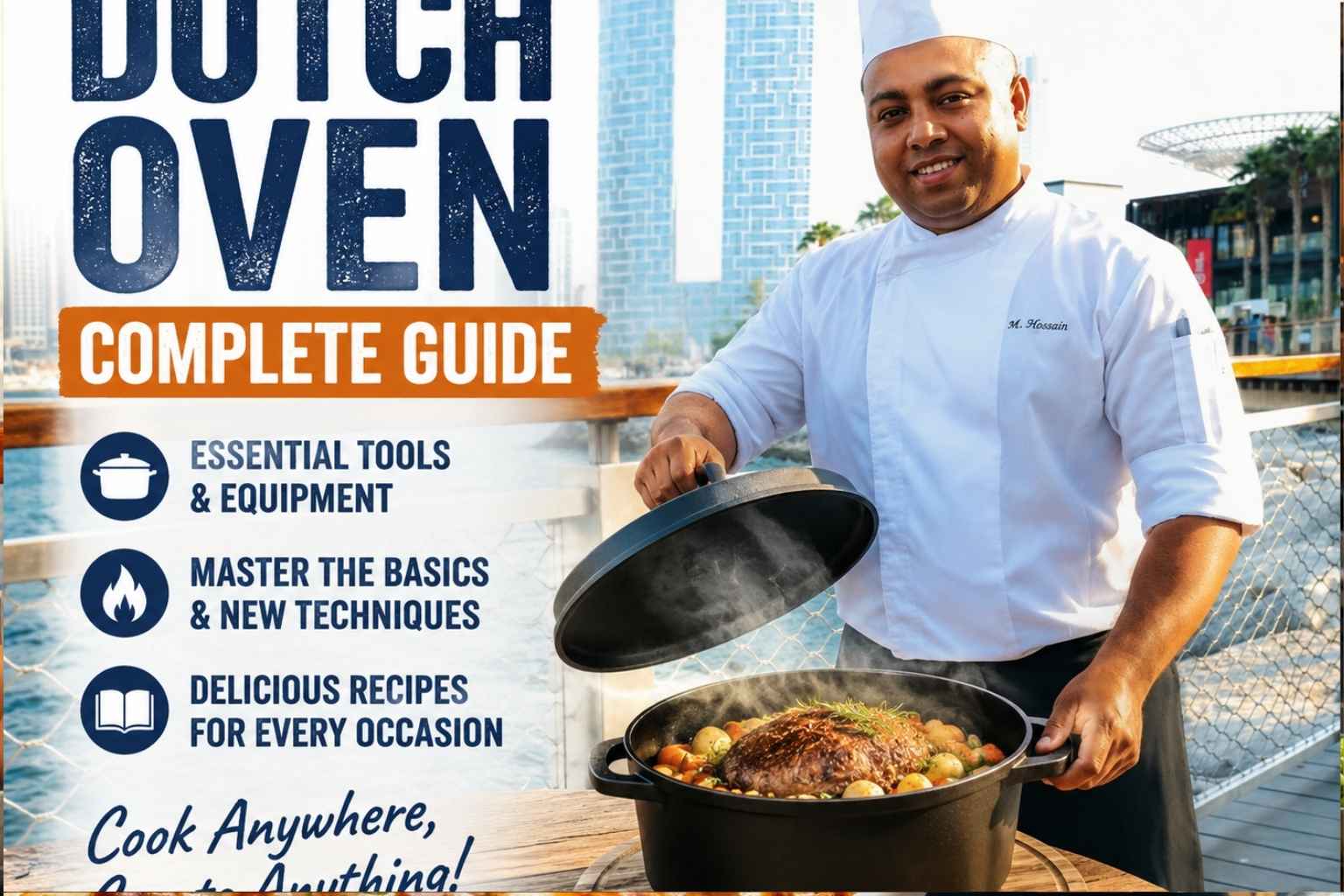
My grandma’s Dutch oven outlived three houses and two marriages, and it still makes the best pot roast I’ve ever tasted. I’m Mossaraof, a chef who’s cooked in tiny apartment kitchens and big restaurant lines, and I still reach for cast iron more than anything fancy. That’s why I built this Dutch Oven Complete Guide, so you can skip my early mistakes and go straight to great meals. Inside, you’ll find real tips on picking, seasoning, and cooking with your Dutch oven like a pro. Stick with me, and your kitchen will feel a whole lot more confident.
What a Dutch Oven Actually Is — Materials, Construction, and Why the Lid Matters
A Dutch oven is a heavy, deep pot with thick walls and a tight-fitting lid. That’s it. The magic is in the physics, not the marketing.
Most Dutch ovens are cast iron — either bare or coated with a layer of vitreous enamel. The walls run 3–5 mm thick on quality models (Lodge Cast Iron, 2024). That thickness is the whole point. Thin pots heat fast and cool fast. A thick cast iron pot heats slowly and holds that heat for a long time after you pull it off the burner.
The lid matters more than most buyers realize. A well-fitted lid traps moisture inside the pot. That trapped steam braises meat, keeps bread crusts soft during the initial bake, and stops stews from reducing too fast. A bad lid — one that rocks or sits loosely — lets steam escape, and your results suffer.
When I was cooking at a restaurant in 2011, we had two Dutch ovens: one Le Creuset with a tight lid and one off-brand with a wobbly one. Same recipe, same oven temp, same cook time. The Le Creuset braise came out glossy and fall-apart tender. The other one was dry and stringy. I never bought a cheap Dutch oven again.
Enameled Cast Iron vs. Bare Cast Iron — Which One Should You Buy?
Enameled cast iron is bare cast iron coated with a layer of glass-based enamel. Bare cast iron is raw, uncoated iron that you season yourself with oil.
Here is how they compare:
| Feature | Enameled Cast Iron | Bare Cast Iron |
|---|---|---|
| Price range | $80–$400+ | $30–$120 |
| Seasoning required | No | Yes |
| Handles acidic foods (tomatoes, wine) | Yes | No — strips seasoning |
| Dishwasher safe | No (hand-wash only) | No |
| Rust risk | None | Yes, if not dried promptly |
| Weight | Heavy | Heavy |
| Best brands | Le Creuset, Staub, Lodge | Lodge, Camp Chef |
| Longevity | Decades with proper care | Decades with proper care |
Choose enameled if you cook a lot of tomato sauces, wine braises, or acidic dishes. Also choose it if you do not want to think about seasoning or maintenance. The enamel coating handles that for you.
Choose bare cast iron if you want to spend less money upfront and do not mind re-seasoning every few months. Bare cast iron also handles higher heat — above 500°F — better than most enameled options, since extreme heat can darken or damage enamel over time (Lodge Cast Iron, 2024).
One note: Staub uses a matte black enamel interior rather than the cream-colored interior on Le Creuset. The Staub interior hides discoloration better and handles higher stovetop heat without staining. That is my personal preference. But Le Creuset’s cream interior makes it easier to see when your fond is starting to burn.
Dutch Oven Size Guide — How to Pick the Right Quart Size
The right size depends on how many people you cook for and what you cook most often. Here is the full breakdown:
| Size | Best Use | Serves |
|---|---|---|
| 2 qt | Sauces, small side dishes, melting chocolate | 1–2 people |
| 3.5 qt | Soups, chilis, small braises | 1–3 people |
| 5 qt | Most everyday cooking — braises, stews, roasts, bread | 2–4 people |
| 5.5 qt | The sweet spot — the most popular home size | 2–5 people |
| 6 qt | Larger roasts, big batches of soup or chili | 4–6 people |
| 7 qt | Family cooking, batch cooking, whole chickens | 5–8 people |
| 9 qt | Large roasts, turkeys, big-batch recipes | 8–12 people |
| 13 qt | Commercial use, very large gatherings | 12–20 people |
My recommendation for most home cooks: a 5.5 qt or 6 qt. This size fits a whole chicken, a 3-pound chuck roast, or a standard loaf of bread. It goes into most home ovens without touching the walls. And it does not feel absurdly large when you are making soup for two.
If you cook for one or two people regularly, a 3.5 qt works well for daily use. Buy the larger size when you need to batch cook or entertain.
One size I do not recommend as your only Dutch oven: the 2 qt. It is too small to be useful as an everyday pot. It makes a good specialty piece for sauces or fondue, but it will not replace a full-size Dutch oven.
Stovetop to Oven Cooking — Why Dutch Ovens Excel at Braising
A Dutch oven is the best pot for braising because it does three things at once: it sears, it holds moisture, and it distributes heat evenly on all sides — including through the thick lid.
Braising is a two-step process. You sear your protein on high heat to build flavor. Then you add liquid — stock, wine, tomatoes — and move the whole pot into a low oven (275–325°F) for a long time. The meat sits partially submerged in liquid and cooks in steam and direct heat simultaneously.
Cast iron holds heat so well that when you set your oven to 300°F, the temperature inside the Dutch oven stays remarkably steady. There are no hot spots from oven cycling. Serious Eats tested this and found that cast iron pots had more stable internal temperatures during low-and-slow cooking than stainless steel or aluminum Dutch ovens (Serious Eats, 2022).
This steady heat is why cheap Dutch ovens — thin stainless with an aluminum core — cannot replicate the results of cast iron. They heat faster, yes. But they also fluctuate more, and the results are inconsistent.
My standard short-rib braise takes 3.5 hours at 300°F. The braising liquid barely bubbles the entire time. That is exactly what you want. A hard boil toughens meat. A gentle, steady simmer breaks down collagen into gelatin and makes the sauce glossy and rich. Only a cast iron Dutch oven gives you that level of control without babysitting the stove.
Bread Baking in a Dutch Oven — The Steam Trap Effect
A Dutch oven is the best home bread-baking tool available, better than a baking stone. The reason is steam.
Professional bread ovens inject steam during the first 15–20 minutes of baking. Steam keeps the crust soft long enough for the bread to expand fully before it sets. Without steam, the crust hardens too early, and the loaf cannot rise properly. You get a dense, tight crumb and a thin, pale crust.
A Dutch oven solves this at home. You preheat the pot in the oven at 450–500°F. You drop your shaped dough in, put the lid on, and bake covered for 20 minutes. The moisture from the dough itself creates steam, trapped inside the pot. Then you remove the lid for the last 20–25 minutes so the crust crisps and darkens.
The result — a thick, shatteringly crunchy crust — is nearly impossible to achieve any other way at home. King Arthur Baking tested six different baking methods and found that a preheated Dutch oven produced the best crust color, spring, and ear formation of any home method (King Arthur Baking, 2023). A baking stone with a separate steam pan came second but was inconsistent.
The pot size matters here. A 5–6 qt Dutch oven fits a standard 1.5-pound loaf with room for the bread to expand. A 3.5 qt pot is too tight for a full-size loaf. A 7 qt is fine but the bread may spread sideways instead of up.
Frying and Searing in a Dutch Oven — Heat Retention Wins
A Dutch oven holds oil temperature better than any standard fry pot. When you drop cold food into hot oil, the food cools the oil instantly. In a thin pot, the oil temperature drops significantly and recovers slowly. Your food absorbs excess oil and comes out greasy.
In a cast iron Dutch oven, the oil temperature still drops when you add food, but it recovers faster because the walls hold residual heat. America’s Test Kitchen found that cast iron Dutch ovens maintained oil temperatures within 10–15°F of target after adding food, compared to 25–40°F drops in lighter aluminum pots (America’s Test Kitchen, 2022).
I use my Dutch oven for fried chicken every time. I fill it with 3 inches of oil, heat it to 350°F, and fry in small batches. The temperature stays steady, the crust sets fast, and I get golden, crunchy chicken without greasy spots.
For searing, the thick base distributes heat evenly across the bottom. You do not get a bull’s-eye sear from a concentrated burner. Every part of the surface stays hot, so your crust forms uniformly.
One practical note: do not fill a Dutch oven more than halfway with oil for frying. The high walls give you the safety margin you need if the oil bubbles up, but overfilling is still dangerous.
How to Clean and Season a Dutch Oven — What Actually Damages Your Pot
Cleaning Enameled Cast Iron
Wash your enameled Dutch oven by hand with warm water and a soft sponge. Dish soap is fine — the old myth that soap ruins cast iron applies to bare cast iron, not enamel. The enamel surface is glass. Soap does not strip glass.
What does damage enamel:
- Thermal shock — going from a hot burner to a cold sink, or from the fridge into a preheated oven. The enamel cracks. Always let the pot cool on the stove before washing.
- Metal utensils — scratching the enamel interior with metal spoons or spatulas. Use wood or silicone.
- High heat with empty pot — never heat an empty enameled Dutch oven over high heat. The enamel can discolor permanently or crack.
- Dishwasher — the heat and harsh detergents dull the enamel and can cause crazing (a network of hairline cracks) over time. Always hand-wash.
For stuck food, fill the pot with warm water and let it soak for 20 minutes. Then use a non-abrasive scrubber. For heavy staining on a cream interior, mix water and baking soda into a paste, coat the stained area, and let it sit overnight. Rinse in the morning.
Seasoning and Cleaning Bare Cast Iron
Bare cast iron builds up a seasoning layer — polymerized oil bonded to the iron surface. This is your non-stick coating. Every time you cook with fat and heat the pan, the seasoning gets a little better.
After each use:
- Rinse the pot with hot water while it is still warm.
- Use a stiff brush or chain mail scrubber to remove food residue.
- Dry it completely on the stovetop over low heat for 2–3 minutes.
- Rub a thin layer of neutral oil (flaxseed, vegetable, or Crisco) over the entire interior surface.
- Store with the lid slightly ajar to allow airflow.
When to re-season: If you see rust spots, a dull gray color instead of black, or food is sticking consistently, strip the pot and re-season it.
To re-season: Wash with hot soapy water to remove all old seasoning. Dry completely. Rub a thin layer of oil all over — inside, outside, and on the lid. Place it upside down in a 450–500°F oven for one hour. Let it cool in the oven. Repeat 2–3 times for best results (Lodge Cast Iron, 2024).
Common Dutch Oven Mistakes — and How to Fix Them
Mistake 1: Heating the pot too fast on high heat.
Cast iron does not need high heat to get hot. It needs time on medium heat to heat evenly. High heat on a cold cast iron pot creates hot spots. Start on medium-low, let the pot warm for 3–4 minutes, then increase to your target temp.
Mistake 2: Thermal shock with enameled cast iron.
Going from cold to high heat fast, or rinsing a hot pot with cold water, can crack the enamel. The fix is simple: always let the pot cool before washing, and never put a cold pot into a very hot oven without a slow warm-up.
Mistake 3: Using soap on bare cast iron.
This one goes both ways. Mild dish soap on a well-seasoned bare cast iron pan will not destroy the seasoning. But harsh detergents used repeatedly will strip it. Use hot water and a brush for daily cleaning. Reserve soap for when you need to fully re-season.
Mistake 4: Storing with the lid on tight.
Trapping moisture inside a closed Dutch oven — especially bare cast iron — causes rust. Store with the lid cracked open or use a folded paper towel to keep a gap.
Mistake 5: Cooking acidic foods in bare cast iron.
Tomatoes, wine, citrus, and vinegar react with bare iron and pull iron into your food. This strips seasoning and can give food a metallic taste. Use enameled cast iron for acidic recipes.
Mistake 6: Buying the wrong size.
The most common regret I hear from home cooks is buying a 3.5 qt thinking it was big enough. For two people who entertain occasionally or batch cook, a 5.5 qt is the right call from the start.
How to Shop for a Dutch Oven — What to Check Before You Buy
Lid Fit
Pick up the pot. Place the lid on. Tilt the pot slightly. The lid should not slide off or rattle. A tight lid is essential for braising and bread baking.
Wall Thickness
Pick up the empty pot. If it feels surprisingly light, the walls are thin. A quality 5.5 qt Dutch oven weighs 11–14 lbs empty. Anything under 9 lbs in that size is too thin (Lodge Cast Iron, 2024).
Handle Size
The handles need to be large enough to grip with oven mitts. Some budget Dutch ovens have small, decorative handles that are nearly impossible to grip safely when the pot is full and hot.
Interior Color
Cream interiors (Le Creuset) let you see fond development easily. Dark interiors (Staub) hide staining and handle higher heat without discoloring. Both are good — pick based on your preference.
Budget
You do not need to spend $350 on a Le Creuset to get good results. Lodge makes a quality enameled cast iron Dutch oven for around $80–$100 that performs well in testing. The Le Creuset and Staub justify their price with better fit and finish, more consistent enamel, and longer warranties. But Lodge is a legitimate option for most home cooks.
My Dutch Oven Routine — What I Actually Do in the Kitchen
I have owned the same 5.5 qt Le Creuset for 11 years. Here is exactly how I use it.
Sunday braises: I brown short ribs or pork shoulder in batches on medium-high heat. I deglaze with wine, add aromatics and stock, and put the lid on at 300°F for 3–4 hours. I do not touch it. The result is always better than anything I could get from a slow cooker or instant pot at the same temperature.
Weekly bread: I make a no-knead loaf two to three times a week. I preheat the Dutch oven at 475°F for 30 minutes, drop the cold dough in, lid on for 20 minutes, lid off for 22 minutes. The crust is always perfect.
Fried chicken: Once a month, roughly. I use 3 inches of neutral oil at 350°F. The cast iron holds the temperature between batches far better than my stainless stockpot.
Beans and lentils: I cook beans from scratch in the Dutch oven at least twice a week. The even heat keeps them simmering gently without scorching the bottom.
After every use: hot water, brush, dry on the burner, thin wipe of oil. That is it. My pot looks better now than it did in 2015 because the enamel interior has built up a faint patina that makes it easier to clean.
Frequently Asked Questions About Dutch Ovens
What is a Dutch oven and what is it used for?
A Dutch oven is a heavy-walled pot with a tight-fitting lid, made from cast iron or enameled cast iron. It is used for braising, stewing, roasting, soup-making, bread baking, deep frying, and slow cooking. It moves from stovetop to oven without issue, which makes it one of the most flexible pots in a home kitchen.
What size Dutch oven should I buy first?
For most households, a 5.5 qt or 6 qt is the right starting size. It fits a whole chicken, a standard bread loaf, and a full batch of soup. If you regularly cook for 6 or more people, go up to a 7 qt.
Is Le Creuset worth the price?
Le Creuset Dutch ovens cost $250–$400 depending on the size. They have tighter lid fits, more consistent enamel, and a lifetime warranty than most budget options. If you cook frequently and want to use the pot for 20+ years, the cost per use becomes very low. If you cook occasionally, Lodge’s enameled Dutch oven at $80–$100 is a better value.
Can I use a Dutch oven on an induction cooktop?
Yes — bare cast iron and most enameled cast iron Dutch ovens are induction-compatible. Check the packaging for an induction symbol before buying if this matters to you. Le Creuset, Staub, and Lodge all work on induction.
What temperature is too hot for an enameled Dutch oven?
Most enameled cast iron manufacturers recommend a maximum oven temperature of 450–500°F. Le Creuset’s official limit is 500°F (Le Creuset, 2024). Above that, you risk darkening or cracking the enamel. Bare cast iron has no upper limit for oven use.
Can I bake bread in a Dutch oven without preheating it?
You can, but you will not get the same crust. The preheated Dutch oven shocks the dough with immediate high heat, which drives rapid expansion (called oven spring). Starting from a cold pot gives you less spring and a softer, less defined crust. Always preheat for best results (King Arthur Baking, 2023).
How do I get rid of white residue on the inside of my enameled Dutch oven?
White mineral deposits from hard water or calcium build-up are common. Fill the pot with water and add two tablespoons of white vinegar. Bring it to a simmer for 3–5 minutes. Let it cool, then rinse. The residue comes right off. Do not scrub with abrasive pads — that scratches the enamel.
Does a Dutch oven need to be seasoned?
Enameled cast iron does not need seasoning. The enamel coating is the non-stick surface. Bare cast iron does need seasoning. Before you use a new bare cast iron Dutch oven, wash it, dry it, coat it with a thin layer of oil, and bake it upside down at 450°F for one hour. Repeat twice before the first use (Lodge Cast Iron, 2024).
Key Takeaways
- A Dutch oven’s thick walls and tight lid are not features — they are the entire reason it works. Thin, cheap alternatives do not produce the same results.
- The 5.5 qt size fits most households. Go larger only if you batch cook or cook for 6+ people regularly.
- Enameled cast iron handles acidic foods and needs no maintenance beyond hand-washing. Bare cast iron costs less but needs regular seasoning and cannot handle tomatoes, wine, or citrus.
- Bread baked in a preheated Dutch oven gets the steam environment that professional bakeries have. No other home tool does this as reliably.
- Never put cold enameled cast iron into a very hot oven. Let it warm gradually to avoid thermal shock.
- Thermal shock, metal utensils, and high heat on an empty pot are the three most common ways home cooks damage enameled Dutch ovens.
- A quality Dutch oven — cared for properly — will outlast you. Buy once, buy right.

I’m Mossaraof, a trained chef and the founder of OvenInsights.com. I spent years cooking at Larrupin’ Cafe and in kitchens across Chicago and Seattle. Now I test kitchen gear for a living. I moved to North Acton, London, and I test every tool I write about. I use real meals and real heat. No brand deals. No shortcuts. I cover 12 kitchen types and hundreds of recipes. I believe this: the right tools matter as much as the recipe.