
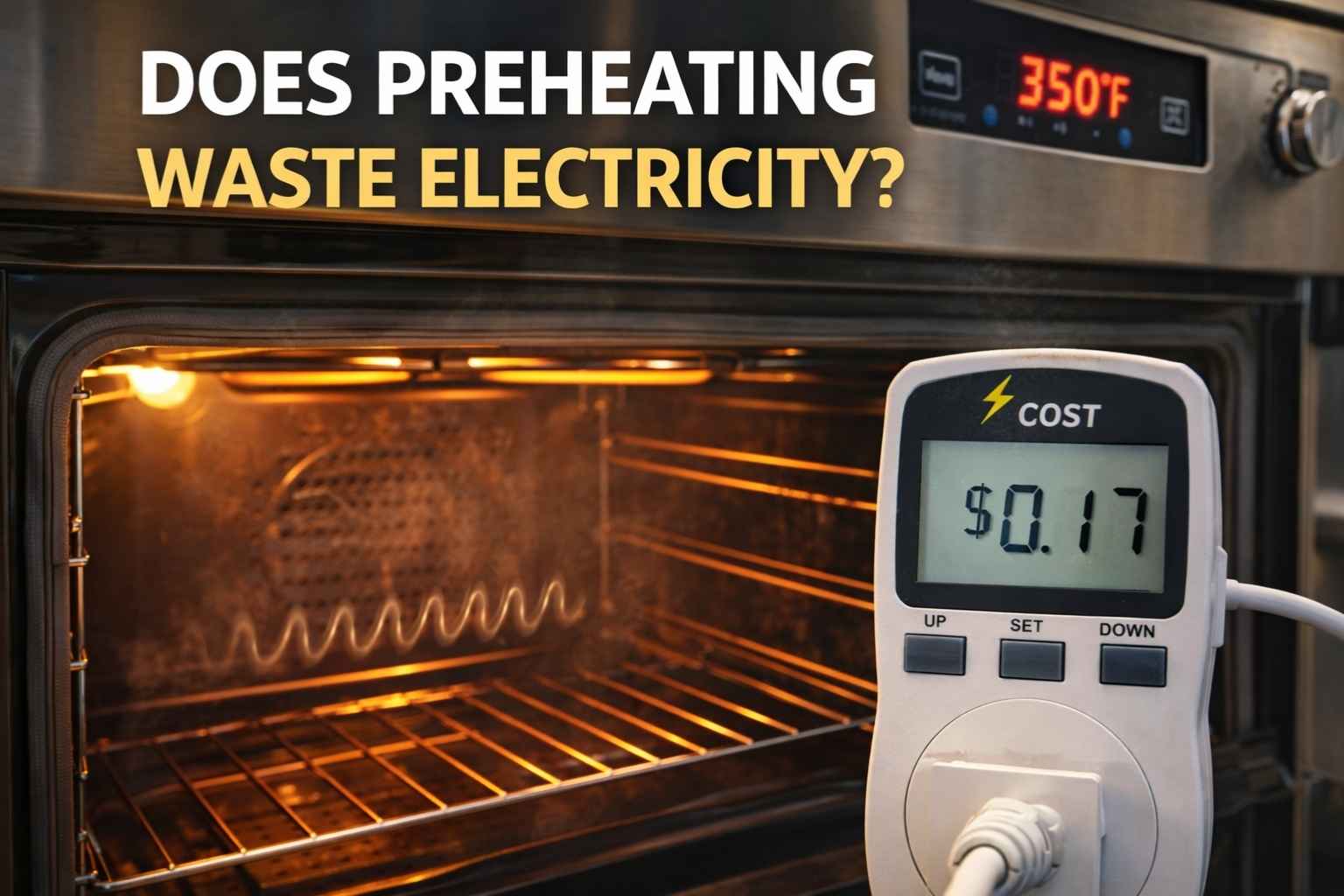
Ever wait for your oven to beep while watching your power meter spin? As a cook, I hate wasting time and heat, so I often wonder: does preheating waste electricity? My years of baking have taught me when to wait and when to just start cooking to save money. Today, I will share some simple tricks to help you bake better for less. Take a look at our Ultimate Guide: Energy Use & Costs to cut your bills today!
What Happens During Oven Preheating?
We hear about it all the time: “Preheat to 350°F.”
But what’s really going on inside your oven while it hums to life?
Before we jump into cost, let’s look at what actually happens when your oven preheats — and why it’s not just about hitting a number.
The Science Behind Preheating
Preheating is the process where your oven reaches the target temperature before you put food inside.
Sounds simple — but it’s doing more than just heating air.
- Electric ovens warm metal coils, which slowly radiate heat through the chamber
- Gas ovens use an open flame at the bottom — it heats quickly, but not evenly
- Convection ovens kick on fans to move hot air around, speeding things up
Each type behaves differently. My GE electric oven in Chicago was a turtle — slow, but steady.
Meanwhile, the gas one in my Arizona kitchen got hot fast… and sometimes too fast.
What’s Changing Inside the Oven?
Here’s what you don’t see:
- The interior walls expand with heat (some even creak — spooky at night)
- Hot and cold spots begin to stabilize — important for even cooking
- Temp sensors cycle the heat source on and off to keep the heat close to target
I used to toss things in early, thinking “close enough.” But I’ve learned the oven’s beep isn’t always the whole story.
In fact, my thermometer once read 310°F when the oven said 350°F.
That 40 degrees made a big difference in my cookies.
Why Oven Model and Brand Matters
Not all ovens preheat equally — especially in U.S. kitchens where brands vary wildly.
- My Whirlpool electric range in Florida took 15+ minutes to preheat
- A friend’s Samsung Flex Duo preheated in 6 minutes flat (I was jealous)
- Older GE gas ranges I’ve used were unpredictable — quick to flame, slow to settle
Even features matter.
Self-cleaning ovens tend to have more insulation, which slows preheat time.
Double ovens? One heats faster than the other — almost always.
Does Preheating Waste Electricity? Let’s Break It Down
I didn’t want to guess. I wanted real numbers. So I tracked how often I preheated, for how long, and what it actually did to my electricity bills — across different states and seasons.
How Much Energy Preheating Actually Uses
On average, I found myself preheating my oven about 4–5 times a week.
Sometimes for baking, sometimes just reheating something quick.
Before I knew it, I was burning 45–60 minutes a week on empty oven time.
Here’s what I learned:
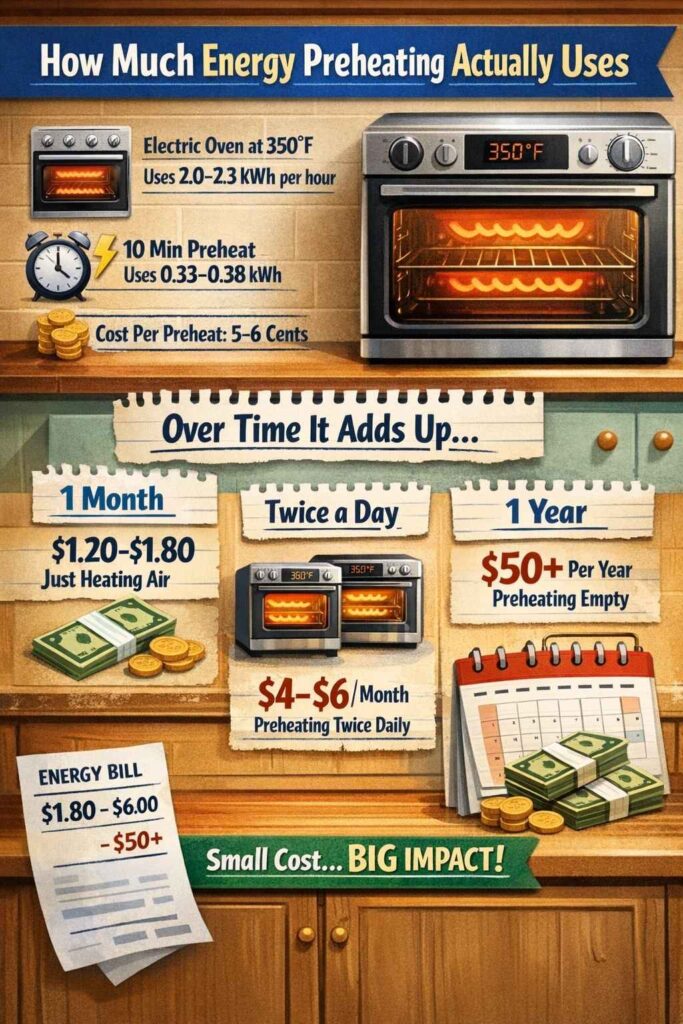
- Electric ovens use about 2.0–2.3 kWh per hour at 350°F
- A 10-minute preheat burns about 0.33–0.38 kWh
- At $0.15 per kWh (U.S. average), that’s roughly 5–6 cents per session
Doesn’t sound like much. But over a month?
- That’s $1.20–$1.80 — just for heating air
- If you preheat twice a day? It jumps to $4–$6
- Over a year? $50+ — and that’s without cooking anything
I know, it’s not a fortune.
But for something I sometimes didn’t even need? It started to feel wasteful.
What I Noticed Across Different Climates
This is where it got interesting — and why I think more U.S. home cooks should pay attention to regional energy habits.
In Florida (hot and humid)
- My oven heat made the AC work overtime
- One preheat felt like turning on a second space heater
- I noticed higher cooling bills the more I baked in the summer
- So I switched to cooking earlier in the day or after sunset
In Arizona (dry and sunny)
- Convection mode helped preheat faster — around 6 minutes
- But even that short burst raised the kitchen temp fast
- I used a fan to vent out the heat, but it added another plug to the wall
In Chicago (cold winters)
- I didn’t mind preheating at all — it warmed the kitchen
- My electric bill stayed steady
- I even left the oven door cracked open after baking to let out heat (old-school trick, I know)
When Preheating Is Actually Worth the Energy
Not all preheating is a waste.
There are times it saves more energy (and hassle) than it uses.
I always preheat when:
- Baking sensitive foods like cakes, cookies, or soufflés
- Using frozen meals that call for a set temp and exact timing
- Roasting veggies at high temps (400°F+) — you want that instant crisp
Skipping preheat here leads to:
- Flat cookies
- Mushy crusts
- And weird half-frozen lasagna middles (yes, I did that once)
When Preheating Feels Totally Wasteful
These days, I skip preheat when:
- I’m baking potatoes or foil-wrapped anything
- I’m reheating leftovers, especially casseroles or pizza
- I’m cooking low and slow — like baked mac and cheese or stuffed peppers
In these cases, I toss food in while the oven heats up.
It saves energy, and honestly? The food turns out just fine.
Cooking Without Preheating — What Actually Happens?
I’ve skipped preheating more times than I care to admit. Sometimes it saved time. Sometimes it ruined dinner. Here’s what I’ve learned from trial, error, and a few charred surprises.
Real-Life Results from Skipping Preheat
One Saturday, I tossed a tray of frozen fries into my electric oven without waiting for the beep.
I figured, “It’s just fries. They’ll catch up.”
Well… they didn’t.
- The outsides crisped unevenly
- Some fries were still cold inside
- And the cook time stretched from 18 minutes to nearly 30
I’ve had similar results with baked fish, frozen nuggets, even pizza.
When I skipped preheating, the food cooked — but not always well.
Here’s what I’ve noticed across different foods:
- Cookies: Flatten oddly or don’t rise properly
- Cakes: Domed centers, undercooked bottoms
- Roasted veggies: Steamed instead of crispy
- Frozen meals: Inconsistent — especially ones with breading or cheese
It’s not always a disaster, but it’s almost never better than using a preheated oven.
When Skipping Preheat Is Actually Fine
Now, it’s not all bad news.
There are plenty of times I’ve gotten away with cold starts — and even preferred them.
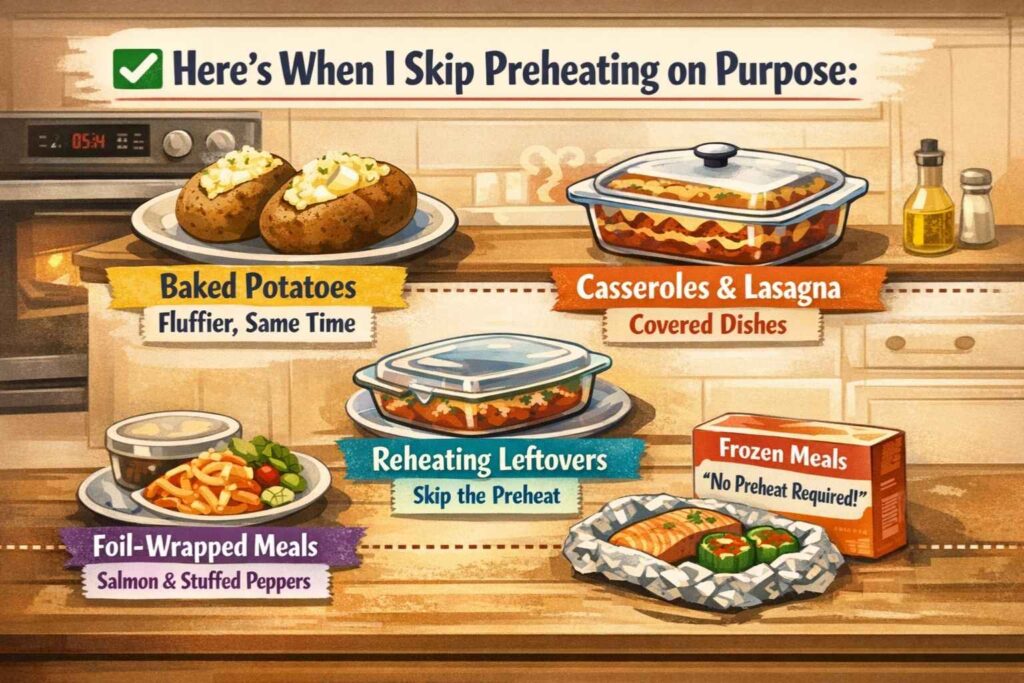
✅ Here’s when I skip preheating on purpose:
- Baked potatoes — they come out fluffier and take the same time
- Casseroles or lasagna — especially if they’re covered
- Leftovers — no need to waste energy preheating for a quick reheat
- Foil-wrapped meals — like salmon or stuffed peppers
Some frozen meals even say “no preheat required” on the box.
I’ve tried those with decent success — just don’t expect gourmet.
U.S. Brands That Support No-Preheat Cooking
A few brands are starting to lean into this idea.
- GE now has No Preheat Air Fry Ovens — I tested one during a demo, and it worked great for quick snacks
- Whirlpool’s Rapid Preheat mode cuts the wait time in half
- Frigidaire’s ReadyCook trays help circulate air even in a cold oven start
Still, even with these features, I don’t trust them for baked goods.
Quick meals? Sure.
Brownies for guests? Not a chance.
Climate + Kitchen Size: How Preheat Waste Differs by Region
I never thought about how much my kitchen’s location affected oven use… until I moved around. From muggy Florida to bone-dry Arizona to snow-packed Chicago — preheating hit differently in every place.
Florida: Humid, Hot, and Energy-Hungry
In my Florida rental, preheating the oven felt like flipping on a space heater.
Within minutes, the kitchen got stuffy. Then the AC kicked on — hard.
It was like burning energy in two directions at once.
Here’s what stood out:
- Electric oven took 15+ minutes to preheat
- I often ran the AC an extra hour after using it
- Even short preheats made the room noticeably warmer
Eventually, I changed how I cooked:
- Preheated early in the morning or late at night
- Used a toaster oven or air fryer for small meals
- Baked in bulk once or twice a week instead of daily
Arizona: Dry Air, Fast Heat, and Convection Benefits
Arizona brought a whole different challenge — dry heat and sunny afternoons that turned the kitchen into an oven before I even cooked.
But the good news?
My convection oven helped a lot.
- Preheated in just 6–8 minutes
- Circulated heat more efficiently
- Didn’t seem to overwork the AC like my Florida setup
I still avoided cooking during peak afternoon hours, though.
I once preheated at 2 p.m. in July — my fridge worked overtime to stay cool.
Lesson learned.
Chicago: Cold Winters Made Preheat Feel… Cozy?
Honestly? I didn’t mind preheating in the Midwest.
- The extra heat felt like a bonus
- My older GE electric oven was slow, but reliable
- I often cracked the door open after baking just to warm up the kitchen
Energy-wise, my winter bills weren’t bad.
Preheating didn’t spike them much — and sometimes helped lower my heating needs.
Funny enough, I baked more in Chicago winters than anywhere else.
Something about that warm kitchen smell made it feel worth it.
Kitchen Size Matters More Than I Thought
Smaller kitchens heat up faster.
If your oven is in a galley or near your thermostat, that heat hits your HVAC system fast.
In my Arizona rental:
- The oven was less than 4 feet from the thermostat
- One preheat cycle raised the room temp enough to trigger the AC
- I started putting a fan between the oven and the thermostat just to “trick” it
In Chicago, my oven was near the back door — better airflow, better balance.
Convection vs Conventional: Who Wastes Less During Preheat?
Not all ovens are built the same. Once I started using a convection oven more regularly, I noticed some real differences — not just in how food turned out, but in how long I had to wait (and how much heat I wasted in the process).
Conventional Ovens: Reliable but Slower
My old GE electric oven in Chicago was as basic as it gets.
No fans. No smart features. Just dials, coils, and the familiar click-whoosh sounds.
- Preheating took 12–15 minutes on average
- Hot spots were common, especially near the back
- If I opened the door mid-preheat, the temp dropped fast
I had to plan ahead.
If I forgot to preheat, dinner got delayed — or rushed (which almost always meant something got burnt).
And during summer months, that long preheat cycle turned into a full-on heat wave in my small kitchen.
Convection Ovens: Faster, Even, and More Efficient
When I moved into an Arizona place with a convection oven, I didn’t expect to love it.
But it changed my routine.
- Preheated in just 6–8 minutes
- Held temperature better — even if I opened the door
- Cooked more evenly across trays
The fan made a huge difference.
I didn’t have to rotate pans halfway through.
And when I was in a hurry, the shorter preheat time genuinely helped.
Energy-wise?
It used less time, which meant less electricity overall.
Side-by-Side Comparison: What I Noticed Most
I ran a simple test one week:
- Same frozen pizza
- One baked in my conventional oven (Florida)
- One in the convection oven (Arizona)
Here’s what happened:
| Feature | Conventional | Convection |
|---|---|---|
| Preheat Time | 14 min | 7 min |
| Total Cook Time | 22 min | 18 min |
| Result | Uneven crust, overdone edge | Evenly browned, crisper bottom |
| Kitchen Temp Rise | High | Moderate |
That was all I needed to see.
U.S. Brands with Better Preheat Efficiency
Some brands really lean into faster preheating — especially newer convection models.
- Samsung Flex Duo: dual oven zones with fast preheat
- KitchenAid True Convection: consistent results with good airflow
- LG InstaView: convection with built-in thermometer for temp tracking
- Frigidaire Gallery: decent price with solid fan performance
I’m not saying everyone needs a high-end model — but if you’re replacing an oven and care about energy use, convection is 100% worth considering.
Hidden Costs of Preheating You May Not Realize
Preheating isn’t just about electricity. Over time, I’ve noticed it affects my routines, my bakeware, and even my cooling bills — especially when I’m not paying close attention.
Wasted Time (and Mental Space)
There’s nothing worse than prepping everything… then realizing the oven’s still cold.
I’ve done it way too many times.
- You stand there, checking your phone, pacing
- Or worse — you walk away and forget, and the oven runs empty for 20 minutes
- I once preheated, then took a call and came back to a kitchen that felt like a sauna
These days, I always set a second timer — one to remind me to put the food in once it’s ready.
Because I’ve definitely let it sit too long more than once.
Cooking in Batches: My Energy-Saving Hack
After one summer where my electric bill jumped 25%, I started doing something new.
I began batch-cooking every Sunday.
- I’d preheat once, then roast veggies, bake chicken, toast nuts — all back to back
- Sometimes I’d even throw in dessert at the end
- One preheat, three meals = saved time, saved energy
It also made weekday meals faster.
And the kitchen didn’t feel like a furnace every night.
Extra Heat = Cooling Costs (Especially in Smaller Kitchens)
In my Florida rental, my oven was maybe 6 feet from the thermostat.
Every time I preheated, the room heated up enough to trigger the AC.
- A 15-minute preheat might cost me 6 cents in power
- But the AC running for an extra hour? That added dollars to the bill
- In summer, I avoided using the oven after noon altogether
In Chicago, I loved that heat. In Arizona? I had to run a fan and cook with the back door open.
Location really changes the impact of that “simple” preheat cycle.
Bakeware Risks: Yes, I’ve Cracked a Dish
I once put a cold Pyrex pan straight into a 450°F gas oven…
Crack. Shatter. Total mess.
- Glass bakeware doesn’t love thermal shock
- Preheating helps stabilize temperature — especially in gas ovens
- But if you skip or rush it, you risk damage
Now I either preheat with the pan inside (for roasting) or I switch to metal trays.
Safer, faster, and better browning anyway.
Tips to Reduce Preheat Energy Waste Without Sacrificing Results
After years of burning time (and sometimes cookies), I’ve figured out a few ways to keep things efficient without ruining dinner. These aren’t hacks — just real habits that actually helped.
Know When You Don’t Need to Preheat
This was a big mindset shift for me.
Not every dish needs a piping-hot oven from the start.
Here’s when I skip preheating now:
- Reheating leftovers — especially casseroles, pasta, or pizza
- Baked potatoes — cold start gives a creamier inside, in my experience
- Foil-wrapped meals — like salmon or veggies in packets
- Slow bakes — lasagna, mac and cheese, or any dish where moisture matters more than crisping
If the recipe doesn’t depend on a chemical rise or delicate browning?
I toss it in cold.
Use Convection When You Can
I didn’t always love convection ovens.
They felt fancy. Unnecessary.
But after using one full-time in Arizona, I became a fan.
- Preheats faster (sometimes 5–7 minutes)
- Cooks more evenly
- Retains heat better, so you open the door less
Just remember to lower the temperature by 25°F if the recipe doesn’t already adjust for convection.
Most modern ovens do this automatically now (shout-out to my Samsung Flex Duo for that one).
Batch Bake to Cut Down Preheats
This one changed my weekly flow.
I started baking smarter — not harder.
Here’s how I do it:
- Plan 2–3 meals that need a similar temp (like 375°F)
- Roast veggies, bake proteins, and prep lunches all in one oven session
- Even squeeze in a tray of cookies at the end — using that last bit of heat
One preheat. One kitchen cooldown.
No back-to-back energy spikes.
Bonus? My fridge stays stocked with ready-to-eat food, which keeps me from grabbing takeout.
Use an Oven Thermometer
This might sound extra, but trust me — it’s saved my meals more than once.
Oven dials lie.
- My old Whirlpool said 350°F, but inside was closer to 310°F
- That gap made me preheat longer than needed — wasting electricity without even knowing it
- A $10 oven thermometer fixed that
Now I preheat only until it hits the real temp — not the fake one the display says.
What I Do Now — My Personal Rule of Thumb
After years of cooking, testing, burning a few things, and comparing energy bills across three states… I finally found a rhythm that works for me. It’s not perfect, but it’s honest.
I Preheat When It Matters Most
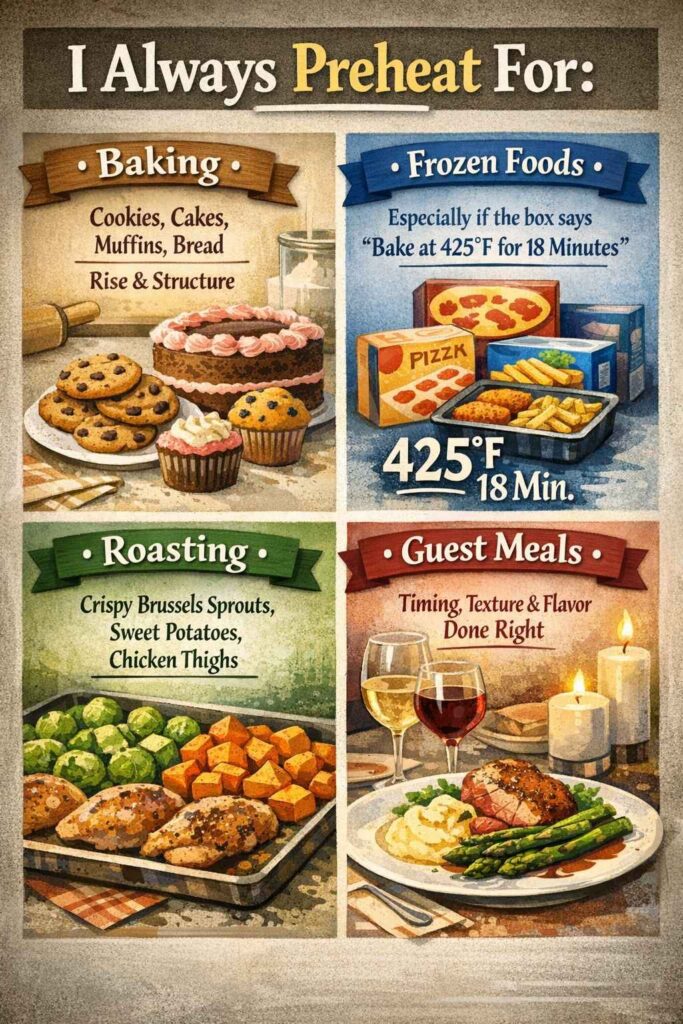
I always preheat for:
- Baking — cookies, cakes, muffins, bread (basically anything that needs rise or structure)
- Frozen foods — especially if the box says “bake at 425°F for 18 minutes”
- Roasting — when I want a crispy edge on Brussels sprouts, sweet potatoes, or chicken thighs
- Guest meals — when timing, texture, and flavor need to be right the first time
These are the situations where skipping preheat usually backfires — either in taste, texture, or time.
I Skip Preheat for Simple, Forgiving Dishes
Here’s when I don’t bother waiting:
- Reheats — like lasagna, mac and cheese, or baked ziti
- Foil-packet meals — salmon, stuffed peppers, leftover fajita wraps
- Casseroles — especially covered ones
- Meal prep — when I’m batch baking and don’t care if the first tray is a little slower to start
And to be honest?
Sometimes I just forget to preheat, and I roll with it.
It happens.
My Final Routine (in Real Life)
Here’s what I actually do most days now:
- Turn the oven on right as I start prepping
- Use an oven thermometer — ignore the preheat beep if it’s not accurate
- Cook multiple things while the oven’s hot — saves energy and dishes
- Skip preheat for anything that doesn’t need precision or browning
Is it perfect? No.
But it’s saved me money, time, and stress — and I still get the results I want.
So… does preheating waste electricity?
Sometimes, yes. But if you know when it’s truly needed — and when it’s not — it doesn’t have to.
FAQs
Does preheating waste electricity?
Preheating does use extra electricity, especially if you let the oven sit empty. But for most recipes, it helps food cook evenly and saves time overall.
Can I skip preheating the oven to save energy?
Yes, for some foods like frozen pizza or casseroles, skipping preheat saves power. But for baking, you risk uneven cooking or poor texture.
How much energy does preheating an oven use?
Preheating an electric oven to 400°F uses about 0.3–0.5 kWh. That’s roughly 5 to 8 cents depending on your U.S. energy rate and oven efficiency.
Does a gas oven use less energy when preheating?
Yes, gas ovens heat faster and cost less per minute to preheat than electric ones. But they still waste energy if left on too long before baking.
What’s the best way to reduce preheating waste?
Only preheat when needed, avoid opening the door, and put food in as soon as the oven reaches temp. For small meals, use a toaster oven or air fryer.

I’m Mossaraof, a trained chef and the founder of OvenInsights.com. I spent years cooking at Larrupin’ Cafe and in kitchens across Chicago and Seattle. Now I test kitchen gear for a living. I moved to North Acton, London, and I test every tool I write about. I use real meals and real heat. No brand deals. No shortcuts. I cover 12 kitchen types and hundreds of recipes. I believe this: the right tools matter as much as the recipe.