Does your heart sink when you see a high power bill after a week of home cooking? As a pro cook, I know the struggle of keeping costs down while feeding a hungry family, so I’ve found the best ways to save energy when using an oven daily. My years in the kitchen taught me that small habits lead to big wins for your wallet. Today, I will share my top secrets to help you roast and bake without the stress. Check out our Ultimate Guide: Energy Use & Costs to start saving right now!
🔥 Skip the Preheat (When You Can)
Preheating used to be automatic for me. I didn’t even question it. Cookies? Preheat. Frozen veggies? Preheat. But one random Tuesday in Arizona, I threw cauliflower in before the oven hit temp—pure laziness, honestly. And guess what? It roasted just fine.
When I Don’t Bother Preheating
Now I skip the preheat when I know it won’t ruin the texture or timing. Here’s what I do this with:
- Baked potatoes — they come out just as fluffy
- Casseroles — especially if they’re covered with foil
- Roasted veggies — they just need time, not a blast furnace
- Leftovers — no reason to waste power for a reheat
- Foil-wrapped salmon or peppers — sealed heat is forgiving
Some frozen foods even say “no preheat needed” right on the box. I finally started reading those instead of assuming every oven needs a runway.
When I Always Preheat
But I’m not reckless. I learned the hard way that some things absolutely need that hot start:
- Cookies — I once baked a batch too early. They spread like puddles.
- Bread — without a hot oven, it won’t rise or crust properly
- Muffins, cakes, pastries — anything that needs an early lift
- Frozen pizza — if the box says “bake at 425°F,” I trust it
Energy Notes
My Whirlpool oven takes about 12–15 minutes to hit 400°F. That’s about 0.3 to 0.5 kWh, depending on the oven type. In some cases, that preheat cycle uses more energy than the whole bake. So if I can avoid it without ruining dinner, I do.
One thing I noticed in summer (especially in Tucson): skipping the preheat also means the kitchen doesn’t heat up as much. That’s a big win when the AC is already fighting for its life.
♨️ Use Residual Heat to Your Advantage
This trick came to me by accident one night in Chicago. I was roasting chicken thighs and totally forgot to turn the oven off when the timer buzzed. By the time I remembered—ten minutes later—they were perfect. Crispy edges, juicy inside, and I hadn’t wasted a bit of extra power.
That little experiment turned into a habit.
How I Use Leftover Oven Heat
Now I plan for it. I shut off the oven before the food’s done and let it coast to the finish line. Kind of like coasting your car downhill to save gas.
Here’s how I do it:
- Turn off the oven 5 to 15 minutes before the timer ends
- Keep the door shut (that trapped heat keeps working)
- Let the food rest inside — finish cooking without fresh power
It’s not magic. It’s just thermal mass. Ovens stay hot for a while, especially if yours is well-insulated. My KitchenAid oven in Florida? That thing holds heat like a sauna. In Arizona, I use it to my advantage so I’m not reheating a room I’m already sweating in.
What Dishes It Works For
Not everything handles the “coast to done” method, but plenty do:
- Roasted veggies — they continue to caramelize
- Lasagna — still bubbles even after I shut it down
- Chicken thighs — crispy skin holds strong
- Baked mac & cheese — thick dishes stay hot and creamy
- Baked pasta with foil — keeps heat sealed even better
If I’m feeling unsure, I give the food a quick probe. Or I just cut in and see. I’m not fancy—just cautious.
What Doesn’t Work
If you’re baking something that’s time-sensitive or needs structure, this won’t work:
- Bread (especially crusty artisan loaves)
- Delicate pastries or soufflés
- Cakes — they’ll collapse if the heat drops too early
I’ve learned to let these guys finish with a full heat cycle. But for most dinners? Residual heat does the job without costing me extra on the electric bill.
🍗 Cook Multiple Dishes at Once
Every Sunday in my Arizona kitchen, I fill the oven like it’s a Tetris board. Roasted chicken, sweet potatoes, Brussels sprouts, sometimes a banana bread if I’m ambitious. The more I stack in, the more efficient the whole session becomes.
Why It Saves Energy
Here’s the thing: preheating takes energy. Cooking takes energy. But if I run the oven once for three dishes instead of three times for one each, I’m cutting total cook time and energy use way down.
Less cycling = fewer preheats = big win.
Plus, the oven’s already hot. I’m using every corner of it—top rack, middle, even the low one when I feel brave.
My Real Combos
Here’s how I pair things:
- Sheet pan dinner (chicken + root veggies) on the middle
- Banana bread or baked oats up top (less direct heat)
- Mac & cheese or a casserole on the bottom (heaviest dish)
I rotate if I need to. I don’t stress too much. If something browns too fast, I swap racks or cover it in foil. Trust me, once you get a feel for your oven’s hot spots, this method makes so much sense.
What to Watch
Cooking multiple dishes isn’t perfect. Sometimes it gets messy—especially if I crowd the pans.
- Watch for uneven heat — rotate halfway
- Don’t block the airflow completely
- Use pans that fit — I avoid oversized baking sheets that trap circulation
And one very important tip: strong-smelling dishes don’t mix. I once roasted garlic broccoli under a pan of blueberry muffins. Bad idea. They tasted… confused.
🌡️ Calibrate Your Oven Temperature
If I had a dollar for every time an oven lied to me, I’d buy a new one. My Frigidaire in Florida ran 30°F hotter than what I set. I kept burning cookies and couldn’t figure out why. Then I stuck a thermometer inside.
That’s when I learned: don’t trust the dial.
Why This Matters
An oven that runs hot or cold changes everything:
- Cook times are off
- Energy use goes up
- Food comes out wrong — burnt edges, underdone middles
- You might extend the bake time without realizing
And if you think a smart oven will save you here? Maybe. But even my newer GE Profile needed recalibration.
How I Check My Oven
This is my simple process:
- Put an oven-safe thermometer in the center
- Set the oven to 350°F
- Wait 20–30 minutes after it says “preheated”
- Check the actual internal temp
I do this a few times just to be sure. Ovens swing up and down as they heat. You want an average, not a one-time fluke.
You can also do the sugar melt test (seriously):
- Sugar melts cleanly at 366°F
- If it doesn’t melt, your oven runs cold
- If it caramelizes fast, it’s running hot
What I Do If It’s Off
Some ovens let you recalibrate the temp yourself (read your manual—most people never do). Others need a service call. But at the very least, knowing your oven’s “real” temperature helps you adjust your cooking without wasting extra energy.
🚫 Why I Stopped Opening the Oven Door
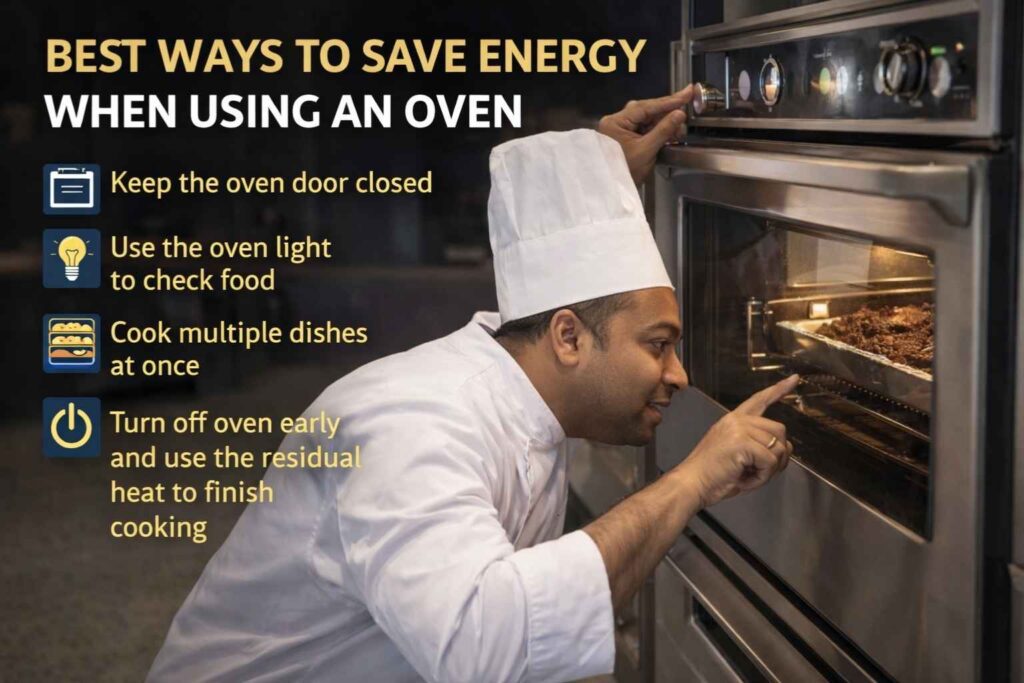
I used to peek all the time. I’d crack the oven door for a quick sniff or poke—especially when baking. It felt harmless, right? But it turns out, each time I opened that door, I was throwing away heat like it was a free sample.
What Actually Happens When You Peek
When you open the door:
- You lose 20–50°F almost instantly
- The oven’s sensor kicks in, trying to reheat
- That spike pulls extra electricity or gas
- Your bake time stretches (and energy use climbs)
I learned this the hard way while baking brownies in my Chicago apartment. Every peek pushed the finish line further. What should’ve been a 35-minute bake took nearly 50. They came out dry—and not in the good fudgy way.
What I Do Instead
Now, I’ve made peace with trusting the process:
- I use the oven light and window (finally cleaned that thing)
- I rely on timers and my nose — when it smells ready, it usually is
- For longer bakes, I rotate once halfway—but that’s it
- If I have to check, I do it fast and shut the door immediately
The difference? Smoother cooking, fewer over-bakes, and noticeably lower oven cycling. Especially with electric ovens, less cycling = less power drain.
🔌 The Cookware That Actually Saves Energy
You ever use a flimsy baking tray and wonder why dinner takes forever? I have. In college, I bought two dollar-store pans that warped at 400°F. They cooked unevenly and leaked heat like a busted window.
Since then, I’ve tested every type of cookware—from vintage Pyrex to cast-iron beasts. Some are just better at holding heat. That matters more than most people realize when it comes to energy savings.
My Go-To Cookware Picks
Here’s what I’ve stuck with (and why):
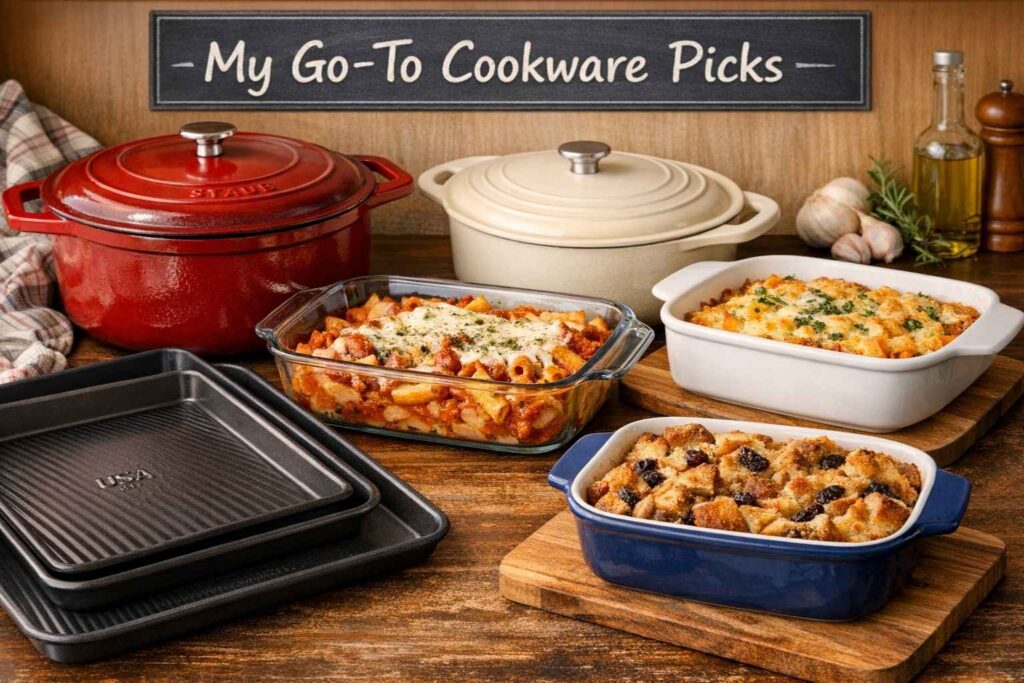
- Enameled cast iron (like Staub and Le Creuset)
- Holds heat beautifully
- Keeps food hot even after the oven’s off
- Great for turning off the oven early
- Dark metal pans (like my USA Pan sheet trays)
- Absorb heat faster
- Cook faster = less oven time
- Amazing for roasted veggies or quick cookies
- Glass baking dishes
- Heat slowly, but retain warmth well
- I use these for lasagna, baked ziti, and bread puddings
- Easy to reheat leftovers in same dish
- Ceramic dishes
- Even cooking, especially for casseroles
- Perfect for oven-to-table meals — less dish juggling
What I Avoid
These just didn’t work for me:
- Cheap aluminum pans — they cool too fast
- Warped or dented trays — lead to uneven baking
- Nonstick pans with scratches — they heat unevenly and smell funky at high heat
And honestly, I stopped using oversized pans unless I really needed them. Too much empty space means more oven energy wasted just heating air.
🧽 Why I Clean the Oven (More Than I Used To)
I’ll admit it: I used to avoid cleaning my oven until something literally caught fire. A few years ago, in Florida, a slice of cheese dripped off a tray and burned on the bottom for weeks. Every time I used the oven, smoke rolled out like I was cooking brisket. Except it was just frozen pizza.
That buildup? It wasn’t just gross. It was costing me energy.
What a Dirty Oven Does
- Absorbs heat inefficiently
- Triggers the thermostat to run longer
- Can block convection fans or airflow
- Makes the kitchen smell like burnt mystery gunk
That same pizza took longer to bake and cooked unevenly—crispy in one corner, soggy in the middle.
How I Clean It Now
Nothing fancy. I don’t love the self-clean cycle (uses a ton of energy), so I do it my way:
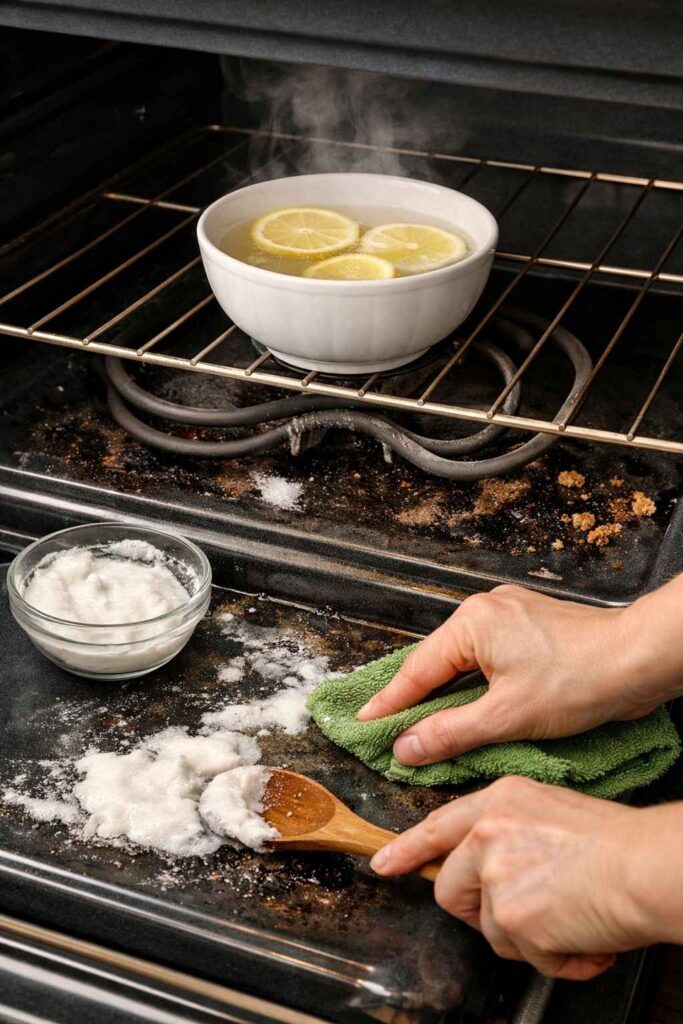
- Steam clean — Bowl of water and lemon juice at 250°F for 30 mins
- Baking soda paste — For stuck-on spots (leave overnight, wipe clean)
- No bleach or harsh chemicals — Especially if I’ll be baking soon after
I check for burnt-on grease under the coil and crumbs in the corners. A clean oven heats faster, cycles less, and cooks way more evenly. And it smells better. Always a plus.
🕒 Best Time of Day to Use the Oven
I didn’t think timing mattered until I moved to Arizona. Summer hit, and suddenly my electric bill felt like a second rent. I called my utility company and found out about “time-of-use” rates. Turns out, when you use your oven matters just as much as how.
What I Learned from My Utility Bill
Many U.S. energy providers charge more during peak hours—usually late afternoon to early evening. That’s when everyone’s home, cranking the AC and running appliances.
My local plan in Tucson had these rate windows:
- Peak: 3 p.m. – 7 p.m. → highest cost
- Off-peak: Before 3 p.m. or after 7 p.m. → cheaper
- Super off-peak (some plans): 10 p.m. – 6 a.m.
One time, I baked a chicken at 6 p.m. and paid nearly double the kWh rate compared to baking it the next morning. That was enough to make me rethink dinner timing.
My New Oven Schedule
Now I plan ahead—especially when I know I’ll be baking or roasting:
- Morning bakes — bread, muffins, casseroles
- Late night meal prep — roasted veggies, full trays of chicken
- Weekend batch cooking — I avoid Sunday evenings, when everyone’s using power
Bonus? My kitchen stays cooler in the evening when I skip the oven. And in winter (like when I was in Chicago), I lean into baking during the day—lets the oven help heat the house.
🔁 Convection Mode — When It’s Worth It
I used to ignore the “convection” button on my oven. It felt like overkill—something for pro kitchens or technical recipes. But one day, out of curiosity, I turned it on while roasting vegetables. They browned faster, more evenly, and I shaved off 10 minutes of cook time. I’ve been a believer ever since.
What Convection Actually Does
It uses a fan to circulate hot air evenly throughout the oven. That means:
- Faster cook times
- Even browning (especially for cookies and veggies)
- Lower temperatures needed (I drop 25°F from standard settings)
- Reduced hot spots — especially helpful in older ovens
It works best when the air can flow freely, so I avoid deep pans or tightly packed trays.
When I Use It
- Roasting potatoes, carrots, squash — crispy edges in less time
- Baking multiple trays of cookies
- Broiling meat with a crisp finish
- Reheating leftovers that need texture (like fries or pizza)
When I Don’t Use It
- Custards, soufflés, delicate pastries
- Cakes that need stable, gentle rise
- Anything tightly wrapped in foil (blocks airflow)
If your oven has convection and you’re not using it, give it a try. Just remember to reduce the temp by 25°F and check early—it really does cook faster.
🧯 Sealing the Oven Properly (Gaskets, Hinges, Leaks)
This one took me a while to catch. In my Chicago apartment, the oven door didn’t close all the way. I figured it was just old. But every time I baked, it ran hotter and longer than it should have. I finally checked the gasket—and it was cracked and peeling.
Why This Matters
A loose or damaged seal means heat leaks out. Constantly. That makes your oven work harder to stay at temp—and that means more energy use.
Here’s what I’ve noticed when the seal is off:
- Oven takes longer to preheat
- Temps fluctuate more
- Food cooks unevenly (front stays cooler, back browns fast)
- Your kitchen gets hotter (hello, Florida summers)
How I Check
I do a quick paper test:
- Open the oven door and stick a strip of paper between the seal and the door frame
- Close the door and tug gently
- If the paper slides out easily, the seal’s too loose
I also look for:
- Cracks or splits in the gasket
- Baked-on gunk blocking the seal
- Hinges that don’t close the door flush
How I Fixed Mine
Replacing the gasket was easier than I thought. I ordered one online for about $20 and installed it in 15 minutes. No tools. Just clips and a bit of patience.
Since then, my oven heats faster, holds temp better, and runs shorter cycles. The difference on my power bill? Small—but noticeable over time.
🛠️ The Right Rack Placement for Efficient Cooking
I used to throw everything on the middle rack by default. No thought, no strategy—just habit. But once I started playing with rack positions, I realized I could save time, cook more evenly, and even cut down how long the oven stayed on.
Why Rack Placement Matters
Each rack level handles heat differently:
- Top rack = hotter, crispier, closer to broiler
- Middle rack = balanced heat, best for even baking
- Bottom rack = slowest heat, great for roasts and heavy dishes
By putting the right food in the right zone, I cook faster—no need to add time or blast the temp.
What I Do Now
Here’s how I use my oven racks:
- Cookies or muffins? Middle rack. No burn, even rise.
- Roasting chicken thighs or bacon? Top rack. Crisp city.
- Lasagna or heavy casseroles? Bottom rack. Steady, slow heat.
- Multiple dishes at once? Rotate halfway, switch rack levels if needed.
In my Whirlpool oven back in Florida, the bottom ran cooler. But in my newer LG gas oven here in Arizona, the top rack gets toasty fast. Every oven’s different—once you know your heat zones, you can make smarter choices.
Small Trick That Helped
I tested this using slices of white bread. Put one on each rack. See which one browns first. It’s a quick way to find your oven’s hot spots without wasting a full dish.
👨🍳 When I Use My Toaster Oven Instead
In the summer, especially down here in Arizona, I’ll do almost anything to avoid heating up the full oven. That’s when my trusty toaster oven steps in. It’s small, fast, and surprisingly powerful for basic meals.
Why I Make the Switch
A standard oven can use up to 2.0–2.3 kWh/hour. My Breville Smart Oven uses about 0.7–1.0 kWh/hour, depending on the setting. That’s a big difference over time.
Plus:
- Heats up in under 5 minutes
- Doesn’t warm the whole kitchen
- Great for small batches or reheats
When I Use It
- Leftovers — pizza, pasta, roasted veggies
- Frozen meals — burritos, fish sticks, or Trader Joe’s stuff
- Quick bakes — a couple cookies, toast with flair, garlic bread
- Small proteins — pork chops, salmon filets, chicken breast
When I Don’t
- Big trays or sheet pans
- Whole roasts or multi-layer dishes
- Large family meals
It’s not a perfect substitute—but for 1–2 servings or small-batch bakes, it’s my go-to.
🧠 Meal Planning for Oven Efficiency
Sundays in my house smell like roasted garlic, spiced carrots, and baked mac & cheese. That’s because I batch cook almost everything I can. It started as a time-saver. But turns out, it’s an energy saver too.
Why Batch Cooking Works
When the oven’s already hot, every extra dish you add costs you less energy. Plus:
- Fewer preheat cycles
- Consolidated cooking time
- Less heat loss from opening the door over and over
- Smarter reheat options during the week
What I Do
Here’s my usual Sunday bake plan:
- Tray 1: Chicken thighs or marinated tofu
- Tray 2: Sweet potatoes, onions, carrots
- Tray 3: Casserole or baked pasta
- Tray 4 (if I’m feeling fancy): Baked oatmeal or banana bread
I cook all of it back-to-back, sometimes overlapping. Then I store it in glass containers (I use Pyrex and Ello) and just reheat in smaller devices during the week.
My Tools
- Weekly whiteboard meal plan on my fridge
- Timer app (I like Paprika for recipe storage)
- Post-it notes for what rack gets what (I’m forgetful mid-cook)
The upfront work saves me time, stress, and plenty of energy. And I don’t end up eating cold cereal on a Tuesday night.
🔌 Turning Off Early (Carryover Cooking, Again!)
This one’s so simple—and yet I didn’t start doing it until last year. I used to bake everything to the last tick of the timer. When it said 40 minutes, I waited 40 minutes. Then I realized I could turn the oven off a little early and let the heat finish the job.
It’s kind of like letting meat rest off the grill. The heat doesn’t disappear the second you cut the power—it lingers. Might as well use it.
How I Do It
- For smaller dishes (cookies, roasted veggies):
I shut off the oven about 3–5 minutes early. - For big trays (lasagna, casseroles):
I give it 10–15 minutes before the timer ends.
Then I just leave it alone. Door closed, no peeking. The food keeps cooking on its own.
What It Works Best For
- Baked pasta and rice dishes
- Roasted vegetables
- Chicken thighs or drumsticks
- Even frozen foods — especially ones already browned
Just keep in mind: don’t try this with bread or soufflés. They need consistent heat to finish properly.
It took me some trust to get into this habit. I used to be nervous the food would be underdone. But with a quick temp check—or just slicing into the edge—you can tell fast if it’s good to go.
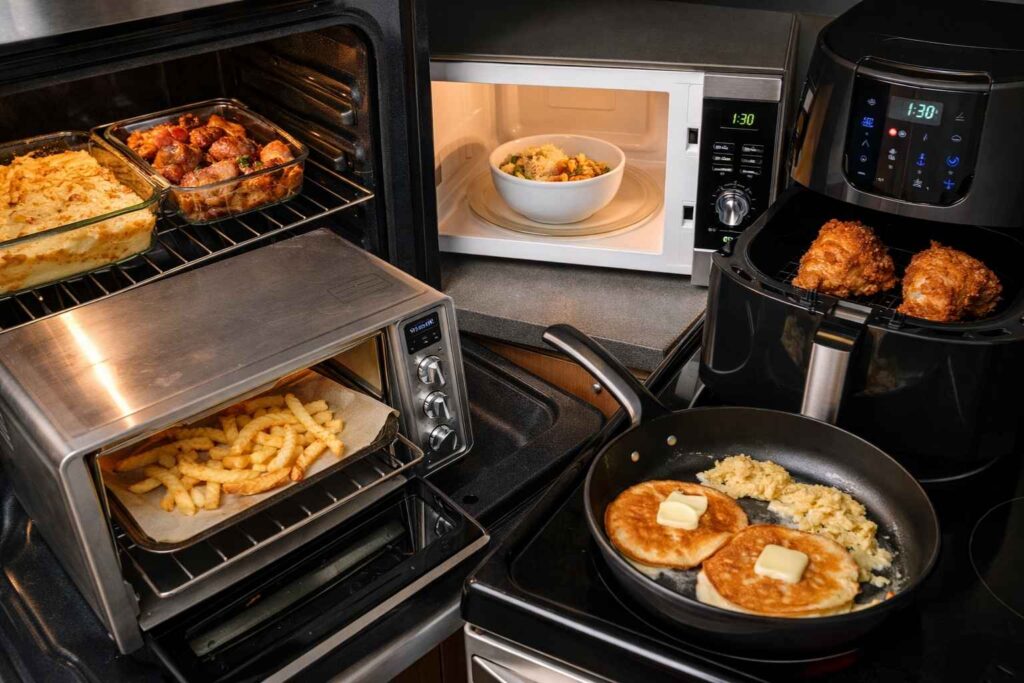
🧊 Reheat Smarter, Not Hotter
I used to pop everything into the oven for reheating—leftover pizza, roasted veggies, even soup (in an oven-safe bowl). But that’s not always the smartest play. Especially not for a single serving.
Now I think about what tool makes the most sense. Sometimes it’s the oven. Other times, it’s not.
What I Learned
- Full oven reheats for one plate? Huge waste of energy.
- I only use the oven to reheat if I’m doing multiple portions or want a crisp texture (like fries or baked pasta).
- Otherwise, I reach for:
- Toaster oven → reheats fast, keeps food crisp
- Microwave → works fine for soups, rice, even potatoes
- Air fryer → amazing for anything that was originally fried or roasted
- Skillet reheat → for eggs, pancakes, or saucy stuff
If I’m already using the oven, I’ll toss in a leftover dish to warm while the main one cooks. No extra cycle. No extra cost.
✅ Quick-Scan Reference: Energy-Saving Oven Chart
Sometimes it helps to just see it all at a glance. So here’s my cheat sheet—what I use in my own planning week to week.
| Strategy | When I Use It | Energy Impact |
|---|---|---|
| Skip Preheat | Casseroles, veggies, leftovers | Cuts out 0.3–0.5 kWh per use |
| Residual Heat Finish | Roasts, baked pasta | Save 5–15 min per cook |
| Batch Cook | Sunday meal prep | Consolidates oven cycles |
| Convection Mode | Roasting, multiple trays | Shorter bake times, lower temps |
| Proper Rack Use | All cooking | Prevents over-baking, less rework |
| Toaster Oven Instead | Small meals, leftovers | Uses half the power |
| Clean Oven | Monthly | Improves heat flow and cycle time |
| Seal Check | Every 6–12 months | Keeps oven efficient |
| Off-Peak Baking | Morning/evening | Utility savings depending on region |
FAQs : Best Ways to Save Energy When Using an Oven
Does preheating the oven waste energy?
Yes, preheating uses 0.3–0.5 kWh. Skip it when baking casseroles, veggies, or leftovers unless the recipe needs precision like cookies or bread.
What is the most energy-efficient way to cook in the oven?
Batch cooking with proper rack use, skipping preheat when possible, and turning off early while using residual heat is most efficient.
Should I use convection mode to save energy?
Yes. Convection mode cooks faster and more evenly at lower temps. Just reduce your recipe temp by 25°F and monitor closely.
Is it cheaper to use a toaster oven than a full oven?
Yes. Toaster ovens use half the energy or less, making them ideal for small meals or single portions, especially in warmer climates.
How often should I clean my oven for best energy use?
Clean monthly. Baked-on grime absorbs heat, slows cooking, and causes cycling. A clean oven cooks faster and saves energy.

I’m Mossaraof, a trained chef and the founder of OvenInsights.com. I spent years cooking at Larrupin’ Cafe and in kitchens across Chicago and Seattle. Now I test kitchen gear for a living. I moved to North Acton, London, and I test every tool I write about. I use real meals and real heat. No brand deals. No shortcuts. I cover 12 kitchen types and hundreds of recipes. I believe this: the right tools matter as much as the recipe.