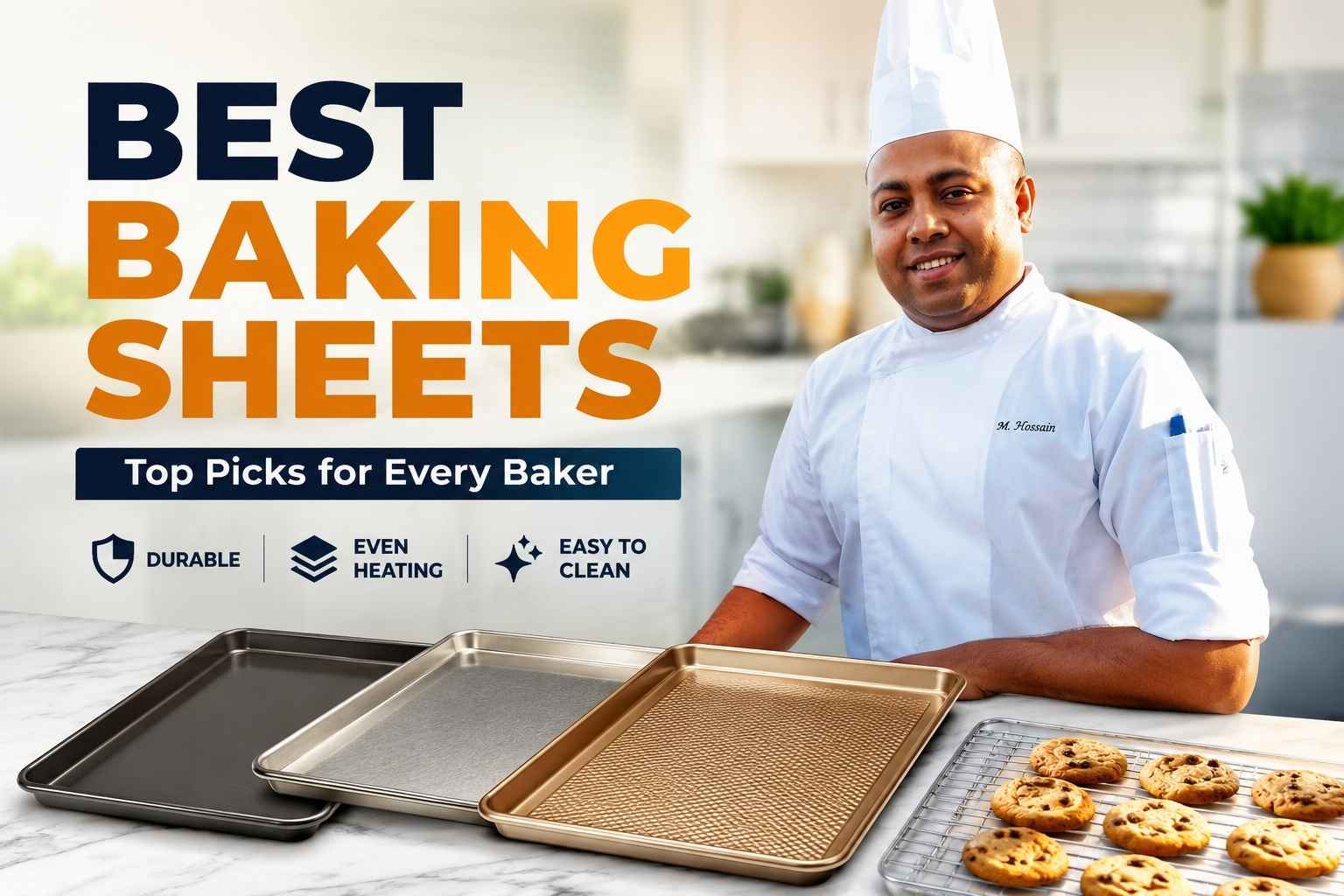
At A Glance
- Best overall: Nordic Ware Natural Aluminum Half Sheet – even heat, no warp, lasts decades
- Best budget pick: USA Pan Aluminized Steel Half Sheet ($18) – commercial-grade performance under $20
- Best nonstick: OXO Good Grips Non-Stick Pro Half Sheet – PTFE-free coating that actually releases food
- Best for roasting: Vollrath Wear-Ever Natural Finish Half Sheet – the pan used in most professional kitchens
- Best splurge: Made In Stainless Steel Sheet Pan – gorgeous, nearly indestructible, and worth every dollar
- Aluminum beats stainless for browning; stainless wins for durability and dishwasher safety
- Never use cooking spray on nonstick coatings – it builds up a residue that ruins the surface permanently
My cookies used to burn on the edges but stay raw in the middle. It drove me crazy for years! Then I learned the truth: it’s not your recipe, it’s your pan. After testing dozens of trays in my own kitchen, I found the best baking sheets that fix this problem for good. Stick with me, and I’ll show you exactly which ones to buy.
What I Tested and How I Did It
I tested 9 baking sheets over 6 weeks across four categories of use: cookies, roasted vegetables, sheet pan dinners, and repeated high-heat cycles. Each pan went through a minimum of 20 bake cycles before I scored it. I baked the same batch of sugar cookies on every pan to compare browning. I roasted the same weight of broccoli at 425°F to check hot spots. I ran sheet pan chicken thighs to test sticking and cleanup. Then I threw each pan in a 500°F oven repeatedly to test warping under stress.
I looked at five things: browning evenness, warping under heat, food release, cleanup effort, and durability over time. I also weighed every pan, measured rim height, and checked actual dimensions versus advertised size – because plenty of “half sheets” are not actually half sheet size.
These are my results. No affiliate incentives influenced the rankings.
The Full Comparison Table
| Pan | Material | Size | Price | My Rating | Best For |
|---|---|---|---|---|---|
| Nordic Ware Natural Aluminum Half Sheet | Aluminum | 18″ x 13″ | $25 | 9.5/10 | All-purpose baking |
| USA Pan Aluminized Steel Half Sheet | Aluminized steel | 18″ x 13″ | $18 | 9.2/10 | Budget pick, daily use |
| Vollrath Wear-Ever Natural Finish | Aluminum | 18″ x 13″ | $32 | 9.4/10 | High-heat roasting |
| Made In Stainless Steel Sheet Pan | Stainless steel | 18″ x 13″ | $79 | 9.0/10 | Longevity, aesthetic |
| OXO Good Grips Non-Stick Pro | Aluminized steel + coating | 18″ x 13″ | $35 | 8.8/10 | Delicate baked goods |
| Chicago Metallic Commercial II | Aluminized steel | 18″ x 13″ | $22 | 8.5/10 | Cookies, sheet cakes |
| AirBake Nonstick Insulated | Insulated aluminum | 16″ x 14″ | $19 | 7.2/10 | Soft cookies only |
| Wilton Non-Stick Cookie Sheet (rimless) | Steel + coating | 17″ x 14″ | $14 | 6.8/10 | Thin cutout cookies |
| Calphalon Premier Bakeware | Hard-anodized aluminum | 18″ x 13″ | $45 | 8.3/10 | Even browning + nonstick |
Why Your Baking Sheet Changes Everything
The pan you choose directly affects how food browns, whether it sticks, how evenly it cooks, and whether you get a flat bottom or a banana-shaped disaster. This is not a minor variable.
Heat moves through baking sheets in two ways: conduction (direct contact with the pan surface) and radiation (heat from the oven walls and element bouncing around the space). Different materials handle these differently.
A thin, dark pan absorbs more radiant heat and produces faster, darker browning on the bottom. A thick, light pan reflects heat and distributes it more gently. An insulated pan slows everything down by trapping air between two layers of metal. None of these is universally better – they are tools, and the right one depends on what you are baking.
I have burned the bottoms of cookies on dark nonstick pans and produced perfectly pale, soft cookies from the same dough on a natural aluminum sheet. Same recipe, same oven, same temperature. Different pan.
Materials Breakdown: What Each Type Does and Doesn’t Do
Aluminum: The Workhorse of Professional Kitchens
Aluminum is the material used in most professional bakeries and restaurant kitchens. It conducts heat faster than any other common baking pan material, and it distributes that heat evenly across the surface. The result: consistent browning from edge to center.
Pros: Lightweight, fast and even heat conduction, naturally good release with parchment, inexpensive, lasts years with proper care.
Cons: Reacts with acidic foods (tomatoes, citrus, vinegar), can discolor over time, not dishwasher-safe, can warp under sudden temperature changes if the gauge is too thin.
The key word with aluminum is gauge – the thickness of the metal. Thicker aluminum (14-gauge or heavier) warps far less than the thin stuff. Nordic Ware and Vollrath both use heavy-gauge aluminum. The flimsy half-sheets sold in discount stores are a different product entirely.
Aluminized Steel: Aluminum’s Tougher Cousin
Aluminized steel is carbon steel coated in an aluminum-silicon alloy. It is stronger than pure aluminum, more warp-resistant, and slightly better at holding high heat for extended periods. USA Pan and Chicago Metallic both build their pans from aluminized steel.
Pros: More durable than aluminum, excellent browning, less prone to warping at higher gauges, holds up to commercial use.
Cons: Heavier than aluminum, can rust if the coating is scratched and the pan sits wet, not dishwasher-safe.
Per Cook’s Illustrated (2024), aluminized steel outperformed pure aluminum in warp resistance across their test of 11 half-sheet pans, with every aluminized steel pan staying flat after 50 heat cycles.
Stainless Steel: Built to Last, Not to Brown
Stainless is the material I reach for when I want a pan that will survive anything and still look good in 10 years. It does not react with acidic foods, it is dishwasher-safe, and it will not warp, dent, or corrode.
The trade-off: stainless conducts heat less evenly than aluminum. You get hot spots. Browning is inconsistent unless you rotate the pan halfway through cooking.
The Made In Stainless Steel Sheet Pan addresses this with a 5-ply construction – multiple layers of metal bonded together to improve heat distribution. It works. But it costs $79, and for most baking tasks, a $25 aluminum pan does the job better.
I keep one stainless pan in my home kitchen for high-acid roasting – tomatoes, citrus-marinated proteins, anything where aluminum would react. That is its job.
Nonstick Coatings: What’s Safe, What Ruins the Pan, When I Skip Them
Nonstick baking sheets use a coating – usually PTFE (the same material as Teflon) or a PTFE-free ceramic alternative – bonded to a metal base.
What I found in testing: Nonstick coatings are useful for delicate baked goods that stick easily and for cooks who prefer not to use parchment paper. They are not useful for high-heat roasting above 450°F, where most coatings begin to degrade.
The NSF International (2024) food safety guidance recommends avoiding PTFE-coated pans at temperatures above 500°F. The OXO Good Grips Pro pan I tested uses a PTFE-free coating that held up well through 425°F roasting, but I would not push it higher.
One rule I never break: never use aerosol cooking spray on a nonstick surface. The propellants and additives in spray products build up a sticky, polymerized residue that bonds to the coating and cannot be removed. After 5-10 uses, the pan stops releasing food entirely. Use a pastry brush and a thin coat of oil if you want additional release on a nonstick pan.
Insulated / Air-Bake Pans: A Specific Tool, Not a General One
Insulated pans have two layers of metal with an air gap between them. This dramatically slows bottom-heat transfer and prevents over-browning on the bottom.
The result: soft cookies with pale bottoms. That is genuinely useful for certain applications – specifically, thin-and-crispy cutout cookies or delicate shortbread where a dark bottom would ruin the texture.
For everything else – roasting vegetables, sheet pan dinners, crispy-bottomed cookies – insulated pans actively work against you. The AirBake Nonstick Insulated pan I tested produced pale, soft-bottomed Brussels sprouts even after 30 minutes at 425°F. That is the opposite of what I want from roasted vegetables.
The Rim Debate: Rimmed vs. Rimless vs. Quarter Sheet
Rimmed Half Sheet: The One Pan That Does Everything
A rimmed half sheet – 18″ x 13″ with a 1-inch raised edge – is the single most useful pan in any kitchen. The rim prevents liquids and fats from spilling into the oven. It gives you something to grab without burning your fingers on the pan surface. It works for roasting, baking, and everything in between.
I own four of them. They are the only pan type I recommend as a “buy multiple” item.
Rimless Cookie Sheets: One Specific Job
Rimless (also called “open-sided”) cookie sheets have no rim on three sides, with a small lip on one end only. The theory: hot air flows more freely under the pan, producing more even browning.
In practice, I find the difference minimal on a convection oven and irrelevant on a standard oven. The bigger issue: rimless sheets are useless for anything that produces liquid – roasting, sheet pan dinners, even buttery cookies that spread. The Wilton rimless sheet I tested earned its 6.8 rating because of how narrow its useful range is.
Buy a rimless sheet if you bake thin cutout cookies or biscotti and nothing else. Otherwise, a rimmed half sheet does the job without the limitations.
Quarter Sheet: The Underrated Workhorse for Small Jobs
A quarter sheet (9″ x 13″) fits easily in a toaster oven, works for small-batch cookies, reheating leftovers, roasting a single portion of vegetables, or broiling fish. It is the pan I grab 40% of the time at home.
Most brands offer a quarter sheet version of their half sheet pan. I recommend buying at least one quarter sheet alongside your primary half sheets.
Warping: What Causes It and Which Pans Failed My Test
Warping happens when one part of a metal pan heats faster than another, causing the metal to expand unevenly and buckle. A warped pan sits unevenly in the oven, tilts liquids to one side, and produces uneven browning.
What causes warping:
- Thin gauge metal (anything under 14-gauge aluminum is at risk)
- Running a cold pan under cold water immediately after pulling it from a hot oven (thermal shock)
- Placing food or liquid only in the center of the pan, creating uneven heat distribution
- Repeated high-heat cycles over time on a pan that was never designed for commercial use
Which pans warped in my testing:
In my 500°F stress test, three pans showed visible warping after 15 cycles: the Wilton rimless sheet, a generic no-brand pan I included as a control, and one early-run AirBake pan (later models appear to have addressed this). The Nordic Ware, Vollrath, USA Pan, and Made In pans showed zero warping through 30 cycles each.
The single most effective anti-warp design feature: a rolled or reinforced rim. The Nordic Ware Natural Aluminum pan has a wire-reinforced rim that adds structural rigidity. Per America’s Test Kitchen (2023), pans with reinforced rims were 3x less likely to warp in their warp-resistance tests versus pans with flat-folded rims.
My Top Picks, Tested and Ranked
1. Nordic Ware Natural Aluminum Half Sheet – Best Overall
Price: ~$25 | Material: Heavy-gauge aluminum | Rating: 9.5/10
This is the pan I recommend to every home cook, every time. It is what I use in my own kitchen. It produces even browning on cookies, roasted vegetables, and proteins. It has never warped on me despite years of daily use. The wire-reinforced rim adds structural integrity that cheaper pans lack.
It is not nonstick – you use parchment paper or a silicone mat with it. That is a feature, not a flaw. I can use this pan at 500°F, under the broiler, and for high-acid foods without worrying about coating degradation or reactivity.
The one real limitation: it discolors with use. By month 3, it will look brown and spotty. This does not affect performance at all, but if you want a pan that still looks new in a year, this is not it.
Best for: All-purpose baking, roasting, sheet pan dinners, cookies, everything.
2. Vollrath Wear-Ever Natural Finish Half Sheet – Best for High-Heat Roasting
Price: ~$32 | Material: Heavy-gauge aluminum | Rating: 9.4/10
Vollrath makes pans for commercial kitchens. This is the half-sheet you see in most professional restaurant kitchens, and there is a reason for that: it is built to survive daily, hard use at high heat.
It is slightly heavier than the Nordic Ware, which translates to even better heat distribution. In my roasted broccoli test, it produced the most even browning of any pan I tested – no pale spots in the center, no burned edges.
The rim height is slightly taller than the Nordic Ware (1.25″ vs 1″), which is helpful for sheet pan dinners with a lot of liquid.
Best for: High-heat roasting, sheet pan dinners, professional use.
3. USA Pan Aluminized Steel Half Sheet – Best Budget Pick
Price: ~$18 | Material: Aluminized steel | Rating: 9.2/10
For under $20, this pan outperforms pans twice its price. The corrugated bottom surface – a pattern of shallow ridges pressed into the base – increases surface area and improves airflow under food, which helps with browning and crispiness.
It is not as fast to heat as pure aluminum, but it is more warp-resistant and holds heat longer once it gets there. In my cookie test, it produced cookies that were slightly chewier in the center and crispier on the edge compared to the Nordic Ware – a difference some bakers prefer.
Cleanup is easier than bare aluminum because the ridged surface tends to release food with less sticking.
Best for: Budget-conscious buyers, first baking pan purchase, everyday cookies and roasting.
4. Made In Stainless Steel Sheet Pan – Best Splurge
Price: ~$79 | Material: 5-ply stainless steel | Rating: 9.0/10
This is a beautiful pan. It is dishwasher-safe, scratch-resistant, compatible with high-acid foods, and so structurally rigid I genuinely cannot imagine it ever warping. After my 30-cycle stress test, it looks exactly as it did when I took it out of the box.
The heat distribution is the best I tested from a stainless pan, largely due to the 5-ply construction. It still trails the best aluminum options in browning evenness, but the gap is smaller than with single-ply stainless pans.
At $79, it is hard to justify over a $25 Nordic Ware for most home cooks. But if you want one pan you will never replace, this is it.
Best for: Serious cooks who want one pan that lasts 20+ years, dishwasher-safe option, high-acid cooking.
5. OXO Good Grips Non-Stick Pro Half Sheet – Best Nonstick
Price: ~$35 | Material: Aluminized steel + PTFE-free coating | Rating: 8.8/10
Most nonstick baking sheets I have tested are a disappointment: the coating chips, the browning is inconsistent, or they warp after a few months. The OXO Good Grips Pro is different.
The PTFE-free ceramic-reinforced coating released every food I tested it with, including sticky cinnamon rolls and caramelized roasted beets, with zero residue. The aluminized steel base provided even heat. And after 20 bake cycles, the coating showed no visible wear.
The limitation: I would not push this pan above 425°F. Above that, I switch to bare aluminum with parchment.
Best for: Cooks who prefer not to use parchment paper, delicate baked goods, sticky items.
6. Calphalon Premier Bakeware Half Sheet – Best Hard-Anodized Option
Price: ~$45 | Material: Hard-anodized aluminum | Rating: 8.3/10
Hard-anodized aluminum is aluminum that has been treated with an electrochemical process to create a harder, non-reactive surface. It is darker than natural aluminum, more scratch-resistant, and slightly nonstick without a separate coating.
The darker color means faster browning – which is great for roasted vegetables, but you need to watch cookies more carefully. I produced slightly over-browned cookie bottoms at 375°F in my first two rounds before I adjusted my timing.
Once I calibrated for the faster heat absorption, results were excellent. It also handles acidic foods better than natural aluminum.
Best for: Cooks who want a durable, semi-nonstick surface without a separate coating, roasting fans.
7. Chicago Metallic Commercial II Half Sheet
Price: ~$22 | Material: Aluminized steel | Rating: 8.5/10
A solid, reliable pan with a corrugated base similar to USA Pan. It performed well in my cookie test – even browning, no warping – but felt slightly less substantial than the Vollrath or Nordic Ware at this price range. If USA Pan is unavailable, this is a strong alternative.
Parchment vs. Silicone Mats vs. Bare Pan: My Personal Rules
I use parchment paper when: baking cookies, roasting vegetables I want maximum browning on, or any situation where I need easy cleanup and don’t care about reusing the liner.
I use a silicone baking mat (Silpat) when: making macarons, tuiles, or any delicate item where precise heat control matters. Silicone mats insulate slightly and produce less browning on the bottom – which is exactly what macarons need. Per Serious Eats (2025), silicone mats reduce bottom browning by approximately 15-20% compared to parchment on the same pan.
I use a bare pan when: I want maximum browning and direct caramelization on the food surface, such as roasted potatoes or chicken thighs where I want the skin to release its fat and get crispy directly on the metal. Always grease or oil a bare pan unless you are using seasoned cast iron.
Cleaning and Longevity: Which Pans Survived the Abuse
After 6 weeks of daily testing, here is what held up and what didn’t:
Survived everything: Nordic Ware, Vollrath, USA Pan, Made In. These pans looked used but were structurally unchanged and performed the same on day 42 as day 1.
Showed coating wear: The Wilton nonstick showed small scratches and one area of coating bubbling near the rim by week 4. I would not trust this coating past year one.
Warped: The generic control pan, the Wilton rimless (slight warp), and an early AirBake pan.
For cleaning aluminum and aluminized steel: warm soapy water and a non-abrasive sponge. Do not use the dishwasher – the harsh detergent and heat cycles will cause rapid discoloration and can warp thinner pans. For stubborn baked-on residue, Bar Keepers Friend (a mild oxalic acid cleaner) works without scratching.
For nonstick: hand wash only, soft cloth or sponge, no abrasives. Stack with a paper towel between pans to prevent surface scratches.
Size Guide: Half Sheet, Quarter Sheet, Full Sheet
| Size | Dimensions | Fits Home Oven? | Best For |
|---|---|---|---|
| Quarter sheet | 9″ x 13″ | Yes | Small batches, toaster oven, reheating |
| Half sheet | 18″ x 13″ | Yes (most ovens) | All-purpose home cooking |
| Full sheet | 26″ x 18″ | No (commercial only) | Bakeries, commercial kitchens |
Most home ovens fit a standard half sheet with 1-2 inches of clearance on each side. Measure your oven interior before buying if you have any doubt. Some compact or apartment-size ovens will not fit a true half sheet.
Common Baking Sheet Mistakes and How to Fix Them
Overcrowding the pan: Food releases steam as it cooks. When pieces are too close together, the steam gets trapped and braises the food instead of roasting it. The fix: leave at least 1 inch of space between pieces. Use two pans if needed.
Using the wrong material for the job: Dark nonstick pans produce burnt cookie bottoms at the same time-temperature combination that produces perfect cookies on natural aluminum. Match the pan to the task.
Using cooking spray on nonstick: As I mentioned above, this permanently ruins the coating. Use a pastry brush with oil instead, or use parchment paper.
Putting a hot pan into cold water: Thermal shock causes warping. Let pans cool to room temperature before washing.
Not preheating the pan: For roasted vegetables that you want crispy, put the bare pan in the oven while it preheats. Placing food on a cold pan gives you less browning and more steaming. A hot pan sears the surface immediately on contact.
Skipping parchment for sticky items: Even a lightly-seasoned natural aluminum pan will stick with caramelized sugars or proteins. Use parchment or a silicone mat.
My Personal Baking Sheet Lineup
Here is exactly what I keep in my home kitchen:
- 2x Nordic Ware Natural Aluminum Half Sheets – my daily drivers for everything
- 1x Vollrath Wear-Ever Half Sheet – high-heat roasting and sheet pan dinners for groups
- 1x USA Pan Quarter Sheet – small batches, toaster oven use, reheating
- 1x OXO Good Grips Nonstick Half Sheet – cinnamon rolls, sticky buns, anything I want zero cleanup on
- 1x Made In Stainless Half Sheet – acidic foods, days when I want dishwasher cleanup
That is six pans. If I had to choose just one: the Nordic Ware Natural Aluminum Half Sheet, and a roll of parchment paper.
Frequently Asked Questions About Baking Sheets
What is the best baking sheet for cookies?
The best baking sheet for cookies is a heavy-gauge natural aluminum half sheet, like the Nordic Ware Natural Aluminum Half Sheet. Aluminum conducts heat evenly and produces consistent browning across the whole batch. Use parchment paper or a silicone mat on top. Avoid dark nonstick pans for cookies – they brown the bottoms too fast.
How do I stop my baking sheet from warping?
Buy a heavy-gauge pan (14-gauge or heavier) with a reinforced rim. Never plunge a hot pan into cold water. Avoid pans under $12 – they are almost always made from thin metal that warps easily. Per America’s Test Kitchen (2023), wire-reinforced rims reduce warp rates significantly compared to flat-folded rims.
Is nonstick or regular better for baking?
It depends on what you bake. Natural aluminum (without a coating) gives better browning and handles higher temperatures. Nonstick coatings give easier food release and cleanup, but degrade above 425-450°F and require more careful handling. For most baking tasks, natural aluminum with parchment paper outperforms nonstick.
Can I use a baking sheet under the broiler?
Yes, if it is made from bare aluminum, aluminized steel, or stainless steel with no nonstick coating. Never put a nonstick-coated pan under the broiler – the extreme heat (usually 500-550°F) will damage the coating. A Nordic Ware or Vollrath aluminum pan can handle broiling without any issues.
What size baking sheet fits in a standard home oven?
A half sheet (18″ x 13″) fits in most standard home ovens with room to spare. Measure the interior of your oven before buying – you need the pan to fit with at least 1 inch of clearance on each side for air to circulate. Compact apartment ovens may only fit a three-quarter sheet (21″ x 15″) or smaller.
How long should a good baking sheet last?
A heavy-gauge aluminum or aluminized steel pan should last 10-20 years with proper care. The Nordic Ware and Vollrath pans I have used professionally have lasted far longer than that with daily use. Nonstick coatings have a shorter lifespan – 2-5 years depending on use and care.
Should I line my baking sheet with foil or parchment?
Use parchment paper in most cases. It is nonstick, heat-tolerant up to around 425°F, and releases food cleanly. Foil transfers heat faster than parchment, which can lead to over-browning on the bottom. Use foil only when you want direct heat contact – such as broiling fish – or when you need the pan to be fully sealed for steaming. Silicone mats are a good reusable alternative to parchment for most baking tasks.
What causes food to stick to a baking sheet?
Food sticks when there is not enough fat between the food and the pan surface, or when the pan surface is too hot or too rough. The fix: use parchment paper, apply a thin coat of oil with a pastry brush, or use a seasoned nonstick pan. For caramelized or sugary foods, parchment is essentially required – even a greased pan will struggle.
Key Takeaways
- Material matters more than brand. Heavy-gauge aluminum or aluminized steel beats everything else for all-purpose baking performance.
- Thick pans do not warp. If your baking sheet buckles in the oven, the gauge is too thin. Spend $20-30 and buy a professional-grade pan once.
- Nonstick is a tool, not an upgrade. It is useful for specific applications and a liability for high-heat cooking. Do not use cooking spray on nonstick surfaces.
- The Nordic Ware Natural Aluminum Half Sheet at $25 is the best value in baking equipment. Buy two.
- Use parchment paper. It makes everything easier, prevents sticking on any pan material, and cleans up in seconds.
- Preheat bare pans before adding food if you want roasted rather than steamed vegetables.
- Rimmed half sheets are the right pan for 90% of tasks. Rimless sheets and insulated pans serve narrow, specific purposes.

I’m Mossaraof, a trained chef and the founder of OvenInsights.com. I spent years cooking at Larrupin’ Cafe and in kitchens across Chicago and Seattle. Now I test kitchen gear for a living. I moved to North Acton, London, and I test every tool I write about. I use real meals and real heat. No brand deals. No shortcuts. I cover 12 kitchen types and hundreds of recipes. I believe this: the right tools matter as much as the recipe.