At A Glance
- The oven wins for flavor: dry heat creates browning, crust, and caramelization that a pressure cooker cannot produce.
- The Instant Pot wins for speed on beans, tough cuts, and broth – tasks that would otherwise take 2-4 hours.
- Energy-wise, the Instant Pot uses roughly 1,000-1,200 watts versus a conventional oven’s 2,000-5,000 watts, but actual savings depend on how long each runs (U.S. Department of Energy, 2024).
- Most “convert this to the Instant Pot” advice on the internet is wrong. Some dishes should never be converted. I’ll tell you which ones.
- The smartest kitchen move is using both together: brown in the oven, finish under pressure, or pressure-cook first, roast to finish.
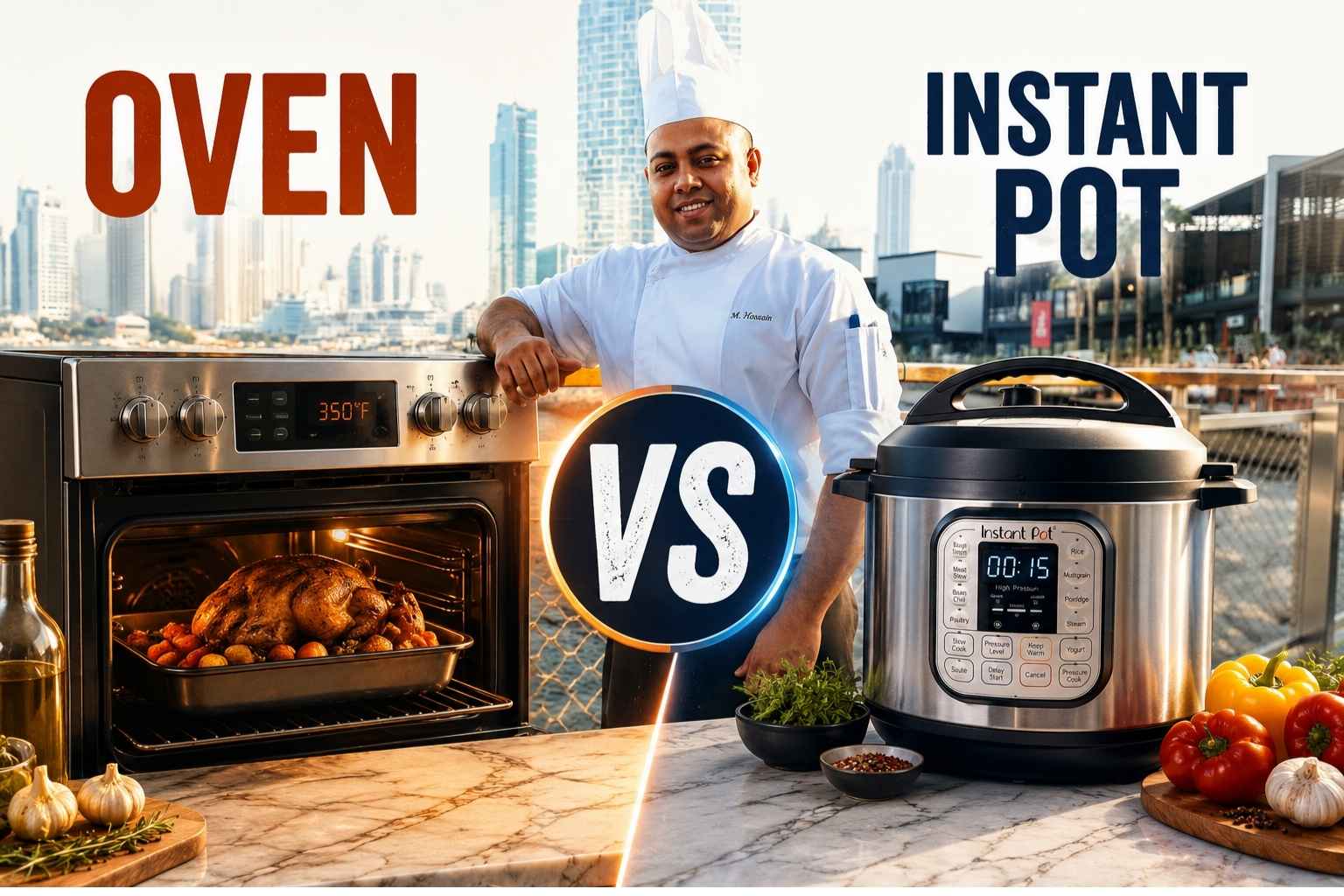
I still remember the night my Instant Pot beeped at me and I just stared at it, confused, holding a cold chicken thigh. That’s the day I really dove into the Oven vs Instant Pot debate, and I haven’t looked back since. After years in professional kitchens, I’ve cooked with both tools more times than I can count. In this guide, I’ll break down when each one wins, so you never waste a good meal again. Stick with me, and you’ll pick the right tool every single time.
What an Oven and an Instant Pot Actually Do – At a Physics Level
The oven and the Instant Pot work through completely different heat transfer mechanisms. Understanding that difference explains every result you get from each appliance.
An oven cooks with dry, radiant heat. Air inside the cavity heats up to your set temperature – anywhere from 300°F to 500°F (150°C to 260°C). That hot air and radiant heat from the elements hit the surface of your food. Moisture evaporates off the surface, and that dry surface gets hot enough to trigger the Maillard reaction – the chemical process where proteins and sugars react at temperatures above 280°F (138°C) to produce hundreds of flavor compounds. That’s the brown crust on your roast chicken. That’s the crackling on pork belly. That’s the caramelized edge on a roasted carrot.
An Instant Pot is a multi-cooker with an electric pressure-cooking function. Seal the lid, and steam pressure builds inside the pot. At sea level, pressure cooking raises the boiling point of water from 212°F (100°C) to around 250°F (121°C) (Modernist Cuisine, 2011). That higher temperature cooks food faster – dramatically faster for dense proteins and starches. But the environment is wet and sealed. There is no evaporation, no surface drying, no Maillard browning. The flavor profiles are fundamentally different.
Neither appliance is better in an absolute sense. They do different things, and the recipes that suit each are different for physical reasons – not preference.
Speed and Convenience: When the Instant Pot Genuinely Wins (and When It’s Overrated)
The Instant Pot is genuinely faster for a specific category of cooking: long, liquid-based dishes that need heat to break down collagen, starches, or dried legumes.
Here is what it actually beats the oven on for speed:
- Dried beans: 25-35 minutes under pressure vs. 90-120 minutes on the stovetop from dry, no soaking needed.
- Beef stew or braised short ribs: 45-55 minutes under pressure vs. 2.5-3.5 hours in a covered Dutch oven at 325°F.
- Bone broth: 3-4 hours under pressure vs. 12-18 hours on the stovetop.
- Whole chicken (poached style): 25 minutes under pressure vs. 60-80 minutes in the oven.
Where it is overrated: anything that takes 30 minutes or less in the oven. A tray of roasted vegetables takes 20-25 minutes at 425°F. The Instant Pot needs time to come to pressure (8-12 minutes), cook (10-15 minutes), and release pressure (5-10 minutes). You have not saved time. You have added steps and dirty equipment.
I once had a prep cook at my restaurant who pressure-cooked broccoli “to save time.” It was done in four minutes, soup-green, and tasted like it had been through a dishwasher. The oven would have taken 15 minutes and given us caramelized, slightly charred edges with actual flavor.
Speed is real when the baseline cooking time is long. For quick dishes, the Instant Pot creates the illusion of efficiency.
Flavor and Texture: Where the Oven Has No Competition
The oven produces flavors that pressure cooking cannot replicate. This is not a preference – it is chemistry.
Browning requires a dry surface above 280°F. The Instant Pot cannot achieve that inside the pot during pressure cooking. The sauté function on the Instant Pot reaches around 320-340°F, which helps, but the surface area is the bottom of a narrow pot, not a wide roasting pan with air circulation on all sides.
Here is what the oven does that the Instant Pot cannot:
Maillard browning: The brown crust on a roast chicken, the sear on a pork shoulder, the dark edges on roasted garlic. The Maillard reaction produces pyrazines, furans, and aldehydes – flavor compounds you cannot get from steaming or braising (America’s Test Kitchen, 2019). The taste difference is not subtle.
Caramelization: Sugar browns at 320°F and above. Roasted carrots, onions, and squash develop sweetness through caramelization. Pressure-cooked versions are soft but flat in flavor.
Crust formation: Bread needs dry oven heat to form a crust. The oven creates steam during the early bake (from the dough itself), then dries the surface to harden the crust. An Instant Pot cannot bake bread that has a proper crust. “Instant Pot bread” recipes exist, but what comes out is more like a dense steamed cake than a loaf.
Rendering fat: A duck leg or pork belly needs the fat to render slowly under dry heat. Pressure cooking softens the meat but leaves the fat greasy, not rendered.
Where the Instant Pot wins on texture: collagen-heavy cuts like brisket, oxtail, or pork shoulder destined for pulling. Pressure cooking breaks down collagen into gelatin faster than the oven can. The result is fall-apart tender in under an hour. That said, a slow 8-hour oven braise at 275°F still produces deeper flavor. The Instant Pot gives you 80% of that result in 20% of the time – a real trade-off, not a lie.
Head-to-Head Comparison Table
| Category | Oven | Instant Pot |
|---|---|---|
| Cook time (roast/braise) | 2-4 hours | 45-75 minutes |
| Cook time (beans, dry) | Not practical | 25-35 minutes |
| Energy use | 2,000-5,000 watts | 1,000-1,200 watts |
| Browning and crust | Excellent | Cannot do it under pressure |
| Hands-on effort | Low (set and monitor) | Moderate (build pressure, release) |
| Capacity | Large (full sheet pans) | Limited (6-8 qt max) |
| Entry cost | $150-$600+ | $80-$150 |
| Best use cases | Roasts, bread, vegetables, casseroles, desserts | Beans, broth, tough braising cuts, rice, soups |
| Flavor ceiling | High (browning, caramelization) | Medium (clean, moist, no crust) |
| Learning curve | Low | Moderate (pressure timing, liquid rules) |
Energy Efficiency: What the Numbers Actually Mean
The Instant Pot uses less electricity than the oven – but the full picture is more complicated than the wattage alone.
A standard electric oven draws 2,000-5,000 watts, depending on size and whether both elements run (U.S. Department of Energy, 2024). An Instant Pot draws 1,000-1,200 watts. On wattage alone, the Instant Pot looks like the clear winner.
But energy consumption is watts multiplied by hours. A beef stew in the oven at 325°F for 3 hours uses roughly 3-5 kWh. The same stew in the Instant Pot under pressure for 50 minutes uses about 0.8-1.0 kWh. That is a genuine saving.
For a recipe that takes 25 minutes at 400°F in the oven – say, roasted potatoes – the oven uses 1-2 kWh. An Instant Pot version (build pressure, cook, release) would use similar energy and take similar total time. No real saving.
At the average U.S. electricity rate of $0.16 per kWh (U.S. Energy Information Administration, 2025), the cost difference per meal is usually under $0.50 either way. Meaningful over hundreds of meals per year – not meaningful for a single decision.
Gas ovens change this entirely. Gas is cheaper per BTU in most U.S. markets (U.S. Energy Information Administration, 2025). A gas oven can be more economical than an electric Instant Pot for long braises.
Which Appliance Wins by Food Category
Roasts (Beef, Pork, Lamb)
Oven wins. Every time. A bone-in pork shoulder needs 6-8 hours at 275°F to build the bark, render the fat, and develop deep flavor. The Instant Pot can get the meat tender in 90 minutes, but the flavor is flatter and you will not get crisp skin or a real crust without finishing it in the oven anyway. If you are making pulled pork for sandwiches and do not care about bark, the Instant Pot is fast and acceptable. If you are serving it to guests, use the oven.
Soups and Stews
Instant Pot wins for speed; oven or stovetop wins for depth. A chicken soup in the Instant Pot takes 30 minutes and tastes clean and well-made. The same soup simmered on the stovetop for two hours tastes richer because slow evaporation concentrates flavor. For weeknight cooking, the Instant Pot is the practical choice.
Bread
Oven wins completely. There is no Instant Pot substitute for a properly baked loaf. The Maillard crust, the spring, the chew – all of these require dry heat above 400°F. I have tested every “Instant Pot bread” recipe I could find (Serious Eats, 2022 review). None produce bread I would serve.
Whole Chicken
Depends on what you want. An Instant Pot whole chicken is done in 25 minutes and the meat is moist and easy to shred. But the skin is rubbery. If you want roast chicken with golden skin – oven, 425°F, 50-60 minutes, no question. If you want tender meat for chicken tacos or soup, Instant Pot is faster.
Rice
Instant Pot wins. Perfect rice in 3 minutes at high pressure plus natural release. No watching, no scorching. For white rice, brown rice, and jasmine rice, the Instant Pot is more reliable than the stovetop for most home cooks (Consumer Reports, 2023).
Dried Beans
Instant Pot wins by a mile. No soaking. 25-35 minutes from dry to fully cooked. I have cooked thousands of pounds of beans in commercial kitchens. Pressure cooking beans is one of the clearest wins the Instant Pot has.
Desserts
Oven wins almost entirely. Cakes, cookies, pies, tarts, and pastries need dry heat for structure and browning. The Instant Pot can steam a cheesecake to a silky, crack-free texture – that is one genuine dessert win. Everything else belongs in the oven.
Vegetables
Oven wins on flavor; Instant Pot wins on speed. Roasted vegetables at 425°F have caramelized edges and concentrated sweetness. Pressure-cooked vegetables are fast but taste flat by comparison. I use the Instant Pot for vegetables only when I am making soup or mashing them into something else where texture is not the point.
Can I Convert This Recipe? What Works, What Fails, and What I Refuse to Do
Home cooks ask this constantly: “Can I make this oven recipe in my Instant Pot instead?” The answer depends on the recipe structure.
Conversions that work well:
- Oven braises (covered Dutch oven, liquid present, long cook time) – these translate to pressure cooking with good results. Reduce liquid by 25% because pressure cooking does not evaporate.
- Soups and bean dishes – straightforward conversion; reduce time by 60-70%.
- Whole grains like farro, barley, and wheat berries – the Instant Pot cuts cook time from 45-60 minutes to 10-12 minutes.
Conversions that fail:
- Any recipe where browning or a crust is part of the dish – roasted chicken thighs, pork belly, roasted cauliflower with char. The dish changes entirely when you remove the dry heat.
- Casseroles with a breadcrumb or cheese topping – the top never browns; it just gets soggy.
- High-sugar dishes – jams, glazes, and caramels can scorch under pressure and are dangerous if they block the steam valve.
What I refuse to convert: roast chicken, any bread or baked good, braised lamb shoulder meant to have a crust, and any dish where the specific texture of oven heat is the whole point. I have eaten too many gray, flavorless “pressure-cooked roasts” at dinner parties to pretend the conversion works. It does not. Cook it properly or make something else.
Safety, Learning Curve, and Kitchen Space
The oven is the lower-risk appliance for new cooks. The controls are straightforward: set the temperature, set a timer, check the food. The main risks are burns from hot surfaces and undercooked meat – both managed with basic knowledge.
The Instant Pot has a moderate learning curve. The main rules to learn:
- Always add at least 1 cup of liquid or the pot will not come to pressure and will burn the food.
- Never fill above the two-thirds line; starchy foods like pasta and oatmeal can foam and block the valve – fill those only halfway.
- Natural pressure release versus quick release matters: proteins need natural release to avoid toughening; vegetables need quick release to avoid overcooking.
- The sealing ring absorbs odors over time. After 12-18 months of regular use, keep a second ring for desserts and dairy dishes (Instant Pot official manual, 2024).
On kitchen space: an oven is built into the kitchen. An Instant Pot takes up counter or cabinet space – roughly the footprint of a large stockpot. A 6-quart model is the most versatile size for 2-4 people; the 8-quart works better for families or batch cooking (Consumer Reports, 2023).
The Combo Method: How I Use Both Appliances in the Same Dish
The best results often come from using both appliances together. This is how I handle it in my own kitchen.
Method 1 – Pressure-cook, then oven-finish: Start ribs or pork shoulder in the Instant Pot for 35-45 minutes to get the collagen broken down and the meat tender. Transfer to a wire rack on a sheet pan. Blast at 425-450°F for 15-20 minutes. You get the speed of pressure cooking and the surface browning of the oven. This is my standard method for weeknight ribs.
Method 2 – Oven-brown, then pressure-cook: Sear or roast the exterior of a pot roast in a very hot oven (450°F, 20 minutes) for color and flavor. Then transfer to the Instant Pot with aromatics and liquid for 60-70 minutes. You get the Maillard crust up front and the speed of pressure cooking for the rest.
Method 3 – Instant Pot broth, oven main: Make the broth or sauce in the Instant Pot (30-40 minutes for a good chicken or vegetable stock). Roast the protein in the oven simultaneously. Combine at the end. This turns a 3-hour meal into a 90-minute one without sacrificing the roast’s quality.
Common Mistakes People Make With Each Appliance (and How to Fix Them)
| Appliance | Mistake | Fix |
|---|---|---|
| Oven | Opening the door too often | Use the oven light and window; opening drops temperature by 25-50°F |
| Oven | Overcrowding the pan | Give food space – steam trapped between crowded pieces prevents browning |
| Oven | Not preheating | Always preheat 15-20 minutes; a cold oven gives uneven results |
| Oven | Using the wrong rack position | Browning on top: upper third. Browning on bottom: lower third. Even cook: center. |
| Instant Pot | Too little liquid | Minimum 1 cup for most recipes; without it the burn notice triggers |
| Instant Pot | Wrong pressure release timing | Meat: natural release 10-15 minutes. Quick-cooking vegetables: immediate release. |
| Instant Pot | Overfilling | Two-thirds full maximum; half for foamy foods like oatmeal or lentils |
| Instant Pot | Skipping the sauté step | Always sauté aromatics first for better flavor – don’t dump everything in raw |
My Honest Verdict After 15 Years in Both Commercial and Home Kitchens
If I could keep only one: I keep the oven. No contest.
The oven is versatile across every category of cooking. It is the only appliance that can bake bread, roast a chicken, caramelize vegetables, make a tart, and braise a short rib – all at a high standard. I used a deck oven in my first restaurant kitchen in 2011 and I still think about how good the roasted garlic came out of it.
The Instant Pot earns a permanent place in my kitchen as a specialist tool. I reach for it specifically for:
- Weeknight beans (I keep a batch cooked every week)
- Bone broth (I run a batch every Sunday, done in four hours instead of overnight)
- Braised meat when I have 90 minutes, not four hours
- Brown rice and farro, where it is faster and more reliable than the stovetop
What the Instant Pot is not: a replacement for the oven. Anyone telling you that you can do everything in a pressure cooker and ditch your oven has never eaten a properly roasted piece of meat. The flavor difference is not small.
Buy the Instant Pot if you cook a lot of beans, broth, or tough braising cuts and want to cut active kitchen time. Do not buy it expecting it to replace the oven. Use both, use each for what it is actually good at, and your cooking will improve.
Frequently Asked Questions About Oven vs Instant Pot
Which is better for a beginner cook – an oven or an Instant Pot?
The oven is easier to start with. Temperature and time controls are straightforward, and the margin for error is wider. The Instant Pot requires learning pressure release timing, minimum liquid requirements, and fill-line rules before you get consistent results. Begin with the oven; add the Instant Pot when you are comfortable with basic cooking techniques.
Can the Instant Pot replace an oven for everyday cooking?
No. The Instant Pot handles soups, stews, beans, grains, and braising cuts well. It cannot bake, roast, brown, or caramelize food. An oven handles all of those. For everyday cooking that includes a variety of dishes, the oven is the more useful appliance.
Which appliance is cheaper to run per month?
For long cook dishes (over 90 minutes), the Instant Pot is cheaper per meal – roughly 0.8-1.0 kWh vs. 3-5 kWh for the oven on the same dish (U.S. Energy Information Administration, 2025). For short dishes under 30 minutes, the difference is negligible. Over a full year of regular cooking, you might save $40-$80 in electricity using the Instant Pot for long braises – meaningful, but not the primary reason to choose one over the other.
Why does my Instant Pot say “burn” and stop cooking?
The burn notice means the bottom of the pot is getting too hot – usually because there is not enough liquid, the liquid is too thick, or tomato paste or sugar is sitting on the bottom without being diluted. Add at least 1 cup of thin liquid (water, broth), deglaze any brown bits from the bottom before sealing, and dilute thick sauces before pressure cooking.
Can I cook the same recipe in both and get the same result?
For braised dishes with a lot of liquid, the results are similar. For anything that relies on browning, a crust, or dry heat, the results are not the same – the oven version will have more flavor complexity. Think of them as different cooking methods that sometimes arrive at compatible destinations, not interchangeable tools.
What size Instant Pot should I buy?
The 6-quart model handles most cooking for 2-4 people. It fits a whole chicken, a large batch of beans, or 6-8 servings of soup. The 8-quart is worth it if you cook for 5+ people or do heavy batch cooking. The 3-quart is too small for most real cooking tasks (Consumer Reports, 2023).
Is pressure cooking safe?
Modern electric pressure cookers like the Instant Pot have multiple safety features: a lid lock that prevents opening under pressure, a pressure-release valve, and automatic temperature cutoffs (Instant Pot official manual, 2024). Follow the fill lines, always check that the sealing ring is properly seated, and keep the steam release valve clear of obstructions. Pressure cooking is safe when used as directed.
Does the Instant Pot actually save time when you factor in preheat and pressure build?
Sometimes. For a dish that takes 3+ hours in the oven, yes – the Instant Pot saves meaningful time even after accounting for 8-12 minutes to come to pressure and 10-15 minutes of natural release. For dishes under 45 minutes in the oven, the total time is often similar or longer with the Instant Pot once you count all the steps.
Key Takeaways
- The oven and the Instant Pot cook through fundamentally different mechanisms – dry heat vs. pressurized steam – and produce different results for that physical reason.
- The oven is the more versatile appliance. It handles every category of cooking at a high level; the Instant Pot excels in a specific subset (beans, broth, braised tough cuts, grains).
- Browning, crust, caramelization, and baking require an oven. These flavors cannot be replicated under pressure.
- The Instant Pot genuinely saves time on dishes that take 2+ hours by conventional methods. For quick dishes, it adds steps without saving time.
- The smartest kitchen setup uses both: pressure-cook for speed on long dishes, oven for browning and finishing.
- The combo method (pressure-cook then oven-finish, or oven-brown then pressure-cook) delivers the best of both appliances.
- Do not convert oven recipes that rely on browning or dry texture to the Instant Pot. The dish changes in ways that hurt it.

I’m Mossaraof, a trained chef and the founder of OvenInsights.com. I spent years cooking at Larrupin’ Cafe and in kitchens across Chicago and Seattle. Now I test kitchen gear for a living. I moved to North Acton, London, and I test every tool I write about. I use real meals and real heat. No brand deals. No shortcuts. I cover 12 kitchen types and hundreds of recipes. I believe this: the right tools matter as much as the recipe.