At A Glance
- You can substitute most baking dishes if the volume and depth are close — use the water method (fill the original dish with water, pour it into the replacement) to confirm the match before you bake.
- Swapping to a shallower dish speeds up baking; swapping to a deeper one slows it down — adjust oven time by 10–25% and start checking early.
- Glass and ceramic dishes run cooler than metal pans — lower your oven temperature by 25°F (14°C) when switching from metal to glass or ceramic (King Arthur Baking, 2024).
- A 9×13-inch pan, an 8×8 square pan, and a 9-inch round cake pan are the three most flexible substitutes in a home kitchen — between them, you can cover about 80% of baking needs.
- Some substitutions will ruin your bake — springform pan batters poured into a regular cake pan will leak or overbake; custards baked outside a water bath will crack and curdle.
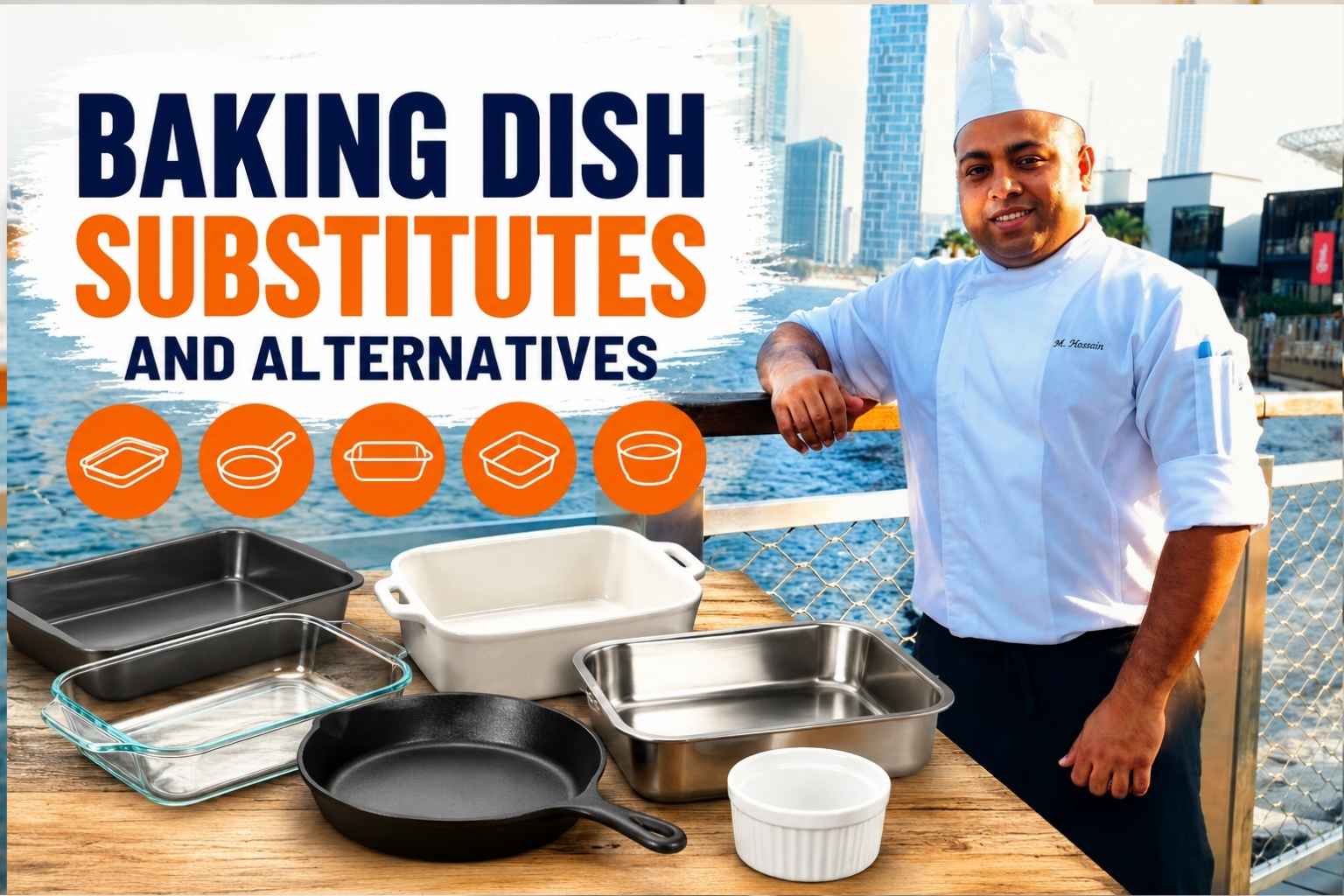
Ever pulled out a recipe, only to find your baking dish is dirty, missing, or just the wrong size? I’ve been there more times than I can count. As a chef, I’ve learned to work with what’s in the kitchen, not against it. That’s why I put together this guide on baking dish substitutes and alternatives, packed with real fixes I use myself. Grab your pan (any pan!) and let’s get your dish in the oven.
Quick Substitution Reference Table
| Original Dish | Best Substitute | Volume Match | Key Adjustment |
|---|---|---|---|
| 9×13-inch pan (3 qt) | Two 8×8 square pans | Exact | Same temp, same time |
| 9×13-inch pan (3 qt) | Two 9-inch round cake pans | Close (2.75 qt) | Check 5 min early |
| 8×8 square pan (1.5 qt) | 9-inch round cake pan | Exact | No adjustment needed |
| 8×8 square pan (1.5 qt) | 9×5 loaf pan | Close (1.7 qt) | Add 8-10 min; deeper |
| Loaf pan 9×5 (1.7 qt) | 8×4 loaf pan | Slightly less | Fill 2/3 full; check early |
| Loaf pan 9×5 (1.7 qt) | 8×8 square pan | Close (1.5 qt) | Reduce time by 10 min; shallower |
| Bundt pan (10-12 cup) | 10-inch tube pan | Exact | No adjustment needed |
| Bundt pan (10-12 cup) | Two 9-inch round pans | Approximate | Reduce time by 15-20 min |
| Pie dish 9-inch (4 cup) | 9-inch cake pan (2-inch deep) | Close | Press crust up sides; watch edges |
| Springform pan 9-inch | No safe general substitute | – | Use only for no-bake; see section below |
| Ramekins (6 oz each) | Muffin tin cups | Very close | Reduce time by 3-5 min |
| Cast iron skillet 10-inch | 9-inch cake pan | Close | Increase time by 5-8 min; no preheat advantage |
Why the Right Baking Dish Matters – Heat, Depth, and Shape
The dish you bake in changes the final result more than most home cooks realize. The right dish is not just a container – it is part of the recipe.
Three things control how heat reaches your food: material, depth, and shape. Change any one of them and you change how fast the center sets, how brown the bottom gets, and whether the edges overcook before the middle is done.
A 9×13-inch metal pan conducts heat fast and directly. The same batter in a deep ceramic casserole dish will take 20-30% longer to set because ceramic is a poor conductor — it stores heat slowly and releases it slowly (Cook’s Illustrated, 2023). The edges will be fine. The center will be underdone if you pull it at the original time.
Depth matters just as much. A shallow dish exposes more surface area to the oven air. That means faster moisture evaporation, faster edge-browning, and a shorter bake time. A deep dish does the opposite — it insulates the center and slows everything down.
Shape affects air circulation around the pan. A round pan has no corners to trap heat. A square pan does — the corners bake faster than the center. That is why dense brownie recipes often call for square pans on purpose: the corner pieces get chewier edges while the center stays fudgy.
How to Calculate Volume Equivalents – The Water Method
The water method is the most reliable way to check if a substitute dish will work. It takes 90 seconds and removes all guesswork.
How to do it:
- Fill the original dish completely with water.
- Pour that water into your substitute dish.
- If the water fills it to within about 1 inch of the top, the substitute will work.
- If the water overfills it, the batter will overflow in the oven — choose a larger dish or split the batter.
- If the water only fills it halfway, the batter will be too shallow and will overbake.
America’s Test Kitchen (2024) recommends staying within 25% of the original volume for baked goods. Beyond that range, timing and texture will suffer enough to matter.
For most standard dishes, the math works out like this:
| Pan Size | Approximate Volume |
|---|---|
| 9×13-inch | 14 cups (3.3 liters) |
| 9×9-inch square | 10 cups (2.4 liters) |
| 8×8-inch square | 8 cups (1.9 liters) |
| 9-inch round (2-inch deep) | 8 cups (1.9 liters) |
| 9×5-inch loaf | 8 cups (1.9 liters) |
| 8×4-inch loaf | 6 cups (1.4 liters) |
| 9-inch pie dish | 4 cups (0.95 liters) |
| 10-cup Bundt | 10 cups (2.4 liters) |
| 6-oz ramekin | 0.75 cups (177 ml) |
Casserole Dish and 9×13 Pan Substitutes
A 9×13-inch pan is the most-used baking dish in the American kitchen. When you do not have one, two 8×8-inch square pans are the closest match — same total volume, same depth. Put them side by side in the oven and bake at the same temperature for the same time.
If you only have 9-inch round cake pans, use two of those. The volume is slightly less than a 9×13 (about 16 cups vs. 14 cups combined), so start checking for doneness about 5 minutes early.
For casseroles with liquid – lasagna, enchiladas, gratins – a deep oven-safe Dutch oven works well. The lid traps steam in the first half of baking, which actually keeps pasta dishes more moist. Remove the lid for the last 15-20 minutes to brown the top.
When this substitution fails:
Do not use a 9×13 dish substitute for recipes that call for a jelly roll pan (10×15 inches with a 1-inch rim). Jelly roll batters are thin and designed to bake fast in a shallow sheet. A 9×13 pan is too deep and will leave the center underdone.
8×8 Square Pan Substitutes
An 8×8 square pan holds about 8 cups of batter. The exact same volume fits in a 9-inch round cake pan (also 8 cups). This is my go-to swap — I have done it hundreds of times for brownies, bar cookies, and coffee cakes without any adjustment to time or temperature.
A 9×5 loaf pan holds about 8-9 cups, which is close. But it is much deeper and narrower, so the center of a brownie or cake bar will take longer to set. Add 10-12 minutes to your bake time and test with a toothpick.
For bar cookies and brownies specifically, the shape of the pan affects the ratio of edges to interior. Serious Eats (2023) notes that a round pan gives you zero corner pieces, so every piece has the same ratio of edge to center. Some people prefer this. Others (myself included) think the corner piece is the point.
Loaf Pan Substitutes
A standard loaf pan is either 9×5 inches or 8×4 inches. The 9×5 holds about 2 more cups than the 8×4. This size difference matters for quick breads and banana bread more than for dense pound cakes.
Best substitutes for a loaf pan:
- 8×8 square pan: Works for most quick breads. The batter spreads shallower, so reduce your bake time by 10-15 minutes. Start checking at the 35-minute mark instead of 50.
- Muffin tin: This is the fastest option. Standard muffin cups hold about 1/2 cup each. A 9×5 loaf recipe makes 12 standard muffins. Bake time drops from 55-65 minutes to 18-22 minutes.
- 9-inch round cake pan: Works for denser quick breads. The batter is shallower than in a loaf pan, so cut 8-10 minutes off your time.
What does not work: Do not pour yeast bread dough into a muffin tin unless the recipe is designed for rolls. Yeast doughs need structure during the rise and will spread sideways in an unconstrained pan.
Bundt Pan Substitutes
A standard Bundt pan holds 10-12 cups of batter. The center tube conducts heat to the middle of the batter, which is why Bundt cakes bake evenly despite being thick.
Without that center tube, a thick cake batter will undercook in the center before the outside is done. This is the main challenge with Bundt substitution.
Best substitutes:
- 10-inch tube pan (angel food pan): This is the same principle as a Bundt – a center tube, same volume. Works perfectly. No adjustment needed.
- Two 9-inch round cake pans: Split the batter evenly. Bake time drops significantly – from 50-60 minutes to 30-35 minutes. Watch closely.
- 9×13-inch pan: Works for the batter, but you lose the Bundt shape entirely. Use this only when the visual presentation does not matter – for a family dinner where you are cutting it into squares, for example.
One thing to know: Bundt batters are usually denser and richer than standard layer cake batters. They can handle the heat of a metal pan without over-browning. If you move Bundt batter to a glass or ceramic dish, drop the temperature by 25°F.
Pie Dish Substitutes
A standard 9-inch pie dish holds about 4 cups and is about 1.5 inches deep. The sloped sides are designed to hold a free-standing pastry crust in shape.
Best substitutes for a pie dish:
- 9-inch cake pan (2-inch deep): This works for custard and cream pies but not great for double-crust fruit pies. The sides are straight, not sloped, so the crust does not hold the same shape. Press it up firmly against the sides.
- 9-inch tart pan with removable bottom: Better than a cake pan for presentation. Same volume, similar depth. The fluted sides are shallower, so your crust will be thinner – blind bake it a few extra minutes.
- Cast iron skillet (9-10 inch): A legitimate substitute used by many professional bakers (Williams-Sonoma, 2024). The cast iron holds heat well and creates an exceptionally crisp bottom crust. The sloped sides work like a pie dish. Just grease it well and serve directly from the skillet.
When pie dish substitution does not work:
Deep-dish pie recipes (3+ cups of filling) need at least 2 inches of depth. A standard cake pan at 2 inches is borderline. A shallow tart pan will overflow.
Springform Pan – When There Is No Good Substitute
A springform pan has a removable side wall that releases after baking. This is the one baking dish with the fewest safe substitutes.
The reason: cheesecakes, mousse cakes, and tortes baked in springform pans need to be unmolded cleanly. The batter is also often too liquid to hold its shape in a regular pan until it is fully set.
For no-bake cheesecakes, any deep bowl or cake pan lined with plastic wrap works. Refrigerate, lift the plastic wrap out, and peel it away.
For baked cheesecakes, the only real substitute is a regular cake pan lined very carefully with a double layer of aluminum foil, brought up and over the outside of the pan, then set inside a water bath (also called a bain-marie – a roasting pan filled with 1 inch of hot water). The foil prevents leaks. The water bath keeps the temperature gentle and prevents cracking (King Arthur Baking, 2024).
Do not try to bake a cheesecake in a glass pie dish without a water bath. It will crack. I have seen it happen more times than I can count.
Ramekin Substitutes
A ramekin is a small, individual ceramic dish. Standard sizes are 4 oz and 6 oz. They are used for souffles, crème brûlée, individual pot pies, and molten lava cakes.
Best substitutes:
- Muffin tin cups: Standard muffin cups hold about 4 oz each. For crème brûlée and baked custards, they work well – same depth, similar heat distribution. Reduce bake time by 3-5 minutes.
- Small oven-safe mugs (4-6 oz): For lava cakes and individual souffles, a ceramic mug works. The shape is taller and narrower, which actually helps souffles rise straighter. Grease the inside thoroughly.
- Mini cast iron skillets (3.5-inch): Work for individual gratins and skillet cookies. Not ideal for custards because the metal heats faster and custards can curdle at the edges.
What to avoid: Do not use non-oven-safe glass jars or mugs. Thermal shock can shatter them.
Glass vs. Ceramic vs. Metal vs. Cast Iron – How Material Affects Your Bake
The dish material is one of the biggest variables in baking. Most recipes assume you are using a light-colored metal pan. If you are not, you need to adjust.
Light-colored metal: Reflects heat, browns the bottom moderately, heats quickly. This is the default for most recipe testing. No adjustment needed.
Dark-colored metal (including nonstick): Absorbs more heat, browns the bottom faster. Reduce oven temperature by 25°F or cut bake time by 10-15% (Cook’s Illustrated, 2023).
Glass (Pyrex): Heats slowly but retains heat well. Reduces browning slightly during baking but continues cooking after you pull it from the oven – a phenomenon called carryover heating. Reduce oven temperature by 25°F. Do not put a hot glass pan on a cold or wet surface; the thermal shock can crack it.
Ceramic: Similar to glass – slow to heat, slow to cool. Also reduces browning. Drop temperature by 25°F. Great for casseroles and braises where slow, even heat is a feature.
Cast iron: Heats slowly but holds heat extremely well once hot. Preheat it in the oven for 10 minutes before adding batter for a crispier crust. A preheated cast iron skillet is the reason cast iron cornbread has a superior crust – the batter hits a hot surface immediately (Serious Eats, 2024).
How to Adjust Baking Time and Temperature When Switching Dishes
Here is the rule I follow in my kitchen and teach every cook I train: shallower means faster, deeper means slower, metal means hotter, glass means cooler.
Combine those four variables and you get a reliable adjustment framework:
| Change You Made | Time Adjustment | Temp Adjustment |
|---|---|---|
| Shallower dish, same material | -10 to -20% | None |
| Deeper dish, same material | +15 to +25% | None |
| Metal to glass or ceramic | None | -25°F (-14°C) |
| Light metal to dark metal | -10 to -15% | None |
| Splitting batter into two smaller pans | -15 to -20% | None |
| Moving to cast iron (cold start) | +5 to +10% | None |
Always start checking 10-15 minutes before the adjusted time. A toothpick inserted in the center should come out with moist crumbs (for cakes and quick breads) or clean (for cheesecakes and custards).
Two extra variables that matter:
- Dark vs. light pan color: A dark nonstick pan runs 20-30°F hotter at the surface than a shiny metal pan (America’s Test Kitchen, 2024). This is the number one cause of over-browned bottoms.
- High altitude (above 3,500 feet): At altitude, baked goods rise faster and can collapse. If you are already substituting a shallower pan at altitude, reduce your baking powder by 10-15% and increase oven temperature by 15-25°F (King Arthur Baking, 2023).
Foil Pan and Disposable Pan Substitutes
Disposable aluminum foil pans are a legitimate option – not a last resort. I use them routinely when I am transporting food, baking for crowds, or do not want to deal with cleanup.
Where they work well:
- Casseroles, gratins, and baked pasta dishes — no structural requirements, easy to cover with foil.
- Sheet cakes meant to be eaten directly from the pan — a 9×13 foil pan is structurally fine.
- Holiday pies and quick breads you are gifting — the pan is part of the gift.
Where they are a problem:
- Any recipe that needs a rigid pan for unmolding. Foil pans flex when you lift them – a cheesecake or layer cake will crack or shift.
- High-sugar recipes (caramel, sticky buns) in thin foil pans – the pan can warp from the heat and tilt, causing uneven baking.
- Recipes that need a preheated pan. Foil pans are too thin to hold and transfer heat the way cast iron or heavy metal does.
For extra stability, set the foil pan on a heavy baking sheet before putting it in the oven. This prevents flex and improves bottom browning.
Common Substitution Mistakes – and How to Fix Them
After 15 years working in professional kitchens and teaching home cooks, I see the same substitution errors come up again and again.
Mistake 1: Using a glass dish without lowering the temperature. Fix: Drop the oven by 25°F any time you go from metal to glass or ceramic. Set a timer 10 minutes early and check.
Mistake 2: Filling the substitute pan too full. Fix: Fill baking pans no more than two-thirds full for batters that rise (cakes, quick breads, souffles). For custards and casseroles, you can fill to within half an inch of the rim.
Mistake 3: Ignoring depth when substituting. Fix: Any time you move to a significantly deeper or shallower pan, recalculate your time. Deeper by 1 inch adds roughly 15-20 minutes. Shallower by 1 inch removes 10-15 minutes.
Mistake 4: Using a pan that is too small and letting batter overflow. Fix: Do the water test before you bake. Takes 90 seconds and saves a major mess.
Mistake 5: Substituting for springform pans without lining the pan. Fix: If you must bake a cheesecake in a regular cake pan, line it with a parchment circle on the bottom and a strip of parchment around the sides. Use a water bath. Even then, unmolding cleanly is difficult — plan to serve directly from the pan.
Mistake 6: Swapping a dark pan for a light one without adjusting. Fix: A dark nonstick pan browns the bottom 20-30% faster. If you switch from a light to a dark pan, reduce oven temperature by 25°F or cut your bake time by 12-15%.
How I Actually Improvise in the Kitchen – A Chef’s Real Approach
I will be direct: recipes are more forgiving about pan substitutions than most recipe writers admit. I have baked banana bread in a cast iron skillet, cheesecakes in coffee mugs, and lasagna in a roasting pan. Most of it worked.
Here is my actual decision process when I am missing a pan:
- Check volume first. I fill the called-for pan with water and see if my substitute holds the same amount. If it does, I proceed.
- Check depth second. If my substitute is more than 1 inch shallower or deeper, I adjust the time immediately before I put it in the oven.
- Check material third. If I am moving to glass or ceramic, I drop the temperature by 25°F. If I am moving to a dark nonstick pan, I do the same.
- Set my timer early. Whatever the original recipe says, I set my timer for 15% less than that and start checking. You can always add time. You cannot unbake something.
- Trust the visual and the toothpick, not the clock. A golden-brown edge and a clean toothpick tell me more than the timer does.
The one place I do not improvise: custards in a water bath. If a recipe says water bath, I use one. Skipping it to save time is how you end up with a cracked, grainy cheesecake that nobody wants.
Frequently Asked Questions About Baking Dish Substitutes
What can I use instead of a 9×13 baking dish?
Two 8×8-inch square pans are the exact volume match for a 9×13-inch pan — each holds about half the total batter. Two 9-inch round cake pans also work well. Use the same oven temperature and the same bake time, but start checking about 5 minutes early since round pans have no corners that hold heat.
Can I use a glass dish instead of a metal pan?
Yes, but lower your oven temperature by 25°F (14°C). Glass heats more slowly than metal and retains heat longer, which means it continues cooking your food after you pull it from the oven. Reducing the temperature compensates for this and prevents over-browning on the bottom (King Arthur Baking, 2024).
How do I substitute for a springform pan?
For no-bake cheesecakes and mousse cakes, line a regular cake pan or deep bowl with plastic wrap, fill it, and refrigerate. Lift the plastic wrap to unmold. For baked cheesecakes, use a regular cake pan lined with parchment and foil, placed inside a water bath (a roasting pan with 1 inch of hot water). This is the only method that works reliably without a springform pan.
Can I use a cast iron skillet instead of a cake pan?
Yes — a 10-inch cast iron skillet holds about the same volume as a 9-inch round cake pan. Cornbread, skillet cakes, and cobblers actually bake better in cast iron because preheating the pan creates an immediate crust. Add 5-10 minutes to your bake time compared to a standard metal pan since cast iron starts cold and heats up slowly.
What is the best substitute for ramekins?
Standard muffin tin cups are the closest ramekin substitute for custards, crème brûlée, and individual pot pies. A standard muffin cup holds about 4 oz — the same as a small ramekin. Reduce bake time by 3-5 minutes. For lava cakes, small oven-safe ceramic mugs work well and give the cakes a straighter, more dramatic rise.
How do I know if my substitute pan is too small?
Fill your intended substitute pan with water and see how full it gets. If the water fills it past the two-thirds point, the pan is too small for a rising batter — it will overflow in the oven. For non-rising fillings like custards or casseroles, you can fill to within half an inch of the rim.
Does the color of my baking pan really matter?
Yes, significantly. A dark metal or nonstick pan absorbs more heat and browns the bottom of baked goods 20-30% faster than a shiny light-colored pan. If you are switching from a light to a dark pan, reduce your oven temperature by 25°F or shorten your bake time by 10-15% (America’s Test Kitchen, 2024). This is especially important for cookies, cakes, and brownies where the bottom can over-brown before the center sets.
Can I use foil pans as a substitute for regular baking dishes?
Foil pans work well for casseroles, sheet cakes, and anything you plan to serve directly from the pan. They are too flimsy for unmolding — do not try to flip a cake out of a foil pan. For stability, always set a foil pan on a heavy baking sheet before putting it in the oven. This prevents warping and helps the bottom brown more evenly.
Key Takeaways
- Match the volume of your original pan first — use the water method (fill with water, pour into the substitute) to confirm before you bake.
- Shallower pan means shorter bake time; deeper pan means longer. Adjust by 10-25% and start checking early.
- Glass and ceramic dishes need a 25°F (14°C) temperature reduction compared to metal pans — they hold heat longer and continue cooking after the oven is off.
- Dark nonstick pans brown bottoms faster than light metal pans — reduce temperature by 25°F or cut time by 10-15%.
- Springform pans have no reliable substitute for baked cheesecakes — use a parchment-lined cake pan in a water bath, or serve from the pan.
- Foil pans work for casseroles and sheet cakes — always place them on a heavy baking sheet for stability.
- At high altitude (above 3,500 feet), substitute shallower pans with extra caution — rising is faster, which means overflows and collapses happen more easily.

I’m Mossaraof, a trained chef and the founder of OvenInsights.com. I spent years cooking at Larrupin’ Cafe and in kitchens across Chicago and Seattle. Now I test kitchen gear for a living. I moved to North Acton, London, and I test every tool I write about. I use real meals and real heat. No brand deals. No shortcuts. I cover 12 kitchen types and hundreds of recipes. I believe this: the right tools matter as much as the recipe.