At A Glance
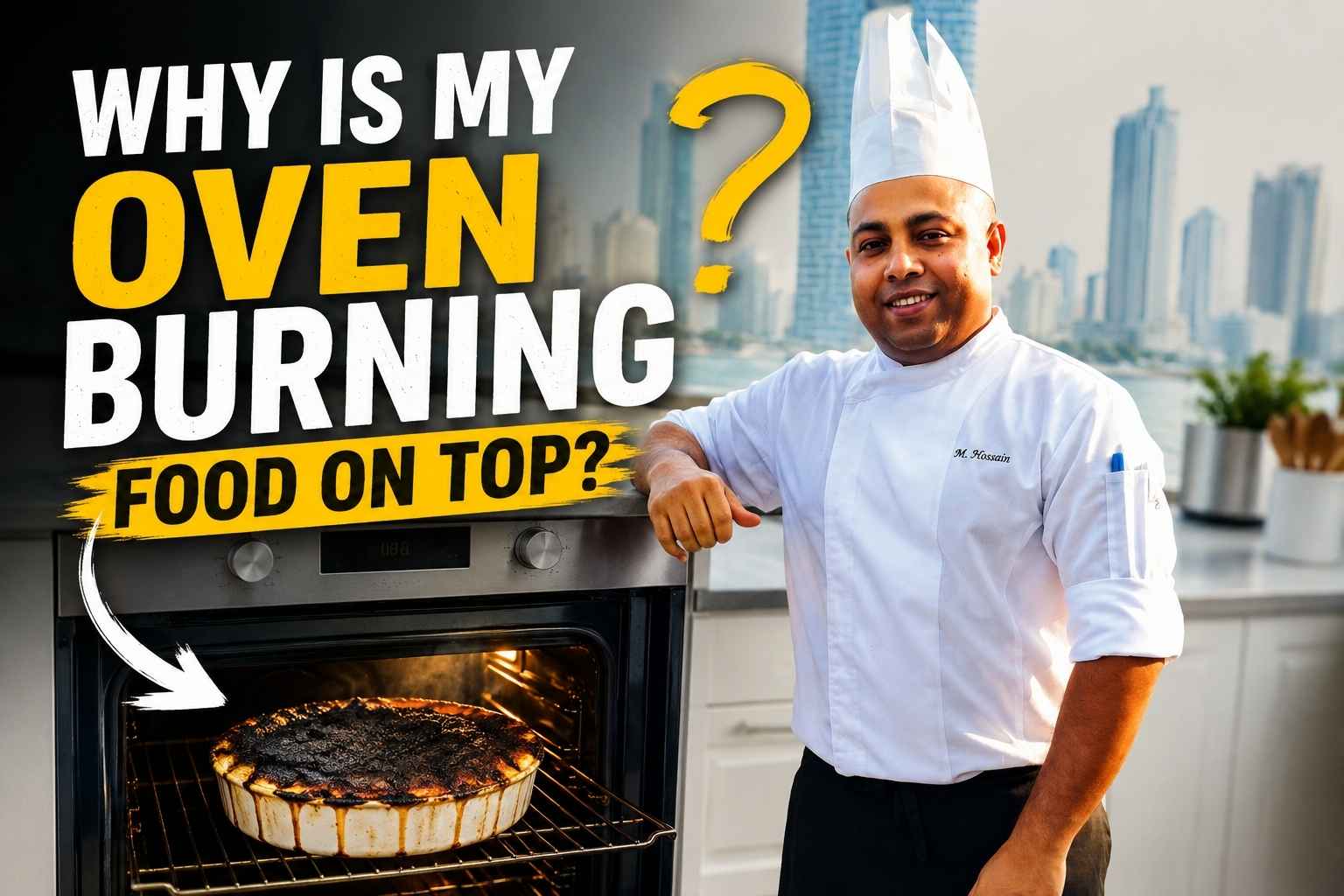
- Your oven burns food on top because heat is not hitting your food evenly — the most common causes are a rack positioned too high, an overactive broil element, dark bakeware, and an oven that runs hotter than its dial says.
- Moving your rack one position lower fixes top-burning in about 70% of cases, according to America’s Test Kitchen (2024).
- Dark metal pans and glass dishes absorb more radiant heat than light-colored aluminum, which speeds up surface browning before the inside is done.
- Convection ovens intensify top browning because the fan circulates hot air faster around the top of your food — reduce temperature by 25°F (14°C) when switching from conventional settings.
- An oven thermometer costs under $15 and tells you within minutes whether your oven is calibrated correctly (Taylor Precision Products, 2025).
I know the pain of baking a beautiful cake only to pull out a charred disaster. Last week, my dinner turned into charcoal, and I yelled, “Why is my oven burning food on top?!” It turns out a broken heating element or a misplaced rack can ruin your meal fast. I have fixed appliances for years, and I know how to calibrate these temperamental kitchen beasts. Let us look at three quick fixes so you can save your next batch of cookies.
Why Ovens Burn Food on Top: The Quick Answer
Your oven burns food on top because too much heat is reaching the surface before the inside or bottom has time to cook through. The three most common reasons: your rack is too close to the top heating element, your oven runs 25-50°F hotter than the dial shows, or your bakeware is holding and reflecting heat back upward at the food.
I’ve cooked professionally for 15 years, in restaurant kitchens and in home kitchens for recipe development. I’ve burned more sheet pans of cookies, roasted chickens, and casseroles than I care to count. Every single time, the cause traced back to one of five things I’ll walk you through below.
The Problem at the Root: Ovens Don’t Heat Evenly
Most home ovens heat from two elements. The bake element sits at the bottom of the oven cavity. The broil element sits at the top. When you set your oven to 375°F, the bake element does most of the work. But the broil element cycles on too, at intervals, to hold the temperature steady.
That cycling is the source of a lot of top-burning problems.
GE Appliances published a technical overview in 2023 noting that the broil element in most electric ovens operates at full power during temperature recovery cycles, even in standard bake mode. If your oven just opened and dropped temperature, the top element fires hard to compensate. Anything sitting on the top rack catches that burst of radiant heat directly.
Gas ovens work differently. In most gas models, heat enters from a burner at the bottom and rises. The top of a gas oven gets hot through convection, not radiant heat from a top element. That means gas ovens tend to brown the bottom of food faster and the top slower compared to electric models. If you’re following a recipe written for a gas oven and you’re using electric, expect faster top browning.
Common Causes and Quick Fixes at a Glance
| Cause | What’s Happening | Quick Fix |
|---|---|---|
| Rack too high | Food sits close to the broil element | Move rack to center or lower-center position |
| Oven runs hot | Actual temperature is 25-50°F above the set temperature | Test with an oven thermometer and recalibrate |
| Dark metal bakeware | Pan absorbs heat and transfers it upward to food surface | Switch to light-colored aluminum pans |
| Glass bakeware | Glass holds heat longer and radiates it into the bottom and sides, pushing the top to overcook | Reduce temperature by 25°F or switch pans |
| Convection fan on | Fan concentrates hot air around the food surface | Reduce temperature by 25°F or turn fan off |
| Broil element cycling | Top element fires during temperature recovery | Move rack down, tent with foil if needed |
| Hot spots | One area of the oven runs hotter than others | Rotate pan 180° at the halfway point |
| High altitude | Water evaporates faster, surface dries and browns before interior cooks | Reduce temperature by 15-25°F and extend cook time |
Rack Position: The First Thing to Check
Rack position is the fastest fix with the biggest impact. Move the rack down one position and you’ve already solved most top-burning problems before touching anything else.
Here’s how I think about rack placement as a professional:
Top third of the oven – Use for broiling only, or for foods that need a fast, direct blast of heat on top (like a gratin or a casserole with a breadcrumb crust that needs browning in the last 5 minutes).
Upper-center rack – Good for foods that need a lightly browned top and a fully cooked interior, like a single-layer cake or a frittata.
Center rack – The default for most baking and roasting. Heat from the bottom and the reflected heat from the top reach your food at roughly equal intensity. America’s Test Kitchen (2024) recommends the center rack as the standard position for cookies, roasted vegetables, and chicken pieces.
Lower-center rack – Right for foods that need a browned bottom more than a browned top: pizza, crusty bread, pies, and casseroles. Also good when your oven runs hot at the top.
Bottom rack – Use specifically for par-baking pie crusts or for foods that need maximum bottom heat. Almost never use this for general cooking.
If your food is browning on top too fast, drop the rack one level before you change anything else. That single move often closes the gap between your top and your bottom cooking at the same rate.
Bakeware: How Your Pan Is Making the Problem Worse
The pan you choose changes how fast the top of your food browns. This surprises a lot of home cooks who think the oven does all the work. It doesn’t. The pan is part of the system.
Dark metal pans absorb radiant heat faster than light-colored pans. They hold that heat and transfer it quickly to whatever is in contact with them. That means the bottom cooks faster. But dark pans also reflect radiant heat from the top element back up toward the food surface, which speeds up top browning too. King Arthur Baking (2024) specifically recommends light-colored aluminum half-sheet pans for cookies because dark pans cause over-browning on both the bottom and top.
Light-colored aluminum pans reflect heat rather than absorb it. They produce more even browning across the top and bottom.
Glass bakeware holds heat longer than metal. It heats slowly, but once hot, it radiates heat into your food from all sides. Serious Eats (2023) tested glass versus metal baking dishes for casseroles and found that glass dishes produced more browning on the bottom and sides. If your top is also burning, the issue is likely that the extended cooking time needed for the center of the dish is exposing the top to too much total heat. The fix: reduce oven temperature by 25°F when using glass and check doneness earlier than the recipe states.
Thin, flimsy pans warp in the oven. A warped pan creates hot spots where part of the food sits closer to the element.
My rule of thumb: use heavy-gauge light aluminum for baking, enameled cast iron for braises, and stainless for roasting. Dark pans go in the drawer for everything except when I want a very dark crust.
Gas vs. Electric Ovens: Why Your Results Differ From the Recipe
If you follow a recipe exactly and still get a burned top, the oven type matters.
Electric ovens heat through two radiant elements. The top element fires intermittently during baking. This creates bursts of direct downward heat. Electric ovens are more consistent overall, but the top element cycles make top-burning more likely when food sits on the upper half of the oven cavity.
Gas ovens heat through a bottom burner and rely on rising hot air. The top of a gas oven is generally cooler than the bottom. Many professional bakers writing for gas ovens account for this by setting temperatures slightly higher, which can over-brown the tops of things when you follow those recipes in an electric oven.
Broiler placement matters too. Some gas ovens have the broiler in a separate drawer below the oven cavity. Others have it at the top of the main cavity, like electric models. If yours is below, top-burning from broiler cycling is not the issue. If yours is at the top of the main cavity, it is.
My advice: if you bake from cookbooks or food media written predominantly for gas ovens (many professional and restaurant-tested recipes fall here), drop your electric oven temperature by 10-15°F and keep your rack at center or lower-center.
Convection Ovens: Why the Fan Intensifies Top Browning
A convection oven adds a fan – sometimes two – that circulates hot air through the oven cavity. That moving air strips the insulating layer of cooled air from the surface of your food faster than still air does. The result: food browns faster on all sides, and the top often goes first because it’s the most exposed to the circulating air.
GE Appliances (2023) recommends reducing temperature by 25°F (14°C) when using convection mode compared to conventional bake settings for recipes not specifically written for convection. Some ovens have a “true convection” or “European convection” setting where a third heating element sits behind the fan, directly heating the air before it circulates. That third element makes the convection even more aggressive.
Here’s what I do with convection settings:
For roasted vegetables, chicken, and anything where browning on all sides is the goal – I use convection and don’t lower the temperature. I want fast, aggressive surface browning.
For cakes, quick breads, and anything with a delicate top that needs time to set before browning – I use conventional bake mode or reduce convection temperature by 25°F and check 10 minutes early.
For cookies – I use conventional bake on the center rack. Convection can cause the tops to brown before the centers set, leaving you with an underdone middle and a too-dark top.
How to Find Hot Spots in Your Oven
Every oven has hot spots. I’ve never worked with an oven that didn’t, including $5,000 professional convection units.
The oven thermometer test is the fastest method. Place an oven thermometer in the center of the oven, set to 350°F, and wait 20 minutes after the preheat signal goes off. Most ovens need 10-15 minutes past the preheat signal to fully stabilize (Taylor Precision Products, 2025). Read the thermometer. If it shows 375°F or higher, your oven runs hot and needs recalibration.
For $14.99, a Taylor or CDN oven thermometer tells you more than your oven’s built-in sensor ever will. Buy one. Put it in every time you bake anything that matters.
The bread slice test shows you hot spots spatially. Line a baking sheet with a single layer of white sandwich bread slices, edge to edge. Bake at 350°F for 10 minutes. Pull the pan. The toast map shows you exactly where your oven runs hot. Darker slices mean hotter spots. Lighter slices mean cooler spots. Serious Eats (2022) documented this method and found that the back corners of most home ovens run 15-20°F hotter than the front center.
Once you know where your hot spots are, you can rotate pans deliberately to counter them. I rotate 180° at the halfway point for everything I bake, every time. It takes five seconds and it saves countless burned batches.
Oven Calibration: When Your Oven Lies to You
A dial that says 350°F does not mean 350°F. Oven thermostats drift over time. The National Institute of Standards and Technology (NIST, 2024) notes that residential oven thermostats are typically accurate to within +/- 25°F when new and can drift significantly after years of use.
An oven running 25-50°F hot explains burned tops clearly. You set 375°F, your oven runs at 415°F. The surface of your food hits that temperature and browns hard before the interior is done.
To test calibration: Use your oven thermometer method above. If the measured temperature is consistently 25°F or more above the set temperature, recalibrate.
To recalibrate most electric ovens: Access the calibration mode through the control panel. On most modern ranges, you hold the “Bake” button for 5 seconds until a calibration menu appears. Each brand is different – check the manual. Most models allow you to offset the temperature up to +/- 35°F.
If your oven is off by more than 35°F, the thermostat likely needs replacing. That’s a service call.
Altitude adds to this problem. At elevations above 3,500 feet, water evaporates faster. The surface of baked goods dries out earlier in the cook cycle, which means browning starts before the inside is cooked through. King Arthur Baking’s High-Altitude Baking Guide (2024) recommends reducing oven temperature by 15-25°F for most recipes at 5,000 feet and above, and monitoring browning 10 minutes earlier than the recipe states.
When Tenting With Foil Helps (and When It Doesn’t)
Tenting with aluminum foil – loosely draping it over the top of your food to block direct heat – works well in specific situations. It does not fix the underlying problem.
Use foil tenting when the top of your food is fully browned but the inside needs more time. Classic example: a roasted chicken that’s golden on top at the 45-minute mark but needs another 20 minutes to reach 165°F internally. Tent the breast loosely and let it finish.
Do not use foil tenting as your first answer. If you’re tenting every single thing you bake, something is structurally wrong: your rack position, your oven temperature, your bakeware, or your oven calibration. Fix the cause. Tenting is a last-resort finish move, not a cooking strategy.
One thing foil does well: it blocks radiant heat from the broil element without blocking the air circulation from the bake element. So if you’re getting that specific pattern where the top surface scorches and the bottom is underdone, a loose foil tent plus a rack drop will typically balance it out.
Common Mistakes Home Cooks Make With Oven Heat
I see these patterns repeatedly when I teach cooking classes:
Skipping the full preheat. The oven says it’s ready after 10 minutes. It often isn’t. The oven cavity walls, racks, and air need 20-25 minutes to fully stabilize at the set temperature. America’s Test Kitchen (2023) found that oven temperature in the cavity center continues rising for up to 15 minutes after most ovens signal they’ve preheated. Put your food in too early and the oven compensates by firing the top element hard, over-browning the surface.
Using the wrong rack without thinking about it. The center rack is the default for a reason. Moving to the top rack without a specific reason is the most common cause of burning I see.
Not rotating pans. Every oven has hot spots. Rotate your pans 180° at the halfway point of the cook time.
Trusting the dial. Buy an oven thermometer. Use it every time you bake anything important.
Using dark pans for recipes written for light ones. If a recipe calls for a “baking sheet” without specifying, the author almost certainly used a standard light aluminum half-sheet pan. Using a dark non-stick sheet pan in that recipe will overbrown the top and bottom.
My Personal Troubleshooting Routine
When I move to a new kitchen – which happened four times in my career when I changed restaurant kitchens – I run the same sequence before I trust the oven for anything that matters.
First, I put in the oven thermometer and let the oven run at 350°F for 25 minutes. I check the actual temperature. If it’s off by more than 15°F, I recalibrate before I do anything else.
Second, I do the bread slice test. I map every hot spot. I note which back corner runs hot (it’s almost always the back right or back left).
Third, I cook a simple reference dish I know by heart – a sheet pan of roasted broccoli at 425°F, center rack, 20 minutes. Broccoli shows me browning behavior clearly. I look at the edges, the tops of the florets, and whether browning is even across the pan.
By the time I’ve done those three things, I know the oven. I know where to put the rack, whether to rotate, and how much to trust the dial.
Do the same in your home kitchen. It takes 40 minutes and saves you from burned food for every meal after.
Frequently Asked Questions About Oven Burning Food on Top
Why does my oven burn the top of my food but leave the bottom underdone?
This means radiant heat from the top broil element is reaching your food faster than conducted heat from the bottom element is working its way up through the pan and food. The fix: drop your rack one level to move food farther from the top element, and make sure your bakeware is light-colored aluminum, which conducts bottom heat more evenly.
How do I know if my oven is running too hot?
Place an oven thermometer in the center of the oven cavity. Set the oven to 350°F and wait 25 minutes after the preheat signal. Read the thermometer. If it shows 375°F or higher consistently across three separate tests, your oven runs hot and needs recalibration (Taylor Precision Products, 2025).
Does opening the oven door cause top-burning?
Opening the oven door drops the cavity temperature. When you close it, the oven compensates by cycling the top element at full power to recover temperature. Food sitting on the top rack catches that burst. The fix: use the oven light to check your food before opening the door, and keep openings quick and infrequent.
Should I use convection or conventional bake to avoid burning the top?
Use conventional bake for anything with a delicate surface that needs time to set before browning – cakes, quick breads, custards. Use convection when you want even browning on all surfaces and you’re confident in your timing. If you do use convection, drop the temperature by 25°F from what the recipe states (GE Appliances, 2023).
Why does my food burn on top when I follow the recipe exactly?
The recipe was probably tested in a different oven type, at sea level, with different bakeware. Recipes in most cookbooks and on most food websites are tested in standard gas or conventional electric home ovens, using light-colored metal pans, at altitudes under 1,000 feet. If your oven is different in any of those ways, adjust.
Does the color of my baking pan really make a difference?
Yes. King Arthur Baking (2024) found that cookies baked on dark pans brown 15-20% faster than the same cookies baked on light-colored aluminum pans at the same temperature and rack position. Dark pans absorb more radiant heat and transfer it to the food surface faster.
When should I tent my food with foil?
Tent when the top surface has reached the color you want but the interior is not yet done. For roasted chicken, this often happens at the 40-50 minute mark on a 3.5-lb bird. Lay the foil loosely over the top – don’t seal it tight – and let the interior finish without adding more color to the surface. Do not tent as a standard practice for every dish. If you’re doing that, fix the underlying cause first.
Can a faulty broil element cause burning in bake mode?
Yes. If the broil element is stuck on or cycling too frequently, it fires in bake mode when it shouldn’t be. Signs of a faulty broil element: the top of every dish burns regardless of rack position, the element glows visibly during standard bake mode, or your oven takes unusually long to preheat. This needs a service call.
Key Takeaways
- Move the rack to the center position first. It’s the fastest fix and solves most top-burning problems.
- Calibrate your oven with a $15 thermometer. An oven running 25-50°F hot explains nearly every top-burning mystery.
- Switch to light-colored aluminum bakeware for standard baking. Dark pans and glass bakeware both intensify surface browning.
- Reduce temperature by 25°F in convection mode. The fan circulates heat faster and browns surfaces more aggressively than still air.
- Rotate pans 180° at the halfway point of every bake. Every oven has hot spots, and rotation evens them out.
- Tent with foil only after the surface reaches your target color. Use it as a finish move, not a cooking strategy.
- At high altitudes above 3,500 feet, reduce oven temperature by 15-25°F and check doneness 10 minutes earlier (King Arthur Baking, 2024).

I’m Mossaraof, a trained chef and the founder of OvenInsights.com. I spent years cooking at Larrupin’ Cafe and in kitchens across Chicago and Seattle. Now I test kitchen gear for a living. I moved to North Acton, London, and I test every tool I write about. I use real meals and real heat. No brand deals. No shortcuts. I cover 12 kitchen types and hundreds of recipes. I believe this: the right tools matter as much as the recipe.