
At A Glance
- The most common reason a cake sinks is underbaking – pulling it from the oven before the internal structure has set.
- Too much baking powder or baking soda causes CO2 bubbles to over-expand and then collapse, pulling the center down.
- Oven temperature is rarely what the dial says; a $10 oven thermometer will tell you the truth.
- Overmixing builds too much gluten and traps too much air – both cause sinking.
- If your cake already sank, fill the crater with frosting, cut it into a trifle, or scoop it into cake pops. It’s not ruined.
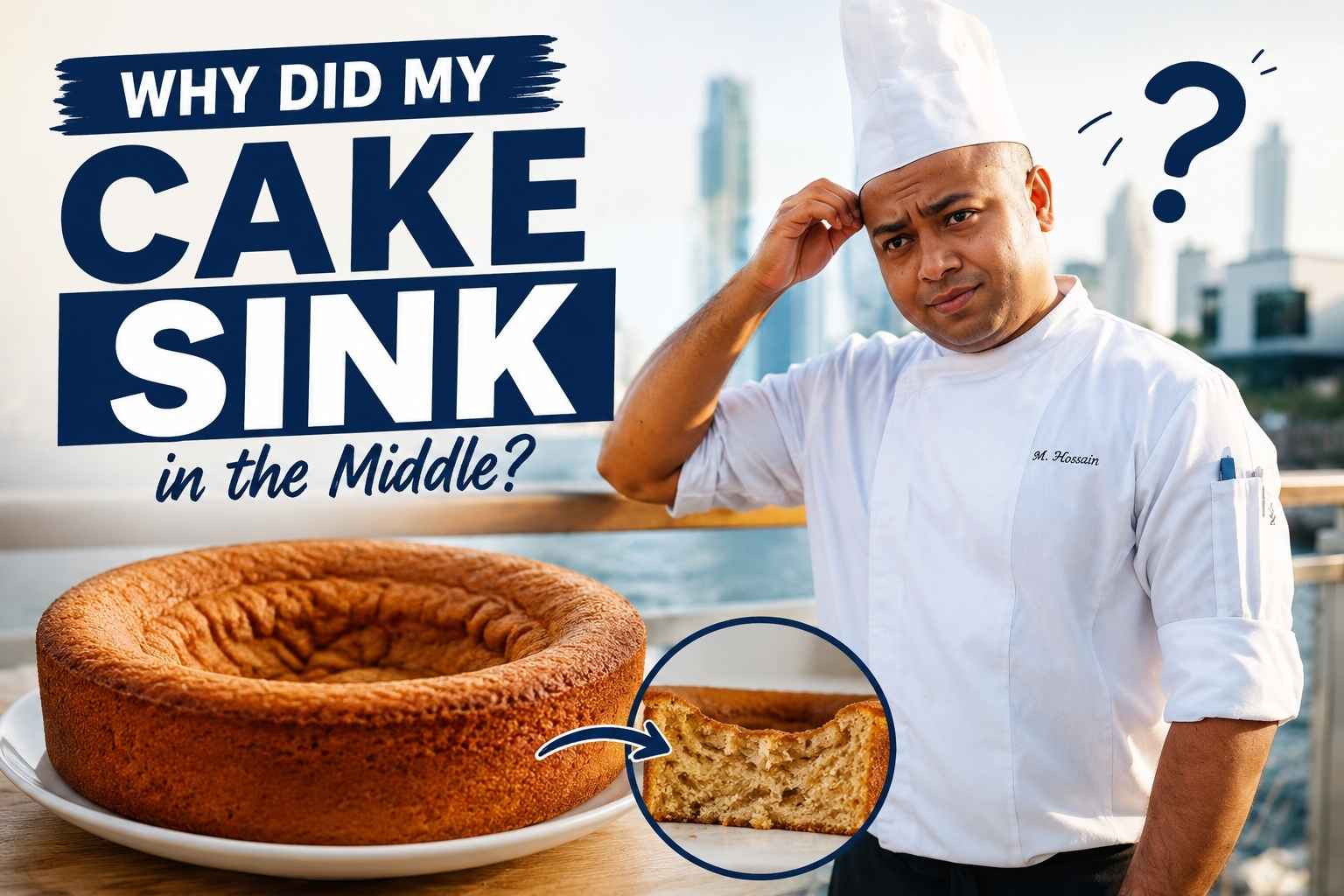
Why did my cake sink in the middle the first time I pulled one from the oven? I stared at that sad dip and almost cried. It happens to so many home bakers, even good ones. I’m Mossaraof, and I’ve fixed this problem in my own kitchen more times than I can count. Stick with me, and I’ll show you the exact reasons your cake sinks and how to stop it for good.
What Is Happening Inside Your Cake as It Bakes
A cake that sinks is a cake whose structure failed before it finished building. To fix the problem, it helps to know what “structure” actually means here.
When you put batter in the oven, three things happen at once. First, heat turns the water in your batter to steam, and that steam, along with gas from baking powder or soda, pushes the batter upward. Second, the eggs and flour proteins start to set – they go from liquid to solid through heat. Third, any remaining fat and sugar melt and flow.
The race is between the gas pushing up and the egg-flour structure setting firm. If the structure sets first, you get a level cake. If the gas expands faster than the structure can hold it, or if the structure never fully sets, the center collapses when you pull the pan from the oven.
Eggs are the main structure builders (The Cake Bible, Rose Levy Beranbaum, 2009). Flour proteins form gluten, which adds a web of support. Baking powder and baking soda create the lift. Fat tenderizes – but too much fat weakens the structure.
Every sink in a cake’s center is a story of one of these systems going wrong. Let’s go through each one.
#1 Cause of a Sunken Cake: Underbaking
Underbaking is responsible for the majority of sunken cakes. I’ve watched it happen at least a hundred times in professional kitchens. A baker checks with a toothpick, gets a clean pull, and takes the cake out. Twenty minutes later, the center has dropped an inch.
The toothpick test is a start, but it’s not the whole story. A toothpick can come out clean from the edges while the center is still liquid batter. This happens most often with dense batters like pound cake, chocolate lava cake, or anything with a high fat ratio.
Here is my actual doneness checklist, developed over 15 years:
- Press the center lightly with one finger. A done cake springs back. An underdone cake leaves a dent.
- Check the color. The edges should pull slightly away from the pan sides.
- Use an instant-read thermometer. Most butter cakes are done at 205-210°F in the center (King Arthur Baking, 2023). Sponge cakes read about 200°F.
- Give it the jiggle test before you open the door. If the center ripples like water, it needs more time.
Wait the full bake time before opening the door. Set a timer and walk away.
Too Much Leavening: Why More Powder Does Not Mean More Rise
I had a pastry apprentice who doubled the baking powder in a vanilla sponge “to make it fluffier.” The cake rose beautifully in the first 15 minutes – then caved in completely. She was genuinely confused. More lift should mean more rise, right?
Wrong. Here is what actually happens.
Baking powder works by releasing CO2 gas when it hits liquid (first reaction) and again when it hits heat (second reaction). If you add too much, you get an enormous amount of gas early in the bake. The batter puffs up fast – faster than the egg proteins can set around it. Then the bubbles get too large, the walls between them get too thin, and they pop. The whole dome collapses.
America’s Test Kitchen documented this effect in their baking science series (America’s Test Kitchen, 2021). They found that doubling the baking powder in a standard yellow cake consistently produced a crater center.
The correct amount of baking powder for most cakes is 1 teaspoon per cup of flour. For baking soda, it’s 1/4 teaspoon per cup of flour. Measure with a measuring spoon, level it off, and don’t eyeball it.
Also check your expiration date. Old leaveners cause different problems – they under-lift rather than over-lift – but they’re still worth replacing. Press a teaspoon of baking powder into hot water. If it doesn’t foam immediately, it’s dead (Serious Eats, 2022).
Oven Temperature Problems: Your Dial Is Probably Lying
Here is something most home bakers don’t know: most residential ovens run 25-50°F off from what the dial shows (Consumer Reports, 2020). Some run hot. Some run cold. Almost none run exactly right.
A cake baked in an oven that runs 50°F hot will set on the outside fast, but the center stays raw longer than the recipe expects. The outside crust forms a “skin” before the center can vent steam. When you pull the cake out, the center is still liquid – and it sinks.
An oven running too cold is worse for sinking. The cake rises slowly, the structure sets late, and you end up with an underbaked center even if you follow the time on the recipe exactly.
Buy an oven thermometer. They cost about $10. Put it in the center of your oven, preheat for 20 minutes (not 10), and check the real temperature before you put anything in.
The Oven Door Rule
Do not open the oven door in the first two-thirds of bake time. For a 30-minute cake, that means no peeking before the 20-minute mark.
When you open the door, temperature drops 25-50°F immediately (King Arthur Baking, 2023). The draft can also physically deflate a partially-risen cake. The protein structure isn’t fully set yet – it’s still fragile – and the sudden temperature drop can stop it from setting correctly.
Preheating Is Not What You Think
Your oven beeps when it hits the target temperature. That doesn’t mean it’s stable at that temperature. The walls, racks, and air all need time to equalize. Give it a full 20 minutes after the beep before you slide your pan in.
Overmixing and Undermixing: How to Find the Right Spot
Both extremes cause sinking, and they cause it in different ways.
What Overmixing Does
When you mix flour with liquid, the flour proteins bond to form gluten. A little gluten is good – it gives the cake structure. Too much gluten makes the batter stiff and elastic. It traps air in pockets that are too large and too tense.
In the oven, those large air pockets expand even more. Then they pop, and the center falls.
Overmixing also incorporates too much air into a butter-based batter. The batter looks fluffy before it goes in. In the oven, all that air expands fast, rises high, then collapses because there’s no protein structure to hold it up.
The fix: Once you add flour to a butter cake batter, mix only until you see no dry flour. That’s it. Stop immediately.
What Undermixing Does
Undermixing leaves pockets of dry flour and unblended fat. Dry flour doesn’t hydrate fully, so those spots don’t set properly. Fat pockets don’t distribute the tenderizing effect evenly – you get dense patches and soft patches. The soft patches sink.
Undermixing is most common when people are afraid of overmixing. They mix for five seconds and call it done.
The right technique for most cakes: cream butter and sugar for 3 full minutes until genuinely pale and fluffy. Add eggs one at a time, mixing 30 seconds each. Add dry and wet ingredients alternately in three additions, mixing on low just until combined (The Cake Bible, Rose Levy Beranbaum, 2009).
Wrong Pan Size or Material: A Frequent and Easy-to-Fix Mistake
I’ve seen this one more than I’d like to admit. A baker uses an 8-inch pan when the recipe calls for a 9-inch pan, or uses a dark nonstick pan without adjusting temperature.
Pan Size
If your pan is smaller than the recipe specifies, you have more batter volume relative to pan surface area. The batter is thicker. It takes longer to bake through. The outside sets before the center is done – and you get a sunken middle.
If your pan is larger, the batter spreads thin and bakes fast. You usually get a flat, dense result rather than a sink, but the texture suffers.
Match the pan size in the recipe. If you don’t have the right size, use a recipe designed for your pan.
Pan Material and Color
Dark pans absorb more heat and cook faster on the outside. Serious Eats tested this directly and found that dark nonstick pans can increase edge browning by 30-40% compared to light aluminum pans (Serious Eats, 2021). That means the edges set and crust before the center has cooked through.
If you use a dark pan, drop your oven temperature by 25°F and check for doneness 5 minutes early.
Thin, flimsy pans heat unevenly. The spots directly over the oven element get hot; the rest stays cooler. That creates hot spots where the cake sets and cool spots where it sinks. Use heavy-gauge aluminum pans when you can.
Ingredient Temperature and Ratios: The Details That Change Everything
Cold Eggs and Cold Butter
Cold eggs added to a creamed butter-sugar mixture cause the mixture to curdle. You’ll see it happen – the batter goes from smooth to lumpy and separated. A curdled batter doesn’t hold air properly, and a cake baked from curdled batter is more likely to sink.
The fix is simple: take your eggs out of the fridge 30 minutes before baking. If you forget, put them in a bowl of warm (not hot) water for 5-10 minutes.
Cold butter doesn’t cream properly. It won’t hold the air you’re beating into it. Take butter out 1-2 hours before baking in a cool kitchen, 30-45 minutes in a warm one. When you press it, it should dent but not squish.
Too Much Liquid or Too Much Fat
Excess liquid dilutes the egg-flour structure. The batter is too thin to support itself as it rises, and the center falls.
Excess fat does the same thing – fat tenderizes by shortening gluten strands, but too much fat means almost no gluten, which means almost no structure.
Follow the recipe measurements exactly the first time you make it. Don’t substitute milk for cream, add extra oil “for moisture,” or use larger eggs than specified without adjusting elsewhere.
Altitude Baking: Why High-Altitude Cakes Sink More Often
If you live above 3,500 feet, your cakes will sink more often than the same recipe baked at sea level – and the recipes are not the problem.
At high altitude, air pressure is lower. Lower pressure means CO2 gas expands more. Baking powder that produces just the right amount of lift at sea level will over-expand at 5,000 feet. The cake rises fast, the structure can’t keep up, and the center collapses.
The King Arthur Baking High Altitude Guide (King Arthur Baking, 2022) recommends the following adjustments above 3,500 feet:
| Ingredient | Sea Level | High Altitude (3,500-6,500 ft) |
|---|---|---|
| Baking powder | 1 tsp per cup flour | Reduce by 15-25% |
| Sugar | Standard amount | Reduce by 1-2 tbsp per cup |
| Liquid | Standard amount | Increase by 2-4 tbsp per cup |
| Oven temperature | Standard | Increase by 15-25°F |
The extra liquid helps the structure set before the CO2 escapes. The slightly higher temperature helps the proteins set faster. Less sugar means less tenderizing, which gives you more structure.
If you’re at 6,500 feet or above, reduce baking powder even more – down by about 1/3 – and add a tablespoon extra of liquid per cup of flour.
Cause and Fix Reference Table
| Cause | What Went Wrong | Prevention |
|---|---|---|
| Underbaking | Structure didn’t set before you pulled the pan | Use thermometer (205-210°F for butter cakes), spring-back test, and edge-pull check |
| Too much leavening | CO2 over-expanded and collapsed | Measure precisely: 1 tsp baking powder per cup flour |
| Old leavening | Under-lift; structure never rose enough to set | Test in hot water; replace every 6-12 months |
| Oven too hot | Outside crusted before center cooked | Use an oven thermometer; preheat 20 full minutes |
| Oven too cold | Slow rise; center never set properly | Use an oven thermometer; increase temp or time |
| Opened door too early | Temperature drop deflated the fragile structure | No peeking before 2/3 of bake time is done |
| Overmixing | Too much gluten and air; large bubbles collapsed | Stop mixing when no dry flour is visible |
| Undermixing | Uneven batter; soft pockets sank | Cream butter fully; alternate wet and dry additions |
| Wrong pan size (too small) | Thick batter baked unevenly | Match recipe pan size exactly |
| Dark or thin pan | Uneven heat; edges set too fast | Drop temperature 25°F for dark pans; use heavy-gauge pans |
| Cold eggs | Batter curdled; couldn’t hold air | Room-temperature eggs, always |
| Too much liquid or fat | Weak structure collapsed | Measure ingredients exactly; don’t improvise |
| High altitude | Excess CO2 expansion | Reduce leavening, increase liquid and oven temperature |
When a Sunken Cake Is Still Salvageable
I’ve rescued a lot of sunken cakes. Here’s what actually works.
Frosting the crater: If the sink is shallow (under half an inch), level it with a generous layer of frosting before adding the next cake layer. When stacked, no one can see it. This is standard practice in most bakeries.
Trifle: A sunken layer cake is perfect for trifle. Cut the cake into cubes, layer with custard, whipped cream, and fresh fruit. The presentation is intentional. Nobody knows the cake was a mistake.
Cake pops: Crumble the sunken cake, mix with a few tablespoons of frosting until it holds together, roll into balls, dip in chocolate. These are genuinely delicious and cost $4 each at trendy bakeries.
Fill the hole: For bundt cakes, a deep center hole can be filled with whipped cream, ganache, or lemon curd right before serving. Use a piping bag and fill from below.
What doesn’t work: trying to re-bake a sunken cake. The structure is already set. You’ll dry out the outside before the center does anything useful.
My Personal Cake Troubleshooting Routine
After 15+ years in professional kitchens, here’s what I actually do when a cake sinks.
First, I smell the cake. An underbaked cake smells eggy and wet in the center. An overbaked cake smells dry and slightly bitter at the edges. Most sunk cakes smell fine overall but wet at the lowest point of the crater.
Then I look at the shape of the sink. A clean crater in the exact center usually means underbaking or too much leavening. An uneven, lopsided sink usually means an uneven oven or a pan that was placed off-center. A sink that runs the whole length of the cake in a loaf pan usually means too much liquid or undermixing.
I check my oven temperature every 6 months with a new thermometer. The calibration drifts. My current oven runs 18°F hot – I’ve adjusted every recipe accordingly.
I never substitute ingredient temperatures. If a recipe says room-temperature butter, I mean butter that has been out for two hours in a 70°F kitchen. Not “I left it out for 15 minutes.” Not “I microwaved it for 10 seconds.” Two hours, room temperature.
And I write down what I change. If I adjust leavening for altitude or try a different pan, I note it. Baking is repeatable when you track variables.
Frequently Asked Questions About Sunken Cakes
Why does my layer cake sink in the middle but the edges are fine?
The edges of a cake bake faster than the center because they’re in direct contact with the hot pan. The edge structure sets while the center is still liquid batter. If you pull the cake too early, or if your oven runs hot, the center hasn’t set yet when the edges are already done – and it sinks. Use the spring-back test in the center, not the edges, to check doneness.
Why does my chocolate cake sink more than my vanilla cake?
Chocolate cakes are generally denser and moister than vanilla cakes. More cocoa powder means more liquid-absorbing starch, and most chocolate cake recipes compensate with extra liquid or oil. This makes the batter heavier and slower to set. You also often add hot liquid (hot coffee or hot water) to bloom the cocoa, which adds even more moisture. Chocolate cakes need a full internal temperature check – I aim for 205°F minimum in the center.
Why does my sponge cake sink after I take it out of the oven?
Sponge cake relies almost entirely on beaten eggs for structure – there’s no baking powder, little or no fat, and minimal flour. That structure is fragile. The most common culprits are underbeating the eggs, deflating the batter while folding in flour, or opening the oven door too soon. Fold in the flour with a wide spatula, using slow, wide strokes from the bottom of the bowl up. Stop as soon as you can’t see dry flour.
Why does my bundt cake always sink in the center tube?
Bundt pans have a hollow center tube that conducts heat into the middle of the batter. This sounds like it should help – and it does, to a degree – but it also means the batter near the tube bakes faster than the batter near the outer wall. The result is a ring of done cake around a layer of underdone cake. Add 5-8 minutes to the bake time compared to a standard round cake, and check internal temperature in the thickest part of the ring, not near the tube.
Can I fix a sunken cake by putting it back in the oven?
No. Once a cake sinks, the structure has collapsed and partially set in the wrong shape. Putting it back in the oven will dry out the edges and sides without fixing the center. The only situation where re-baking helps is if you catch the sink immediately, before the cake has cooled at all, and the internal temperature is still well below done – say, 180°F. Even then, it’s a partial fix at best.
Why does my cake sink when I make ingredient substitutions?
Cake recipes are ratios. Every ingredient plays a specific role, and changing one changes how all the others behave. Swapping whole eggs for egg whites removes fat and yolk proteins, weakening the structure. Using Greek yogurt instead of buttermilk changes the liquid ratio and acidity. Adding applesauce “for moisture” dilutes the fat-protein balance. If you want to substitute, use a recipe that’s already been tested with that substitution.
Why do my cakes sink only in summer?
Humidity and kitchen temperature affect batter behavior. On a hot, humid day, flour absorbs moisture from the air before it even goes into the bowl. Butter softens faster, sometimes to the point of being greasy rather than fluffy. These small changes in ingredient behavior affect structure. In summer, measure flour by weight rather than volume (a scale is more accurate than a cup), keep your kitchen cool while baking, and don’t let butter sit out longer than 45 minutes before using it.
Why does my cake sink every time I make a certain recipe?
The recipe may have an error, or the recipe may have been developed at a different altitude or in a different climate. Some online recipes have never been properly tested. Before blaming yourself, check: Does the leavening ratio match the 1 tsp per cup flour rule? Does the recipe call for unusually large amounts of liquid or fat? Try cutting leavening by 10%, reducing liquid by a tablespoon, and increasing bake time by 5 minutes. If that doesn’t fix it, find a better recipe.
Key Takeaways
- A cake sinks when gas expands faster than the egg-flour structure can set around it.
- The most common fix is longer bake time. Check with a thermometer (205-210°F for butter cakes), not just a toothpick.
- Measure baking powder and baking soda precisely. Too much causes collapse, not extra rise.
- Buy a $10 oven thermometer. Preheat for 20 full minutes before baking.
- Use room-temperature eggs and butter, always.
- Stop mixing as soon as you see no dry flour.
- Match your pan size to the recipe, and drop temperature 25°F for dark pans.
- At altitude above 3,500 feet, reduce leavening and increase liquid per King Arthur Baking guidelines.
- A sunken cake is usually still edible. Frosting, trifle, and cake pops are your rescue options.

I’m Mossaraof, a trained chef and the founder of OvenInsights.com. I spent years cooking at Larrupin’ Cafe and in kitchens across Chicago and Seattle. Now I test kitchen gear for a living. I moved to North Acton, London, and I test every tool I write about. I use real meals and real heat. No brand deals. No shortcuts. I cover 12 kitchen types and hundreds of recipes. I believe this: the right tools matter as much as the recipe.