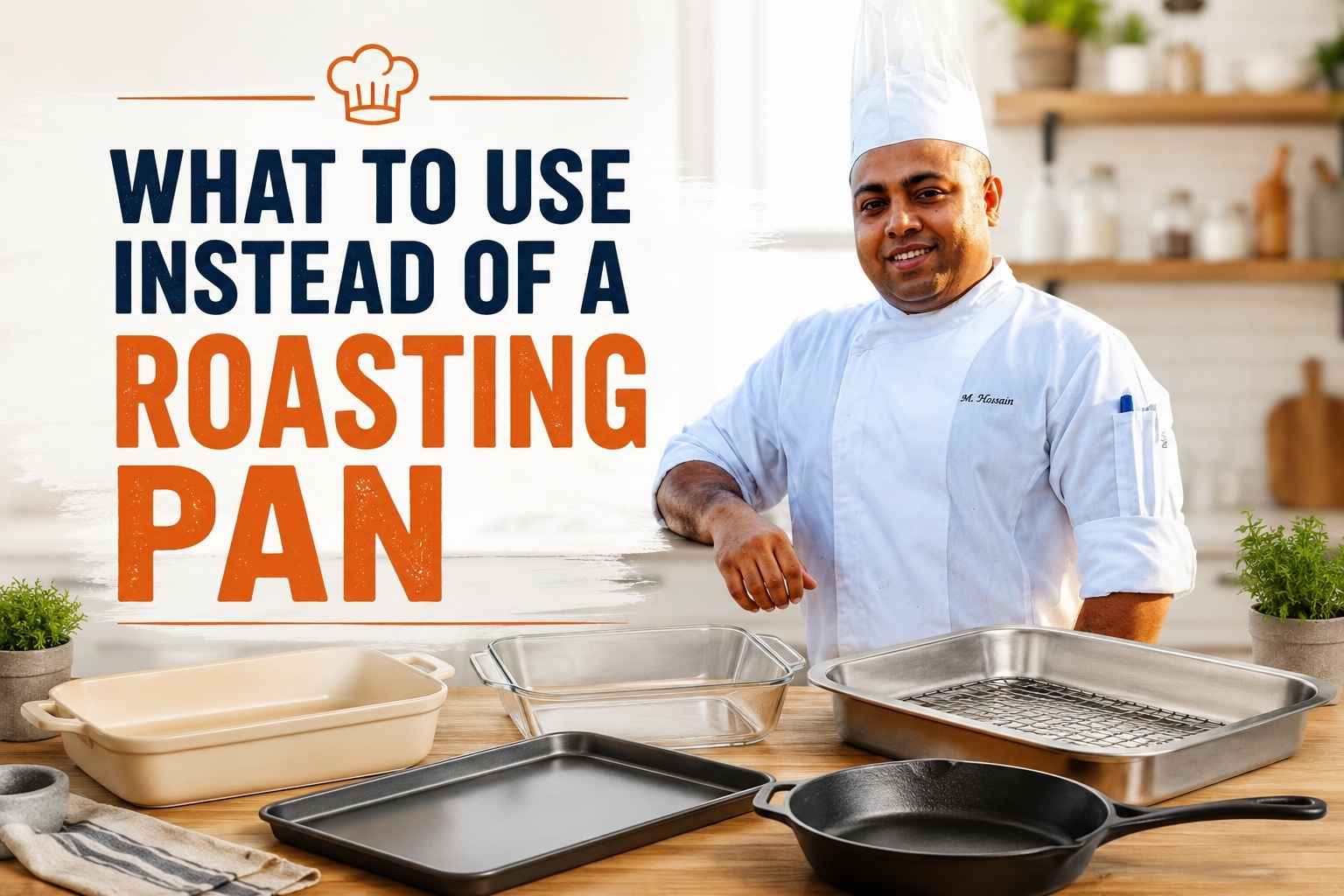
At A Glance
- You do not need a roasting pan to roast meat well. A cast iron skillet, a sheet pan with a wire rack, or a Dutch oven all work — and two of them work better for smaller cuts.
- The best all-around substitute is a rimmed sheet pan with a wire rack. It gives you airflow under the meat, easy drippings access, and works for everything from a spatchcocked chicken to a pork loin.
- A 12-inch cast iron skillet is my personal go-to for anything under 5 lbs. It holds heat better than most roasting pans and goes straight from oven to stovetop for a pan sauce.
- Drippings matter. Not every substitute handles them equally. Foil pans collect them; ceramic dishes do too, but they are slow to heat. Skip glass for high-heat roasting — it can crack.
- Convection ovens change the math slightly. Drop your temperature by 25°F (about 15°C) when using a sheet pan substitute, because the fan accelerates browning fast.
My roasting pan cracked in half last Thanksgiving, right before the turkey went in. I panicked for about ten seconds, then grabbed what I already had in my kitchen. After years of testing ovens for a living, I know what to use instead of a roasting pan without missing a beat. Below, I’ll show you my go-to swaps, plus tips to get the same crispy, juicy results. Grab your apron, and let’s fix this together.
What a Roasting Pan Actually Does — and Why That Changes Everything
A roasting pan does four things: it collects drippings, distributes heat across the bottom of the meat, lifts the roast slightly above the pan floor, and gives you a vessel deep enough to deglaze for gravy.
That is it. Four jobs.
Once you understand those four jobs, picking a substitute gets simple. You just need something that can do as many of those jobs as possible for your specific cut.
Here is what goes wrong when cooks skip the substitute thinking: they put a turkey or roast directly on a baking sheet with no rack and no sides. The meat sits in pooled fat. The bottom steams instead of roasts. You get grey, soft skin on the underside and no real browning.
The pan is not magic. The function is.
Why Most Home Cooks Don’t Own a Roasting Pan
Only about 35% of American home cooks own a dedicated roasting pan, according to a 2024 survey by the Specialty Food Association. That number makes sense. A full-size roasting pan costs $40 to $200, takes up serious cabinet space, and gets used maybe twice a year.
I have cooked in professional kitchens for 15 years. I rarely used a dedicated roasting pan at home until I started testing substitutes side by side. What I found surprised me: for most roasts under 12 lbs, the right substitute is actually equal to or better than a standard mid-range roasting pan.
The roasting pan wins for one specific job: large birds. A 20-lb turkey is hard to manage in anything else. But for 80% of what home cooks actually roast — a chicken, a pork shoulder, a leg of lamb, a rib roast — you can do just as well with what you already own.
Roasting Pan Substitutes at a Glance
| Substitute | Best For | Drippings? | Heat Distribution | Limitations |
|---|---|---|---|---|
| Sheet pan + wire rack | Chicken, pork loin, vegetables | Yes (collect in pan) | Even, with airflow | Too shallow for very large birds |
| Cast iron skillet (12″) | Chicken under 5 lbs, steaks, small roasts | Yes, excellent | Excellent — holds heat | Too small for large cuts |
| Dutch oven | Braised roasts, pot roast, lamb shoulder | Yes, best of all | Excellent | No surface browning (lid on) |
| Broiler pan | Any roast needing maximum browning | Yes | Good | Bottom tray hard to deglaze |
| Ceramic baking dish | Chicken thighs, vegetables, fish | Yes | Slow, even | Not for high heat above 450°F |
| Carbon steel pan | Chicken, pork, smaller roasts | Yes | Excellent | Needs seasoning care |
| Foil roasting pan | Large birds, travel, one-time use | Yes | Weak — needs support | Flimsy; not for stovetop |
| Stainless steel skillet | Small roasts, chicken pieces | Yes | Good | Sticks more than cast iron |
The Best Roasting Pan Substitutes, Ranked by Versatility
1. Rimmed Sheet Pan with a Wire Rack – Best All-Around Substitute
A rimmed sheet pan (also called a half-sheet pan) paired with a wire rack is the most flexible substitute you can use. It handles chickens, pork loins, rack of lamb, root vegetables, and bone-in turkey breasts without any adjustment.
The wire rack is not optional here. It lifts the meat off the pan floor so hot air circulates underneath. That is how you get crispy skin on the bottom of a chicken, not just the top.
America’s Test Kitchen named the sheet pan-plus-rack combination their top roasting pan substitute in their 2023 equipment review, noting it produced comparable browning to a dedicated roasting pan on birds up to 12 lbs.
How it changes cooking: Heat from below is slightly less intense because the sheet pan is thinner than a roasting pan. This actually helps with lean cuts like pork loin — they dry out less. For fatty cuts like duck, you want to drain the pan halfway through or it will smoke.
For gravy: Pour the drippings from the sheet pan into a small saucepan and deglaze with stock on the stovetop. You cannot deglaze the sheet pan directly over a burner — it will warp. So do your fond-building in a separate pan.
Best for: Chicken (whole or spatchcocked), pork loin, rack of lamb, turkey breast under 8 lbs, roasted vegetables alongside meat.
2. Cast Iron Skillet (12-Inch) – My Personal Go-To
A 12-inch cast iron skillet is the substitute I reach for most often. For any roast under about 5 lbs, it outperforms most mid-range roasting pans because of one thing: heat retention.
Cast iron holds heat more evenly than thin stainless steel or enameled steel pans. When you put a cold roast into a hot cast iron skillet, the pan does not drop in temperature the way a light pan does. That means better searing on the bottom and more consistent browning overall.
Lodge Cast Iron’s own cooking guides recommend the skillet for chicken and small roasts, noting the pan-to-oven-to-stovetop workflow as a major advantage (Lodge Cast Iron, 2024). I agree with that. Once your roast comes out of the oven, you can make a pan sauce right on the burner in the same skillet. No extra pots. No extra cleanup.
How it changes cooking: Cast iron runs slightly hotter than other pans at the same oven setting. Drop your oven temperature by 10-15°F compared to a roasting pan recipe. Also, cast iron heats unevenly at first — preheat the skillet in the oven for 10 minutes before adding the meat.
For gravy: Perfect. The cast iron skillet deglazes beautifully on the stovetop. Add your shallots, your wine or stock, scrape the fond (the brown bits stuck to the pan), and you have a gravy base in under five minutes.
Not ideal for: Anything over about 14 inches wide, like a full turkey. You physically cannot fit it.
Best for: Whole chicken under 4 lbs, chicken pieces, pork tenderloin, small beef roasts, duck breast.
3. Dutch Oven – Best for Moist, Braised-Style Roasts
A Dutch oven is the right tool when you want a roast that stays moist and falls apart — think pot roast, lamb shoulder, or pork butt. With the lid on, the Dutch oven traps steam and braises the meat in its own juices.
The trade-off is browning. A closed Dutch oven does not give you a crispy crust. If you want both — tender meat and a crust — sear the roast on the stovetop first, then add liquid and braise.
Serious Eats recommends a minimum of 1/2 cup of liquid for a 4-lb roast in a Dutch oven and suggests removing the lid for the last 30 minutes to let the surface dry and brown (Serious Eats, 2024).
How it changes cooking: Cooking times are longer because you are effectively braising, not dry roasting. A 4-lb chuck roast takes about 3 to 3.5 hours at 325°F (163°C) in a Dutch oven versus about 90 minutes at 425°F (218°C) open-roasted.
For gravy: The liquid already in the Dutch oven is your gravy base. Skim the fat, reduce it on the stovetop, and thicken with a cornstarch slurry or a roux. It is the easiest gravy workflow of any substitute.
Best for: Pot roast, lamb shoulder, pork shoulder, braised short ribs, whole chicken with vegetables.
4. Broiler Pan – Best for Maximum Browning
A broiler pan is the two-piece pan that came with your oven and is probably sitting forgotten in a bottom drawer. The top piece has slots that let fat drain through to the bottom pan. This design gives you excellent airflow and serious browning.
The downside is that the slotted top is hard to deglaze for gravy. The drippings that fall through are mixed with fat and collect in the lower tray, which is a flat, shallow piece not designed for sauteing.
How it changes cooking: Very similar to a sheet pan plus rack, but the slotted surface keeps the meat even drier underneath. Good for skin-on poultry where you want the crispiest result possible.
For gravy: Pour the drippings from the lower tray into a saucepan. Deglaze the lower tray with a small amount of stock on the stovetop if it has good fond, but be careful — the broiler pan is thin and will warp over direct high heat.
Best for: Whole chicken, turkey pieces, pork ribs, any cut where you want very crispy exterior browning.
5. Ceramic Baking Dish – Best for Slow, Even Cooking
A ceramic baking dish (the 9×13 style) works well for bone-in chicken pieces, fish, and vegetables. It heats slowly and holds heat evenly, which is good for gentle cooking and bad for high-heat searing.
Do not use ceramic above 450°F (232°C). Most ceramic baking dishes are rated for that temperature, but rapid changes — like putting a cold dish into a very hot oven — can crack them (King Arthur Baking, 2023).
How it changes cooking: Expect longer cooking times and less browning on the bottom of the meat. The ceramic absorbs heat slowly, so it never gets as hot as metal. This is actually an advantage for fish or chicken breasts, which overcook fast.
For gravy: Good. You can collect drippings easily and add stock right to the dish. Do not put the ceramic dish on a burner — deglaze in a separate saucepan.
Best for: Chicken thighs, chicken breasts, fish fillets, casseroles, roasted vegetables.
6. Foil Roasting Pan – Best for Large Birds When Nothing Else Fits
A disposable foil roasting pan is the answer when you need to roast a 16-lb turkey and have no proper roasting pan. It works. It is not elegant, but it works.
The problem is rigidity. A foil pan full of a heavy turkey is not safe to lift bare-handed. Always place the foil pan on a sturdy sheet pan before loading it into the oven. The sheet pan underneath carries the structural load and makes it safe to move.
How it changes cooking: Thin foil does not distribute heat as well as metal. Browning on the bottom of the bird may be uneven. Tent with foil for most of the cook, then remove it in the last 45 minutes to brown the skin.
For gravy: Yes, but carefully. Let the turkey rest in the pan, then pour or ladle the drippings out. Do not try to lift the full pan and pour — it will buckle.
Best for: Large whole turkey, large pork roast, any one-time use situation.
The Drippings Problem: Which Substitutes Work for Gravy
Gravy depends on drippings — the fat, juices, and fond that collect at the bottom of your pan during roasting. Not every substitute makes gravy easy.
Here is how each option ranks for gravy:
- Cast iron skillet: Best. Deglazes directly on the stovetop. Rich fond. Easy gravy in 5 minutes.
- Dutch oven: Best for braised roasts. The liquid is already your gravy base.
- Sheet pan + wire rack: Good, but requires a separate saucepan for deglazing.
- Ceramic dish: Good collection, but deglaze in a separate pan — never on a burner.
- Broiler pan: Workable, but messy. The two-piece design makes it awkward.
- Foil pan: Drippings are there, but you must ladle them out carefully.
- Glass baking dish: Do not use for roasting. Glass is a poor heat conductor for this job, and the thermal shock risk is real.
How Convection Ovens Change the Rules for Substitutes
If you have a convection oven (also called a fan-forced oven), using a substitute pan changes the math in one important way: browning happens faster.
The fan in a convection oven circulates hot air constantly. When you use an open substitute like a sheet pan or cast iron skillet — both of which expose more of the roast to moving air than a deep roasting pan — browning accelerates even more.
Two adjustments work well here:
- Drop the temperature by 25°F (about 15°C) compared to what the recipe says.
- Start checking 20% earlier than the recipe’s suggested time.
A whole chicken that takes 75 minutes at 425°F (218°C) in a conventional oven with a roasting pan may take only 55-60 minutes at 400°F (204°C) in convection with a sheet pan and rack. America’s Test Kitchen tested this across multiple cuts in 2024 and confirmed the 20-25% time reduction as a reliable rule of thumb (America’s Test Kitchen, 2024).
The Dutch oven is the exception. Because the lid traps steam, convection has little effect on the interior. Keep your temperature and time the same when braising in a Dutch oven.
When a Substitute Is Actually Better Than a Roasting Pan
For specific cuts, a substitute genuinely outperforms a standard roasting pan. Here are the three cases I have seen again and again in my own kitchen:
Spatchcocked chicken on a sheet pan + rack. Spatchcocking (removing the backbone so the bird lays flat) gives you a wider, lower profile that a sheet pan handles perfectly. The airflow from the rack browns the skin on all sides at once. A deep roasting pan actually works against you here because the sides trap steam.
Small pork loin in a cast iron skillet. The skillet’s heat retention gives you a better crust on the underside of the loin than most thin-walled roasting pans. You also go directly to the stovetop for the pan sauce without changing vessels.
Lamb shoulder in a Dutch oven. A lamb shoulder braised low and slow in a Dutch oven at 300°F (149°C) for 4 hours is better than anything you’ll get from open-roasting it. The enclosed environment concentrates the juices and keeps the meat from drying out.
Common Mistakes When Using Roasting Pan Substitutes
Mistake 1: Skipping the wire rack on a sheet pan.
The rack is what separates roasting from steaming. Without it, the underside of the meat sits in pooled fat and juices. It goes grey and soft. Always use the rack.
Mistake 2: Using glass for high-heat roasting.
Glass is a poor conductor of heat. It heats slowly and unevenly, and it can crack when moved from a hot oven to a cooler counter too fast. Use ceramic, cast iron, or metal instead.
Mistake 3: Putting a foil pan in the oven without support underneath.
A foil pan with a 15-lb turkey in it is not structurally sound on its own. Place it on a sheet pan first. Every time.
Mistake 4: Trying to deglaze a sheet pan on the stovetop.
Sheet pans are thin. Direct burner heat will warp them — sometimes permanently. Pour the drippings into a saucepan first.
Mistake 5: Not preheating the cast iron skillet.
Cold cast iron put straight into the oven with a roast on top will not give you an even sear on the bottom. Preheat the empty skillet in the oven for 10 minutes before adding the meat. Then you get real browning, not steaming.
Mistake 6: Using too small a substitute for a large cut.
A 10-inch skillet cannot hold a 4-lb roast with room for air to circulate. Crowding a pan raises the internal humidity and kills browning. Go up a size or use a different vessel.
My Go-To Setup: The Honest Chef’s Answer
I’ll tell you exactly what I use at home: a 12-inch Lodge cast iron skillet for anything under 5 lbs, and a Nordic Ware half-sheet pan with an Oven-Safe Cooling Grid (wire rack) for everything bigger.
Those two pieces of gear cost about $75 total. They cover 95% of what I roast at home. The cast iron skillet has been in my kitchen for 11 years. The sheet pan set I replace every few years when it warps.
For Thanksgiving, if I am cooking for more than eight people and need a full bird over 14 lbs, I buy a heavy-gauge foil pan and place it on the sheet pan. I do not own a dedicated roasting pan, and I have never once regretted it.
The one roasting pan worth owning, if you want one, is an All-Clad Stainless Steel Roasting Pan with Rack — heavy-gauge, stovetop-safe, and large enough for a 25-lb turkey. But at $200, it is hard to justify when a sheet pan and cast iron skillet do the job for a third of the cost.
Frequently Asked Questions About Roasting Pan Substitutes
What is the best substitute for a roasting pan?
The best substitute is a rimmed sheet pan with a wire rack. It works for roasts up to about 12 lbs, gives you good airflow under the meat, and collects drippings for gravy. For smaller cuts under 5 lbs, a 12-inch cast iron skillet is better because it holds heat more evenly and goes straight from oven to stovetop for a pan sauce.
Can I use a glass baking dish instead of a roasting pan?
No. Glass is a poor heat conductor and can crack from thermal shock if moved from a very hot oven to a cooler surface. Use a ceramic dish for gentle roasting under 400°F (204°C), or use a metal pan for anything hotter.
Can I roast a turkey without a roasting pan?
Yes. Place a foil roasting pan on top of a sturdy rimmed sheet pan for support. Tent the turkey with foil for most of the cook, then remove it for the last 45 minutes to brown the skin. The foil pan collects drippings just as well as a standard roasting pan — it is just less rigid.
Does using a substitute affect cooking time?
Yes, slightly. Sheet pans and skillets tend to transfer heat more efficiently than thick-walled roasting pans, so cooking times are often 5-10% shorter. If you use a convection oven, the difference is more pronounced — expect up to 20% less time and drop the temperature by 25°F (15°C).
How do I make gravy when using a sheet pan instead of a roasting pan?
Pour the drippings from the sheet pan into a small saucepan. Heat the saucepan over medium-high, add finely diced shallots or onion, deglaze with wine or stock, and scrape in any stuck bits. Thicken with flour or cornstarch and season to taste. You cannot deglaze the sheet pan itself over a burner — it will warp.
What can I use if I don’t have a wire rack?
Use a bed of thick-cut vegetables — halved onions, thick carrot rounds, celery stalks — to lift the meat off the pan floor. This works surprisingly well and adds flavor to your drippings. America’s Test Kitchen uses this trick regularly in their equipment-free cooking guides (America’s Test Kitchen, 2023).
Is a Dutch oven the same as a roasting pan?
No. A Dutch oven is a thick-walled pot with a tight lid, designed for braising. A roasting pan is open on top and designed for dry-heat roasting. A Dutch oven works as a substitute when you want moist, braised meat. For a dry roast with a crispy exterior, use a sheet pan or skillet instead.
Can I use a cast iron skillet for a whole chicken?
Yes, as long as the chicken is under about 4.5 lbs. Preheat the skillet in the oven for 10 minutes first. Place the chicken breast-side up, season it, and roast at 425°F (218°C) for about 60-70 minutes. The skillet gives you excellent browning on the underside and a straight path to a pan sauce on the stovetop when the chicken is done.
Key Takeaways
- You do not need a roasting pan to roast meat well. A sheet pan with a wire rack or a cast iron skillet handles most cuts just as well.
- The wire rack is essential when using a sheet pan. Without it, the meat steams in its own fat instead of roasting.
- Cast iron is better than most roasting pans for small cuts because it holds heat evenly and goes directly to the stovetop for pan sauce.
- A Dutch oven is not a true substitute for dry roasting — it braises. Use it only when you want moist, fall-apart meat.
- Never use glass for high-heat roasting. It conducts heat poorly and can crack.
- Foil pans always need a sheet pan underneath for structural support. Never lift a heavy roast in a foil pan without backing.
- In a convection oven, drop your temperature by 25°F (15°C) and start checking 20% earlier when using an open substitute like a sheet pan or skillet.
- For gravy, cast iron and Dutch ovens are the easiest substitutes. Sheet pan drippings must be transferred to a saucepan before deglazing.

I’m Mossaraof, a trained chef and the founder of OvenInsights.com. I spent years cooking at Larrupin’ Cafe and in kitchens across Chicago and Seattle. Now I test kitchen gear for a living. I moved to North Acton, London, and I test every tool I write about. I use real meals and real heat. No brand deals. No shortcuts. I cover 12 kitchen types and hundreds of recipes. I believe this: the right tools matter as much as the recipe.