At A Glance
- A heavy stockpot with a tight lid is the best all-around Dutch oven substitute for soups, stews, and braises.
- A cast iron skillet with a foil-and-sheet-pan lid works well for roasts and small braises (Lodge Cast Iron, 2025).
- For bread, an inverted cake pan over a baking sheet traps steam almost as well as a Dutch oven (King Arthur Baking, 2024).
- Slow cookers can replace a Dutch oven for low, slow cooking, but they cannot sear or get a deep crust.
- Glass and ceramic bakeware crack under high heat or sudden temperature shifts, so skip them for stovetop-to-oven recipes (Pyrex, 2025).
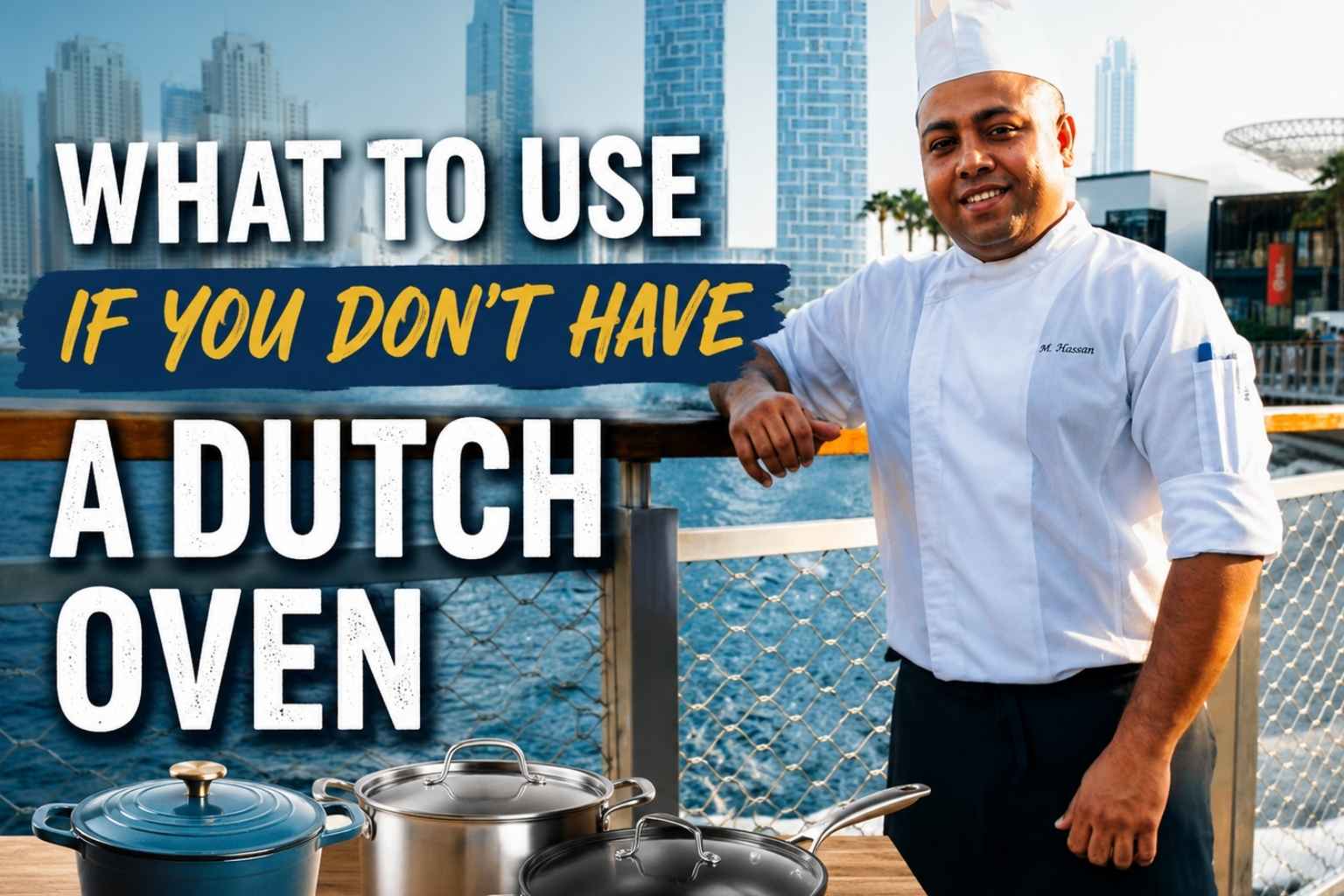
My oven broke last winter, and I panicked. I had no Dutch oven for my stew, and dinner was due in an hour. So I dug through my cabinets and found three tools that saved the day. I’m Mossaraof, a chef who’s burned more than a few pots learning these tricks. Today I’ll show you exactly what to use if you don’t have a Dutch oven, so you can cook like a pro tonight.
Why a Dutch Oven Works So Well
A Dutch oven is just a thick pot with a tight lid. That’s it. But those two things together create a small, sealed cooking world.
The thick walls hold heat. Once they get hot, they stay hot, even when you add cold food. This means your stew keeps simmering at a steady pace instead of dropping in temperature every time you stir it.
The tight lid traps steam. That steam falls back onto the food, keeping it moist. This is why a pot roast in a Dutch oven comes out tender instead of dry.
When you cook without a Dutch oven, your real goal is to copy these two things: heat that doesn’t swing up and down, and a lid that holds in moisture. Every substitute on this list is judged by how well it does those two jobs.
I’ve worked line stations where the only “Dutch oven” we had was a battered stockpot and a sheet pan. It worked fine. The pot just has to be heavy and the lid just has to fit.
What to Look for in a Dutch Oven Substitute
Lid Fit Matters More Than Lid Material
A lid that fits snugly traps steam. A lid that’s too small or warped lets it escape. Even a flat sheet pan can work as a lid if it covers the pot’s opening with no big gaps.
Material Thickness Affects Heat Retention
Thin pots heat up fast but cool down fast too. Thick pots, like cast iron or heavy stainless steel, hold their heat through the whole cook. This matters most for braises and stews that simmer for an hour or more.
Oven-Safe Handles Are Non-Negotiable
Plastic or rubber handles can melt or warp at oven temperatures above 400°F (America’s Test Kitchen, 2024). Before you put anything in the oven, check every handle and knob for “oven safe” markings.
Even Heat Distribution Prevents Hot Spots
Some pots heat unevenly, with hot spots right above the burner. This can scorch food on the bottom while the top stays raw. Heavier, thicker pots spread heat more evenly across the base.
Dutch Oven Substitute Comparison Table
| Substitute | Heat Retention | Lid Options | Oven-Safe Rating | Best Use Case |
|---|---|---|---|---|
| Heavy stockpot with lid | High | Original lid or foil | Most safe to 400-500°F | Soups, stews, braises |
| Cast iron skillet | Very high | Foil + sheet pan | Safe to 500°F+ | Roasts, small braises, frying |
| Slow cooker (with oven-safe insert) | High, but slow | Built-in lid | Insert only, check rating | Long, low cooks |
| Casserole dish (ceramic) | Medium | Often included | Usually safe to 350-400°F | Baked dishes, gratins |
| Dual-handle stock pot | Medium-high | Original lid | Check handle material first | Large-batch soups, stocks |
| Clay pot (cazuela, tagine) | Medium | Built-in lid | Safe but needs slow preheat | Slow braises, rice dishes |
Best Substitutes by Cooking Method
Braising: Use a Heavy Stockpot or Cast Iron Skillet
For braising, a heavy stockpot with a tight lid is your best bet. The pot needs enough weight to hold steady heat for one to three hours.
Sear your meat in the pot first, just like you would in a Dutch oven. Then add your liquid, cover, and move the whole pot to the oven. If your stockpot’s lid doesn’t fit your oven, a sheet of foil pressed tightly over the rim works as a backup.
Cast iron skillets work too, but only for smaller cuts. A short rib or a chicken thigh fits fine. A whole pot roast won’t.
Soup and Stew: A Stockpot Is Often Better Than a Dutch Oven
For soup and stew, a stockpot is often the better tool, not just a backup. Stockpots are taller and hold more liquid, which is exactly what soup needs.
The one thing a stockpot lacks is a Dutch oven’s thick base. To fix this, keep your heat lower and stir more often. This stops the bottom layer from scorching while the rest of the pot stays cool.
I learned this the hard way during my first year cooking professionally. I cranked the heat on a thin stockpot of lentil soup and walked away for five minutes. The bottom burned, and the smoky taste ruined the whole batch.
Bread Baking: Trap Steam With a Covered Casserole Dish or Inverted Pan
For bread, the goal is trapping steam in the first 20 minutes of baking. This steam keeps the crust soft long enough for the bread to rise fully before it sets.
A covered ceramic casserole dish does this well, as long as it’s oven-safe at 450°F or higher. Place your dough inside, cover with the lid, and bake as directed.
No casserole dish? Place your dough on a baking sheet, then cover it with a large inverted metal bowl or cake pan for the first part of baking. Remove the cover for the last 10 to 15 minutes so the crust browns (King Arthur Baking, 2024).
Deep Frying: Cast Iron Skillet or Heavy Saucepan
For deep frying, you need a pot with high sides and thick walls so the oil temperature stays steady. A cast iron skillet or a heavy-bottomed saucepan both work well.
The key is depth. Oil should never come more than halfway up the sides, since it expands and bubbles when food goes in. A taller, narrower pot is safer than a wide, shallow one.
Always use a thermometer here. Without the steady mass of a Dutch oven, oil temperature can swing fast when you add food (Serious Eats, 2025).
One-Pot Roasts: Cast Iron Skillet With a Foil Lid
For a one-pot roast, a cast iron skillet with a foil lid gets you most of the way to Dutch oven results. The skillet’s thick base sears well, and the foil traps enough steam to keep the meat moist.
Sear your roast on all sides first. Add your vegetables and a small amount of liquid, then cover tightly with foil before moving to the oven. Check halfway through, since foil traps less steam than a solid lid and may need replacing if it tears.
Cast Iron Skillet + Foil Lid: How to Rig a Makeshift Lid
This is my go-to combo when I’m cooking at home and don’t want to drag out a heavy Dutch oven. Here’s how I do it.
First, sear your food in the skillet as normal. Once everything is in the pan and your liquid is added, tear off a sheet of heavy-duty foil large enough to cover the entire pan with two inches of overhang on each side.
Press the foil down over the rim of the skillet, then crimp the edges around the lip of the pan. This creates a seal that traps most of the steam.
For extra security, place a sheet pan upside down over the foil-covered skillet. This adds weight, holds the foil in place, and reflects heat back down onto the food.
Common mistake: using light foil instead of heavy-duty. Light foil tears from steam pressure within 20 minutes, and your moisture escapes right when you need it most.
Stockpot vs. Saucepan vs. Stock Pot With Lid
A Stockpot Is Tall and Narrow, Built for Liquid
A stockpot is tall, with straight sides and a narrow base relative to its height. This shape is great for soups, stocks, and pasta water, but it’s not ideal for browning meat since there’s less surface contact.
A Saucepan Is Shallow and Wide, Built for Sauces and Sears
A saucepan is shorter and wider, with more surface area touching the heat. This makes it better for searing and reducing sauces, but it holds less liquid.
Which One Goes in the Oven?
Check your handles before either pot goes in the oven. Many stockpots have long handles riveted with plastic grips, which is a fire risk above 350°F (America’s Test Kitchen, 2024).
If your pot has a metal lid that fits snugly, it’s likely oven-safe up to the pot’s rated temperature. If the lid is glass with a plastic knob, remove the knob or replace the lid with foil before baking.
Slow Cooker as a Dutch Oven Substitute
What a Slow Cooker Can Replicate
A slow cooker is great at one thing: long, slow, low-heat cooking with trapped moisture. For pulled pork, chili, or a simple pot roast, it gets you close to Dutch oven results with almost no effort.
The ceramic insert holds heat steadily for hours, and the lid traps steam just like a Dutch oven lid would. Set it, walk away, and come back to tender meat.
What a Slow Cooker Cannot Replicate
A slow cooker cannot sear, brown, or build a crust. Searing is what gives braised meat its deep flavor, and a slow cooker simply doesn’t get hot enough for that reaction (Cook’s Illustrated, 2024).
Fix for this: sear your meat in a skillet first, then transfer it to the slow cooker. This two-step process takes an extra five minutes but makes a real difference in flavor.
A slow cooker also can’t go in the oven (unless the manufacturer says the insert is oven-safe), so it’s not useful for bread or roasted dishes that need direct oven heat.
Baking Bread Without a Dutch Oven
The Steam Trick With a Pan of Water
One option is placing a metal pan filled with water on the lowest oven rack while your bread bakes on the rack above. The water creates steam that surrounds the loaf during the first 15 to 20 minutes (King Arthur Baking, 2024).
Covered Casserole Dish Method
A covered casserole dish, if it’s oven-safe to at least 450°F, traps steam almost as well as a Dutch oven. Place your shaped dough inside, cover, and bake. Remove the lid for the final stretch to brown the crust.
Inverted Pan Method
Place your dough on parchment on a baking sheet, then cover it with a large inverted stainless steel bowl or roasting pan. This traps steam around the loaf without needing a lidded vessel at all. Remove the cover after 20 minutes to let the crust set.
Glass and Ceramic Bakeware: Know the Limits
Thermal Shock Can Crack Glass and Ceramic
Glass and ceramic bakeware can crack or shatter if they go from cold to hot too fast, or from oven heat straight onto a cold stovetop or wet surface (Pyrex, 2025). Never move a hot glass dish directly to the stovetop, and never add cold liquid to a hot dish.
Most Glass and Ceramic Has a Temperature Ceiling
Most glass bakeware is rated safe up to around 425°F to 450°F, and many manufacturers warn against direct stovetop use entirely (Pyrex, 2025). If a recipe calls for searing on the stove before going in the oven, glass and ceramic are the wrong choice.
Bottom line: save glass and ceramic for dishes that go straight into the oven without any stovetop step first, like casseroles or baked pasta.
Common Substitution Mistakes (and How to Fix Them)
Mistake 1: Using the Wrong Lid Material
Using a plastic-knobbed glass lid in a hot oven is a common mistake, and the knob can melt or the glass can crack from sudden heat (America’s Test Kitchen, 2024). Fix: swap to a metal lid, or use heavy-duty foil pressed tightly over the rim.
Mistake 2: Choosing a Pot That’s Too Thin
A thin pot heats fast but loses heat just as fast every time you open the oven or lift the lid. Fix: choose the heaviest pot you own for braises and stews, even if it’s a bit small.
Mistake 3: Skipping the Sear
Skipping the sear step because your substitute “isn’t really for searing” leaves you with pale, flat-tasting meat. Fix: always sear in a skillet first, even if you finish the dish in a different vessel.
Mistake 4: Overfilling a Shallow Substitute
Overfilling a saucepan or skillet with liquid for a braise causes spills and uneven cooking once it’s in the oven. Fix: fill no more than two-thirds full, and use a deeper pot if your recipe makes a large batch.
Mistake 5: Not Checking Handle Materials Before Oven Use
Not checking handle materials before sliding a pot into the oven can mean melted plastic, smoke, and a ruined dish. Fix: check every handle, knob, and grip for an oven-safe rating before preheating.
My Go-To Substitute: The Cast Iron Skillet and Sheet Pan Combo
After 15 years in kitchens, both professional and at home, my go-to substitute is simple: a 12-inch cast iron skillet with a sheet pan flipped upside down on top.
I sear whatever I’m cooking directly in the skillet on the stove. Then I add my liquid, cover it tightly with foil, and place the upside-down sheet pan on top to hold the foil in place and reflect heat back down.
This combo has made it through pot roasts, braised short ribs, and even a basic no-knead bread when my actual Dutch oven was being used for something else. It’s not pretty, but it works every time, and it cleans up faster than a 12-pound enameled pot.
My one rule: always use heavy-duty foil, not the regular kind. Regular foil tears under steam pressure about 30 minutes in, and I’ve lost more sauce that way than I’d like to admit.
Frequently Asked Questions
What is the best Dutch oven substitute for soup?
A heavy stockpot with a tight-fitting lid is the best substitute for soup. Its tall, narrow shape holds liquid well, and a snug lid keeps moisture from escaping during a long simmer.
Can I use a regular pot in the oven instead of a Dutch oven?
Yes, as long as the pot and its handles are rated oven-safe at your recipe’s temperature. Check for plastic or rubber parts on the handles and lid before placing it in the oven.
How do I make a lid for a pot that doesn’t have one?
Cover the pot tightly with two layers of heavy-duty foil, pressing the edges down around the rim to create a seal. For extra weight, place an upside-down sheet pan or oven-safe plate on top.
Is a slow cooker a good substitute for braising?
A slow cooker works for the slow cooking part of braising, but it can’t sear meat first. Sear your meat in a skillet, then transfer it to the slow cooker to finish.
Can I bake bread in a regular casserole dish?
Yes, as long as the dish and its lid are oven-safe at 450°F or higher. Cover the dough for the first part of baking to trap steam, then remove the lid to brown the crust.
Why did my glass dish crack in the oven?
Glass dishes crack from sudden temperature changes, called thermal shock. This happens when a cold dish goes into a hot oven, or a hot dish touches a cold or wet surface (Pyrex, 2025).
What’s the difference between a stockpot and a Dutch oven?
A Dutch oven has thick walls that hold heat steadily, while a stockpot usually has thinner walls built for boiling large amounts of liquid quickly. A Dutch oven is better for braising; a stockpot is better for soup and stock.
Can I deep fry without a Dutch oven?
Yes, a cast iron skillet or a heavy-bottomed saucepan with high sides both work for deep frying. Keep oil no more than halfway up the sides, and always use a thermometer to monitor the temperature.
Key Takeaways
- A heavy stockpot with a tight lid is the best substitute for soups, stews, and braises.
- Cast iron skillets with a foil lid handle roasts, braises, and frying well.
- Slow cookers replicate slow cooking but can’t sear, so sear first in a skillet.
- For bread, trap steam with a covered casserole dish or an inverted pan over your loaf.
- Glass and ceramic bakeware can crack from sudden heat changes, so keep them oven-only.
- Always check handles, knobs, and lids for oven-safe ratings before baking at high heat.

I’m Mossaraof, a trained chef and the founder of OvenInsights.com. I spent years cooking at Larrupin’ Cafe and in kitchens across Chicago and Seattle. Now I test kitchen gear for a living. I moved to North Acton, London, and I test every tool I write about. I use real meals and real heat. No brand deals. No shortcuts. I cover 12 kitchen types and hundreds of recipes. I believe this: the right tools matter as much as the recipe.