
At A Glance
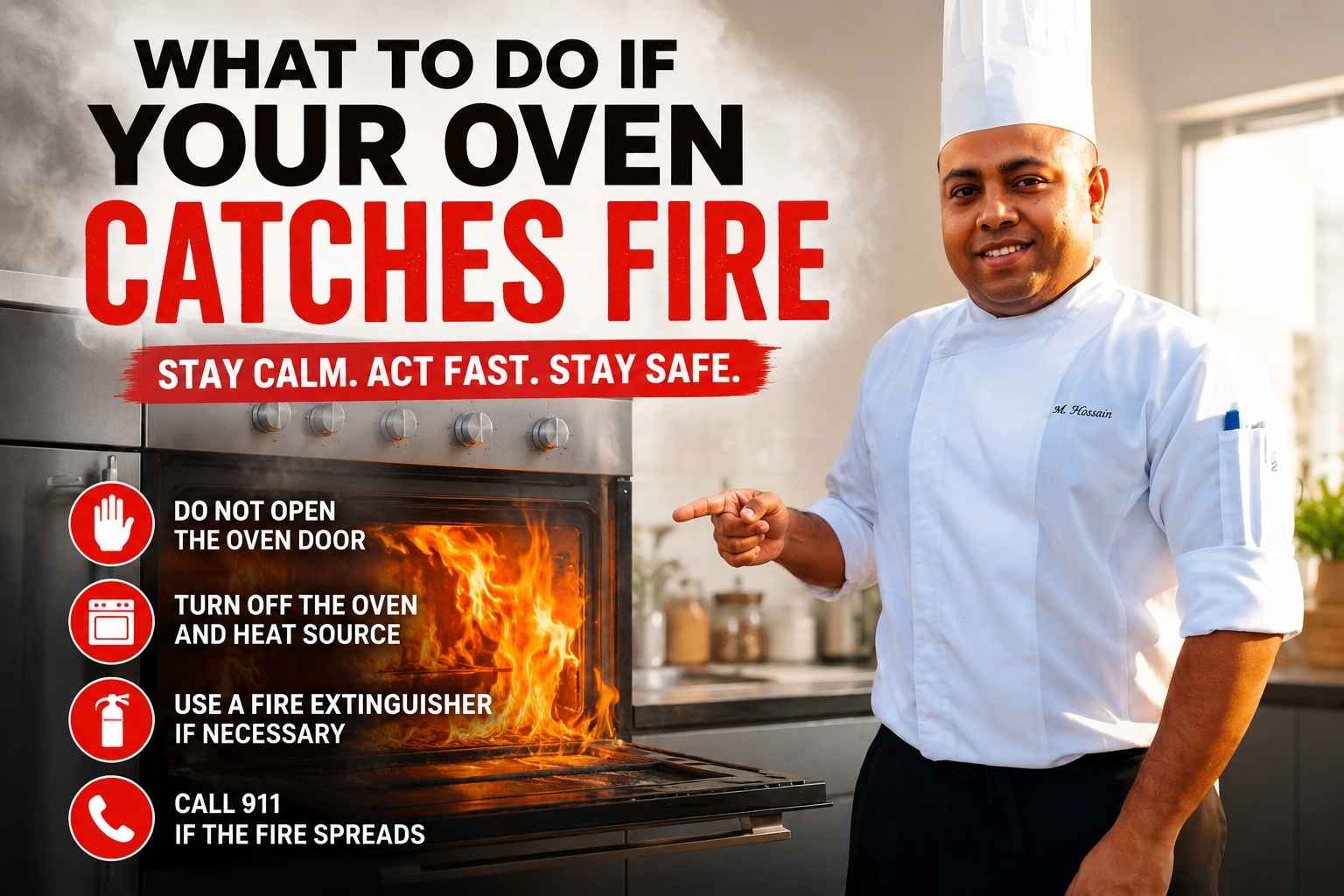
- If you see smoke or flames, turn off the oven and keep the door closed – this starves the fire of oxygen (U.S. Fire Administration, 2024)
- Never use water on a grease or oil fire. Water causes the fire to splatter and spread (National Fire Protection Association, 2023)
- For a fire inside the oven cavity, leave the door shut and switch off the power at the breaker if needed
- Keep baking soda, salt, and a fire extinguisher rated for kitchen use within arm’s reach of your oven at all times
- If the fire doesn’t die down within 60 seconds, or smoke is filling the room, get everyone out and call 911
Seeing flames inside your oven can be scary. If you are wondering What to Do If Your Oven Catches Fire, you are not alone. I have faced that moment too, and I know how fast panic can take over. The good news is that calm, safe steps can stop a small problem from turning into a big one.
In this guide, I will show you what to do first, what you should never do, and how to stay safe during an oven fire. You will also learn simple tips to help prevent future fires. Let’s get started so you can protect your home and feel ready if it ever happens.
Why Oven Fires Happen and What’s Actually Burning
Most oven fires start with grease, food debris, or packaging left inside the cavity. These materials ignite when they hit the heating element or an open flame from a gas burner.
I’ve cooked professionally for over 15 years, and I’ve seen this exact scenario play out more times than I can count. A line cook leaves a sheet pan with bacon grease on the bottom rack. Someone preheats the oven to 450°F for a pizza. Within minutes, smoke starts pouring out of the door seal.
Grease and Fat Buildup
Fat drips off meat, poultry, and bacon during roasting. It pools at the bottom of the oven and hardens into a layer that smokes long before it catches fire.
Once that layer hits its smoke point – usually around 400°F for most cooking fats – it starts to smolder. Keep heating it past that, and it ignites.
Food Debris and Packaging
Crumbs, cheese drips, and bits of foil or plastic wrap left in the oven char and smoke at high temperatures. Plastic packaging is especially dangerous because it can melt onto heating elements and catch fire fast.
I once watched a new prep cook leave a plastic cutting board resting on top of a still-warm oven. It slid against the door seal and started smoking within ten minutes.
Faulty Heating Elements and Electrical Issues
Electric ovens have heating elements that can short out, spark, or arc if they’re damaged, corroded, or improperly installed. This type of fire looks and behaves differently from a grease fire (Consumer Product Safety Commission, 2023).
A sparking element, a burning smell with no food inside, or a breaker that keeps tripping are all warning signs. These point to a wiring problem, not a cooking accident.
The First 10 Seconds: What to Do When You See Flames or Smoke
The first 10 seconds decide whether this stays a small kitchen incident or becomes a bigger problem. Stay calm, turn off the heat source, and do not open the oven door.
Here’s the order of operations I drill into every new cook on my line:
- Turn off the oven – hit the dial or press the power button. Do this first, before anything else.
- Keep the door closed. Opening it feeds the fire fresh oxygen and can cause flames to flare toward your face.
- Move flammable items away – dish towels, paper towels, oven mitts, anything within two feet of the oven.
- Watch the smoke level. Light haze that’s clearing means the fire is dying out. Thick, dark smoke that’s increasing means it’s getting worse.
- Get your extinguisher or baking soda within reach – don’t use it yet, just have it ready.
If smoke is light and seems to be settling within 30 to 60 seconds, the fire is likely starving itself out. If it’s getting thicker, move to evacuation.
Quick-Reference Action Table: Fire Type, Response, and What Never to Do
This table covers the four most common kitchen oven fire scenarios and the correct first response for each. Use this as your at-a-glance guide when seconds matter.
| Fire Type | Correct Response | What Never to Do |
|---|---|---|
| Grease/oil fire (inside oven) | Turn off oven, keep door closed, smother with baking soda or salt if accessible, or use a Class K extinguisher | Never use water – it causes the fat to splatter and spread flames (NFPA, 2023) |
| Electrical/wiring fire | Cut power at the breaker if safe, do not touch the oven, use a Class C or ABC extinguisher only | Never use water or a water-based extinguisher on live electrical components |
| Food/oven cavity fire | Turn off oven, leave door closed, let the fire burn out from lack of oxygen | Never open the door to “check” – this is the most common cause of flare-ups |
| Broiler fire | Turn off broiler, close oven door, remove pan only after flames are fully out and oven has cooled | Never pull a flaming pan out and carry it across the kitchen |
Never Use Water on a Grease or Oil Fire
Water and hot oil do not mix, and the result can be explosive. When water hits burning grease, it instantly vaporizes and expands, throwing burning oil droplets into the air.
This is one of the most well-documented causes of severe kitchen burns (U.S. Fire Administration, 2024). I’ve seen a small grease fire on a stovetop turn into a fireball that singed someone’s eyebrows because they grabbed a cup of water out of panic.
What to Use Instead
- Baking soda – smothers small grease fires by releasing carbon dioxide when it hits heat. Keep an open box near your stove and oven.
- Salt – works the same way as baking soda. Pour generously over the flames to cut off oxygen.
- A fire blanket – lay it flat over the fire source to cut off air supply completely. These are cheap and reusable after a non-grease fire.
- Class K extinguisher – designed specifically for commercial kitchen fat and oil fires. If you don’t have one, a standard ABC fire extinguisher works for most home kitchen situations.
A Class K extinguisher sprays a fine mist that cools the fire and creates a soapy barrier on top of the grease, which stops it from reigniting. Every commercial kitchen I’ve worked in has had one mounted within ten feet of the fryer and ovens.
Step-by-Step: Smothering a Fire Inside the Oven Cavity
The single best thing you can do for a fire inside a closed oven is to leave it closed. Fire needs oxygen, and a sealed oven cavity has very little of it.
Step 1: Turn Off the Oven Immediately
Switch off the heat source first. For gas ovens, this stops fuel from feeding the flames. For electric ovens, it stops the heating element from generating more heat.
Step 2: Do Not Open the Door
I cannot say this enough. The door is your best tool right now. Opening it lets a rush of oxygen in, which can cause the fire to flare up dramatically, sometimes right at face height.
Step 3: Cut Power at the Breaker if You Can Do So Safely
If your home or kitchen has an electrical panel that’s easy to reach without going near the fire, switch off the breaker for the oven circuit. This removes any chance of an electrical fault making things worse.
Step 4: Wait It Out
Most small oven cavity fires burn out within one to two minutes once the oxygen supply is cut. Watch the smoke and any visible glow through the oven window.
Step 5: Confirm the Fire Is Out Before Opening
Wait at least 15 to 20 minutes after the smoke and any visible flame have stopped. Then crack the door slightly and check before opening fully.
When the Fire Won’t Go Out or Is Behind the Door
If flames are visible coming from the door seams, around the controls, or the smoke is getting heavier instead of lighter, this is no longer a “wait it out” situation. Evacuate and call the fire department.
Signs You Need to Evacuate Now
- Flames visibly escaping from the oven door seal or vents
- Smoke that’s thickening, turning black, or filling the room within 30 seconds
- The smoke alarm is going off and doesn’t stop
- You smell burning plastic or wiring along with visible smoke
- The fire has spread to anything outside the oven – cabinets, a dish towel, the counter
What to Do During Evacuation
Get everyone out of the kitchen and close the door behind you if it’s safe to do so. Closing doors slows a fire’s spread by limiting its oxygen supply (NFPA, 2023).
Call 911 from outside the building, not from inside. Give the dispatcher your address first, then describe what’s burning.
Do not go back in for anything. I’ve worked in restaurants where staff tried to grab a cash drawer or a phone during a fire evacuation, and it’s never worth the risk.
Self-Cleaning Cycle Fires: A Special Case
Self-cleaning cycles run at extremely high temperatures, often 800 to 900°F, which can ignite grease residue that wouldn’t normally catch fire during regular cooking. This makes self-clean fires more intense and harder to predict.
Why These Fires Are More Dangerous
The self-clean cycle is designed to burn off food residue completely, turning it to ash. But if there’s a heavy buildup of grease, especially in older ovens, that residue can ignite into an actual flame rather than just smoking and burning off slowly.
I had a home oven do this to me years ago. I ran the self-clean cycle without wiping out a layer of bacon grease first, and about 40 minutes in, I saw orange flickering through the window.
What to Do
- Turn off the self-clean cycle immediately using the control panel
- Do not open the door – the cycle locks the door automatically on most models, and that’s working in your favor
- Wait for the oven to cool and the lock to release on its own, which can take an hour or more
- If smoke is heavy or flames are visible through the window and growing, evacuate and call the fire department
How to Prevent Self-Clean Fires
Wipe out any loose grease, large food chunks, or spills with a damp cloth before starting a self-clean cycle. This single step prevents the vast majority of self-clean fire incidents (Consumer Product Safety Commission, 2023).
Electrical and Wiring Fires: A Different Kind of Threat
An electrical fire in your oven looks different from a grease fire. You’ll often smell burning plastic or rubber, see sparks, or notice the breaker tripping repeatedly before any flame appears.
How to Recognize an Electrical Fire
- A sharp, acrid smell like burning plastic, distinct from burning food
- Visible sparking or arcing near the back panel, controls, or heating element
- Flickering oven lights or a display that goes dark and restarts
- A breaker that trips the moment you turn the oven on
Why the Response Is Different
Water and standard foam extinguishers conduct electricity and can make an electrical fire worse or shock the person using them. You need a Class C or ABC-rated extinguisher, which uses a non-conductive agent.
What to Do
- Turn off the oven using the control panel if it’s still responsive
- Cut power at the breaker box – this is the most important step for an electrical fire
- Do not touch the oven itself once you suspect an electrical fault
- If small flames are visible and you have a Class C or ABC extinguisher, use it from a safe distance
- If the fire grows or you’re not confident the breaker cut all power, evacuate and call the fire department
After any electrical fire, the oven needs a full inspection by a licensed technician before it’s used again, even if the fire was small (Consumer Product Safety Commission, 2023).
Broiler Fires: The Underestimated Culprit
Broiler fires happen fast because the broiler element sits just inches from your food at temperatures often exceeding 500°F. Fat splatter, marinades, and breadcrumbs ignite almost instantly under that kind of heat.
I’ve had more broiler flare-ups than I’d like to admit, mostly from cooking steaks or fatty fish under high heat without a drip pan underneath. The fat hits the element and ignites in seconds.
Why Broiler Fires Catch People Off Guard
People tend to walk away from the broiler because cook times are short, usually 5 to 10 minutes. That’s exactly when a flare-up happens unsupervised and grows before anyone notices.
What to Do
- Turn off the broiler immediately using the control
- Close the oven door – even broiler drawers and compartments should be closed if it’s safe to do so
- Let the flames die out on their own, which usually takes under a minute once the broiler element is off
- Do not pull the pan out while it’s flaming. Wait until flames are fully gone and the pan has cooled before removing it
Preventing Broiler Fires
Always use a broiler pan with a slotted top that lets fat drip away from the heat source. Trim excess fat from meat before broiling, and never leave the kitchen while the broiler is running.
After the Fire: Ventilating, Checking for Damage, and Next Steps
Once the fire is out, your next priority is clearing smoke and checking for hidden damage before you use the oven again. Don’t assume everything’s fine just because the flames stopped.
Ventilate the Kitchen
Open windows and turn on your range hood or any exhaust fans. Smoke particles and carbon monoxide can linger in the air for longer than you’d expect, especially in smaller kitchens.
Check for Hidden Damage
- Look at the door seal (gasket) for melting, warping, or charring
- Check the wiring at the back of the oven if you can safely access it – look for melted insulation or scorch marks
- Inspect the racks and interior walls for warping or bubbling paint, which can indicate the fire burned hotter or longer than expected
- Smell for lingering burning odors after the oven has cooled completely, which can point to residue still smoldering inside insulation
When It’s Safe to Use the Oven Again
If the fire was small, contained to a grease spill, and the oven shows no visible damage to wiring, controls, or the door seal, it’s generally safe to clean it out and use it again. Wipe down the cavity completely first.
When to Call a Technician
Call a technician if the fire involved any sparking, the breaker tripped, the display isn’t working correctly, or you smell burning plastic even after cleaning. Don’t run the oven again until it’s been checked (Consumer Product Safety Commission, 2023).
Common Mistakes People Make During Oven Fires
Most injuries and bigger fires happen because of a handful of repeated mistakes. Here’s what I see most often, and what to do instead.
Mistake 1: Opening the Door Too Soon
This is the number one mistake. The moment someone sees smoke, the instinct is to open the door and look inside. That rush of oxygen can turn a smoldering fire into an open flame in under a second.
Fix: Keep the door closed for at least 60 seconds after turning off the oven, and don’t open it until smoke has visibly stopped for several minutes.
Mistake 2: Throwing Water on the Fire
As covered earlier, water on a grease fire causes splattering and can spread flames or cause severe burns (NFPA, 2023).
Fix: Use baking soda, salt, a fire blanket, or a Class K/ABC extinguisher instead.
Mistake 3: Trying to Carry a Flaming Pan to the Sink
Moving a burning pan spreads the fire along your path and increases the chance of dropping it or spilling burning oil on yourself.
Fix: Smother the fire where it is. Only move the pan once flames are completely out and it has cooled.
Mistake 4: Using a Flour-Based Powder Instead of Baking Soda
Flour can actually be combustible in fine, airborne quantities and won’t smother a fire the way baking soda does.
Fix: Keep baking soda specifically, not flour or other powders, near your cooking area.
Mistake 5: Ignoring a Recurring Smell or Tripped Breaker
People often reset a tripped breaker and keep cooking, assuming it was a one-time glitch.
Fix: A breaker that trips more than once when using the oven is a sign of an electrical fault. Stop using the oven and have it inspected.
My Fire-Ready Kitchen Routine
After 15 years in professional kitchens, I keep a short list of habits and equipment that have prevented small problems from becoming big ones. None of this is complicated or expensive.
What I Keep Within Arm’s Reach
- An open box of baking soda on the counter near the oven, always
- A fire blanket mounted on the wall, not stuffed in a drawer
- A small ABC-rated fire extinguisher, checked twice a year for pressure
- A pair of long, heat-resistant gloves separate from my regular oven mitts
Habits I Never Skip
I wipe down the bottom of my oven after any roast that drips fat, even if it looks minor. A thin layer today becomes a fire hazard after a few uses.
I always use a drip pan or foil-lined tray under anything I broil. This single habit has stopped more flare-ups for me than anything else.
Before running a self-clean cycle, I do a quick wipe-down of any visible grease or large debris, every single time, no exceptions.
I never leave the kitchen while the broiler is on, even to grab something from another room. Five minutes is enough time for a small flare-up to become a real problem.
Equipment I Tell Everyone to Buy
A fire blanket costs less than a dinner out and takes up almost no space. It’s one of the most useful, least-used pieces of safety equipment in most home kitchens.
Frequently Asked Questions
What is the first thing I should do if my oven catches fire?
Turn off the oven and keep the door closed. This cuts off both the heat source and the oxygen supply, which causes most small fires to burn out within a minute or two.
Can I use water to put out an oven fire?
No, never use water on a grease or oil fire. Water causes hot fat to splatter violently, which can spread the fire and cause serious burns (NFPA, 2023).
How long should I wait before opening the oven door after a fire?
Wait at least 15 to 20 minutes after smoke and flames have completely stopped. Opening the door too early can reignite the fire by supplying fresh oxygen.
What type of fire extinguisher should I keep in my kitchen?
A Class K extinguisher is best for fat and oil fires in commercial kitchens. For home kitchens, a standard ABC-rated extinguisher covers grease, paper, and electrical fires effectively.
Are self-cleaning oven cycles more likely to cause fires?
Yes, self-clean cycles run at 800 to 900°F, which can ignite grease buildup that wouldn’t normally catch fire. Wiping out loose grease before starting the cycle prevents most of these incidents (Consumer Product Safety Commission, 2023).
How do I know if it’s an electrical fire versus a grease fire?
An electrical fire often comes with a burning plastic smell, sparking, or a breaker that trips repeatedly, even without food cooking. A grease fire produces thick smoke and smells like burning fat, usually right after cooking something fatty.
Is it safe to use my oven again after a small fire?
If the fire was minor, limited to grease, and there’s no visible damage to the wiring, door seal, or controls, it’s generally safe after a thorough cleaning. Any sparking, electrical issue, or lingering burning smell means you should call a technician first.
What should I do if the fire is coming from behind the oven door and won’t stop?
Evacuate immediately, close the kitchen door behind you if safe, and call 911 from outside. Flames escaping the door seal mean the fire has more fuel or oxygen than the cavity can contain on its own.
Key Takeaways
- Turn off the oven and keep the door closed the moment you see smoke or flames – this is the single most effective first response
- Never use water on a grease or oil fire. Baking soda, salt, a fire blanket, or a Class K/ABC extinguisher are the correct tools (NFPA, 2023)
- Self-clean cycles and broilers carry higher fire risk due to extreme heat. Wipe out grease before self-cleaning and never leave a broiler unattended
- If flames escape the door seal or smoke keeps thickening, evacuate and call 911 – don’t try to fight it yourself
- After any fire, check the door seal, wiring, and interior for damage before using the oven again, and call a technician if anything seems off (Consumer Product Safety Commission, 2023)

I’m Mossaraof, a trained chef and the founder of OvenInsights.com. I spent years cooking at Larrupin’ Cafe and in kitchens across Chicago and Seattle. Now I test kitchen gear for a living. I moved to North Acton, London, and I test every tool I write about. I use real meals and real heat. No brand deals. No shortcuts. I cover 12 kitchen types and hundreds of recipes. I believe this: the right tools matter as much as the recipe.