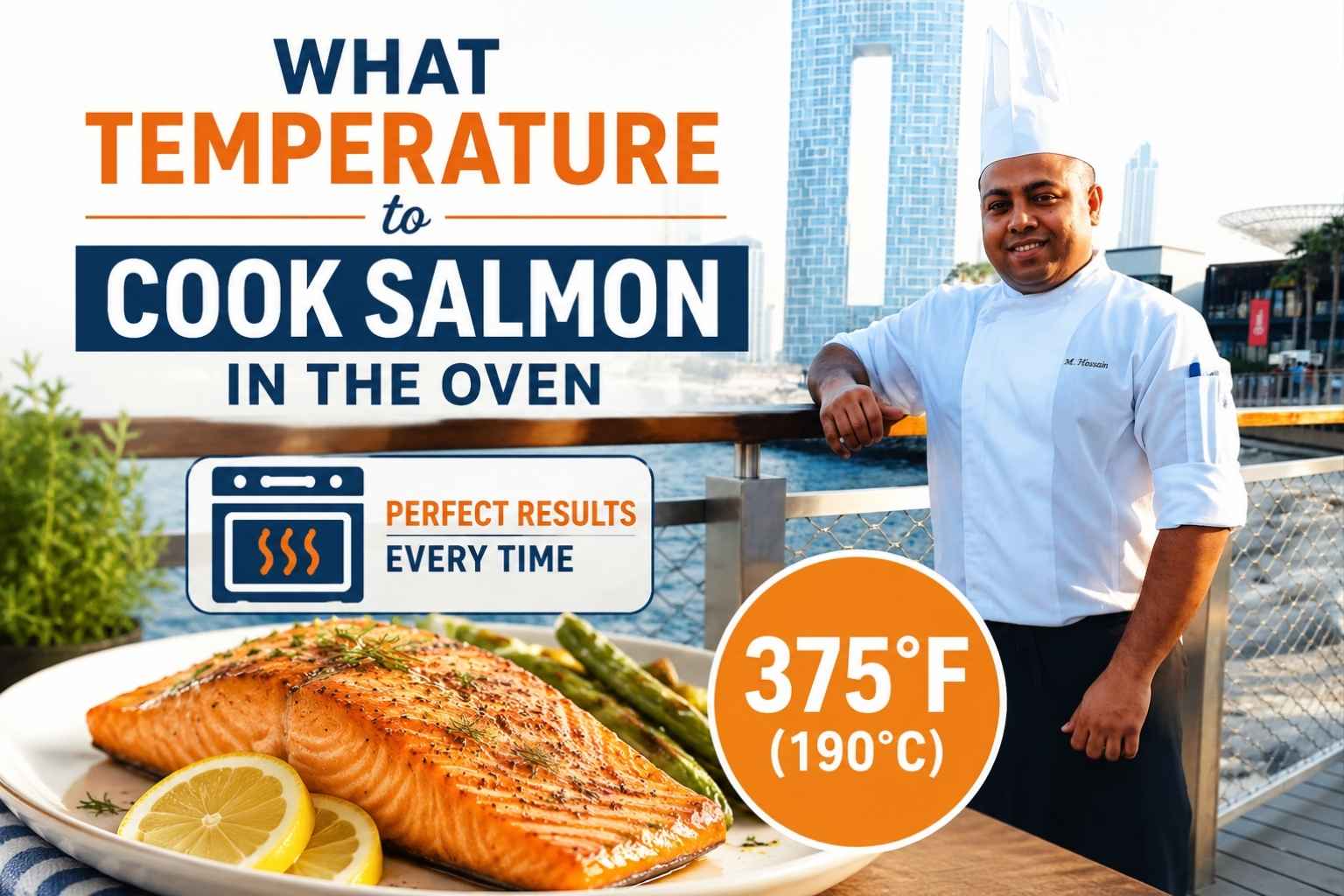
Have you ever pulled a salmon fillet out of the oven, only to find it dry and sad? I have, more times than I’d like to admit! That’s why I dug deep into what temperature to cook salmon in the oven, so you never have to face a rubbery dinner again. After years of testing in my own kitchen, I found the sweet spot that gives you soft, flaky fish every single time. Stick with me, and I’ll walk you through the easy steps below.
At A Glance
- The best all-purpose oven temperature for salmon is 400°F (205°C) – it gives you a set crust, moist interior, and done in 12-15 minutes for a 1-inch fillet.
- The USDA says cook salmon to 145°F internal – most professional chefs pull it at 125-130°F for medium-rare and let carryover heat finish the job.
- Fillet thickness matters more than weight: add 3-4 minutes per extra half-inch of thickness.
- Always use a instant-read thermometer – the flake test alone is not reliable enough for precise results.
- Starting with cold fish straight from the fridge adds 3-5 minutes to cook time and causes uneven cooking.
Why Oven Temperature Changes Everything About Your Salmon
The oven temperature you pick decides the texture of your salmon before you even open the door.
At low heat (275-300°F), fat in the salmon renders out slowly. The fish stays silky, almost custardy. At high heat (425°F+), that same fat hits fast heat, the outside firms up quickly, and you get a light crust on the surface. The interior is still moist – but it has a firmer bite.
This is not a small difference. It is the whole game.
Carryover cooking is the part most home cooks miss. When you pull salmon from a 400°F oven at 125°F internal temp, it keeps cooking for 3-5 minutes on the resting pan. That fish hits 130-133°F by the time it reaches the plate. Pull it at 130°F and it lands at 138-140°F. Pull it at 135°F and it is overcooked. Every time.
I spent two years cooking at a seafood restaurant where we served 80-120 salmon portions a night. Carryover was the single biggest variable between a perfect plate and a dry one.
The Internal Temperature Debate: USDA 145°F vs. Chef-Preferred 125-130°F
The USDA recommends cooking salmon to 145°F internal temperature to eliminate pathogens (USDA Food Safety and Inspection Service, 2024). At that temperature, salmon is fully cooked through and completely safe.
It is also, in my opinion, overcooked for most cuts.
At 145°F, the proteins in salmon have tightened fully. The flesh flakes apart and looks chalky at the edges. The fat has rendered out. It is safe – and dry.
Here is what the internal temps actually look like in practice:
| Internal Temp | Doneness | Texture |
|---|---|---|
| 110-115°F | Rare | Translucent center, very soft, almost raw-feeling |
| 120-125°F | Medium-rare | Slightly translucent center, silky, pulls apart in large flakes |
| 125-130°F | Medium | Fully opaque, moist, tender – the chef sweet spot |
| 135-140°F | Medium-well | Firm, starts to dry at edges |
| 145°F+ | Well-done | Fully set, dry, USDA-safe |
America’s Test Kitchen (2023) tested salmon at multiple temperatures and found that 125°F produced the highest ratings for texture and moisture in blind tastings. Serious Eats (2022) recommends 125°F for farmed Atlantic salmon and 120°F for wild-caught, which is leaner and overcooks faster.
My recommendation: pull at 125°F for wild salmon, 128°F for farmed. Let it rest two minutes. It will arrive at the table perfect.
If you are cooking for someone who is pregnant, elderly, immunocompromised, or if you are simply not comfortable with medium-rare fish – cook to 145°F. Safety first, always.
Salmon Oven Temperature Reference Table: 275°F to 450°F
This table applies to a standard 1-inch thick salmon fillet (skin-on or skin-off) starting at room temperature (68°F). Cold fish from the fridge adds 3-5 minutes.
| Oven Temp | Cook Time (1-inch fillet) | Doneness at Pull | Best Use Case | Notes |
|---|---|---|---|---|
| 275°F (135°C) | 25-30 min | 120-125°F (med-rare) | Whole side, thick portions | Silky texture, no browning, forgiving |
| 300°F (150°C) | 20-25 min | 120-125°F (med-rare) | Thick portions (1.5″+), meal prep | Still very moist, slight exterior set |
| 325°F (165°C) | 18-22 min | 125-130°F (medium) | Weeknight fillets, baked with sauce | Good balance of moisture and set flesh |
| 350°F (175°C) | 15-18 min | 125-130°F (medium) | General purpose, family cooking | Most common home-cook temp, reliable |
| 375°F (190°C) | 13-16 min | 128-132°F (medium) | Skin-on portions, foil-wrapped | Starts to develop light browning on top |
| 400°F (205°C) | 12-15 min | 130°F (medium) | My go-to: skin-on fillets, most recipes | Fast, good crust, requires attention |
| 425°F (220°C) | 10-13 min | 130-135°F (medium-well) | Crispy skin, high-temp glazes | Watch closely – margin for error is small |
| 450°F (230°C) | 8-10 min | 135°F+ | Broiler-style, blackened preparations | Only for thin fillets under 3/4-inch |
Times assume fillets pulled at target internal temp and rested 2 minutes before serving. Always verify with a thermometer.
How to Cook Salmon at Each Temperature Range
Low-and-Slow (275-300°F): The Silkiest Salmon You Will Ever Make
Low-and-slow salmon is the best-kept secret in home cooking. At 275°F, a thick salmon fillet – say, a whole side or a 2-inch portion – cooks evenly from edge to center without the outside going tight before the inside catches up.
ChefSteps (2021) popularized this method and showed it produces the most consistent texture of any oven method without sous vide equipment. The fat stays in the fish. The flesh stays together. You can leave it in for an extra 3-4 minutes and it will not dry out.
Use this method when:
- You are cooking a whole salmon side (2+ lbs).
- Your fillet is thicker than 1.5 inches.
- Texture is your top priority over a browned exterior.
- You are doing meal prep and need forgiving cook times.
Do not preheat for low-and-slow. Put the fish in a cold oven, set to 275°F, and start your timer when the oven reaches temp – or just use total time from cold start (about 35-40 minutes for a 1-inch fillet).
Moderate Heat (350°F): The Reliable Weeknight Method
350°F is where most home cooks live. It is the oven temp on the bottle of teriyaki sauce. It works fine.
At this temperature, salmon cooks through in 15-18 minutes per inch of thickness. It will be moist if you pull it on time. It will be dry if you do not. There is no safety net here – you need a thermometer.
This is the right temperature for:
- Foil-packet salmon with vegetables.
- Baked salmon with a sauce or marinade that might burn at higher heat.
- Cooking for a crowd where the oven is also running other dishes at moderate temp.
High Heat (400-425°F): My Recommended Range for Most Cooks
400-425°F is where I cook salmon at home about 80% of the time.
At this range, the oven is hot enough to set the exterior of the fish in the first few minutes. That gives you a slight crust – not a hard sear, but a defined edge with a little color. The interior cooks through quickly and stays moist if you are watching your thermometer.
For skin-on fillets, 400-425°F is the only way to get the skin to crisp up in the oven. The fat under the skin renders, the skin tightens against the pan, and you get something close to pan-seared skin without the smoke and splatter.
Serious Eats (2022) recommends 425°F for skin-on portions on a preheated sheet pan – the hot pan contact on the skin side starts the crisping before the top even sets.
Preheat is required at this range. A cold oven start at 425°F just extends the time in the danger zone without the benefit of fast exterior setting.
Broiler and Blast Heat (450°F+): For Thin Fillets and Glazes Only
The broiler is not a general-purpose salmon tool. It is for specific jobs.
Use it for:
- Thin fillets (under 3/4 inch) where you want color fast.
- Finishing a glaze – miso, honey-soy, or teriyaki – that needs a few minutes of direct heat to caramelize.
- Salmon that started in the pan and needs 2-3 minutes of top heat to finish.
At 450°F+ or under the broiler, a 1-inch fillet goes from raw to overcooked in about 3 minutes if you are not watching. I use a timer and check at 7 minutes. No exceptions.
How Fillet Thickness and Starting Temperature Change Your Cook Time
Salmon cook time is not about weight – it is about thickness.
The standard rule: 10 minutes per inch of thickness at 400°F, starting from room temperature. That is the baseline. Every variable adjusts from there.
Fillet thickness adjustments at 400°F:
- 1/2-inch fillet: 6-8 minutes
- 3/4-inch fillet: 8-10 minutes
- 1-inch fillet: 11-13 minutes
- 1.5-inch fillet: 16-20 minutes
- 2-inch fillet (thick center-cut): 22-28 minutes
Starting temperature matters a lot.
A fillet straight from the fridge (38-40°F) adds 3-5 minutes compared to one that has sat at room temperature for 20-30 minutes (65-68°F). Cold fish also cooks unevenly – the outside hits temp before the center thaws out, so to speak.
Cook’s Illustrated (2023) tested this directly and found that fillets rested at room temp for 20 minutes before cooking had a 15% smaller temperature gradient from edge to center compared to cold-from-fridge fillets at the same oven temp.
Pull the salmon from the fridge 20 minutes before it goes in the oven. That is the single easiest improvement most home cooks can make.
How to Use a Meat Thermometer Correctly on Salmon
Use an instant-read thermometer. Not a probe you leave in. Not the flake test alone. An instant-read, inserted correctly.
Here is how to do it right:
Insert the probe into the thickest part of the fillet, angled in from the side – not straight down from the top. Going in from the side gives you a longer path through the flesh and a more accurate center reading. Straight down often misses the true center of thick fillets.
What “done” actually looks like without a thermometer:
- At 125°F: The fish is just barely opaque in the very center when you press it open slightly. It flakes when pressed but holds together.
- At 130°F: Fully opaque. Flakes with light pressure. No translucency.
- At 145°F: Flakes apart with almost no pressure. White albumin (the white protein) is showing on the surface.
The flake test – pressing the fish with a fork and watching it separate – tells you it is cooked. It does not tell you if it is 130°F or 145°F. For precision, use the thermometer.
White albumin is the white curd-like protein that appears on the surface of salmon as it cooks. A little is normal. A lot means the fish is getting close to overcooked. If you see heavy albumin running down the sides of a fillet before it hits your target temp, your oven is running hot.
Foil and Parchment vs. Bare Pan: What Each Does to Your Salmon
Foil traps steam. Parchment does the same but less aggressively. A bare pan lets moisture escape.
Here is when each method makes sense:
Foil packet (wrapped):
- Best for: meal prep, cooking with vegetables, keeping extra-lean wild salmon moist.
- Trade-off: no browning, no crust, exterior stays soft.
- The steam inside the packet essentially braises the fish. It is moist and forgiving but flat in texture.
Parchment (sheet underneath, not wrapped):
- Best for: protecting the pan, gentle heat transfer, and easy cleanup.
- Slightly less steam than foil. You get a little more exterior set.
- Good default for most weeknight baking.
Bare sheet pan (preheated):
- Best for: crispy skin, high-heat cooking, any time you want browning.
- The direct metal contact conducts heat fast. Preheating the pan at 425°F for 5-10 minutes before adding the fish gives the skin a jump start.
- Harder to clean but worth it for the texture.
I keep a dedicated fish pan – a heavy sheet pan I use for nothing else – lightly oiled and preheated at 425°F. It is the closest thing to a screaming-hot cast iron you can get in a home oven for salmon.
When to Skip Preheating vs. When It Is Required
Skip preheating for low-and-slow (275-300°F). The whole point of that method is gradual, even heat. Starting in a cold oven and letting it come up slowly gives you the gentlest possible cook environment.
Preheat is required for anything above 375°F. Here is why:
At high heat, the first 2-3 minutes in a hot oven set the exterior before the interior overcooks. If you start in a cold oven at 425°F, the fish spends too long in the 200-300°F range where moisture evaporates but no crust forms. By the time the oven hits 425°F, the fish is already half-cooked and drying out.
Preheat at 400-425°F for at least 15 minutes. If you are using a sheet pan, put it in the oven during preheat.
Six Common Salmon-Cooking Mistakes (and How to Fix Them)
Mistake 1: Cooking salmon straight from the fridge. Fix: Rest the fillet at room temp for 20-30 minutes before cooking. Cold fish cooks unevenly and takes longer, so you end up with overcooked edges and an underdone center.
Mistake 2: Relying on time instead of temperature. Fix: Buy a $15 instant-read thermometer. Oven temps vary by 25-50°F from the dial reading (America’s Test Kitchen, 2024). The only reliable measure is internal temp.
Mistake 3: Ignoring carryover cooking. Fix: Pull the salmon 5-7°F below your target temp. It will reach target on the resting pan. Pull at 145°F and it will reach 150°F+. Dry every time.
Mistake 4: Not drying the surface before cooking. Fix: Pat the salmon dry with a paper towel before it goes in the oven – especially if it was in a marinade. Wet surface = steam = no browning, no crust.
Mistake 5: Using a cold pan at high heat. Fix: If you want any texture on the exterior, preheat your sheet pan. A cold pan drops temp the moment the fish touches it and stalls the crust formation.
Mistake 6: Opening the oven door repeatedly to check. Fix: Set a timer. Every time you open the door, the oven drops 25-50°F (Cook’s Illustrated, 2022). Check once, at the earliest possible done time, with a thermometer.
My Go-To Method for Cooking Salmon at Home
I have cooked salmon hundreds of ways over 15 years. This is what I do at home on a Tuesday night when I want it to be excellent with minimal effort.
Setup: I pull a 1 to 1.25-inch skin-on Atlantic salmon fillet from the fridge 25 minutes before cooking. I put a heavy sheet pan in the oven and set it to 425°F.
Prep: I pat the fillet completely dry. I rub the flesh side with a thin coat of neutral oil – grapeseed or avocado. Salt and pepper directly on the flesh. No oil on the skin side.
Cook: When the oven hits temp, I pull the pan out with a cloth, set it on the stove, and lay the fillet skin-side down onto the hot pan. It sizzles on contact. Back in the oven for 10-12 minutes.
Check: I check at 10 minutes with an instant-read in the thickest part from the side. I am looking for 125-127°F. I pull it the second it hits that reading.
Rest: Two minutes on the pan. The carryover takes it to 130-132°F. That is medium – fully opaque, pulling apart in large clean flakes, with no albumin running off the sides.
Finish: A squeeze of lemon and whatever is on hand. Capers, dill, a spoonful of crème fraîche. Done.
Total active time: under 5 minutes. The oven does everything.
Frequently Asked Questions About Cooking Salmon in the Oven
What is the best temperature to cook salmon in the oven?
400-425°F (205-220°C) is the best oven temperature for most salmon fillets. At this range, a 1-inch fillet cooks in 12-15 minutes and comes out with a set exterior and moist interior. Pull the fish at 125-128°F internal temp and rest for 2 minutes.
How long does salmon take to cook at 400°F?
At 400°F, a 1-inch thick salmon fillet takes 12-14 minutes from room temperature. Add 3-4 minutes if the fish is cold from the fridge. Use an instant-read thermometer – pull at 125°F for medium-rare or 130°F for fully set medium.
Do I need to flip salmon in the oven?
No. Salmon does not need to be flipped when baking. Place it skin-side down on a preheated pan and leave it. Flipping risks breaking the fillet and pulls the skin off if it has started to stick.
What internal temperature is salmon done at?
The USDA standard for salmon doneness is 145°F internal temperature (USDA, 2024). Professional chefs pull salmon at 125-130°F for medium-rare to medium, which is moist and tender. If you cook for pregnant, elderly, or immunocompromised people, use the USDA standard.
Should I cover salmon with foil when baking?
You do not have to. Foil traps steam and keeps the fish moist, which is useful for lean wild salmon or when cooking with vegetables. For skin-on fillets where you want any texture on the exterior, leave it uncovered on a bare pan.
How do I know when salmon is done without a thermometer?
Press the thickest part gently with a fork. At medium doneness (about 130°F), the flesh should just start to flake apart under light pressure and be fully opaque. A fully translucent center means it needs more time. White albumin (white protein) running off the surface in large amounts means it is overcooking.
Does salmon need to rest after cooking?
Yes – 2 minutes minimum. Carryover cooking raises the internal temp 5-7°F after you pull it from the oven. Resting also lets the juices redistribute through the flesh. Skip the rest and the fish will still be good – but you lose 5-7°F of precision on your final temp.
Can I cook salmon from frozen in the oven?
Yes. Cook frozen salmon at 375°F for 25-30 minutes for a 1-inch fillet. Do not try to cook frozen salmon at high heat – the exterior will overcook before the center thaws. Rinse the fillet under cold water for 1-2 minutes first to remove ice glaze. Use a thermometer – it is the only way to hit your target reliably from a frozen start.
Key Takeaways
- 400°F is the best all-purpose oven temp for a 1-inch salmon fillet – fast enough for a crust, forgiving enough for home cooks.
- Pull salmon at 125-130°F internal temp and let carryover do the last 5-7°F. That lands you at medium – moist, opaque, and fully flaked.
- Thickness, not weight, sets your cook time. Use 10 minutes per inch at 400°F as your base, then adjust for fridge-cold vs. room-temp fish.
- Low-and-slow at 275-300°F gives you the silkiest texture of any oven method – ideal for thick cuts and whole sides.
- High heat (425°F) on a preheated pan is the only way to get crispy skin in a home oven without a cast iron on the stove.
- Pat the fillet dry, rest it at room temp first, use a thermometer. Those three habits alone will fix 90% of overcooked salmon problems.

I’m Mossaraof, a trained chef and the founder of OvenInsights.com. I spent years cooking at Larrupin’ Cafe and in kitchens across Chicago and Seattle. Now I test kitchen gear for a living. I moved to North Acton, London, and I test every tool I write about. I use real meals and real heat. No brand deals. No shortcuts. I cover 12 kitchen types and hundreds of recipes. I believe this: the right tools matter as much as the recipe.