At A Glance
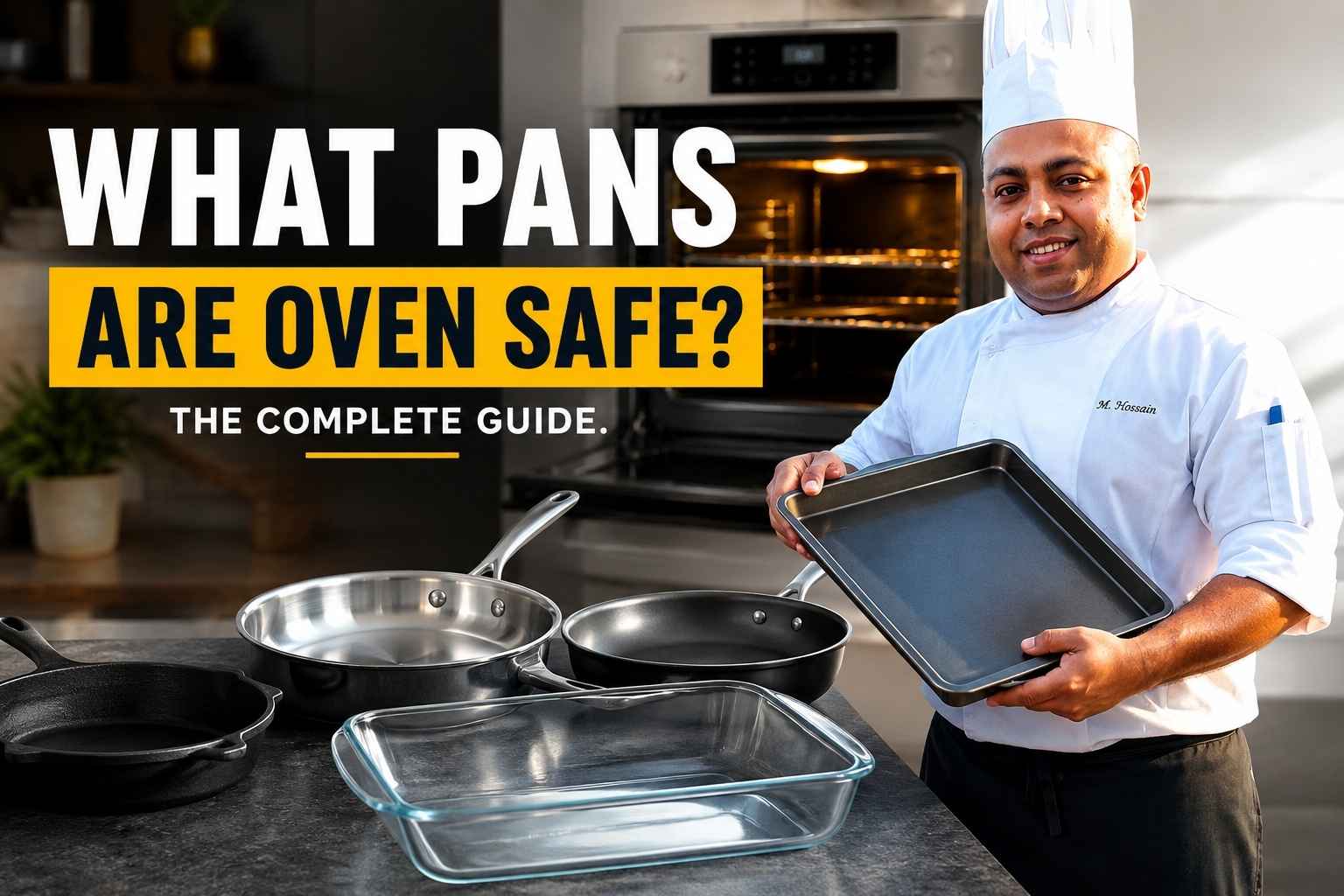
- Cast iron and carbon steel are the safest pans for oven use — they handle temperatures up to 500°F and beyond with no risk.
- Most stainless steel pans are oven safe to at least 500°F, but only if the handle is all-metal — no plastic, no rubber grips.
- Nonstick pans with PTFE coating should never go above 500°F, and should never go under a broiler — ever.
- Glass and ceramic bakeware are oven safe, but they are NOT broiler safe — that distinction has destroyed more dishes than I can count.
- Always check the bottom of your pan for the oven-safe symbol before you assume anything.
I once shoved a pretty non-stick pan into a hot oven, and the handle melted right off. Lesson learned the hard way! That’s why I always tell people to ask one key question first: what pans are oven safe? I’ve tested dozens of pots and pans in my own kitchen over the years, so I know exactly what holds up and what doesn’t. Stick with me, and you’ll never ruin a good dinner (or a good pan) again.
The Oven-Safe Temperature Reference Table
| Pan Type | Max Safe Temp | Broiler Safe? | Notes |
|---|---|---|---|
| Cast Iron (bare) | 700°F+ | Yes | The safest pan in the oven — no limits under normal cooking |
| Carbon Steel | 600°F+ | Yes | Same family as cast iron; avoid high-acid foods |
| Stainless Steel (all-metal) | 500–600°F | Yes | Check handle construction — rivets must be stainless |
| Hard-Anodized Aluminum | 400–500°F | No | Check manufacturer spec; nonstick coating lowers limit |
| Enameled Cast Iron | 500°F | No | Enamel can crack under direct broiler heat |
| Ceramic (uncoated) | 450–500°F | No | Thermal shock risk — never move from fridge to hot oven |
| Nonstick (PTFE) | 400–500°F | No | Above 500°F the coating degrades; broiler destroys it |
| Copper (tin-lined) | 450°F | No | Tin lining melts above 450°F |
| Copper (stainless-lined) | 500°F | Yes | Far safer than tin-lined for oven use |
| Pyrex / Borosilicate Glass | 425°F | No | Thermal shock danger — never cold-to-hot or hot-to-cold |
| Tempered Glass Lids | 350–400°F | No | Most shatter under broiler heat |
| Aluminum (bare) | 450°F | No | Reactive with acidic foods at high heat |
Why Pan Construction Changes Everything in the Oven
Your pan’s job on the stovetop is simple: conduct heat from a single flat surface. In the oven, the heat comes from all directions — top, bottom, and sides — and it stays there for 20, 40, sometimes 60 minutes or more.
That changes the equation completely.
A handle that’s perfectly comfortable at stovetop temperatures can warp, melt, or off-gas when it sits in a 450°F oven for half an hour. A coating that’s stable at medium-high heat on a burner can break down when surrounded by dry, intense oven heat. A glass lid that looks identical to an oven-safe lid can shatter the moment you slide it under a broiler.
I’ve cooked in professional kitchens for 15 years. I’ve seen a cook pull a pan out of a 500°F oven and realize — too late — that the handle was hollow-cast metal over a plastic core. I’ve watched a glass dish crack clean in half when someone set it on a cold granite countertop straight out of the oven. These aren’t edge cases. They happen in real kitchens, regularly.
So before you ever slide a pan into the oven, you need to understand three things: what the pan body is made of, what the handle is made of, and what (if any) coating is on the cooking surface. All three matter independently.
Cast Iron and Carbon Steel: The Ones You Never Have to Worry About
Cast iron is the right answer for oven cooking. Full stop.
A bare cast iron skillet — brands like Lodge or the older Griswold pans you find at estate sales — has no coatings, no rubber, no plastic. It’s one solid piece of metal. You can put it in a 700°F oven (most home ovens don’t go above 550°F anyway) and it will come out unchanged. Lodge explicitly rates their skillets for any oven temperature a home oven can produce (Lodge, 2024).
I use a 12-inch Lodge cast iron for everything from searing steaks to finishing frittatas to baking cornbread. Once it’s properly seasoned, it goes from stovetop to oven without a second thought.
Carbon steel is cast iron’s lighter sibling. It’s the pan that fills professional kitchens — every French bistro line cook works with carbon steel, not cast iron, because the weight difference matters when you’re moving 30 pans a night. Carbon steel handles the same temperature range as cast iron and works just as well in the oven (Serious Eats, 2023). The one difference: carbon steel is thinner, so it heats faster and cools faster. That makes it slightly more responsive to temperature changes but equally safe.
One warning for both: the handle on a bare cast iron skillet gets just as hot as the pan itself. I keep a folded kitchen towel near every oven I work at. Forgetting this lesson once is enough — you remember it for life.
Stainless Steel: Safe, With Conditions
Most stainless steel pans are oven safe. But “most” is doing a lot of work in that sentence.
All-Clad’s D3 and D5 stainless lines are rated to 600°F — completely safe for any home oven use, including broiling (All-Clad, 2024). The key is that every component — the pan body, the handle, and the rivets that attach the handle — is made of stainless steel with no filler materials inside.
The problem shows up in cheaper stainless pans. Some budget lines use handles that look like stainless on the outside but have a hollow core filled with epoxy or a plastic insert to reduce heat transfer. Those handles are not oven safe above 350–400°F. You usually can’t tell by looking. Check the product listing or the bottom of the pan.
Also watch for these specifics:
- Rivets: On all-clad construction, the rivets are stainless. On some cheaper pans, rivets are a different alloy that can corrode or warp at high heat.
- Lids: Most stainless lids with glass inserts are rated only to 350–400°F because of the glass. A fully stainless lid with no glass window is fine up to the pan’s rated temperature.
- Non-stick coatings on stainless: Some stainless pans have a light PTFE interior coating for easier food release. That coating drops the safe temperature limit to the coating’s limit, not the steel’s.
Nonstick Pans: Know the Line Before You Cross It
I’ll be direct: nonstick pans are not built for high-heat oven cooking.
PTFE (polytetrafluoroethylene) — the coating used in Teflon and most nonstick surfaces — starts to degrade at around 500°F. Below that temperature, it’s stable and safe. Above it, the coating begins to break down and can release fumes that are dangerous to birds and, at extreme temperatures, irritating to humans (American Cancer Society, 2022).
PFOA, the chemical once used in making PTFE coatings, was phased out by most major manufacturers by 2013. Modern nonstick pans from brands like Calphalon, T-fal, and Cuisinart no longer contain PFOA. But PTFE itself is still the coating, and the heat limits still apply.
The practical rule I use: nonstick pans can go in the oven at 350–400°F for short cooking tasks. Finishing a frittata, keeping pancakes warm, reheating something gently — fine. Long roasting sessions at 450°F — no. And the broiler is completely off-limits, no exceptions. The broiler surface can hit 550–600°F, which is well past the safe ceiling for any PTFE coating.
Ceramic nonstick (marketed as “PTFE-free”) has different chemistry but similar practical limits. Most ceramic nonstick coatings are rated to around 450°F, and they’re still not broiler safe. The coating chips more easily than PTFE at high heat (Cook’s Illustrated, 2023).
Enameled and Ceramic Cookware: Safe Until You Push It
Le Creuset’s enameled cast iron Dutch ovens are rated to 500°F (Le Creuset, 2024). Staub rates theirs to the same. These are workhorses — I use a 5.5-quart Dutch oven for bread baking, braises, and soups, and it goes in the oven constantly.
The two things that damage enamel are sudden temperature changes and the broiler.
Thermal shock happens when you move a cold pot into a screaming-hot oven, or set a blazing-hot pot on a cold stone countertop. The enamel and the cast iron underneath expand at different rates. If the difference is dramatic enough, the enamel cracks. Once it cracks, the cookware is compromised — you’re cooking on exposed cast iron in some spots, and the cracked enamel can chip into food.
The fix is simple: let pots come to room temperature before they go in the oven, and set them on a folded towel or wooden board when they come out.
The broiler problem with enamel is different. The direct radiant heat of a broiler can cause the enamel surface — especially light-colored interiors — to discolor, blister, or crack. Le Creuset specifically says not to use their enameled pieces under the broiler (Le Creuset, 2024). I follow that guidance without exception.
Glass and Pyrex: Oven Safe Is Not Broiler Safe
This is the mistake I see home cooks make more than any other.
Pyrex and similar borosilicate glass baking dishes are oven safe up to about 425°F. They handle the slow, even heat of an oven perfectly — casseroles, lasagna, roasted vegetables, baked pasta. For that use, they’re excellent.
They are not broiler safe. Period.
The broiler produces intense, direct radiant heat concentrated on the top surface of whatever’s in the pan. Glass doesn’t distribute that heat — it absorbs it unevenly. The result is thermal stress, and thermal stress in glass causes shattering.
There’s also a second thermal shock risk with glass that many home cooks overlook: moving a cold glass dish directly into a hot oven. If you have a Pyrex dish stored in the refrigerator and you slide it straight into a 425°F oven, you’re asking for trouble. Let it sit at room temperature for 20–30 minutes first. Similarly, don’t set a hot glass dish on a cold or wet surface — the temperature difference can crack it instantly (America’s Test Kitchen, 2022).
Copper Pans: The Handle With Care Situation
Copper cookware is the most beautiful thing in a kitchen and also the most complicated when it comes to oven use.
The answer depends entirely on what the interior lining is made of.
Tin-lined copper — the traditional choice — has a max safe temperature of about 450°F. Above that, the tin lining begins to melt. If the tin melts, the pan is ruined and needs to be re-tinned by a specialist. Most of the antique copper you find at kitchen stores or estate sales is tin-lined. Treat it gently.
Stainless-lined copper — the modern standard from makers like Mauviel — is safe to around 500°F and can go under the broiler. The stainless lining doesn’t have the low-temperature weakness of tin. If you’re buying copper today, stainless-lined is the smarter choice for oven use.
Copper handles are another variable. Some copper pans have cast iron handles (oven safe), some have brass handles (oven safe, but they get extremely hot), and some cheaper pans have stainless handles with hidden plastic components. Check before you go in.
Aluminum and Hard-Anodized: Depends on What’s On It
Bare aluminum — the thin, shiny pans that came with rental apartments everywhere — are technically oven safe to around 450°F. The problem isn’t the temperature; it’s that aluminum reacts with acidic foods at high heat, leaving a metallic taste and sometimes discoloring the food. Tomato sauce in an aluminum pan in a 400°F oven is a bad idea.
Hard-anodized aluminum is a different story. The anodizing process creates a hardened, non-reactive surface that handles heat better and doesn’t react with acid. Calphalon’s hard-anodized line is rated to 450–500°F (Calphalon, 2024). The catch: if the pan also has a nonstick interior coating, the coating’s temperature limit applies, not the aluminum’s.
The Handle Problem: Where Most Pans Actually Fail
Here’s something the product listings don’t say clearly: the pan body is almost never the problem. The handle is.
A quick guide to handle materials and their real limits:
- Cast iron or stainless steel handles: Safe at any temperature a home oven reaches. Gets very hot — always use a mitt.
- Silicone handles/sleeves: Most rated to 400°F, some to 450°F. Check the spec. Silicone sleeves that slide on can be removed before the pan goes in the oven.
- Hollow stainless handles (stay-cool design): Often not oven safe above 350°F because they’re hollow specifically to avoid heat transfer — but that construction uses adhesives or inserts that can fail at high oven heat.
- Bakelite and phenolic handles (dark brown/black plastic-like material): Maximum 350°F, often lower. Common on older pans.
- Wood handles: Not oven safe. Wood chars, cracks, and can catch fire above 300°F.
- Plastic of any kind: Not oven safe. It melts.
If you’re not sure what your handle is made of, run your thumb along the inside where it connects to the pan. If there’s a seam, a visible screw, or it feels hollow — be cautious.
Lids, Glass Lids, and Foil: What Goes In the Oven
Most glass lids are rated to 350–400°F and are not broiler safe. I remove them before putting pans in the oven above 400°F.
Stainless lids with no glass are fine at any temperature the pan is rated for.
Enameled cast iron lids follow the same rules as the pot — safe to 500°F, not safe under the broiler.
Foil as a lid is my go-to when I need to cover something in a hot oven. A sheet of aluminum foil crimped over the top of a pan handles any oven temperature with no risk. It’s not a permanent solution, but for braising or keeping moisture in a roasting pan, it works perfectly.
How to Read the Bottom of Your Pan
Flip your pan over and look at the bottom. Here’s what to look for:
- Oven with a temperature number: The pan is oven safe to that temperature.
- Oven symbol (no number): Oven safe, but you’ll need to check the manufacturer’s website for the actual limit.
- No symbol: Assume it’s NOT oven safe unless you can find documentation.
- “Hob only” or flame symbol only: Stovetop use only.
The bottom of the pan is the most honest part of it. Marketing on the box can say anything. The symbol on the bottom is what the manufacturer is willing to stand behind legally.
When to Skip the Pan and Use a Baking Dish Instead
Some tasks genuinely belong in a baking dish, not a skillet.
Anything with a high liquid content — casseroles, baked pasta, gratin — works better in a ceramic or glass baking dish. These materials hold heat evenly and are designed for the kind of long, moderate-heat cooking these dishes need.
Delicate items that need an even, gentle oven environment — custards, bread puddings, anything baked in a water bath — belong in ceramic ramekins or glass dishes, not metal pans.
And anything where the final presentation matters — serving straight from the vessel — usually looks better in a ceramic baking dish than a skillet.
Save the skillet for tasks where you need high heat, searing before finishing, or a good fond on the bottom of the pan.
Common Mistakes (And How to Fix Them)
Moving a cold glass dish straight from the fridge to a hot oven. Fix: Let glass come to room temperature first — 20 to 30 minutes on the counter. If you’re in a rush, put it in a cold oven and let them heat up together.
Using nonstick pans under the broiler. Fix: Don’t. Move anything that needs to be broiled to a cast iron skillet, a stainless pan, or a sheet pan. The broiler will ruin a nonstick surface quickly.
Trusting old pans with unknown coatings. Fix: If you bought a pan at a garage sale or inherited one and you don’t know its age or what the coating is, treat it as stovetop-only until you can identify the material. Old nonstick coatings from before 2013 may contain PFOA.
Forgetting that a cast iron handle is as hot as the pan. Fix: Hang a kitchen towel on the oven handle as a reminder every time you put a cast iron pan in. That visual cue stops burns.
Putting a hot pan on a cold stone or wet surface. Fix: Always have a wooden board, folded towel, or trivet ready before you open the oven.
My Go-To Oven-Safe Pan Lineup
After 15 years of cooking professionally, this is what I actually use:
Lodge 12-inch Cast Iron Skillet. My most-used pan, full stop. Stovetop to oven without a second thought. I use it for searing, cornbread, frittatas, pan pizza, and finishing thick proteins. It costs around $30 and lasts forever.
All-Clad D3 10-inch Stainless. The stainless I reach for when I need to make a pan sauce or deglaze. Safe to 600°F, goes under the broiler, dishwasher safe (though I hand-wash it). The price is real, but the pan lasts decades.
Le Creuset 5.5-quart Dutch Oven. For braised short ribs, no-knead bread, stocks, and anything that needs long, covered oven time. Goes to 500°F. I’ve had mine for 11 years and it looks the same as it did on day one.
de Buyer 11-inch Carbon Steel Skillet. My restaurant habit following me home. Lighter than cast iron, gets just as hot, oven safe to 600°F. Takes a few months to build a seasoning, but once it’s there, it’s extraordinary.
Half-sheet aluminum sheet pan. Not glamorous, but I have four of them. Cookies, roasted vegetables, sheet pan dinners — the backbone of oven cooking for home cooks. Cheap, indestructible, and replaceable.
Frequently Asked Questions About Oven-Safe Pans
What pans can go from stovetop to oven?
Cast iron, carbon steel, and all-metal stainless steel pans move from stovetop to oven with no issues, as long as the handle is also metal. Avoid pans with plastic, silicone, wood, or rubber on the handle unless you can confirm the handle’s oven-safe rating.
Can I put a nonstick pan in the oven?
Yes, at temperatures below 400–500°F, depending on the manufacturer’s rating. Check your specific pan — most quality nonstick pans (Calphalon, Cuisinart, T-fal) list a specific max temperature. The broiler is off-limits for all nonstick pans regardless of temperature rating.
How do I know if my pan is oven safe?
Look at the bottom of the pan for an oven-safe symbol or temperature rating. If there’s no symbol, check the manufacturer’s website. If you can’t find documentation, treat it as stovetop-only.
Is Pyrex oven safe?
Pyrex and similar borosilicate glass baking dishes are oven safe up to around 425°F. They are not broiler safe — direct broiler heat causes thermal stress that can shatter glass. Also avoid moving cold Pyrex directly into a hot oven (America’s Test Kitchen, 2022).
Can stainless steel go in the oven?
Most all-metal stainless steel pans are oven safe to 500–600°F. The limit depends on the handle construction. Pans with hollow handles, rubber grips, or plastic inserts may not be oven safe above 350°F.
What temperature is safe for nonstick pans in the oven?
Most PTFE nonstick pans are rated to 400–500°F. Above that range, the coating begins to break down. Always check your specific brand’s rating — and never use nonstick under the broiler at any temperature.
Can I use a cast iron pan under the broiler?
Yes. Bare cast iron and carbon steel are safe under the broiler. They can handle the direct, intense heat without any damage. Enameled cast iron should not go under the broiler, as the enamel can crack or discolor.
Why did my glass dish crack in the oven?
Almost always thermal shock — either the dish went from cold to hot too fast, or it came from a hot oven and landed on a cold or wet surface. Glass needs gradual temperature changes. Let cold dishes reach room temperature before putting them in a hot oven, and set hot dishes on a dry towel or wooden board (Serious Eats, 2023).
Key Takeaways
- Cast iron and carbon steel are safe at any home oven temperature — they are the gold standard for stovetop-to-oven cooking.
- Stainless steel is oven safe only if the entire handle construction is metal with no plastic or hollow inserts.
- Nonstick PTFE pans cap out at 400–500°F and must never go under the broiler.
- Glass and ceramic baking dishes are oven safe but not broiler safe — thermal shock is the main risk.
- Enameled cast iron is safe to 500°F but should not go under the broiler.
- Always read the bottom of your pan for the oven-safe symbol before you assume anything.
- The handle is where most pans fail in the oven — check it as carefully as you check the cooking surface.
- When in doubt, move to a bare cast iron skillet — it will never let you down.

I’m Mossaraof, a trained chef and the founder of OvenInsights.com. I spent years cooking at Larrupin’ Cafe and in kitchens across Chicago and Seattle. Now I test kitchen gear for a living. I moved to North Acton, London, and I test every tool I write about. I use real meals and real heat. No brand deals. No shortcuts. I cover 12 kitchen types and hundreds of recipes. I believe this: the right tools matter as much as the recipe.