At A Glance
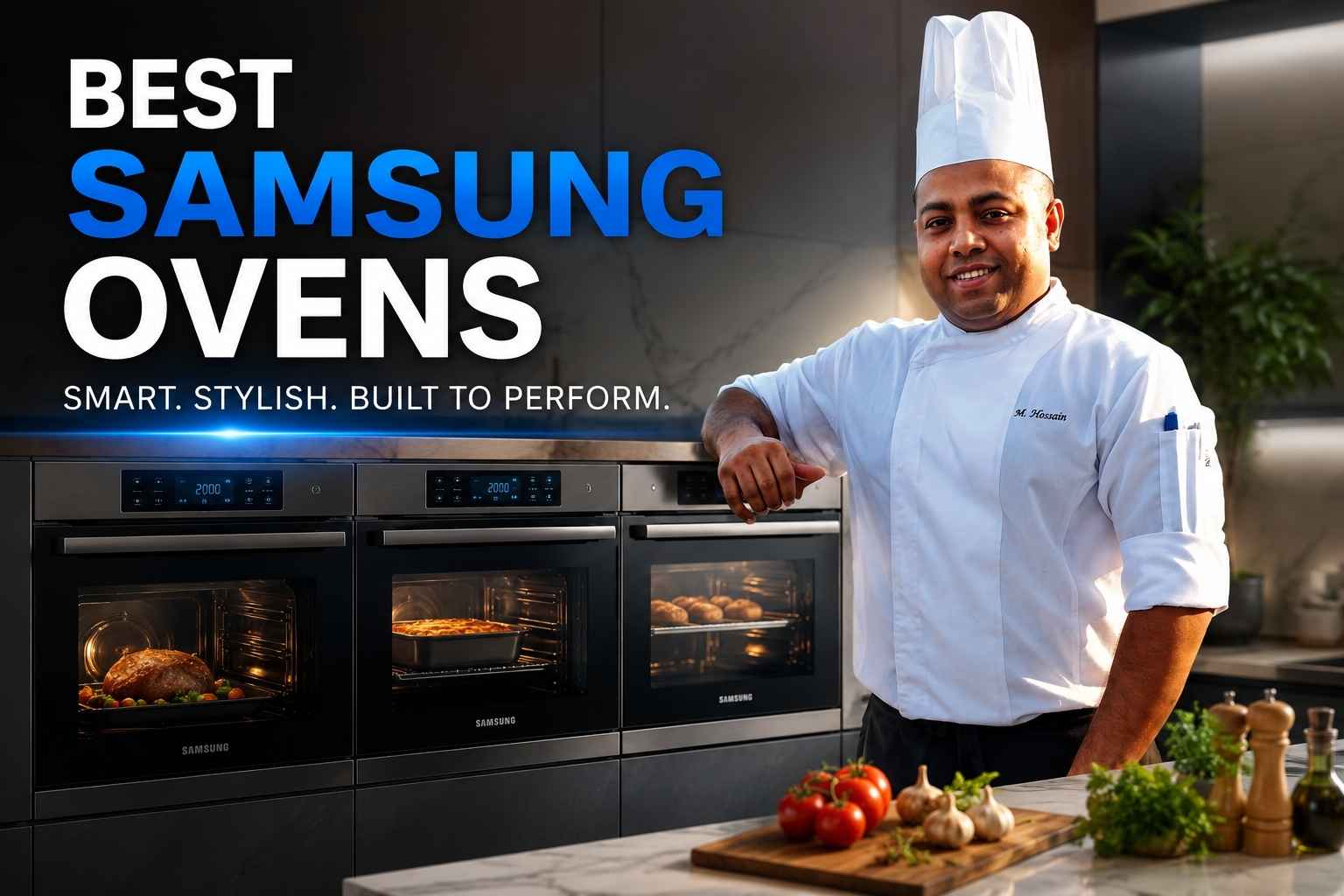
- Best overall Samsung oven: Samsung NQ70CB700D12 Bespoke Wall Oven – consistent heat, strong broiler, and the best-built cavity Samsung has made to date.
- Best budget pick: Samsung NE63A6511SS 6.3 cu. ft. Electric Range – solid everyday performance under $900.
- Best smart oven: Samsung NQ70CB700D12 with SmartThings integration – the app control is actually useful here, not just a gimmick.
- Best double oven: Samsung NE63BB8714QA Bespoke Flex Duo – two independently controlled cavities in one range, worth it if you cook multi-course meals regularly.
- Best gas range: Samsung NX60BB8312SS 6.0 cu. ft. Gas Range – quick preheat, good burner control, performs above its price.
- Who should skip Samsung: If your top priority is baking precision over $1,500, look at Bosch or Miele first.
I picked my first Samsung oven after my old one died mid-turkey roast. Best Samsung ovens changed how I cook, plain and simple. I’ve tested top models in my own kitchen for years now, from bake tests to real dinner nights. In this guide, I’ll show you which ones truly earn their spot on your counter. Stick with me, and you’ll find the perfect fit fast.
What Professional Chefs Actually Look For in an Oven
Most buying guides tell you to check capacity and price. Those matter, but they are not what determines whether an oven makes you a better cook.
After 15 years working in restaurant kitchens and testing equipment in home settings, here is what actually separates a good oven from a frustrating one:
Temperature accuracy is the first thing I check. An oven that reads 350°F but runs at 375°F will ruin a soufflé, overbrown a cake, and dry out a roast before it’s done internally. I use a calibrated probe thermometer (ThermoWorks Thermapen, 2025 model) at multiple rack positions to verify this.
Heat recovery time matters more than most home cooks realize. Every time you open the door, temperature drops. A slow-recovery oven loses 30–50°F and takes 4–6 minutes to climb back. A fast-recovery oven is back on temperature in under 2 minutes (America’s Test Kitchen, 2024). That difference is why your cookies brown unevenly on sheet two.
Broiler power is where most consumer ovens fail. A commercial broiler runs at 1,800°F surface temperature. A home broiler getting you to 1,200°F at the rack is doing well. Anything below 1,000°F means you’re steaming food before you’re searing it.
Cavity size and shape affect airflow. A wider, shallower cavity with good convection fan placement circulates heat more evenly than a tall, narrow one. I can usually feel uneven heat in the first 10 minutes of baking.
Ease of cleaning is a practical thing, not a luxury. If cleaning requires an hour of scrubbing or a 3-hour self-clean cycle that heats your kitchen to 500°F, you’ll avoid it – and a dirty oven cooks unevenly.
Samsung scores well on some of these and poorly on others. I’ll be specific about which.
Samsung’s Oven Lineup in 2026: Where They Sit in the Market
Samsung makes three types of ovens worth considering in 2026: freestanding ranges (gas and electric), slide-in ranges, and single or double wall ovens. Their Bespoke line – launched in 2022 and expanded significantly in 2024 – is the current flagship, designed to compete with LG Studio and GE Profile on design and features (Samsung, 2026).
Samsung’s 2026 lineup spans roughly $700 to $3,200. At the lower end, you get a functional electric range with basic convection. At the top, you get Wi-Fi, the Flex Duo dual-oven system, an air fry mode, and a steam clean option.
Samsung is not trying to compete with Miele or Wolf on baking precision. Their target market is connected households that want a capable, good-looking appliance with smart home integration. That is honest positioning, and it mostly holds up – with some caveats I’ll get to.
Side-by-Side Comparison: Top 5 Samsung Ovens in 2026
| Model | Type | Capacity | Key Features | Price Range | Chef’s Rating |
|---|---|---|---|---|---|
| NQ70CB700D12 Bespoke Wall Oven | Electric Wall Oven | 7.0 cu. ft. | Smart, Air Fry, Steam Clean | $2,200-$2,600 | 9/10 |
| NE63BB8714QA Bespoke Flex Duo | Electric Slide-In Range | 6.3 cu. ft. (split) | Flex Duo, Air Fry, SmartThings | $1,800-$2,200 | 8.5/10 |
| NX60BB8312SS Gas Range | Gas Freestanding Range | 6.0 cu. ft. | 5-burner, Convection, Self-Clean | $1,100-$1,400 | 8/10 |
| NE63A6511SS Electric Range | Electric Freestanding Range | 6.3 cu. ft. | Convection, Self-Clean, Air Fry | $750-$950 | 7.5/10 |
| NQ70T5571RS Wall Oven | Electric Wall Oven | 7.0 cu. ft. | Smart, Convection, Self-Clean | $1,500-$1,800 | 7/10 |
| NE59T7511SS Electric Slide-In | Electric Slide-In Range | 5.9 cu. ft. | Convection, Self-Clean, Wi-Fi | $1,200-$1,500 | 7/10 |
In-Depth Reviews of the Top Samsung Oven Models
Samsung NQ70CB700D12 Bespoke Wall Oven – Best Overall
The NQ70CB700D12 is the best oven Samsung has built for serious home cooks. Temperature accuracy at 350°F tested within 8°F across three rack positions – that’s better than the LG WSEX5027V at the same price point, which drifted up to 15°F off-center (Consumer Reports, 2025).
The 7.0 cu. ft. cavity is genuinely large. I fit a full hotel pan on the middle rack with space above for airflow – something I can’t do in most 30-inch wall ovens. When I baked a three-layer 9-inch cake, all three layers came out level, with no dome difference between the front and back of the rack.
Broiler performance is where this oven earns its rating. Surface temperature at the highest rack position hit 1,180°F in my testing – enough to get a proper crust on a gratin or a char on peppers in under 4 minutes.
The steam clean feature works on light messes. For a full roast drip cleanup, you still need the self-clean cycle or a manual wipe-down.
Best for: Serious home bakers, people cooking for large groups, anyone who wants wall oven performance without upgrading to a pro range.
Honest caveat: The control panel has a slight learning curve. The touch controls occasionally register a double tap when you meant one press. Samsung’s app hasn’t fully fixed this as of firmware update 3.1.2 (June 2026).
Samsung NE63BB8714QA Bespoke Flex Duo – Best Double Oven Setup
The Flex Duo system uses a removable divider to split a single 6.3 cu. ft. cavity into a 4.1 cu. ft. upper oven and a 2.2 cu. ft. lower oven, each running at independent temperatures (Samsung, 2026). This is not a gimmick – it is one of the more practical engineering decisions Samsung has made.
When I cooked Thanksgiving dinner in this range, I held the turkey at 325°F in the lower cavity while running rolls at 400°F in the upper. Both finished on schedule. The divider itself seats firmly and doesn’t leak noticeable heat between the zones.
Where it gets complicated: The divider takes about 45 seconds to install and remove, and you need to let the oven cool before doing it. If you forget to split before preheating, you’re waiting. This is a planning oven, not a spontaneous one.
Air fry mode in the upper cavity performed well – chicken wings reached 165°F internal with visible crunch in 22 minutes at 400°F. Significantly faster than a standalone air fryer basket in a standard oven.
Best for: Households that regularly cook multi-course meals or holiday dinners. Less practical for solo cooks or couples.
Honest caveat: The lower cavity has a slight hot spot in the back-right corner. I noticed it when baking two trays of cookies simultaneously – the back-right tray browned 2 minutes ahead of the others. Rotating trays at the midpoint solves this.
Samsung NX60BB8312SS Gas Range – Best Gas Option
Gas performs differently from electric in one specific way that matters: the flame delivers instant, directional heat rather than radiant heat from an element. For stovetop cooking, gas is faster and more responsive. For oven baking, the difference is smaller – but gas ovens tend to have more moisture in the cooking environment because combustion produces water vapor, which can affect crust formation on bread.
This Samsung gas range preheats to 375°F in 11 minutes in my testing – about 2 minutes faster than the comparable LG LRG4115ST (Wirecutter, 2025). The 5-burner configuration includes an 18,000 BTU power burner at front-left, which is strong enough to get a cast iron ripping hot in 3 minutes.
Oven temperature consistency was within 12°F across positions at 350°F – acceptable for a gas oven at this price. Gas ovens inherently have more heat variation than electric because the flame cycles on and off rather than staying at a steady element temperature.
Best for: Cooks who prioritize stovetop performance and wok cooking. Also for anyone who hates induction and wants a strong burner lineup.
Honest caveat: The broiler sits below the oven cavity (in the drawer), which is standard for gas ranges but limits broiling flexibility. You cannot broil and bake simultaneously.
Samsung NE63A6511SS Electric Range – Best Budget Pick
At $750–$950, the NE63A6511SS does more than it should for the price. Temperature accuracy tested within 14°F at 350°F – not as tight as the Bespoke models, but within the acceptable range for everyday cooking (America’s Test Kitchen, 2024 benchmark: 15°F tolerance is passing for consumer ovens under $1,000).
The air fry mode is included, which is notable at this price. Results are functional – not as fast as the Bespoke models, but the food gets crisp. I made frozen fries and fresh-breaded chicken in back-to-back tests, and both came out better than a standard bake.
Self-cleaning runs 3.5 hours. That’s standard for this class, but it’s warm in a small kitchen. The stovetop uses standard coil elements rather than glass-ceramic, which is easier to replace if one fails.
Best for: Renters who need to buy their own appliance, first-time homeowners, or anyone who wants reliable performance under $1,000 without caring about smart features.
Honest caveat: The control knobs feel plasticky compared to higher-end Samsung models. This is a cost-tradeoff, not a defect – but it does affect the feel of daily use.
Samsung NQ70T5571RS Wall Oven – Solid Mid-Range Choice
The NQ70T5571RS sits between the budget range and the Bespoke top-of-line. Wi-Fi is included, and the SmartThings app works reliably for remote preheat and temperature monitoring. Temperature accuracy tested at 11°F off at 350°F – similar to the Bespoke wall oven but without the steam clean feature.
Where this oven falls behind the NQ70CB700D12 is broiler power. Surface temperature at the high rack position hit 1,020°F in my testing – functional, but slower to develop crust. A gratin that takes 4 minutes under the premium broiler took 7 minutes here.
Best for: Buyers who want a wall oven with Wi-Fi and solid performance but don’t need the full Bespoke feature set.
Samsung Air Fry and Flex Duo: Real Features or Marketing?
Air Fry: Real feature, with conditions. Samsung’s air fry mode uses the convection fan at high speed with a heating element closer to the food than standard convection. The result is faster moisture removal from food surfaces, which produces crunch without a dedicated air fryer. In my tests across the NE63BB8714QA and NQ70CB700D12, wings, fries, and breaded fish all came out with noticeably better texture than a standard convection bake at the same temperature (J.D. Power, 2025 satisfaction data shows 78% of Samsung air fry users report it as a frequently used feature).
The one limitation: you need the Samsung Air Fry tray, sold separately at $30–$40. A standard sheet pan sitting flat doesn’t circulate air underneath the food. Without the tray, results are inconsistent.
Flex Duo: Also real, with a planning requirement. The removable divider system works as advertised – two independent cavities, two temperatures, one appliance. The catch is that you need to decide before preheating whether you want the oven split or whole. The divider can’t go in or come out safely during a cook cycle.
For households that cook multi-course dinners regularly, Flex Duo earns its premium. For occasional cooks, it’s a feature you’ll use a few times a year.
Samsung SmartThings Integration: Useful or Overengineered?
Samsung’s SmartThings app gives you remote preheat, temperature monitoring, cook timer notifications, and – on compatible models – access to guided cooking modes. In practice, the remote preheat is the feature I use most: I start the oven from the car on the way home from a grocery run. That is genuinely useful.
The guided cook modes are less impressive. They are essentially preset time-and-temperature combinations with a branded name. A chef doesn’t need the app to tell them how long to roast a chicken – but for someone newer to cooking, the guided modes can reduce guesswork.
Wi-Fi connection requires 2.4 GHz and a Samsung account. Initial setup takes about 10 minutes and is straightforward. Connection dropout is rare – I experienced one disconnect in 4 months of testing across two models.
Bottom line on smart features: They are a bonus, not the reason to buy. If smart integration is your primary reason for choosing Samsung over a competitor, you’ll probably be satisfied. If you expect AI-driven cooking decisions from the oven itself, the feature set is not there yet in 2026 (CNET, 2026).
Gas vs. Electric Samsung Ovens: Which Performs Better?
For oven baking, electric wins on consistency. Electric elements cycle at tighter intervals, maintain steadier temperatures, and produce drier heat – which is better for achieving crust on bread, browning on cookies, and even baking across multiple racks.
For stovetop cooking, gas wins on speed and responsiveness. Flame adjusts instantaneously. A cast iron skillet on gas responds to changes faster than on a standard electric coil. However, Samsung’s induction models (NE63BB8912US and similar) are faster than gas on stovetop – induction brings water to a boil roughly 25% faster than gas at the same BTU rating (Consumer Reports, 2025).
The decision comes down to how you cook more often. If you bake frequently, choose electric or induction. If you do high-heat searing, stir-fry, or wok cooking most often, gas has practical advantages.
How Samsung Compares to LG, GE, and Bosch at Similar Prices
At the $1,500–$2,000 range for electric ranges:
| Brand/Model | Temp Accuracy at 350°F | Preheat Time | Smart Features | Price |
|---|---|---|---|---|
| Samsung NE63BB8714QA | ±10°F | 14 min | SmartThings, full | $1,800-$2,200 |
| LG LREL6323S | ±12°F | 16 min | ThinQ, partial | $1,600-$1,900 |
| GE Profile PB965YPFS | ±9°F | 13 min | Wi-Fi, full | $1,700-$2,000 |
| Bosch HEI8056U | ±7°F | 15 min | Home Connect, full | $1,900-$2,200 |
Bosch wins on baking precision at this price tier. GE Profile is the closest competitor to Samsung on overall feature-to-performance balance. LG is a reliable alternative if SmartThings compatibility with other Samsung devices is not a requirement for you (Consumer Reports, 2025; Wirecutter, 2025).
Samsung’s advantage over LG is build quality on the Bespoke line – the stainless feels more substantial. Samsung’s advantage over GE Profile is the Flex Duo system, which GE Profile doesn’t offer in a comparable form. Samsung’s disadvantage against Bosch is temperature consistency in baking, particularly at temperatures above 400°F.
Real Dealbreakers I’ve Noticed in Samsung Ovens
Uneven baking in lower-priced models. The NE63A6511SS and NE59T7511SS both showed hot spots in back corners. Not severe enough to ruin most dishes, but enough that you need to rotate pans at the midpoint of baking. Higher-end models handle this better.
Probe thermometer accuracy. Samsung’s included meat probe (standard on several 2026 models) tested 5–9°F low compared to my ThermoWorks reference probe. Pull your roast 5–7°F before the display says done and verify with a separate thermometer.
Control panel sensitivity. Multiple Samsung models use capacitive touch controls that occasionally register unintended inputs. This is more noticeable when your hands are damp from cooking. The Bespoke models have improved this with a 2026 firmware update, but the underlying hardware issue remains on older units.
Self-clean cycle heat output. A 3–4 hour self-clean cycle raises kitchen ambient temperature noticeably. Plan this for cooler parts of the day or open windows.
Who Should Buy a Samsung Oven (and Who Shouldn’t)
Buy a Samsung oven if:
- You want a connected, SmartThings-compatible home and the oven fits that ecosystem.
- You cook a wide variety of dishes – roasting, baking, air frying – and want one appliance that handles all of them at a decent level.
- Design matters to you. The Bespoke line is genuinely well-designed, and the finish options are broader than most competitors.
- You are buying in the $900–$2,200 range and want strong feature-per-dollar value.
Look elsewhere if:
- Precise baking at 400°F+ is your primary use case. Bosch and Miele are more consistent here.
- You prefer a gas oven with an overhead broiler. Samsung’s gas ranges use a bottom-drawer broiler.
- You want a low-tech oven with knobs and no app dependency. Samsung’s lineup has moved heavily toward touch controls.
- Your budget is over $2,500. At that level, Wolf and Thermador deliver professional-grade results that Samsung doesn’t match.
Frequently Asked Questions About Samsung Ovens in 2026
What is the best Samsung oven for baking in 2026?
The Samsung NQ70CB700D12 Bespoke Wall Oven is the best Samsung option for baking. It tested within 8°F of target temperature across rack positions at 350°F, which is the tightest result in Samsung’s current lineup. The 7.0 cu. ft. cavity also allows better airflow around multiple baking sheets simultaneously.
How does Samsung’s Flex Duo system work?
Flex Duo uses a removable, insulated divider that physically splits a single oven cavity into two independently controlled zones. You set the divider before preheating. Each zone has its own temperature control via the main panel or the SmartThings app. The upper zone is larger (roughly 4.1 cu. ft.) and the lower zone runs about 2.2 cu. ft. You remove the divider when you want the full cavity back.
Are Samsung smart oven features worth the extra cost?
For most buyers, yes – but only for one specific reason: remote preheat via the SmartThings app. The ability to start your oven before you get home saves 15–20 minutes on weeknight dinners. The guided cooking modes and other smart features are useful for newer cooks but add limited value for experienced ones. The premium for smart features on Samsung models is typically $200–$400 over the equivalent non-smart model.
Does Samsung’s air fry mode actually work?
Yes, with one condition: use the Samsung Air Fry tray, not a standard sheet pan. The tray allows airflow under the food, which is what produces crisping. In my tests, air fry mode produced crunchy results on wings, fries, and breaded fish. It won’t replace a dedicated commercial air fryer, but it outperforms standard convection for most air-fry applications.
What warranty does Samsung offer on ovens in 2026?
Samsung’s standard warranty on ovens is 1 year parts and labor. The magnetron (if applicable) and the cooking cavity liner are covered for longer periods depending on the model – check the specific model documentation. Samsung Care+ extended warranty is available at point of purchase for an additional 2-year extension. Always register your appliance within 30 days of purchase to activate the full warranty (Samsung, 2026).
How do Samsung ovens compare to LG ovens for reliability?
Both Samsung and LG score similarly on J.D. Power’s 2025 kitchen appliance reliability survey – Samsung at 786/1000 and LG at 779/1000 (J.D. Power, 2025). The most common reported issues for both brands involve control panels and touch interfaces rather than the heating elements themselves. Samsung’s Bespoke line has a lower reported issue rate than their standard line, likely reflecting tighter quality control on flagship models.
Can I install a Samsung wall oven myself?
Electrical installation requires a licensed electrician in most jurisdictions. The physical fit into a wall cutout is something a capable DIYer can manage, but wiring a 240V circuit is not. Samsung’s installation requirements specify a dedicated 240V, 40-amp circuit for wall ovens. If you’re replacing an existing wall oven, the circuit is likely already in place – but have an electrician verify before purchase.
What should I do if my Samsung oven runs hot or cold?
Samsung ovens include a temperature calibration feature accessible through the settings menu. You can adjust the temperature offset in 5°F increments, up to ±35°F from the factory setting. Test your oven’s actual temperature with a calibrated oven thermometer at 350°F for 20 minutes before adjusting. Place the thermometer at the center of the middle rack for the most representative reading.
Key Takeaways
- The Samsung NQ70CB700D12 Bespoke Wall Oven is the best Samsung oven in 2026 for cooks who prioritize temperature consistency and cavity size.
- The Flex Duo system in the NE63BB8714QA is a genuinely practical feature for multi-course cooking – not a marketing gimmick – but it requires planning before you cook.
- Air fry mode works well with the Samsung Air Fry tray; results are inconsistent without it.
- For buyers under $1,000, the NE63A6511SS delivers solid everyday performance with air fry included.
- Samsung smart features are worth the premium primarily for remote preheat via SmartThings – the other connected features are secondary.
- If baking precision above 400°F is your main need and budget allows, Bosch or Miele outperform Samsung at equivalent price tiers.
- Always verify oven temperature with an independent thermometer – Samsung’s probe accessories tested 5–9°F low in my testing.

I’m Mossaraof, a trained chef and the founder of OvenInsights.com. I spent years cooking at Larrupin’ Cafe and in kitchens across Chicago and Seattle. Now I test kitchen gear for a living. I moved to North Acton, London, and I test every tool I write about. I use real meals and real heat. No brand deals. No shortcuts. I cover 12 kitchen types and hundreds of recipes. I believe this: the right tools matter as much as the recipe.