At A Glance
- The oven is the most underused tool in a college kitchen – it cooks while you study, cleans up fast, and makes food that actually tastes good.
- You need exactly two pieces of equipment: one sheet pan and one 9×13 baking dish.
- Eight dead-simple oven meals in this guide cost between $1.50 and $4.80 per serving.
- Cooking once on Sunday gives you four meals for the week – no reheating sad takeout at midnight.
- A five-spice starter kit bought once for under $15 will make everything you cook taste like you know what you’re doing.
College life is wild. You’ve got classes, assignments, and zero time to cook a proper meal. I’ve been there, staring at an empty fridge at 9 PM, wondering what to eat. That’s exactly why simple oven meals for college students are a total game changer.
The oven is your best friend in college, and most students don’t even know it. You don’t need fancy skills or a big grocery budget to eat well. A basic sheet pan and a few cheap ingredients are all it takes. Hot, real food is closer than you think.
I’ve tested dozens of easy baked meals that are quick, filling, and actually taste good. These recipes work even in the smallest kitchen with the most basic tools. No stress, no mess, and no culinary degree needed. Just honest, simple food that fuels a busy student life.
In this guide, you’ll find the best easy oven recipes for college students that fit your budget and your schedule. From one-pan dinners to quick baked snacks, there’s something here for every taste. You’ll also get tips on meal prep, cutting costs, and making cooking feel less like a chore. Let’s get your oven working for you, starting right now.
Why Your Oven Is the Best Cooking Tool You’re Not Using
The oven does the work so you don’t have to. You put food in, set a timer, and go read your notes. No stirring. No watching. No standing over a stove at 11pm while your roommate watches TV at full volume.
I spent 12 years cooking in professional kitchens before I started teaching home cooks. And I can tell you this with zero hesitation: the oven is more forgiving than any other cooking method. Stovetops burn food the second you turn away. Microwaves make chicken rubbery and vegetables sad. The oven just… works.
Here’s what I cooked when I was 19 and broke in a 200-square-foot dorm room: ramen, cereal, and whatever my mom packed when she visited. If I’d known then what I know now, I would have eaten like a king for $4 a day.
This guide gives you what I wish I had back then.
The Only Equipment You Need
Forget the gadgets. You need two things.
A half-sheet pan (18×13 inches): This is the workhorse of oven cooking. Chicken, vegetables, fish, potatoes – everything goes on this. A basic aluminum sheet pan from any kitchen store runs $12-15 and lasts a decade (America’s Test Kitchen, 2024).
A 9×13 baking dish: Glass or ceramic. This is for pasta bakes, casseroles, eggs, and stuffed things. Around $10 at any grocery store.
That’s it. Line both with foil or parchment paper and you’ll barely wash them.
One extra tip: grab an oven thermometer for $8. Most dorm and apartment ovens run 25-50°F hotter or cooler than the dial says (USDA Food Safety and Inspection Service, 2023). Knowing your actual temp is the single biggest difference between food that’s burnt and food that’s perfect.
Quick Meal Reference Table
| Meal | Temp | Cook Time | Cost Per Serving | Skill Level |
|---|---|---|---|---|
| Sheet pan chicken thighs | 425°F | 35-40 min | $2.10 | Beginner |
| Roasted vegetables | 400°F | 25-30 min | $1.50 | Beginner |
| Baked pasta (no-boil) | 375°F | 40 min | $1.80 | Beginner |
| Stuffed bell peppers | 375°F | 45 min | $3.20 | Easy |
| Oven-baked eggs in tomato sauce | 375°F | 15 min | $1.60 | Beginner |
| Sheet pan sausage and potatoes | 400°F | 40 min | $2.80 | Beginner |
| Baked salmon with lemon | 400°F | 12-15 min | $4.80 | Easy |
| Garlic butter shrimp on rice | 400°F | 10 min | $3.90 | Beginner |
| One-pan mac and cheese bake | 375°F | 30 min | $1.50 | Beginner |
| Baked sweet potatoes | 400°F | 50-60 min | $1.20 | Beginner |
Cost estimates based on average U.S. grocery prices (Bureau of Labor Statistics, 2025)
8 Dead-Simple Oven Meals You Can Make This Week
Meal 1: Sheet Pan Chicken Thighs
Chicken thighs are the best protein you can buy for under $3 per pound. They don’t dry out. They don’t need babysitting. And they get crispy skin with zero effort.
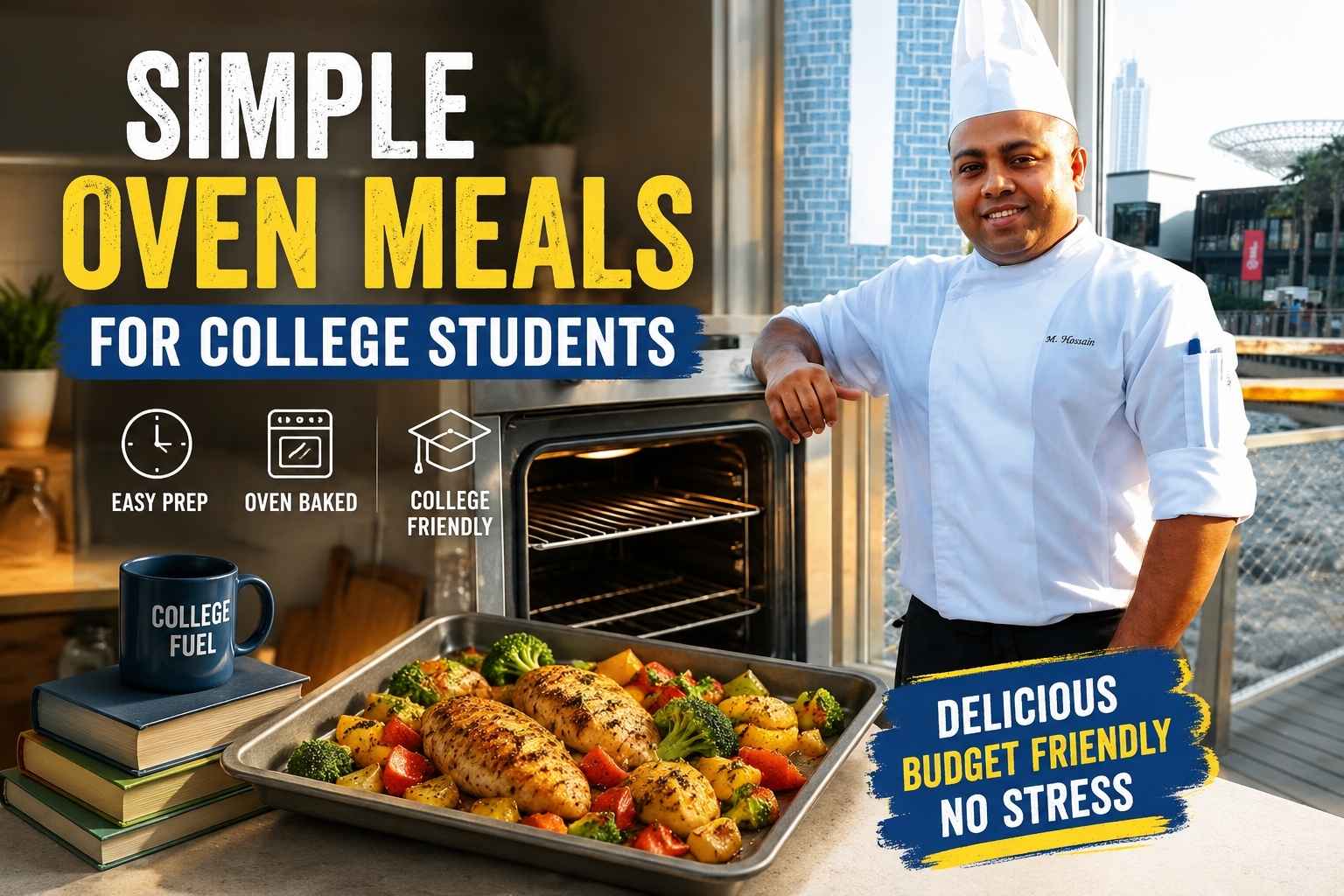
How to make it: Pat thighs dry with a paper towel (this is the most important step – moisture is the enemy of crispy skin). Rub with olive oil, salt, pepper, and garlic powder. Place skin-side up on your sheet pan. Roast at 425°F for 35-40 minutes until the skin is golden and the juices run clear.
Budget tip: A pack of six bone-in thighs at most grocery stores runs $5-7. That’s four meals for two people.
Meal 2: Roasted Vegetables
Roasting transforms vegetables. Raw broccoli is fine. Roasted broccoli with crispy edges is something you’ll actually want to eat.
How to make it: Cut any vegetable into similar-sized pieces – about 1 inch. Toss with olive oil, salt, and pepper on your sheet pan. Don’t crowd the pan or they’ll steam instead of roast. Roast at 400°F for 25-30 minutes, flipping once halfway through.
Best vegetables for roasting: Broccoli, cauliflower, Brussels sprouts, zucchini, bell peppers, carrots, sweet potatoes, and red onion. All cheap. All good.
Meal 3: No-Boil Baked Pasta
You don’t need to boil pasta before baking it. This is the best piece of cooking information I can give a college student.
How to make it: Add 12 oz of dry penne to your baking dish. Pour in one jar of marinara sauce and one jar of water (use the empty sauce jar to measure). Add salt and stir. Cover tightly with foil. Bake at 375°F for 40 minutes. Remove foil, scatter mozzarella on top, bake 10 more minutes uncovered.
The pasta cooks directly in the sauce. Less cleanup. More flavor. Budget Bytes puts this style of meal at under $2 per serving with store-brand ingredients (Budget Bytes, 2025).
Meal 4: Stuffed Bell Peppers
This looks harder than it is. It takes about 10 minutes to assemble and the oven does the rest.
How to make it: Cut the tops off four bell peppers and pull out the seeds. Mix 1 lb of cooked ground beef or turkey with 1 cup of cooked rice, half a can of diced tomatoes, salt, pepper, and garlic powder. Stuff the mixture into the peppers. Stand them upright in your baking dish. Add a splash of water to the bottom of the dish. Cover with foil and bake at 375°F for 40 minutes. Remove foil, add shredded cheese, bake 5 more minutes.
Make-ahead note: You can stuff the peppers a day ahead and refrigerate them. Just add 10 minutes to the cook time.
Meal 5: Oven-Baked Eggs in Tomato Sauce (Shakshuka)
This is my “I have nothing in the fridge” meal. A can of diced tomatoes, a few eggs, and 20 minutes.
How to make it: Pour one can of diced tomatoes into an oven-safe skillet or your baking dish. Add half a teaspoon of cumin and a pinch of chili flakes. Stir and make small wells in the sauce. Crack one egg into each well. Bake at 375°F for 12-15 minutes – 12 for runny yolks, 15 for set. Eat with toast or pita.
This is a full protein meal for under $2. It sounds fancy. It is not fancy to make.
Meal 6: Sheet Pan Sausage and Potatoes
This is my lazy Sunday meal. One pan. 40 minutes. Done.
How to make it: Cut 4 medium potatoes into 1-inch cubes. Slice 4 sausage links (kielbasa or Italian sausage work great) into coins. Toss everything on your sheet pan with olive oil, salt, pepper, and smoked paprika. Spread in a single layer. Roast at 400°F for 40 minutes, stirring once at the 20-minute mark.
Add sliced bell peppers in the last 15 minutes if you have them.
Meal 7: Baked Salmon
Salmon sounds expensive and intimidating. It’s neither. A 6 oz fillet costs $4-5 at most grocery stores, and it cooks in 12 minutes flat.
How to make it: Place salmon skin-side down on a foil-lined sheet pan. Squeeze half a lemon over it. Season with salt, pepper, and garlic powder. Add a thin pat of butter on top. Bake at 400°F for 12-15 minutes. The fish is done when it flakes easily with a fork.
Per the New York Times Cooking guide on baking salmon, 400°F is the sweet spot – hot enough to cook fast, cool enough to keep the flesh moist (NYT Cooking, 2024).
Meal 8: Baked Sweet Potatoes
The easiest thing in this list. Almost embarrassingly simple.
How to make it: Poke a sweet potato four or five times with a fork. Place it directly on the oven rack (put a piece of foil on the rack below to catch drips). Bake at 400°F for 50-60 minutes. Split open, add butter and salt.
A sweet potato has 103 calories, 4g of protein, and 24g of complex carbs (USDA FoodData Central, 2024). It costs under $1. Load it with black beans and shredded cheese for a complete meal under $2.
How to Meal Prep With Your Oven: Cook Once, Eat Four Times
Meal prepping with an oven is easier than with any other method because you can run two dishes at the same time.
A simple Sunday prep session (about 90 minutes of actual oven time, 20 minutes of your time):
- Sheet pan chicken thighs at 425°F (40 min)
- Sheet pan roasted vegetables at 400°F (30 min – put these in 10 minutes after the chicken)
- Baked sweet potatoes at 400°F (60 min – start these first)
While those cook, boil a pot of rice or pasta on the stove. You now have four to five complete meals in your fridge. Total cost for a full week of lunches: around $20-25 for two people.
Key storage rules:
- Cooked chicken keeps in the fridge for four days (USDA Food Safety and Inspection Service, 2023).
- Roasted vegetables keep for three to four days.
- Cooked rice keeps for four to six days if covered and refrigerated within two hours of cooking.
Label everything with the date using masking tape and a marker. Seriously. You will not remember what day you made it.
Eating Well for Under $5 a Serving: The Budget Breakdown
The cheapest proteins for oven cooking, ranked by cost per pound at typical U.S. grocery prices (Bureau of Labor Statistics, 2025):
| Protein | Avg Cost Per Lb | Cost Per Serving |
|---|---|---|
| Dried beans (bake or use canned) | $0.50-1.00 | $0.30-0.50 |
| Eggs | $0.25-0.40 per egg | $0.50-1.00 |
| Chicken thighs (bone-in) | $1.50-2.50 | $1.00-1.80 |
| Ground turkey | $3.00-4.00 | $1.50-2.00 |
| Sausage (kielbasa) | $3.00-4.00 | $1.00-1.50 |
| Salmon (fillet) | $8.00-12.00 | $4.00-5.00 |
The $25 weekly grocery list for one person:
- 1 pack chicken thighs ($6)
- 1 lb ground turkey ($4)
- 1 dozen eggs ($3)
- 1 bag potatoes ($3)
- 2 heads broccoli ($3)
- 1 can diced tomatoes ($1)
- 1 jar marinara sauce ($2)
- 12 oz penne ($1)
- 2 sweet potatoes ($2)
That’s 10+ meals for $25. That’s $2.50 per meal.
The 5-Spice Starter Kit That Makes Everything Taste Good
You don’t need 40 spices. You need five. Buy these once and they last six months to a year.
The five:
- Garlic powder – goes on everything, no exceptions
- Smoked paprika – adds depth to chicken, potatoes, and eggs without heat
- Cumin – essential for any bean, beef, or egg dish
- Italian seasoning – covers basil, oregano, and thyme in one bottle
- Chili flakes – a pinch adds warmth without burning your mouth
Total cost: around $12-15 if you buy the generic store brand. Name-brand spices cost the same and taste the same (Cook’s Illustrated, 2023).
The default seasoning formula for any protein: 1/2 teaspoon garlic powder + 1/2 teaspoon smoked paprika + salt and pepper. That’s it. Use it on chicken, salmon, shrimp, and potatoes and you’ll never have bland food again.
Common Beginner Oven Mistakes and How to Fix Them
Problem: Burnt bottoms, raw middles
This means your oven runs hot, the pan is too dark, or the rack is too low. Fix it: move the rack to the middle of the oven. Use a light-colored aluminum sheet pan, not a dark nonstick one. Dark pans absorb more heat and burn food faster. If your oven runs hot (check with a $8 thermometer), drop the temp by 25°F.
Problem: Chicken is cooked outside but pink inside
The only fix is a meat thermometer. Chicken is safe at 165°F internal temperature (USDA Food Safety and Inspection Service, 2023). Don’t guess. Don’t cut it open and poke it. A basic instant-read thermometer costs $10-12 and removes all the anxiety from cooking protein.
Problem: Vegetables turned to mush instead of getting crispy
Two causes: the pan is overcrowded, or the vegetables were wet. Fix: spread vegetables in a single layer with space between each piece. Pat them dry after washing. If you crowd a pan, the moisture steams out and has nowhere to go, so everything gets soft instead of caramelized.
Problem: Pasta bake turned out dry
You didn’t add enough liquid, or you baked it uncovered the whole time. Fix: always cover the dish tightly with foil for the first two-thirds of the cook time. Remove foil only at the end to brown the top.
The Chef’s Personal “Lazy Night” Oven Meal
I’m going to tell you what I actually make when I get home tired, don’t want to think, and have exactly 40 minutes before I need to eat.
Sheet pan sausage, potato, and egg bake:
I put this together in about 8 minutes. Cube two potatoes. Slice two sausage links. Toss both on the sheet pan with olive oil, smoked paprika, garlic powder, salt, and pepper. Roast at 400°F for 30 minutes. Pull the pan out. Make two small wells in the mixture. Crack one egg into each well. Slide it back in. Bake 8-10 more minutes until the whites are set.
That’s a complete breakfast-for-dinner meal with protein, carbs, and fat. It costs about $3. It uses one pan. It takes me less than 10 minutes of active work.
When I was cooking in professional kitchens, the running joke was that chefs eat the worst food at home because nobody has energy to cook after 14 hours on their feet. This is the meal I actually make. I’m not going to recommend something I don’t eat myself.
Flavor Upgrades You Can Add Without Buying Anything New
If you have the 5-spice kit, olive oil, and salt, you can build flavor without spending more money.
Acid: A squeeze of lemon or a splash of vinegar at the end of cooking wakes up every flavor in a dish. This is one of the most important skills in professional cooking and it’s free if you already have a lemon in your fridge.
Fat: A pat of butter on top of fish or chicken in the last five minutes of cooking adds richness without extra work.
Heat: Chili flakes at any stage. Add them at the start for mild warmth. Add them at the end for heat that hits fast.
Sweetness: A drizzle of honey on roasted carrots or sweet potatoes right before serving costs almost nothing and makes the dish feel restaurant-level.
Frequently Asked Questions About Oven Cooking for College Students
Can I use aluminum foil to line my pan?
Yes. Foil works well for most oven meals and makes cleanup almost instant. Use heavy-duty foil if you can find it – standard foil tears easily. For very high-heat recipes above 450°F, know that foil can sometimes stick to food. In those cases, parchment paper works better.
What if I don’t have a meat thermometer?
Buy one. A basic digital thermometer runs $10-12 at any grocery store or Target, and it removes the guesswork from cooking chicken and pork. Until you get one, use this rough guide for chicken thighs: if the juices run clear (not pink) when you cut into the thickest part and the meat pulls away from the bone easily, it’s cooked through. But a thermometer is faster and more reliable.
Can I cook frozen vegetables or proteins straight from frozen?
Yes, with adjustments. Frozen vegetables can go straight onto the sheet pan – just add 10-15 minutes to the cook time and expect a bit less crispiness. Frozen proteins like salmon fillets or shrimp work fine from frozen at 400°F – add about 50% more cook time and check the internal temperature. Never cook a frozen whole chicken or large roast from frozen – the outside overcooks before the inside reaches a safe temperature.
Is it safe to leave the oven on while I study in another room?
Yes, a standard household oven is safe to leave unattended. Don’t leave it on and leave the building, but studying in your room while the oven runs is fine. Set a timer on your phone so you don’t forget about it.
How do I know if my oven temperature is accurate?
Buy an oven thermometer for $8 and place it on the center rack. Set your oven to 350°F, wait 20 minutes for it to fully preheat, and read the thermometer. If there’s a difference, adjust your dial accordingly. Many ovens are off by 25-50°F, which explains a lot of burnt and undercooked food.
Can I cook two things on different racks at the same time?
Yes. Put proteins on the upper-middle rack where heat is stronger. Put slower-cooking items like potatoes or root vegetables on the lower-middle rack. Expect both items to take slightly longer than normal – about 10-15 extra minutes – because the oven has more mass to heat. Rotate pans halfway through if one side is browning faster.
What’s the best way to reheat oven meals without drying them out?
The oven itself. Set it to 325°F, cover your food with foil, and heat for 15-20 minutes. This keeps moisture in. Microwaves are faster but they make chicken rubbery and vegetables limp. If you need to use a microwave, cover the food with a damp paper towel and use 60-70% power.
How long do leftovers keep and is it really safe to eat them at day four?
The USDA recommends eating cooked leftovers within four days of refrigeration (USDA Food Safety and Inspection Service, 2023). Day four is fine if the food was stored correctly – in an airtight container in a fridge set to 40°F or below. If it smells off or looks wrong, throw it out regardless of the date.
Key Takeaways
- You need one sheet pan and one baking dish. That’s the whole equipment list.
- Every meal in this guide costs between $1.20 and $4.80 per serving.
- The five spices to buy once: garlic powder, smoked paprika, cumin, Italian seasoning, chili flakes.
- Sunday meal prep with the oven takes about 20 minutes of your active time and gives you food for the whole week.
- An oven thermometer ($8) and a meat thermometer ($10) are the two purchases that will improve your cooking more than anything else.
- The most important rule: open each section with the answer, then add the detail. The same goes for cooking – get the basics right first, then build from there.
- If a tired, broke 20-year-old can roast a sheet pan of chicken thighs and come out with something genuinely good to eat, so can you.
Sources: America’s Test Kitchen Equipment Review (2024); Budget Bytes Cost Analysis (2025); Bureau of Labor Statistics Consumer Price Index – Food at Home (2025); Cook’s Illustrated Spice Testing (2023); NYT Cooking Salmon Guide (2024); USDA Food Safety and Inspection Service Food Storage Chart (2023); USDA FoodData Central Sweet Potato Nutrition Data (2024).

I’m Mossaraof, a trained chef and the founder of OvenInsights.com. I spent years cooking at Larrupin’ Cafe and in kitchens across Chicago and Seattle. Now I test kitchen gear for a living. I moved to North Acton, London, and I test every tool I write about. I use real meals and real heat. No brand deals. No shortcuts. I cover 12 kitchen types and hundreds of recipes. I believe this: the right tools matter as much as the recipe.