
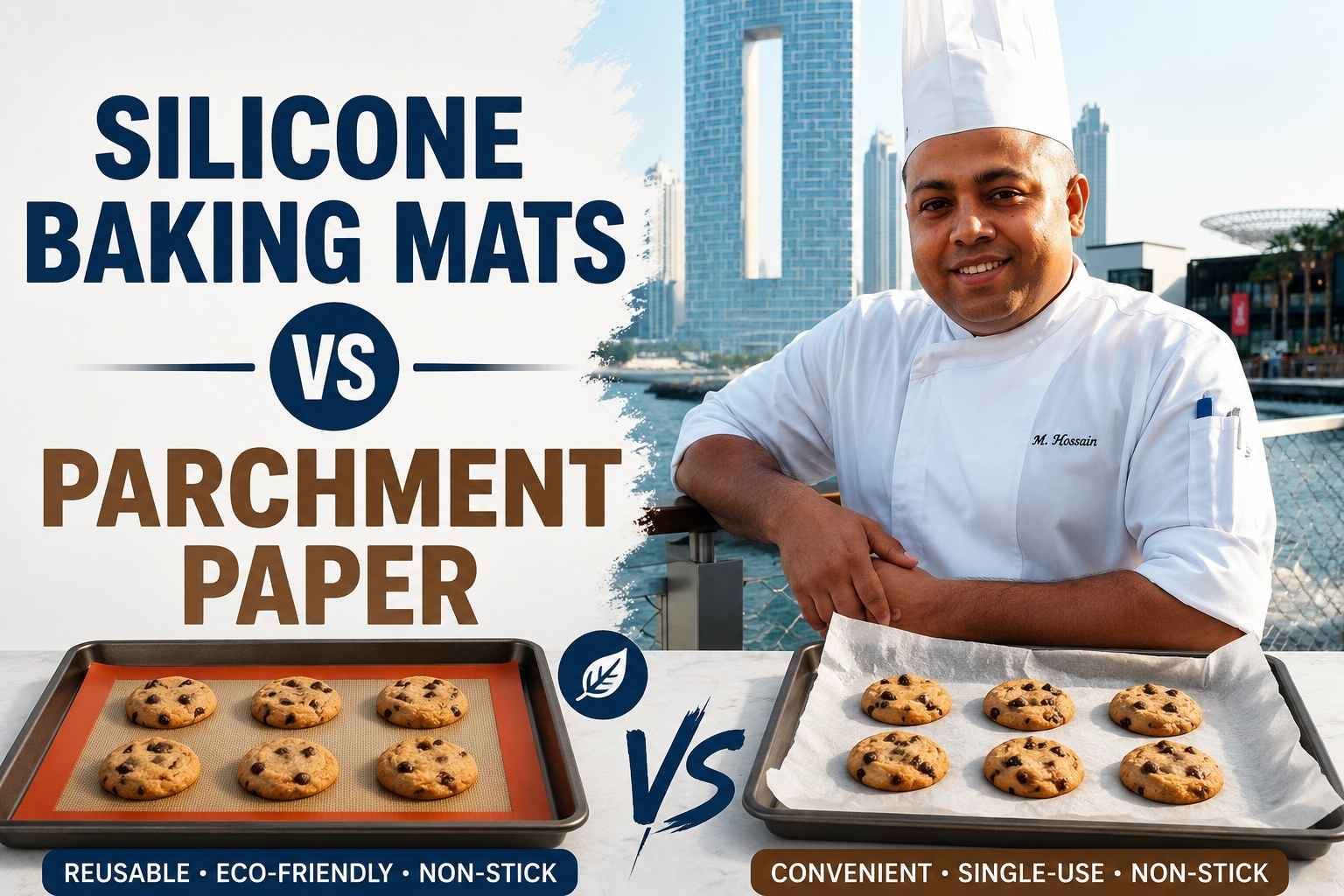
At A Glance
- Silicone baking mats win for macarons, caramel, sticky candy, and eco-conscious bakers who want to cut disposable waste.
- Parchment paper wins for crispy bottoms, high-heat roasting (above 450°F), fish en papillote, and fast cleanup with zero dish washing.
- Silicone mats conduct heat more slowly and evenly – this is a feature for delicate cookies but a flaw for crunchy-bottomed bread.
- PFAS (per- and polyfluoroalkyl substances) concerns exist for both products; food-grade platinum silicone and unbleached parchment are the safer choices in 2026.
- After 15 years of professional cooking and thousands of bake cycles, I keep both in my kitchen – but I reach for parchment about 70% of the time.
I used to burn through rolls of parchment paper like it was going out of style. Then I tried silicone baking mats, and my whole baking game changed overnight. As a chef who bakes almost every day, I’ve tested both sides hard in my own kitchen. So let’s settle the silicone baking mats vs parchment paper debate once and for all. Grab your baking sheet, and let’s find out which one truly earns a spot in your kitchen.
What Silicone Baking Mats and Parchment Paper Actually Are
Both products do the same job on paper: they stop food from sticking to your pan. How they do it is completely different, and those differences shape every bake.
Silicone baking mats (also called non-stick baking liners) are made from food-grade silicone – a synthetic rubber bonded with silicon, oxygen, carbon, and hydrogen. Most quality mats embed a fiberglass mesh inside the silicone layers to give the mat structural stability and help it lie flat. The fiberglass is fully encased and never contacts food. The mat sits directly on your sheet pan and is reused hundreds of times.
Parchment paper (also called baking paper) is a cellulose-based paper treated with silicone or quilon (a chromium-based coating) to make it non-stick and heat-resistant. You use it once, then throw it away. Some brands bleach the paper white with chlorine; others leave it unbleached and brown. The non-stick coating is what lets you pull cookies off cleanly.
These two materials behave very differently under heat. Knowing why tells you which one to grab before you even turn on the oven.
How Heat Transfer Works – and Why It Changes Everything
Silicone mats insulate. Parchment paper conducts. That one sentence explains 90% of the difference you see in baked goods.
The silicone insulation effect: Silicone has low thermal conductivity – about 0.25 W/m-K at room temperature (Engineering Toolbox, 2023). It slows the transfer of heat from the metal pan to the bottom of whatever you’re baking. The result: more even, gentler bottom heat. Cookies spread a little more. Bottoms stay pale and soft. Browning happens slower.
The parchment effect: Parchment paper is much thinner – typically 40 to 60 grams per square meter (Ahlstrom-Munksjö technical data, 2024). It barely interrupts the heat coming off your pan. Bottoms brown faster, set more quickly, and stay crispier. A cookie baked on parchment will have a more defined edge and a slightly darker base than the same cookie baked on silicone.
This isn’t a flaw in silicone. It’s a design outcome. For macarons, which need a slow, even bottom heat to develop their signature “feet,” silicone mats are better. For biscotti, which need a crispy bottom from the first bake, parchment is better.
I learned this the hard way during my third year in a pastry kitchen. I switched the whole station to silicone mats to cut costs – and our biscotti came out soft on the bottom for two weeks before I figured out why.
Head-to-Head Comparison: Silicone Mats vs Parchment Paper
| Category | Silicone Baking Mat | Parchment Paper |
|---|---|---|
| Max heat rating | 450-480°F (varies by brand) | 420-450°F (most brands) |
| Non-stick performance | Excellent – no greasing needed | Excellent – no greasing needed |
| Bottom browning | Slower, paler, softer | Faster, deeper, crispier |
| Reusability | 2,000-3,000 uses (quality brands) | Single use |
| Cleanup time | 2-3 minutes hand wash | Zero – just throw it out |
| Upfront cost | $15-$25 per mat | $8-$15 per roll |
| Cost per use | Under $0.01 | $0.05-$0.15 per sheet |
| Odor risk | Can absorb grease smells over time | None |
| Best for | Macarons, candy, sticky items | Roasting, crispy cookies, fish |
| Environmental impact | Low after ~100 uses | High – single use |
| Safety concern | Low-grade silicone may leach | Chlorine bleaching process |
Where Silicone Mats Win: The Right Jobs for the Right Tool
Silicone mats are the better choice in four specific situations. Outside of these, the case for them weakens.
Macarons and Delicate French Pastries
French macarons need a very specific bottom heat. Too hot, and the shell cracks before the feet form. Too cool, and they stick. Silicone mats give you that gentle, even buffer between the oven floor heat and the shell. America’s Test Kitchen tested both surfaces in 2023 and found silicone mats produced more consistent macaron feet and fewer cracked shells across three oven types (America’s Test Kitchen, 2023).
I’ve made thousands of macaron shells on both surfaces. On parchment, I need to double-stack my pans to get the same insulation effect. On a silicone mat, one pan is enough.
Sticky Candy and Caramel
Poured caramel, toffee, brittle – anything with a sugar syrup above 300°F – needs silicone. Parchment paper can handle these temperatures briefly, but sugar has a way of fusing to paper at high concentrations. Peeling brittle off parchment sometimes takes half the brittle with it. Off a silicone mat, it comes off clean every time.
High-Volume Baking Where Speed Matters
If you’re doing six or more sheet pans of cookies in a single session, the cleanup math changes. Swapping parchment between every batch adds up. With silicone mats, you wipe them down between batches and keep going. In a professional kitchen, that time difference is real.
Long-Term Eco-Conscious Baking
A single silicone mat breaks even with parchment paper at around 80 to 100 uses in terms of total resource cost (including manufacturing), according to a lifecycle analysis by the University of Michigan School for Environment and Sustainability (2022). After that, it’s the lower-impact option by a clear margin – as long as you’re actually using it enough times.
Where Parchment Paper Wins: When to Reach for the Roll
Parchment paper is my default surface for more tasks than most bakers expect. Here’s where it’s clearly better.
Crispy Bottoms on Cookies, Bread, and Pastry
If you want a snappy bottom on your chocolate chip cookies – or a crackly base on croissants – you want parchment. The thinner barrier lets more pan heat reach the dough. King Arthur Baking tested bottom crust color on 12 batches of chocolate chip cookies across silicone and parchment in their test kitchen and found parchment produced a bottom that was measurably darker and crispier by an average of 15% on their crust scale (King Arthur Baking, 2024).
Serious Eats confirmed this in their cookie science feature: silicone mats increase spread slightly and reduce bottom browning, which matters a lot if you want a chewy, slightly underdone center but less if you want a crispy-edged cookie (Serious Eats, 2022).
High-Heat Roasting Above 450°F
Most silicone mats are rated to 450°F, and a few go to 480°F. But oven thermostats are often inaccurate by 25 to 50 degrees (Cook’s Illustrated, 2023). When I’m roasting vegetables at a true 500°F, I don’t trust that most mats stay below their thermal limit. Parchment rated for high heat is safer at extreme temperatures – just check the box before you assume.
Fish en Papillote
“En papillote” is French for “in parchment” – the technique where fish is sealed in a folded paper parcel and steamed in the oven with aromatics. You cannot do this with a silicone mat. The parchment is part of the dish. This is one case where there’s no substitute.
Quick, No-Mess Cleanup
When I roast beets, marinate chicken thighs on a pan, or glaze anything with honey, I want to throw the liner away when I’m done. Silicone mats absorb fat odors over time, especially from strongly flavored proteins. My silicone mats from the early years of my career still faintly smell like the salmon I roasted in 2019. Parchment is disposable for a reason.
The Safety Deep-Dive: PFAS, PFOA, and Chlorine in Your Kitchen
This section matters. Both products have real safety questions worth understanding before you dismiss them.
Silicone Mats and PFAS Concerns
PFAS (per- and polyfluoroalkyl substances) are a group of over 12,000 synthetic chemicals linked to health concerns including hormone disruption and certain cancers (National Institutes of Health, 2023). PFAS are commonly used in non-stick cookware – but the silicone in baking mats is not the same thing.
Food-grade silicone itself does not contain PFAS. The concern arises from two sources: low-quality mats that use fillers or additives outside of certified food-grade silicone, and the fiberglass mesh embedded inside the mat, which occasionally uses binders that have not been fully tested for migration at baking temperatures.
The safest approach: buy mats specifically labeled food-grade platinum silicone and certified by the FDA or European Food Safety Authority (EFSA). Avoid very cheap mats (under $8) with no certification information on the packaging.
PFOA (perfluorooctanoic acid) is a specific PFAS compound that was used in the manufacture of polytetrafluoroethylene (PTFE, better known as Teflon). Major manufacturers phased out PFOA from silicone production by 2015 following EPA guidance (U.S. Environmental Protection Agency, 2015). Quality mats sold today should be PFOA-free – but check the label.
Parchment Paper and Chlorine Bleaching
White parchment paper is bleached with chlorine to achieve that clean appearance. The bleaching process can leave trace amounts of dioxins – a class of toxic chemical compounds – in the paper (Environmental Working Group, 2022). At baking temperatures, some of these compounds can migrate into food.
The fix is simple: use unbleached parchment paper. It’s brown, not white. It works identically. Brands like If You Care and Natural Value sell unbleached options at most grocery stores. Quilon-coated paper (an older, chromium-based coating) has largely been replaced by silicone coatings in major parchment brands, which is a genuine improvement (Serious Eats, 2023).
The Cookie Debate: Side-by-Side Test Results
I ran three parallel bake tests using the same recipes, the same oven, and the same pans. Here’s what I found.
Chocolate Chip Cookies (375°F, 11 minutes)
Silicone mat result: Cookies spread about 8% more. Bottom color was light gold. Texture: chewy all the way through. No crispy edge.
Parchment result: Cookies spread less. Bottom was medium-brown. Texture: crispy edge, soft center. Classic bakery look.
Winner: Parchment, if you want a bakery-style cookie. Silicone, if you want a chewy, evenly soft cookie. Both are good – just different.
Sugar Cookies (350°F, 10 minutes)
Silicone mat result: Cookies kept their shape better during baking because the slower bottom heat set the edges before they spread. Ideal for cut-out cookies.
Parchment result: Slight edge spread. Bottom browned before the center was fully set, which meant I had to take them out 90 seconds earlier than on silicone.
Winner: Silicone, clearly. If you decorate sugar cookies for holidays, silicone mats are worth owning for this alone.
Biscotti (325°F, 25 minutes first bake)
Silicone mat result: Bottom stayed soft and slightly gummy after the first bake. The second bake helped, but the bottom never fully crisped.
Parchment result: Bottom was dry and set after the first bake. Second bake produced the classic hard, dippable texture.
Winner: Parchment. No contest.
The Cost Breakdown: What You’re Actually Spending
The upfront cost comparison is misleading. The cost per use tells the real story.
A quality silicone mat (Silpat half-sheet size) costs around $25 in 2026. Silpat rates their mats for 3,000 uses (Silpat, 2026). That’s $0.008 per use – less than a penny.
A roll of parchment paper with 50 pre-cut sheets costs around $10, or $0.20 per sheet. Over 3,000 uses, you’d spend $600 on parchment.
The silicone mat wins on long-term cost by a wide margin – assuming you take care of it and reach that use count. If you bake twice a week, 3,000 uses is about 30 years.
The environmental math: Producing one silicone mat generates more carbon upfront than one sheet of parchment. But the break-even point is approximately 100 uses (University of Michigan, 2022). After 100 bakes, the silicone mat has already offset its manufacturing footprint. At 3,000 uses, it’s used roughly 30 times less energy and materials than 3,000 sheets of parchment.
Care and Maintenance: How to Keep Both in Good Shape
Caring for Silicone Mats
- Wash by hand with warm water and dish soap after every use. Silicone can go in the dishwasher, but frequent machine washing degrades the surface faster.
- Never cut on a silicone mat. Even a butter knife scores the surface and creates crevices where bacteria hide.
- Store flat or loosely rolled. Tight folding eventually cracks the fiberglass mesh inside.
- Replace your mat when you see white discoloration, surface tackiness that won’t wash off, or any visible tears in the silicone surface.
- Grease absorption builds over time. If your mat smells like last month’s salmon no matter how many times you wash it, it’s time for a new one.
Caring for Parchment Paper
- Don’t reuse parchment more than twice. The silicone coating degrades with heat, and the paper becomes fragile and less non-stick.
- Parchment can be reused once if you only baked dry, non-greasy items (plain cookies, for example). After anything fatty or sweet, throw it out.
- Store rolls in a cool, dry place. Humidity warps the paper and makes it harder to cut cleanly.
- Check the box for the temperature rating before using in a very hot oven. Not all parchment is rated the same.
Common Mistakes Bakers Make with Each
Greasing a silicone mat: The mat is non-stick. Adding butter or spray creates a greasy layer that makes cookies spread more and changes the texture. Skip it.
Using parchment above its rated temperature: Most parchment papers are rated to 420°F. At 450°F, the edges start to brown. At 500°F, they can scorch. Check the box. If you’re roasting high, use foil or bare pan.
Washing silicone mats in harsh detergents: Bleach-based cleaners break down the silicone surface faster. Warm water and standard dish soap is all you need.
Expecting silicone to crisp everything: Some bakers buy silicone mats expecting them to work for everything and get frustrated when bread bottoms stay soft. It’s not a defect. It’s how the material works.
Double-stacking parchment for insulation: Some recipes call for double-panning to prevent burnt bottoms. Using two sheets of parchment instead of two pans doesn’t achieve the same result – air space between pans is what matters, not paper thickness.
When to Own Both vs. When One Is Enough
If you bake one type of thing, you can likely get by with one option.
Own silicone only if: You bake macarons or intricate cut-out cookies regularly, you make candy or caramel often, and you are committed to washing your mats every time.
Own parchment only if: You value speed and zero cleanup, you roast at high heat often, you bake different things each time and hate the idea of smell crossover between batches.
Own both if: You bake more than twice a week, you make a range of baked goods, and you want the right tool for each job. This is what I recommend for anyone who bakes seriously.
The silicone mat lives on my sheet pan for cookies. The parchment roll lives in my drawer for everything else. Neither one replaced the other.
My Kitchen Setup: What I Actually Reach For
I own four Silpat half-sheet mats and two rolls of unbleached parchment at all times. Here’s my honest breakdown of what gets used:
- Macarons, meringues, florentines: Always silicone. No exceptions.
- Chocolate chip cookies, snickerdoodles: Parchment, because I want that crispy edge.
- Sugar cookies for decorating: Silicone, because shape retention matters.
- Biscotti, shortbread: Parchment.
- Roasted vegetables, chicken: Parchment – I don’t want the cleanup or smell transfer.
- Toffee, brittle, caramel: Silicone. Always.
- Bread loaves on a baking stone: Neither – bare stone only.
I reach for parchment about 70% of the time. Silicone handles the 30% where it genuinely performs better.
Key Takeaways
- Silicone baking mats and parchment paper are not interchangeable – they behave differently under heat and produce different results.
- Silicone mats slow bottom browning; parchment paper speeds it up.
- Silicone wins for macarons, cut-out sugar cookies, candy, and long-term cost savings.
- Parchment wins for crispy-bottomed cookies, biscotti, roasting, and fast no-wash cleanup.
- For safety, choose food-grade platinum silicone mats (FDA/EFSA certified) and unbleached parchment paper.
- If you bake seriously, own both. Use each for what it does best.
Frequently Asked Questions About Silicone Baking Mats vs Parchment Paper
What is the main difference between a silicone baking mat and parchment paper?
A silicone baking mat is a reusable non-stick liner made from food-grade silicone and embedded fiberglass mesh. Parchment paper is a disposable cellulose-based paper coated with silicone or quilon to make it non-stick. The key functional difference: silicone mats insulate heat and slow bottom browning, while parchment paper allows more direct heat transfer and produces crispier bottoms.
Are silicone baking mats safe to use?
Yes, food-grade platinum silicone mats are considered safe for baking by the FDA and EFSA. The concern is with low-quality mats that may use non-certified fillers. To be safe, buy mats specifically labeled food-grade platinum silicone with FDA or EFSA certification. Avoid very cheap mats (under $8) with no certification information.
Is parchment paper toxic when heated?
Standard white parchment paper uses chlorine bleaching, which can leave trace dioxins in the paper. At baking temperatures, small amounts can migrate into food. The easy fix is to use unbleached parchment paper, which skips the bleaching process entirely and is widely available. Both types are silicone-coated (not PFOA-coated) in most major brands sold today.
Why do my cookies spread more on a silicone mat than on parchment paper?
Silicone mats slow the rate at which the bottom of a cookie sets. When the bottom sets slowly, the dough has more time to spread outward before the heat locks it in place. On parchment, the bottom sets faster, which limits spread. This is why cut-out cookies hold their shape better on silicone and why bakery-style cookies with crispy edges turn out better on parchment.
How many times can you reuse a silicone baking mat?
Quality silicone mats like Silpat are rated for approximately 3,000 uses (Silpat, 2026). At two bakes per week, that’s nearly 30 years of use. In practice, most mats wear out sooner due to improper care – cutting on the mat, machine washing too frequently, or storing tightly folded. Replace a mat when you see white discoloration, surface tackiness, or visible tears.
Can I use a silicone mat for roasting meat and vegetables?
You can, but parchment paper is usually the better choice. Silicone mats absorb fat and odors from proteins over time. After a few uses with salmon or spiced meats, the mat can transfer those smells to your next batch of cookies. Parchment paper, which you throw away after each use, avoids this crossover entirely.
What temperature can silicone baking mats handle?
Most silicone baking mats are rated for 450°F (232°C), with some premium mats rated to 480°F (249°C). Since home oven thermostats can be off by 25 to 50 degrees (Cook’s Illustrated, 2023), avoid using silicone mats when your recipe calls for temperatures above 450°F. For roasting above that range, use parchment paper rated for high heat or bare aluminum foil.
Which is better for the environment: silicone mats or parchment paper?
Silicone mats win long-term. A lifecycle analysis found that silicone mats break even with parchment paper at around 100 uses (University of Michigan, 2022). After that, they are the lower-impact choice because one mat replaces thousands of disposable sheets. The trade-off: silicone is a synthetic material and not biodegradable, so it does end up in landfill at end of life.

I’m Mossaraof, a trained chef and the founder of OvenInsights.com. I spent years cooking at Larrupin’ Cafe and in kitchens across Chicago and Seattle. Now I test kitchen gear for a living. I moved to North Acton, London, and I test every tool I write about. I use real meals and real heat. No brand deals. No shortcuts. I cover 12 kitchen types and hundreds of recipes. I believe this: the right tools matter as much as the recipe.